
Two hills, one city
Armagh
Two St Patrick's cathedrals face each other across a Georgian city shaped by faith, scholarship and astronomy.
- Best for
- Cathedrals, Georgian history and astronomy
- Give it
- One unhurried day
- Don't miss
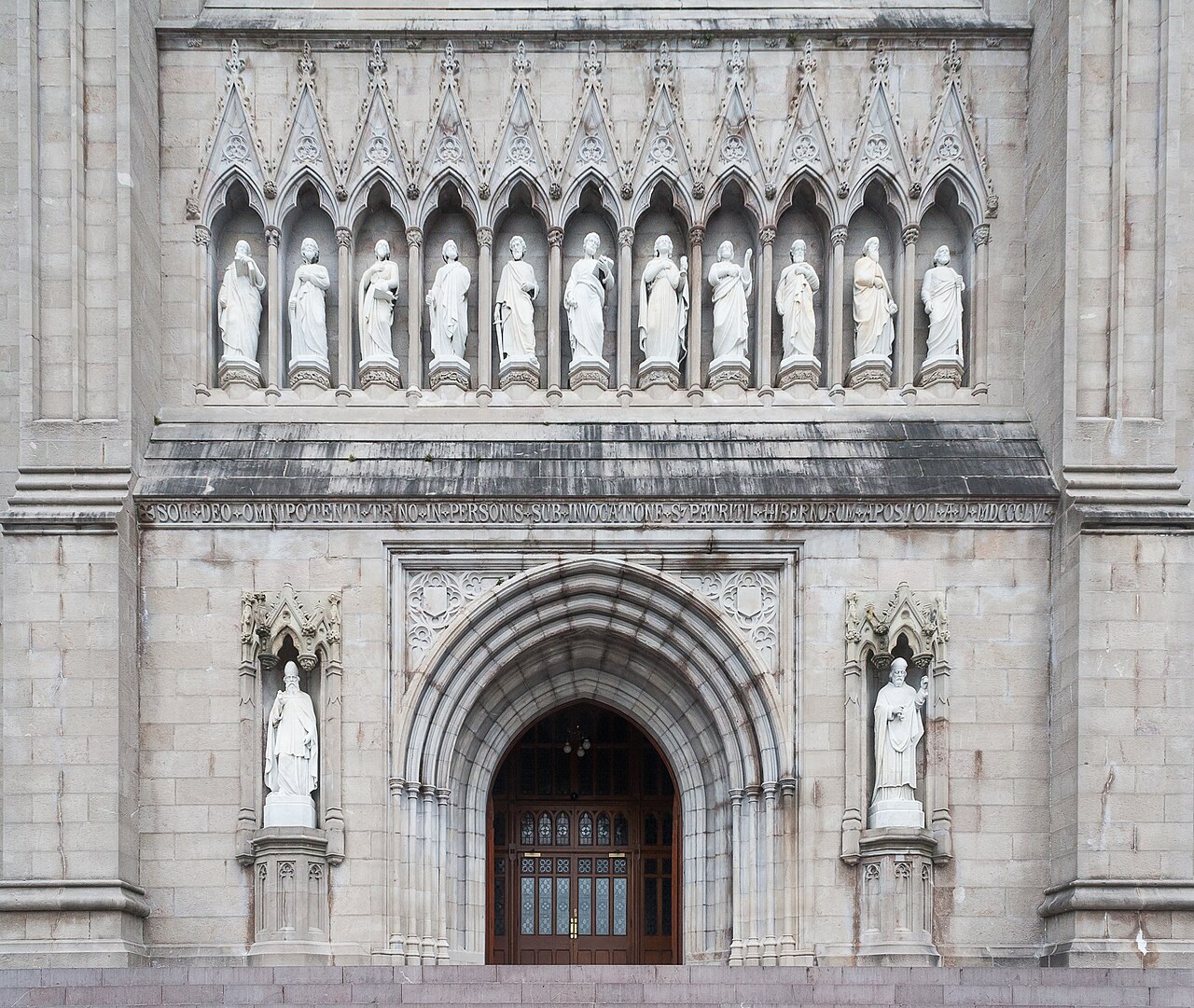
- The two St Patrick's cathedrals on opposing hills
Photo: Andreas F. Borchert · CC BY-SA 4.0 · cropped
The Fox verdict
A city with an unusually deep story
Armagh brings two cathedrals, Georgian institutions, a working observatory and Orchard County character into one visit.
Its two St Patrick's cathedrals face one another from separate hills, while Archbishop Richard Robinson's legacy runs through the Palace Demesne, Robinson Library and Observatory. Add the county museum, Navan Fort and a pub in a former gaol for a compact but varied day.
Where to go
Places in Armagh
Every place below is checked against a published source, listed with what it is and how long to give it.
Local signatures
3 placesPalace Demesne Public Park
About 300 acres of parkland with formal gardens, back meadows, mature trees, open green and panoramic city views.
- Visit length
- Editorial estimate: Allow around 90 minutes
- Locality
- within walking distance of the city centre
Armagh Observatory & Planetarium
A headline family attraction with refurbished digital-dome planetarium shows and exhibits beside the working observatory founded in 1790.
- Visit length
- Editorial estimate: Allow around 90 minutes
- Locality
- up at the Observatory
Armagh County Museum
Ireland's oldest county museum, covering local history, fine art, archaeology and natural history.
- Visit length
- Editorial estimate: Allow around 60 minutes
- Locality
- on The Mall
Food & drink
1 placeThe Hole in the Wall Bar
A characterful pub in a building dating to 1615, formerly a gaol, with low ceilings, an open fire and beams.
- Visit length
- Editorial estimate: Allow around 75 minutes
- Locality
- down an alleyway off the city centre
History & heritage
4 placesSt Patrick's Cathedral (Church of Ireland)
A cathedral with a medieval core on the traditional site of St Patrick's church, and the burial place of Brian Boru.
- Visit length
- Editorial estimate: Allow around 45 minutes
- Locality
- on the ancient hill of Ard Macha
St Patrick's Cathedral (Roman Catholic)
A Gothic Revival cathedral built in phases from 1840 to 1904, with twin 64-metre spires and extensive interior mosaics.
- Visit length
- Editorial estimate: Allow around 45 minutes
- Locality
- on a hill opposite the medieval cathedral
Armagh Robinson Library
A free-to-enter library founded in 1771, with around 42,000 printed works plus maps and atlases in a Georgian interior.
- Visit length
- Editorial estimate: Allow around 45 minutes
- Locality
- Armagh
Navan Centre & Fort
The ancient royal capital of Ulster, paired with a visitor centre that brings its Celtic myths to life.
- Visit length
- Editorial estimate: Allow around 120 minutes
- Locality
- about 1.6 miles west of Armagh
No places match this filter. Choose All places to reset the list.
Three ways to explore Armagh
Signature outings
Enter the medieval cathedral
See the cathedral's medieval core, the remains of an 11th-century Celtic cross and the memorial to Brian Boru.
Climb towards the twin spires
Approach the Roman Catholic cathedral by its dramatic flight of steps, then look for the carved roof and wall mosaics inside.
Walk from gardens to meadows
Move from formal gardens into back meadows, mature trees and open green with panoramic views over the city.
The town story
Armagh Town Guide
Old pubs, Orchard County cider, Georgian walks, two cathedrals and a working observatory shape the original Travel Fox portrait of Armagh.
Historic pubs and local character
The Hole in the Wall Bar is down an alleyway off the city centre, and you have to know it's there to find it. It dates to 1615, which makes it one of the oldest buildings in Armagh, and it was a gaol before it was a pub. Friends and relatives of the prisoners passed food and letters through a hole in the wall, which is where the name comes from. Inside there are low ceilings, an open fire, and beams full of character. The Guinness and the Smithwick's are well kept, and there's a gin menu that runs to the Jawbox served with homemade honeycomb. It is reputedly haunted by a friendly ghost called Wilfy. Before the pandemic it kept a parrot called Casper who whistled and talked at people passing outside.
There are other bars. Red Ned's on Ogle Street is 104 years old, has six screens for the sport and live music on Friday and Saturday nights, and stocks around twenty Irish whiskeys including its own Red Ned's Malt — "one of the best drink collections in town," according to one pub guide. Keegan's on Irish Street does home-cooked food in a cosy dark-wood room. The Gables, also on Ogle Street, has a reputation for excellent food. Uluru Bar & Grill on Market Square serves a mix of European and Australian classics, which is not a combination you meet every day.
The Orchard County in a glass
This is the Orchard County, and the apples are taken seriously. The Armagh Bramley has EU protected status for its sharp, clean taste, and two family cideries press it into something you can drink. The Troughtons at Armagh Cider Company have grown apples on the same farm since 1898; their Carsons Crisp and Maddens Mellow carry the Bramley's PGI mark. Long Meadow, run by father and son Pat and Peter McKeever, makes cider, juice and apple cider vinegar three generations in.
The Mall and Palace Demesne
For walking, The Mall is a tree-lined Georgian promenade in the centre of the city that was once a racecourse. It's flanked by some of the best Georgian terraces in Ulster and makes for a level stroll. The Palace Demesne, about 300 acres of parkland created by Archbishop Robinson, edges the city with formal gardens, back meadows and the ruins of a 13th-century Franciscan friary, whose church is among the longest ruins in Ireland.
Two cathedrals on two hills
Armagh is the only city in the world with two cathedrals of the same name. Both are St Patrick's, and each stands on its own hill facing the other. The older, Church of Ireland one has a medieval core on the site where, by tradition, St Patrick founded a church in 445; Brian Boru, High King of Ireland, is buried against its north wall. The Roman Catholic one opposite went up between 1840 and 1904, with twin 64-metre spires and interior mosaics covering every blank wall, painted by the Italian artist Oreste Amici.
Rail links and a working observatory
Portadown, twelve miles off, has the nearest railway, on the Belfast–Dublin Enterprise line; Belfast itself is under an hour up the M1. Up at the Observatory, founded in 1790 and still working, they've been watching the same sky the whole time.
Stay around Armagh
Make a longer stay of it
Travel Fox holiday homes around Armagh, linked directly to their property pages.
A guide with a point of view
Written from research. Edited for real journeys.
Use the Official site links for live practical details, then use this guide for context, ideas and room to explore.
Photography credits & licences
Third-party photographs are credited to their named creators and reused under the linked Creative Commons licence or public-domain dedication. Travel Fox stores an optimised local copy; the file-specific changes and any browser-applied display crop are disclosed below. Reused photographs link both to the Wikimedia Commons source record and to the declared source image; Travel Fox's own photographs carry no such record and are marked as ours. These image licences do not cover Travel Fox text, branding or page design.
- File:Armagh Roman Catholic Cathedral of St. Patrick South Portal 2013 09 24.jpg — photograph by Andreas F. Borchert; Andreas F. Borchert. Source record on Wikimedia Commons. Declared source image. Licence: CC BY-SA 4.0. File changes: Downloaded from Wikimedia Commons, resized to a maximum 1920px edge and encoded as an optimised JPEG. Display changes: Displayed with responsive CSS cropping.
Sources
Every place on this page is checked against a published source. Each entry links the record we used and names who publishes it.
- The Hole in the Wall Bar — theholeinthewallbar.co.uk operator, sector body or destination organisation
- St Patrick's Cathedral (Church of Ireland) — stpatricks-cathedral.org operator, sector body or destination organisation
- St Patrick's Cathedral (Roman Catholic) — visitarmagh.com operator, sector body or destination organisation
- Palace Demesne Public Park — visitarmagh.com operator, sector body or destination organisation
- Armagh Observatory & Planetarium — armagh.space operator, sector body or destination organisation
- Armagh County Museum — visitarmagh.com operator, sector body or destination organisation
- Armagh Robinson Library — armaghrobinsonlibrary.co.uk operator, sector body or destination organisation
- Navan Centre & Fort — visitarmagh.com operator, sector body or destination organisation