
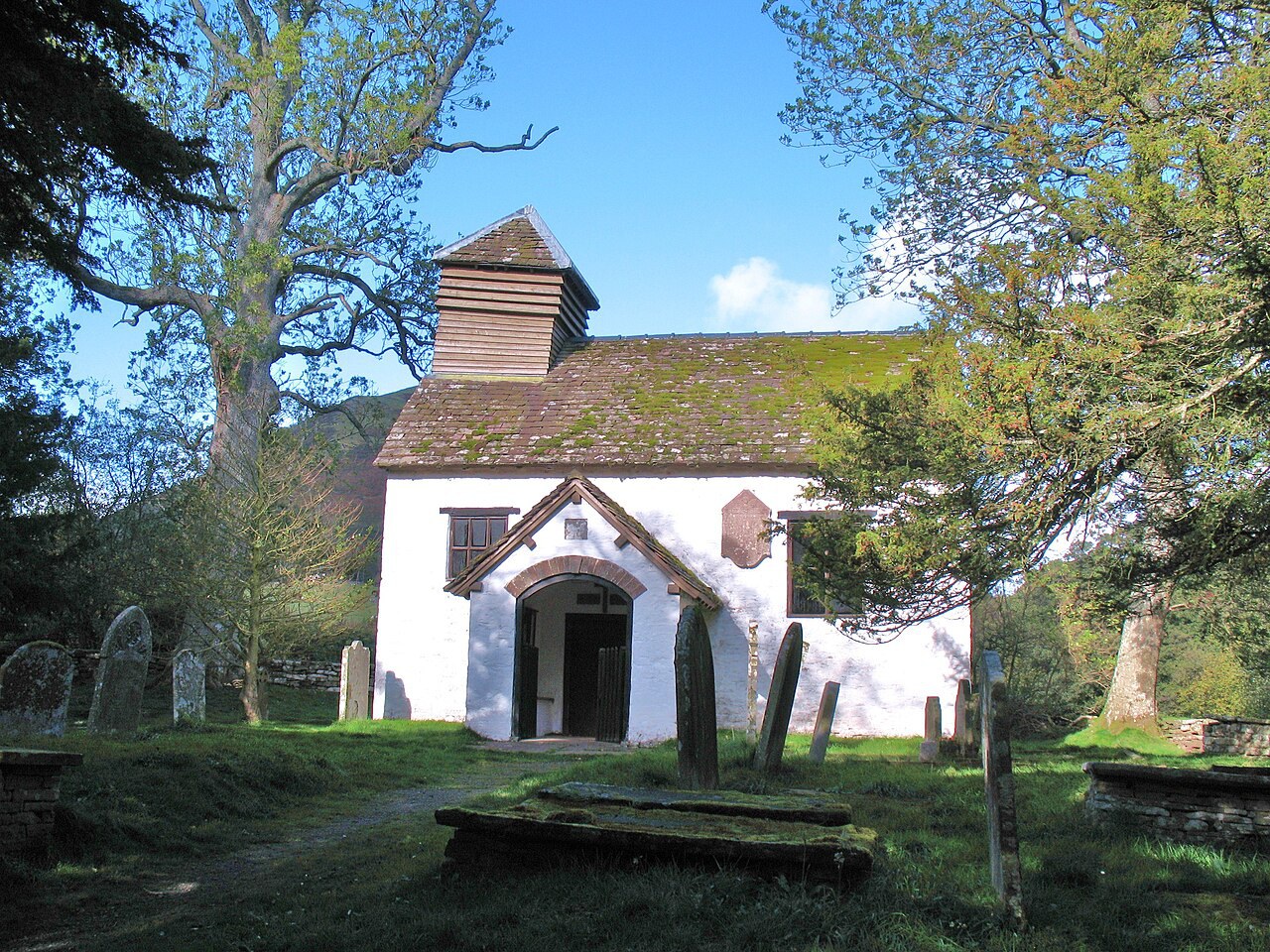
Vale of Ewyas
Capel-y-ffin
A small Honddu valley hamlet shaped by a chapel among old yews, Black Mountains paths and the road over Gospel Pass.
- Best for
- Black Mountains walking and valley history
- Give it
- A half day, or longer for a hard hill loop
- Don't miss
- St Mary’s medieval font and old yews
Photo: Gordon Hatton · CC BY-SA 2.0 · cropped
The Fox verdict
A chapel, a valley and paths into the hills
Capel-y-ffin is strongest as a quiet base for walking and layered religious history, with food and drink down the valley at Llanthony.
St Mary’s simple eighteenth-century chapel, the Honddu valley and the Black Mountains path network give the hamlet its character. Llanthony Priory adds a substantial free-to-enter ruin, while serious food shopping means a trip to Hay-on-Wye.
Where to go
Places in Capel-y-ffin
Every place below is checked against a published source, listed with what it is and how long to give it.
Local signatures
3 placesBlack Mountains path network
Waymarked links lead towards Hatterrall Hill, the Beacons Way and Offa’s Dyke National Trail. A separate hard 6.7-mile Twmpa loop takes about 4.5–5 hours and is not represented by this shorter planning allowance.
- Visit length
- Editorial estimate: Allow around 2 hours for a short outing
- Locality
- from Capel-y-ffin
- Access
- The National Park authority warns that the dense path network can be difficult to navigate.
Llanthony Priory Cellar Bar
A tiny historic country-inn bar in the priory’s vaulted thirteenth-century undercroft, with settles and wall panelling.
- Visit length
- Editorial estimate: Allow around 75 minutes
- Locality
- at Llanthony Priory
- Access
- Check current service days and hours before travelling. Cadw permits assistance dogs only within the monument; CAMRA describes outside space beyond the priory grounds for visitors with dogs.
Upper Court Farm Butchery
Tom and Julie’s independent farm butcher sells beef and lamb from Upper Court Farm alongside home-grown pork, poultry, game and delicatessen goods.
- Visit length
- Editorial estimate: Allow around 30 minutes
- Locality
- 8 Broad Street, Hay-on-Wye
Food & drink
1 placeHay Thursday Market
More than forty traders spread across four named market areas, with artisan bread, locally reared meat, seasonal produce, fish, game, cheese, cakes, coffee and hot takeaway food.
- Visit length
- Editorial estimate: Allow around 75 minutes
- Locality
- Memorial Square, Cheese Market, Butter Market and Clock Tower, Hay-on-Wye
- Access
- This is a year-round Thursday market.
Walks & outdoors
1 placeCourt Farm campsite
A simple campsite whose own visitor information emphasises quiet, riverside picnics and walking rather than organised entertainment.
- Visit length
- Editorial estimate: Allow around 45 minutes for a riverside picnic
- Locality
- Llanthony
History & heritage
2 places
St Mary, Capel-y-ffin
A simple chapel-of-ease dating from 1762, with old yews, a medieval tapered octagonal font, a west gallery, an inscribed 1780 pulpit and an eighteenth-century oak plank door.
- Visit length
- Editorial estimate: Allow around 40 minutes
- Locality
- Capel-y-ffin
Llanthony Priory
Free-to-enter ruins of an Augustinian house founded by 1118, with richly decorated red stonework and pointed arches.
- Visit length
- Editorial estimate: Allow around 75 minutes
- Locality
- Llanthony
- Access
- The ruins are free to enter; most of the site is flat, though grass can be muddy and there are low remains and a few shallow steps.
No places match this filter. Choose All places to reset the list.
Three ways to explore Capel-y-ffin
Signature outings
St Mary’s layered interior
See a medieval tapered octagonal font inside the simple 1762 chapel, together with its west gallery, 1780 pulpit and old oak door.
Llanthony’s priory arches
Explore the free-to-enter remains of an Augustinian house founded by 1118, where red stonework and pointed arches stand beneath the hills.
Paths into the Black Mountains
Use the National Park waymarking from Capel-y-ffin towards Hatterrall Hill, the Beacons Way and Offa’s Dyke National Trail.
The village story
Capel-y-ffin Village Guide
A chapel among old yews, a narrow Honddu valley and paths rising into the Black Mountains.
The chapel and the mountain approach
The chapel of St Mary sits low among a ring of old yews, so dark and hunched that the Victorian diarist Francis Kilvert described it as "squatting like a stout grey owl among its seven great black yews." The present building dates from 1762, with a south porch added in 1817, but the tapered octagonal font inside is medieval, older than the walls around it. There is a west gallery, a pulpit inscribed 1780, a settle dated 1783 and an eighteenth-century oak plank door. Opposite the churchyard stands a red K6 telephone box, a George VI design cast by the Lion Foundry, listed in its own right partly for the company it keeps with the church. Behind the chapel is a former Baptist meeting house, whose inscription records that William and David Prosser brought the Gospel to their house in 1737.
The hamlet lies in the Vale of Ewyas, strung along the River Honddu below the long border ridges of the Black Mountains. The rock here is Old Red Sandstone, which gives the eroded gullies and slopes a ruddy tone rather than the black the name suggests. From the south you leave the A465 north of Abergavenny and take the narrow minor road up through Llanthony. From the north the only way in is over Gospel Pass, the highest public road in Wales, threading between Twmpa and Hay Bluff before dropping into the valley. It is exposed and quick to close in bad weather, so check conditions before you commit to it.
Walking down to Llanthony
This is walking country before it is anything else. From the hamlet a hard loop climbs Twmpa, better known as Lord Hereford's Knob, a little under seven miles with well over two thousand feet of ascent, following the ridge before returning down the Nant Bwch side valley. Gentler is the path south to Llanthony Priory, about three and a half miles down the valley floor, where the free-to-enter ruins of an Augustinian house founded by 1118 stand open beneath the hills. The waymarked network from Capel-y-ffin also reaches towards Hatterrall Hill, the Beacons Way and Offa's Dyke, though the paths run dense enough that a map matters.
For food and drink you go down to Llanthony. The Cellar Bar occupies the vaulted thirteenth-century undercroft of the priory, all settles and wall panelling, serving food and drink from Tuesday to Sunday, with Felinfoel Double Dragon and Dragon Welsh IPA among the cask beers; recent visitors have eaten beef lasagne and a beef-and-stout chilli cottage pie. Across the field the Half Moon Inn is a plainer walkers' pub with a beer garden and simple food, pizza and toasties and chips, breakfast cobs in the morning, and dogs are welcome.
Market provisions in Hay-on-Wye
Serious food shopping means Hay-on-Wye, about eight miles north over the pass in good conditions. Upper Court Farm Butchery on Broad Street, run by Tom and Julie, sells beef and lamb off their own farm alongside home-grown pork, poultry and game, and the Thursday market fills Memorial Square, the Cheese Market, Butter Market and Clock Tower with more than forty traders, bread, fish, cheese, cakes and coffee among them.
Father Ignatius and the artists
Above the hamlet, on the morning-facing slope of Tarren yr Esgob, stand the remains of a stranger venture. In 1869 the Rev. Joseph Leycester Lyne, known as Father Ignatius, began building an Anglican Benedictine monastery here; the cloister followed in 1870 and a detached church in 1872. Work stopped in 1882, and the church collapsed around 1920, leaving only its chancel. In 1924 the sculptor Eric Gill took the place over for a Catholic community of craftsmen. The painter David Jones came with him from Ditchling and stayed until 1928; his watercolour Capel-y-ffin of 1926 to 1927 hangs in the national collection at Amgueddfa Cymru.
Rail access and the valley pilgrimage
The nearest railway is at Abergavenny, twelve or thirteen road miles down the valley, with a taxi rank; check a journey planner before counting on a bus this far up the valley. Once a year an ecumenical pilgrimage still walks between the old priory at Llanthony and the chapel in its yews, the two ends of the same narrow valley.
Stay around Brecon Beacons
Make a longer stay of it
Travel Fox holiday homes around Brecon Beacons, linked directly to their property pages.
For homeowners
Own a holiday home near Capel-y-ffin?
We manage holiday lets across the UK from 12% commission, charged after cleaning costs, with no lock-in. A co-founder visits before you decide.
How our holiday let management works →
A guide with a point of view
Written from research. Edited for real journeys.
Use the Official site links for live practical details, then use this guide for context, ideas and room to explore.
Photography credits & licences
Third-party photographs are credited to their named creators and reused under the linked Creative Commons licence or public-domain dedication. Travel Fox stores an optimised local copy; the file-specific changes and any browser-applied display crop are disclosed below. Reused photographs link both to the Wikimedia Commons source record and to the declared source image; Travel Fox's own photographs carry no such record and are marked as ours. These image licences do not cover Travel Fox text, branding or page design.
- File:St Mary's Chapel, Capel y Ffin - geograph.org.uk - 2690940.jpg — photograph by Gordon Hatton; St Mary's Chapel, Capel y Ffin by Gordon Hatton. Source record on Wikimedia Commons. Declared source image. Licence: CC BY-SA 2.0. File changes: Downloaded from Wikimedia Commons, resized to a maximum 1920px edge and encoded as an optimised JPEG. Display changes: Displayed with responsive CSS cropping.
Sources
Every place on this page is checked against a published source. Each entry links the record we used and names who publishes it.
- St Mary, Capel-y-ffin — churchinwales.org.uk other published source
- Black Mountains path network — beacons-npa.gov.uk statutory register or public authority
- Llanthony Priory — cadw.gov.wales statutory register or public authority
- Llanthony Priory Cellar Bar — visitmonmouthshire.com operator, sector body or destination organisation
- Court Farm campsite — llanthonycamping.co.uk other published source
- Upper Court Farm Butchery — uppercourtfarmbutchery.co.uk operator, sector body or destination organisation
- Hay Thursday Market — hay-on-wye.co.uk other published source