
Colleges, culture and the Cam
Cambridge
Cambridge packs fan-vaulted architecture, free collections, historic pubs, green commons and river views into a compact, walkable historic core.
- Best for
- Colleges, free museums and river views
- Give it
- A full day on foot
- Don't miss
- King's fan vault and a punt past the Backs
Photo: Marathon · CC BY-SA 2.0 · cropped
The Fox verdict
A small city with a long view upward
The historic core keeps colleges, museums, the market and the Backs within an easy walk, while the Cam opens a second view from the water.
Start with the fan vault at King's, follow Cambridge's scientific story into The Eagle, then balance the colleges with free art, working green spaces and the independent life around the market. Punting supplies the classic river perspective; Grantchester Meadows carries the walk beyond the centre.
Where to go
Places in Cambridge
Every place below is checked against a published source, listed with what it is and how long to give it.
Local signatures
3 placesThe Eagle
See the plaques recalling the 1953 DNA announcement, then look up at the RAF Bar ceiling marked by Allied airmen during the Second World War.
- Visit length
- Editorial estimate: Allow around 1 hour
- Locality
- Bene't Street
The Fitzwilliam Museum
Explore a free collection of more than half a million artworks and artefacts, including a notable Ancient Egypt collection.
- Visit length
- Editorial estimate: Allow around 1 hour 30 minutes
- Locality
- Trumpington Street
Cambridge Market
Browse colourful striped stalls in a market that has traded near-daily since Saxon times, with street food, produce, books, vinyl, jewellery, fudge and coffee.
- Visit length
- Editorial estimate: Allow around 45 minutes
- Locality
- Market Hill / Market Square
Food & drink
1 placeThe Orchard Tea Garden
Take tea where scholars first asked Mrs Stevenson to serve them under her fruit trees in 1897, later joined by guests including Rupert Brooke and Virginia Woolf.
- Visit length
- Editorial estimate: Allow around 1 hour
- Locality
- Grantchester
Walks & outdoors
2 places
Cambridge University Botanic Garden
A teaching garden created in 1846, with two pinetums, a fragrant rose bed and a Glasshouse Range spanning tropical rainforest to arid desert.
- Visit length
- Editorial estimate: Allow around 1 hour 30 minutes
- Locality
- Bateman Street
Grantchester Meadows
Follow the Cam from Newnham into open meadow and wildflower country, with swimmers and paddleboarders in summer, towards Grantchester.
- Visit length
- Editorial estimate: Allow around 2 hours
- Locality
- From Newnham along the Cam to Grantchester
History & heritage
3 placesKing's College Chapel
Look up at the world's largest fan vault, built between 1512 and 1515, in the chapel where A Festival of Nine Lessons and Carols began in 1918.
- Visit length
- Editorial estimate: Allow around 1 hour 15 minutes
- Locality
- Cambridge historic centre
Kettle's Yard
Visit the former home of Jim and Helen Ede, formed from four cottages and preserved with its collection of early twentieth-century art.
- Visit length
- Editorial estimate: Allow around 1 hour 15 minutes
- Locality
- Castle Street
Parker's Piece
Walk the common regarded as the birthplace of association-football rules, and find the Reality Checkpoint lamppost at its centre.
- Visit length
- Editorial estimate: Allow around 45 minutes
- Locality
- Near the centre
Things to do
1 placePunting on the Cam
Choose a self-punt or a chauffeured trip with narration, passing the Backs and Cambridge bridges including the Mathematical Bridge and Bridge of Sighs.
- Visit length
- Editorial estimate: Allow around 1 hour
- Locality
- River Cam at the Backs
No places match this filter. Choose All places to reset the list.
Three ways to explore Cambridge
Signature outings
Stand beneath the fan vault
King's College Chapel carries the world's largest fan vault, built between 1512 and 1515 by master mason John Wastell.
See the Backs from a punt
Self-punt or settle into a chauffeured trip with narration as the boat glides past the college Backs.
Walk the Glasshouse Range
The Botanic Garden's Glasshouse Range moves from tropical rainforest to arid desert in a few steps.
The city story
Cambridge, from the Chronophage to the market
The accepted Travel Fox article moves from a clock that eats time through DNA, fan vaults and river bridges to buns, pubs, free museums, meadows and the university's accidental beginning.
A clock, a lunch and an airmen's ceiling
On Bene't Street there is a gold clock with a giant grasshopper on top, and the grasshopper appears to eat each passing second. It is a metre and a half across, cost over a million pounds, and has no hands — hours, minutes and seconds are shown by LED-lit slits, and the whole thing was designed and given to Corpus Christi College by an inventor called Dr John C. Taylor. It was unveiled in 2008. People stand in front of it waiting for it to do something, which it is always already doing.
A few doors along the same street is The Eagle, and this is where you should begin, because on 28 February 1953 Francis Crick walked in at lunchtime and interrupted the drinkers to announce that he and James Watson had "discovered the secret of life." What they had was the double-helix structure of DNA. The Cavendish Laboratory was round the corner on Free School Lane at the time, which made the Eagle their regular lunch spot. There is a blue plaque now, and plaques by the table they used, and a 2023 addition that names Rosalind Franklin and Maurice Wilkins alongside them. The pub also brews an ale called Eagle's DNA, which is the sort of thing that happens when a discovery gets made over a pint.
The Eagle has a second ceiling worth tilting your head back for. During the war, Allied airmen wrote their squadron numbers, names and doodles on the ceiling of the RAF Bar using candle smoke, petrol lighters and lipstick. The tradition is credited to a Flight Sergeant P. E. Turner, and in the 1990s a former RAF Chief Technician named James Chainey deciphered and preserved the lot. It is still up there.
Vaults, courts and the Cam
Cambridge is small in the way that matters to a visitor. The historic core is compact and walkable — most of the places you have come to see are within ten or fifteen minutes of each other on foot — and once you accept that you will spend a lot of your stay looking upward, the city rewards it. King's College Chapel is the obvious place to look. It has the world's largest fan vault, built between 1512 and 1515 by the master mason John Wastell. The original plan called for a different kind of vaulting, and the piers were built to suit it before somebody changed their mind, which means the columns are holding up a roof they were not designed for and doing it beautifully anyway. On Christmas Eve the Choir of King's sings A Festival of Nine Lessons and Carols here, a service first held in 1918 and first broadcast in 1928, now heard by millions of people who will never see the room it comes from.
Behind the chapel are the Backs — the strip of college lawns running down to the River Cam behind King's, Clare, Trinity and St John's. This is the view people mean when they say Cambridge. Trinity's grounds alone run to thirty-six acres. Its Great Court is said to be the largest enclosed courtyard in Europe, largely finished under a Master called Thomas Nevile who then built a second court, Nevile's Court, heading down towards the river. Inside is the Wren Library, designed by Christopher Wren in 1676 and finished in 1695, which holds two of Shakespeare's First Folios, a fourteenth-century manuscript of Piers Plowman, and letters by Isaac Newton. Newton had rooms next to the Great Gate from 1667 to 1695 and wrote the Principia in them.
To see the Backs properly you get on the water. Punting is the flat-bottomed boat propelled by a long pole, and you can either take a chauffeured trip where a guide narrates the history or you can do it yourself, which is harder than it looks and more entertaining for everyone watching from the bank. From the river you pass under the Mathematical Bridge at Queens', the only surviving wooden bridge on the Backs, built in 1749 and rebuilt twice since. There is a persistent story that Newton built it without bolts; he did not, having died in 1727. Further along is St John's Bridge of Sighs, a covered stone crossing from 1831 that Queen Victoria is said to have loved more than anywhere else in the city. Students say the name comes from the sighs of people walking to and from their exams.
Buns, Mill Road and back-street pubs
When you come off the water there is food, and Cambridge takes it seriously across a wide range of price. At the top is Midsummer House, chef-patron Daniel Clifford's restaurant in a Victorian house on the bank of the Cam overlooking Midsummer Common — two Michelin stars, the second held since 2005, and a tasting menu called the Solstice Menu. A roasted Orkney scallop with salt-baked celeriac and Granny Smith apple has been on it since the day the place opened. At the other end, and far more likely to fit a holiday, is Fitzbillies on Trumpington Street, an independent bakery founded in November 1920 and named for its spot near the Fitzwilliam Museum. It makes hand-made Chelsea buns to a secret recipe — over three hundred thousand a year — and it has gone bankrupt twice, in 1980 and 2011, surviving the second time because Stephen Fry launched a public appeal and the restaurateur Tim Hayward bought and reopened it.
The real eating happens on Mill Road, the diverse quarter running southeast from the centre over a railway bridge that everyone in Cambridge has an opinion about. It is packed with independent shops, international restaurants and vintage stores, and gets called the city's answer to Brick Lane often enough that the comparison has stopped meaning much. Once a year the whole street closes for the Mill Road Winter Fair. Al Casbah at number 62 is an Algerian-Moroccan charcoal grill established in 1997, allegedly the first charcoal grill restaurant in East Anglia, cooking marinated meats and fish in front of you alongside a long meze bar and tagines. A little further along is Vanderlyle, a near-zero-waste vegetable tasting menu that is mostly plants and books up weeks ahead. Between them sit Indian restaurants like Bharat Bhavan and Kohinoor and a lively evening scene that has nothing to do with the colleges.
Cambridge is a proper pub city, and the good ones are not the ones on the postcard streets. The Free Press on Prospect Row dates from the 1890s, keeps coal fires going in winter, and still has its original bookable snug. Off Mill Road, the Kingston Arms reopened in March 2023 after what its own history politely calls "an ill-fated spell as a Mediterranean restaurant," and in the summer of 2025 became the first pub in the city to be listed as an Asset of Community Value. Nearby on Gwydir Street the Cambridge Blue pours a large range of real ales and foreign beers. The Pickerel Inn on Magdalene Street claims to be the oldest pub in the city — the building goes back to the fifteenth century and it was first licensed in 1608 — and has been a brewery, a malting house and stables in its time. It is named after a young pike once caught in the Cam, and it is reputed to have ghosts. The Punter on Pound Hill is the definitive Cambridge local despite, whatever the name suggests, not sitting on the river.
Free art, green commons and Grantchester
Much of what there is to do here is free. The Fitzwilliam Museum on Trumpington Street holds over half a million artworks and artefacts, including a notable Egyptian collection, and charges nothing. Kettle's Yard on Castle Street is stranger and better for it: the former home of Jim Ede, a writer and ex-Tate curator, who from 1956 knocked four small cottages into one house to display his collection of early twentieth-century art and left it arranged exactly as he wanted it. It opened in 1957 and it is still that house. The University Botanic Garden on Bateman Street, a teaching garden since 1846, runs a glasshouse range that takes you from tropical rainforest to arid desert in a few steps.
The green spaces are working parts of the city rather than ornaments. Parker's Piece, a twenty-five-acre flat common near the centre, is regarded as the birthplace of the rules of football — in 1848 Cambridge students agreed a single set of eleven rules and nailed them to the trees, and the Football Association adopted almost all of them in 1863. At the centre of the common stands a lamppost that generations of students called Reality Checkpoint until, in 2017, the City Council gave up and painted the name on officially. Over on Jesus Green, the Lido opened in 1923 and is one of the longest open-air pools in Europe at over ninety metres, with its own sauna, open May to September. For small children there is the Sheep's Green learner pool, ninety centimetres deep and free, sitting in a wild water-meadow on the Cam next to a paddling pool and play area at Lammas Land.
If you want the walk that Cambridge people take, go from Newnham out along the Cam through Grantchester Meadows — open meadow, wildflowers, swimmers and paddleboarders in summer — for about two miles until you reach the village of Grantchester. The Orchard Tea Garden there began in 1897 when scholars asked a Mrs Stevenson to serve them tea under her fruit trees, and its guest list over the years reads like a syllabus: Rupert Brooke, Virginia Woolf, E. M. Forster, Maynard Keynes, Bertrand Russell. Brooke lodged at The Orchard and then at the Old Vicarage, and in 1912, homesick in Berlin, wrote the poem that ends "Stands the Church clock at ten to three? / And is there honey still for tea?" Just beyond the village is Byron's Pool, a weir now kept as a nature reserve, where Lord Byron is said to have swum as a Trinity student.
Arrivals, origins and the market
Getting here is easy enough that you can leave the car at home. Cambridge station sits about a mile southeast of the centre and is the busiest in the East of England; the fastest trains from London Liverpool Street take about an hour and twelve minutes, and a second station, Cambridge South, opened up more direct routes to King's Cross, Birmingham, Brighton and Stansted. Once you arrive, the historic core is best done on foot or by bike, with park-and-ride and the guided busway covering the edges.
The university, for all its weight, arrived by accident. In 1209 scholars fled Oxford after townsmen there hanged students in reprisal for a killing, and they settled in Cambridge because a small teaching community was already here. The whole thing that follows — the chapels, the Wren Library, the DNA announcement over lunch — started with people leaving somewhere else in a hurry. On a striped stall in the market square, which has traded near-daily since Saxon times, someone is still selling fudge and secondhand vinyl to a queue that does not know any of this and does not need to.
Stay around Cambridgeshire
Make a longer stay of it
Travel Fox holiday homes around Cambridgeshire, linked directly to their property pages.
A guide with a point of view
Written from research. Edited for real journeys.
Use the Official site links for live practical details, then use this guide for context, ideas and room to explore.
Photography credits & licences
Third-party photographs are credited to their named creators and reused under the linked Creative Commons licence or public-domain dedication. Travel Fox stores an optimised local copy; the file-specific changes and any browser-applied display crop are disclosed below. Reused photographs link both to the Wikimedia Commons source record and to the declared source image; Travel Fox's own photographs carry no such record and are marked as ours. These image licences do not cover Travel Fox text, branding or page design.
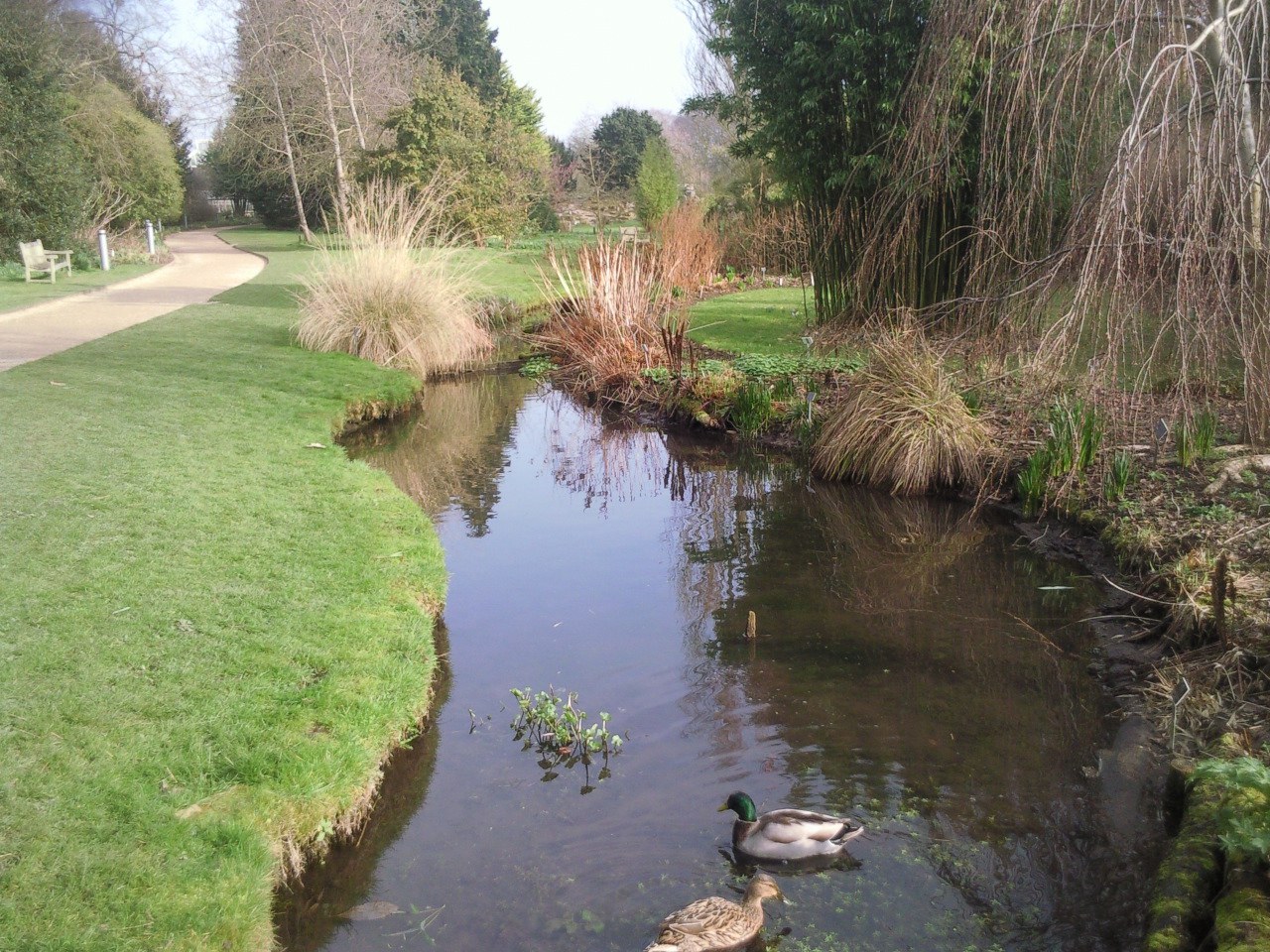
- File:The Stream Garden, Cambridge University Botanic Garden - geograph.org.uk - 2325086.jpg — photograph by Marathon; The Stream Garden, Cambridge University Botanic Garden by Marathon. Source record on Wikimedia Commons. Declared source image. Licence: CC BY-SA 2.0. File changes: Downloaded from Wikimedia Commons, resized to a maximum 1920px edge and encoded as an optimised JPEG. Display changes: Displayed with responsive CSS cropping.
Sources
Every place on this page is checked against a published source. Each entry links the record we used and names who publishes it.
- King's College Chapel — kings.cam.ac.uk other published source
- Punting on the Cam — cambridge.gov.uk statutory register or public authority
- The Eagle — historicengland.org.uk statutory register or public authority record not machine-readable; publisher restricts automated access
- The Fitzwilliam Museum — historicengland.org.uk statutory register or public authority record not machine-readable; publisher restricts automated access
- Kettle's Yard — kettlesyard.cam.ac.uk other published source
- Cambridge University Botanic Garden — botanic.cam.ac.uk other published source
- Parker's Piece — cambridge.gov.uk statutory register or public authority
- Cambridge Market — cambridge.gov.uk statutory register or public authority
- Grantchester Meadows — cambridge.gov.uk statutory register or public authority
- The Orchard Tea Garden — theorchardteagarden.co.uk operator, sector body or destination organisation