
Coast, castle and old town
Abergele
A North Wales market town where a shingle shore, medieval church and wooded hills sit within one varied visit.
- Best for
- Coastal walking and layered local history
- Give it
- A full day between town, shore and hills
- Don't miss
- The twin naves of St Michael's Church
Photo: Llywelyn2000 · CC BY-SA 4.0 · cropped
The Fox verdict
A coast town with more than one horizon
Abergele combines Pensarn's shingle beach with medieval fabric, a Gothic Revival castle and paths into the limestone hills.
Start with the double-naved St Michael's, pause in Pentre Mawr Park, then choose between the coast at Pensarn and the higher ground around Tower Hill and Castell Cawr. Gwrych Castle adds a substantial historic visit on the town's doorstep.
Where to go
Places in Abergele
Every place below is checked against a published source, listed with what it is and how long to give it.
Local signatures
3 placesPentre Mawr Park
A 44-acre Green Flag park with playgrounds, sports facilities, a walled garden, sculptures and a biodiversity area of ponds, meadows and woodland.
- Visit length
- Editorial estimate: Allow around 60 minutes
- Locality
- near Pensarn beach
Wales Coast Path
A long-distance coastal route that follows the North Wales shoreline, passing Abergele's seafront and Pensarn Beach alongside the North Wales Path.
- Visit length
- Editorial estimate: Allow around 1 hour 45 minutes
- Locality
- Pensarn seafront
Castell Cawr
An Iron Age hillfort at about 620 feet, locally nicknamed Lover's Lane, with views over Abergele and out to sea.
- Visit length
- Editorial estimate: Allow around 90 minutes
- Locality
- above Abergele
Walks & outdoors
1 placeAbergele Pensarn Beach
A long, quiet and predominantly shingle beach beside the station, with both the Wales Coast Path and North Wales Path running along the seafront.
- Visit length
- Editorial estimate: Allow around 75 minutes
- Locality
- Pensarn seafront
History & heritage
2 placesSt Michael's Church
A Grade II* church with medieval fabric, parallel naves and chancels, a six-bay arcade, historic monuments and rare yellow-stained glass from around 1500.
- Visit length
- Editorial estimate: Allow around 45 minutes
- Locality
- Church Street
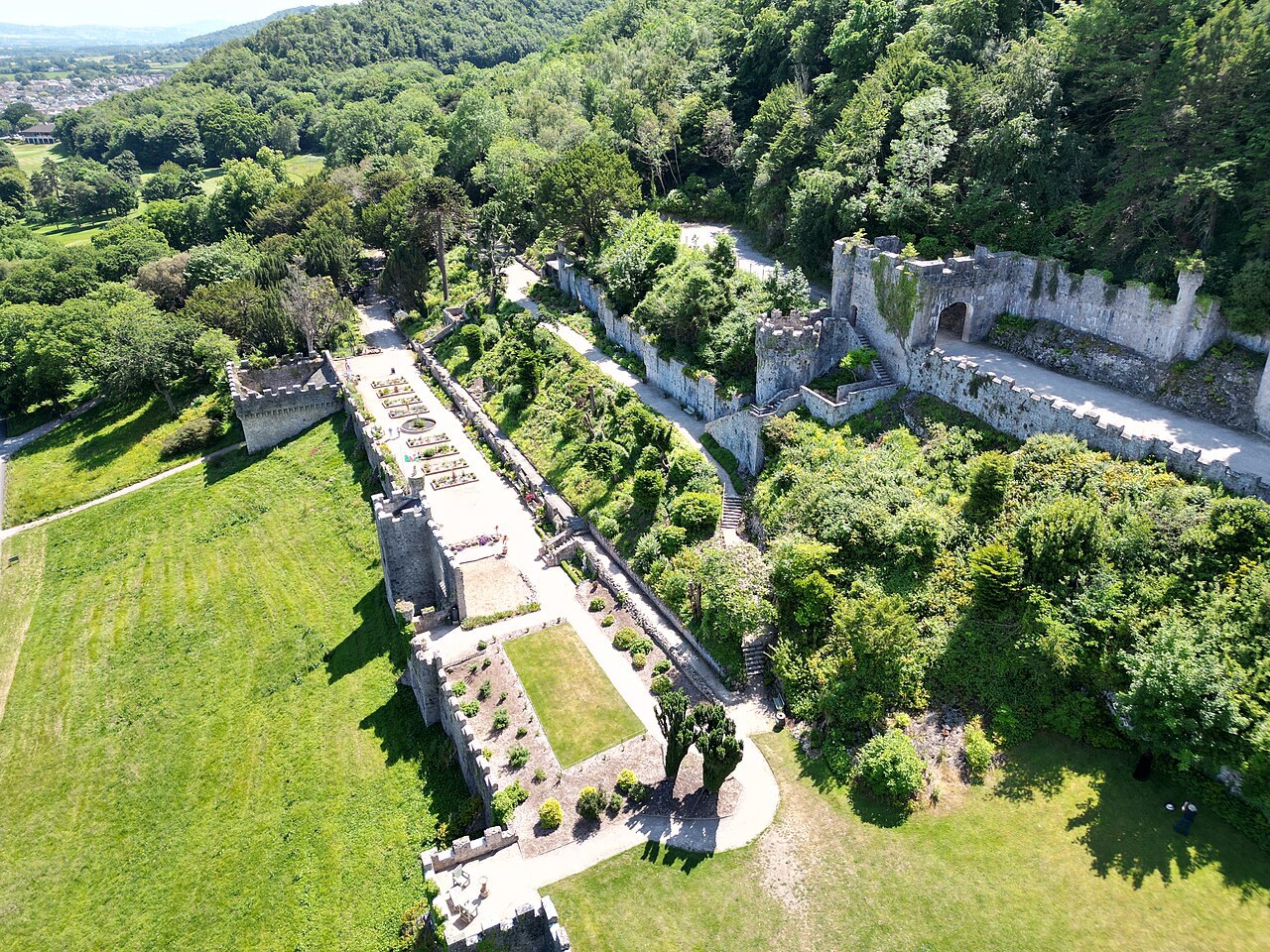
Gwrych Castle
A Grade I 19th-century Gothic Revival castle, built in 1812–1822 and used as the base for I'm a Celebrity in 2020 and 2021.
- Visit length
- Editorial estimate: Allow around 2 hours
- Locality
- on Abergele's doorstep
- Access
- Day visits and events are offered; check the Official site before travel.
No places match this filter. Choose All places to reset the list.
Three ways to explore Abergele
Signature outings
Two naves under one roofline
Step into St Michael's to see its parallel naves and chancels, six-bay arcade and surviving yellow-stained glass from around 1500.
Shingle, paths and open coast
Follow the seafront at Pensarn, where the Wales Coast Path and North Wales Path meet a long, predominantly shingle beach.
Gwrych above the coast
Visit Gwrych Castle for a close look at the Grade I Gothic Revival landmark built in 1812–1822.
The town story
Abergele Town Guide
Pubs, medieval stonework, a railway tragedy and paths from the beach into the hills shape Abergele's story.
From Tavern Tables to Market Street
At the Harp Inn on Market Street, dogs are given treats when they arrive, and on Sundays there's a free doggie dinner. The humans do well too: roast beef and turkey, lamb shank, a homemade steak and ale pie that doubles as the pie of the day, fish and chips, and a Sunday lunch that reviewers single out above the rest. There's a good range of ales and bitters, plenty for vegetarians, and prices people describe as excellent value. The Harp is one of the town's older taverns — it turns up in the pub records of 1859 and 1862 at an £18 rateable value, and its frontage reportedly didn't change between 1861 and 1911.
It was not always this quiet a scene. The 1859 rate book listed fourteen taverns, and an 1862 plan showed sixteen hotels and inns — the Gwindy, the Mona Vaults, the Bull, the Cross Keys run by a joiner who was also a Baptist, a Crown kept by a Wesleyan. The Crown later became Gwalia House, which is now the butcher. A pub becoming a butcher's is one way for a town to sober up.
The River, the Sea and St Michael's
Abergele sits on the North Wales coast between Colwyn Bay and Rhyl, a market town of eight or nine thousand people. The name means "mouth of the Gele," after the river that runs through it. There's a long-standing local belief that the original town lay further north and was overwhelmed by the sea, a story people still repair to at low water, where a submerged tract of loam holds preserved oak trees.
St Michael's on Church Street is the reason to slow down. It has two naves side by side, a west tower, and two chancels of similar length, separated by a six-bay arcade — a double church, essentially, listed II* for its medieval fabric and its monuments. In the vestry there are nine quarries of yellow-stained glass from around 1500, still there. The site has held a church since the eighth century, and before the Conquest this was the most important mother church in the region.
Remembering the Railway Disaster
The churchyard also holds the dead of the Abergele rail disaster. On 20 August 1868, runaway wagons of paraffin rolled down the gradient from Llanddulas into the path of the Irish Mail; the bursting casks caught fire and thirty-three people died, some burned beyond recognition. It was Britain's worst railway accident to that date. A memorial stands where they were buried.
Coast Paths and Castle Hills
The walking pulls you out of all this. The Wales Coast Path and the North Wales Path both run along the seafront and Pensarn beach, a long quiet shingle strand right by the station. Head west and you reach Llanddulas, or climb through woodland past the Northern Towers of Gwrych Castle — the Gothic Revival pile that housed I'm a Celebrity in 2020 and 2021. Above the town is Castell Cawr, an Iron Age hillfort locally nicknamed Lover's Lane.
Arriving beside the Beach
The station, Abergele & Pensarn, is an unstaffed request stop on the Chester–Holyhead line with six free parking spaces and a machine for tickets. It sits, appropriately, right on the beach.
Stay around Conwy
Make a longer stay of it
Travel Fox holiday homes around Conwy, linked directly to their property pages.
A guide with a point of view
Written from research. Edited for real journeys.
Use the Official site links for live practical details, then use this guide for context, ideas and room to explore.
Photography credits & licences
Third-party photographs are credited to their named creators and reused under the linked Creative Commons licence or public-domain dedication. Travel Fox stores an optimised local copy; the file-specific changes and any browser-applied display crop are disclosed below. Reused photographs link both to the Wikimedia Commons source record and to the declared source image; Travel Fox's own photographs carry no such record and are marked as ours. These image licences do not cover Travel Fox text, branding or page design.
- File:Castell Gwrych, Abergele, Cyngor Bwrdeisdref Conwy - Aerial photographs of Gwrych Castle, Abergele, Wales 09.jpg — photograph by Llywelyn2000; Own work. Source record on Wikimedia Commons. Declared source image. Licence: CC BY-SA 4.0. File changes: Downloaded from Wikimedia Commons, resized to a maximum 1920px edge and encoded as an optimised JPEG. Display changes: Displayed with responsive CSS cropping.
Sources
Every place on this page is checked against a published source. Each entry links the record we used and names who publishes it.
- St Michael's Church — churchinwales.org.uk other published source
- Pentre Mawr Park — conwy.gov.uk statutory register or public authority
- Abergele Pensarn Beach — visitconwy.org.uk operator, sector body or destination organisation
- Gwrych Castle — gwrychcastle.co.uk operator, sector body or destination organisation
- Wales Coast Path — visitconwy.org.uk operator, sector body or destination organisation
- Castell Cawr — coflein.gov.uk statutory register or public authority