
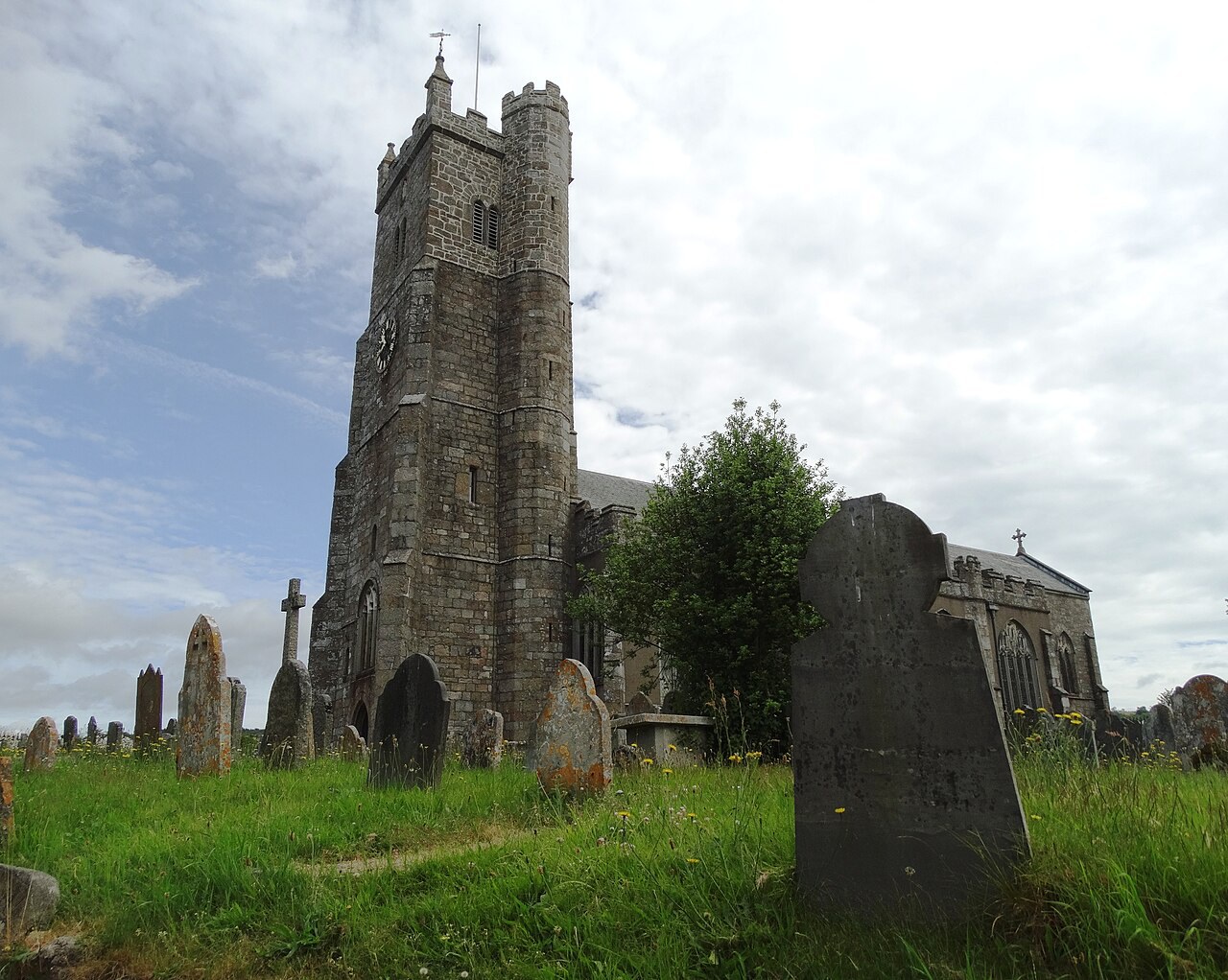
Gateway to the high moor
Moretonhampstead
A Dartmoor market town with medieval roots, granite landmarks, open moorland and a former-railway trail.
- Setting
- North-eastern edge of Dartmoor
- Historic name
- Mortone in Domesday
- Outdoors
- Mardon Down and the Wray Valley Trail
Photo: Neil Theasby · CC BY-SA 2.0 · cropped
The Fox verdict
A small town with a long view
Moretonhampstead brings together moorland, medieval and coaching-inn history, family recreation and routes into the wider Dartmoor landscape.
Mardon Down's Bronze Age landscape, St Andrew's granite tower and the thatched almshouses provide a strong historical thread. The Sentry, the Wray Valley Trail and long-trading inns add useful stops for a varied visit.
Where to go
Places in Moretonhampstead
Every place below is checked against a published source, listed with what it is and how long to give it.
Local signatures
3 placesMoretonhampstead Almshouses
A thatched, colonnaded granite row with a 1637 datestone over a much older core, owned by the National Trust since 1952.
- Visit length
- Editorial estimate: around 20 minutes
- Locality
- Moretonhampstead
Wray Valley Trail
A traffic-free walking and cycling route along the former railway line from Moreton towards Bovey Tracey.
- Visit length
- Editorial estimate: around 3 hours
- Locality
- From Moreton towards Bovey Tracey
The Union Inn
Moretonhampstead's oldest tavern still trading, with home-cooked food and a rotating selection of local English ales and cider.
- Visit length
- Editorial estimate: around 90 minutes
- Locality
- Ford Street
Food & drink
1 placeThe White Hart Hotel
A Grade II-listed coaching inn dating to 1639, with a restaurant, bar snug and rotating local real ales.
- Visit length
- Editorial estimate: around 90 minutes
- Locality
- Central crossroads
Walks & outdoors
1 placeMardon Down
Open-access moorland with a Bronze Age landscape of cairns and the nearby Seven Stones circle, plus wide views over Moretonhampstead and Dartmoor.
- Visit length
- Editorial estimate: around 2 hours
- Locality
- Straight from the town
History & heritage
1 place
Church of St Andrew
A granite church whose early 15th-century west tower rises in four stages with battlements, corner pinnacles and a medieval stair turret.
- Visit length
- Editorial estimate: around 45 minutes
- Locality
- Adjacent to The Sentry
Things to do
2 placesThe Sentry
Moretonhampstead's communal green has a fenced play area at the top of the field and views towards Mardon Down and Hingston Rock.
- Visit length
- Editorial estimate: around 45 minutes
- Locality
- Adjacent to St Andrew's church
King George V Playing Field
A community sports and leisure hub with cricket and football pitches, a skate park and camping.
- Visit length
- Editorial estimate: around 60 minutes
- Locality
- Moretonhampstead
No places match this filter. Choose All places to reset the list.
Three ways to explore Moretonhampstead
Signature outings
St Andrew's west tower
Take in the church's imposing four-stage granite tower, battlemented top, corner pinnacles and medieval stair turret.
The Sentry
Use the communal green for its fenced play area and views towards Mardon Down and Hingston Rock.
Mardon Down
Explore open moorland whose Bronze Age landscape includes cairns and the nearby Seven Stones circle.
The village story
Moretonhampstead Village Guide
Food, moorland routes and seven centuries of town history at Dartmoor's north-eastern edge.
Pizzerias, posting inns and the high moor
The Horse, on George Street, was a biker bar fifteen years ago. Then Nigel Hoyle and his wife Malene Graulund took it over and turned it into a pizzeria with a serious kitchen. Hoyle had appeared in Band of Brothers alongside Damian Lewis before he trained at a pizzeria in Rome, from which he pinched the dough recipe — a twice-risen romana-style crust that turns up under things like the Vesuvio ('nduja, chorizo, confit potatoes, buffalo mozzarella) and the Eastern (spiced lamb, harissa, tahini). There is also Pasta Pollo Pugliese, which is tarragon chicken meatballs in a tomato ragout with creamed orecchiette. A three-course dinner starts at £22. Graulund runs the front of house, the bar still has live music and locals in it, and the team sends you home with a doggie bag for the leftovers. One reviewer took his home and reported: "Pizza for breakfast: happy days."
That is a lot of restaurant for a place this size, and Moretonhampstead is a town rather than a village — just. It sits on the north-eastern edge of Dartmoor, between the rivers Teign and Bovey, at about 700 feet, with the moor rising above 1,100 feet behind it. The central crossroads is where the Exeter road meets the moor-edge road running from Okehampton down to Bovey Tracey, and the single true road across Dartmoor to Princetown starts here, which is why the town is officially styled the Gateway to the High Moor. The name means, roughly, a town in moorland; the "Hampstead" was tacked on by the fifteenth century to tell it apart from other Moretons, and the result is one of the longest single-word place names in England.
The Union Inn, on Ford Street, is the oldest tavern still trading in the town. It was the Swan until the early nineteenth century, when it was renamed to mark the 1801 Act of Union. Dave and Siân Colridge run it now. There are three Dartmoor Brewery casks behind the bar — Jail Ale, Legend and Zero — and a menu built on the Union's Famous Ploughman's, Devon beef chilli, cottage pie, and a Sunday carvery served from noon to seven with sticky toffee and lemon meringue roulade for afters. The dining room was once the stable. Reviewers keep describing the portions as ginormous and keep taking food home, which puts the Union and the Horse in unusual agreement about how a Moretonhampstead meal should end.
The White Hart, on the central square, dates to 1639, when it was a posting inn for the coaches crossing the open moor between Exeter and Princetown — horses changed, passengers given a hot meal, a pint of cider and a bed. The Jackson family bought it in February 2024, having run the Jamaica Inn on Bodmin Moor for the previous eight years, and put half a million pounds through the bars, restaurant and kitchen. There are three handpumps, Jail Ale and Otter Amber among them, a famous full English, and 28 rooms. Dogs are welcome everywhere in the hotel except the dining room.
Painted rooms, food shops and the first climb
The Bell Inn is the half-timbered one, Tudor, in the centre. An oak beam over the bar is said to have once carried carvings of the king's head, mutilated by Roundheads during the Civil War. Upstairs, the function room — the "Painted Room" — has walls done in Etruscan-style panels separated by heraldic devices, the work of French prisoners of war held here in the early 1800s. The Bell was also the first pub in town to get electricity, in 1935.
For daytime eating there is Hippo Dartmoor on Cross Street, a naturopathic bistro run by Ione Rucquoi, an artist and nutritional therapist, named after Hippocrates and run to his line about food being medicine. The Earl's Breakfast is olive oil, miso and peanut butter on sourdough, which is either the future or a step too far depending on your morning; there is also a chicken shawarma salad and a pork belly ramen. The Central Café does the traditional version — big breakfasts renowned among cyclists and, apparently, local builders on a Friday. The Cross Street Cafe is the one for beetroot soup.
The food shops are where a town proves itself. Michael Howard's, the family butcher on Court Street, sells venison sausages and artisan pies and doubles as a deli counter doing bacon butties and made-to-order pasties. On Tuesday and Saturday mornings the Van du Pain sets up in the centre — Liz and Laurent Gavrilenk, who bake nearby, and whose semla is a brioche bun filled with marzipan and cream. Gibson's fish van brings fish landed that morning at Brixham. Berto's, on Cross Street, is a tiny pizzeria run by an Italian called Berto; it is cash only, you bring your own wine, and you book ahead. And on Ford Street there is an ice-cream parlour called the Hound of the Baskervilles, which does Italian-style ice cream and where the house recommendation is the cherry ripple.
The walking starts from the town itself. The Sentry is the communal green beside the church, with a fenced play area at the top of the field and views across to Mardon Down and Hingston Rock. Mardon Down is the moorland ridge directly above town, and it carries a Bronze Age landscape: the largest stone circle on Dartmoor, roughly 38 metres across, which probably once held around sixty-one stones and now shows six standing and a scatter more lying in the grass, along with a group of burial cairns including one twenty metres across known as the Giant's Grave.
Trails, swimming and seven centuries of wool
For a full day there is the nine-mile circuit signposted as All Around Moretonhampstead, which leaves the village cross and takes in four tors — Rectory, Butterdon Hill at 351 metres, Ash and Linscott — with distant views to Haytor and Cosdon Beacon. The Two Moors Way, the long trail linking Dartmoor to Exmoor, passes through. And the Wray Valley Trail runs seven traffic-free miles down the old railway line to Bovey Tracey, descending most of the way, which makes it the family-and-bicycle option.
Ten minutes north, the classic local walk is the Teign Gorge circuit from Castle Drogo — Lutyens' castle, the last one built in England — where the high Hunter's Path and the low Fisherman's Path meet at the thirteenth-century packhorse crossing at Fingle Bridge, with a riverside pub at the bottom.
The town's best family asset is the swimming pool, at the base of the Court Street car park: a 25-metre open-air pool, volunteer-run, filled with naturally sourced water and heated by air-source pumps and solar, open May to September. There is a swim club, aqua-fit, lessons and lane sessions, all lifeguarded. King George V Playing Field adds cricket and football pitches, a skate park and camping. Further out the country fills with day-trips: Chagford ten minutes one way, Lustleigh — often called the prettiest village on the moor — ten minutes another, and the Warren House Inn out on the B3212, the highest pub in southern England, where the hearth fire is said never to have gone out since 1845.
The town has been here a long time. It appears in Domesday as Mortone, a royal manor held by King William himself: twenty-eight households, land for twenty ploughs, twenty cattle and a hundred and thirty sheep — the sheep the more telling number, because wool and cloth were the making of the place for the next seven hundred years. There was a water-powered fulling mill before the end of the thirteenth century; the last one closed in 1776. In 1207 King John granted the town a weekly market and a five-day fair, the rent set at one sparrowhawk a year. The sparrowhawk is still the town's emblem.
Prisoners, dancing trees and granite landmarks
The town's oddest chapter is the French one. From January 1807, paroled prisoners of war — French and Spanish, later Dutch and Danish — were billeted here, free to live in the town but not to leave it, their arrangements overseen by a local surgeon, John Ponsford. Among them was General Rochambeau and his West Indian servant Pierre Courpon, known locally as Peter the Black. Three French officers died and were buried here; one, Lieutenant Louis Quintain, was seen off with Masonic honours and a good local turnout, and two of the memorial stones are kept in the church porch.
The prisoners also had a band, and they played it in a tree. The Cross Tree — a pollarded elm on the square, clipped into a punch-bowl shape with a railed platform built up in its crown — was where villagers and musicians climbed to dance at the fair. An eyewitness in 1801 reckoned there was room in the branches for thirty people to sit around and six couples to dance. A storm damaged it in 1891, another finished it in 1903, and a copper beech was planted in its place in 1912. Only the base of an old cross marks the spot now, near the almshouses.
Those almshouses — a thatched, colonnaded row of solid granite, a 1637 datestone over a core two hundred years older — are the town's most photographed building, and have been in the National Trust's hands since 1952. The Church of St Andrew, a short walk off, is Grade I listed, built almost entirely of granite, its ninety-foot west tower finished by 1418. Pevsner thought it short on interesting fittings, which the Victorian restorers had seen to; the upper room over the porch is thought to have been the town's first school, and somewhere among the stonework is a carving that has been likened to a brontosaurus with a curly tail.
Fire, the lost railway and the Calculating Boy
The railway arrived in 1866 and the passenger service was run down and closed in 1959, the goods trains following in 1964. Fire did more lasting damage: a long series of them, the worst in 1845 starting in a bakehouse and running through Cross Street and Fore Street, took out a good deal of the old thatch-and-timber town, and as recently as 2007 the medieval Punchbowl Inn burned down. The buildings that survived, survived because granite does not catch.
The A382 links the town to Chagford one way and Lustleigh and Bovey Tracey the other, on toward the A38 and A30; the B3212 is the moor road west to Postbridge and Princetown. Buses run to Exeter on the 359 and 173 and to Newton Abbot and Okehampton on the 178, from the car park west of the centre. There is no station any more, but there was, and the trackbed is now the path you can walk to Bovey Tracey.
The town's most famous son is George Parker Bidder, born here in 1806, the son of a stonemason, who could do enormous sums in his head and was exhibited at fairs up and down the country as the Calculating Boy before growing up into a civil engineer who worked with Robert Stephenson and built London's Victoria Docks. There is a monument to him near the top of Lime Street. It was made as a bronze bust rather than marble, on the advice that marble would not survive a Dartmoor winter.
Stay around Dartmoor
Make a longer stay of it
Travel Fox holiday homes around Dartmoor, linked directly to their property pages.
A guide with a point of view
Written from research. Edited for real journeys.
Use the Official site links for live practical details, then use this guide for context, ideas and room to explore.
Photography credits & licences
Third-party photographs are credited to their named creators and reused under the linked Creative Commons licence or public-domain dedication. Travel Fox stores an optimised local copy; the file-specific changes and any browser-applied display crop are disclosed below. Reused photographs link both to the Wikimedia Commons source record and to the declared source image; Travel Fox's own photographs carry no such record and are marked as ours. These image licences do not cover Travel Fox text, branding or page design.
- File:St Andrew's Church, Moretonhampstead - geograph.org.uk - 4546117.jpg — photograph by Neil Theasby; St Andrew's Church, Moretonhampstead by Neil Theasby. Source record on Wikimedia Commons. Declared source image. Licence: CC BY-SA 2.0. File changes: Downloaded from Wikimedia Commons, resized to a maximum 1920px edge and encoded as an optimised JPEG. Display changes: Displayed with responsive CSS cropping.
Sources
Every place on this page is checked against a published source. Each entry links the record we used and names who publishes it.
- Moretonhampstead Almshouses — historicengland.org.uk statutory register or public authority record not machine-readable; publisher restricts automated access
- Church of St Andrew — historicengland.org.uk statutory register or public authority record not machine-readable; publisher restricts automated access
- The Sentry — moretonhampstead-pc.gov.uk statutory register or public authority
- Mardon Down — dartmoor.gov.uk statutory register or public authority record not machine-readable; publisher restricts automated access
- Wray Valley Trail — dartmoor.gov.uk statutory register or public authority record not machine-readable; publisher restricts automated access
- King George V Playing Field — visitmoretonhampstead.co.uk operator, sector body or destination organisation record not machine-readable; publisher restricts automated access
- The Union Inn — theunioninn.co.uk operator, sector body or destination organisation
- The White Hart Hotel — whitehartdartmoor.co.uk operator, sector body or destination organisation