
Where Highland forest meets the Forth
Aberfoyle
Small-batch baking, village pubs and layered church history sit within minutes of steep woodland trails at the Highland Boundary Fault.
- Landscape
- River Forth, wooded Craigmore and the Highland Boundary Fault
- Trail
- Doon Hill: 2¼ miles / 3.5 km, about 1½ hours
- Rail
- No working station; the X10A links Aberfoyle with Stirling and Glasgow
Photo: WeeHolly · CC BY-SA 4.0 · cropped
The Fox verdict
A Main Street with forest trails at the door
Aberfoyle combines small-batch baking and village pubs with church, quarry and railway history beside the upper River Forth.
The sharp change from the low Carse of Stirling to wooded hills gives the town its character. Start at the former station buildings or riverside car park, then choose between Robert Kirk's fairy lore on Doon Hill, a gentler waterfall trail at The Lodge, or the buildings left by parish life and the slate quarrymen.
Where to go
Places in Aberfoyle
Every place below is checked against a published source, listed with what it is and how long to give it.
Local signatures
3 placesThe Faerie Tree Inn
A family-run pub and restaurant with a wood-burning stove, pool table, darts and weekend live music; it serves seasonal British and international food made with locally sourced produce.
- Visit length
- Editorial estimate: allow around 90 minutes
- Locality
- on Main Street
Waterfall Trail at The Lodge
A one-mile trail passing a Women's Timber Corps monument and a waterfall; the longer option crosses an arched wooden bridge to a red-squirrel hide.
- Visit length
- Editorial estimate: About 30 minutes
- Locality
- The Lodge, one mile north
- Access
- The trail uses a wide, firm gravel surface with gentle and short moderate gradients plus a brief boardwalk.
Aberfoyle Parish Church
John Honeyman designed this Category B Early English Gothic Revival church in 1869–70 and added transepts in 1883–84.
- Visit length
- Editorial estimate: allow around 30 minutes
- Locality
- below Craigmore beside the River Forth
Food & drink
1 placeMaggie's Aberfoyle Kitchen
A bakery and shop with an open kitchen, making cakes, biscuits, scones, shortbread, Scottish tablet and clootie dumpling from raw ingredients in small batches.
- Visit length
- Editorial estimate: allow around 45 minutes
- Locality
- at the Station Building
Walks & outdoors
1 placeDoon Hill Trail
A steep woodland loop to a solitary Scots pine among oaks, traditionally treated as the doorway to the Fairy Queen's underground palace and linked to Reverend Robert Kirk.
- Visit length
- Editorial estimate: About 1½ hours
- Locality
- from Aberfoyle's riverside car park
- Access
- The route climbs steeply on uneven gravel, rough rock, mud and exposed roots.
History & heritage
2 placesOld Parish Church and Burial Ground
The roofless shell of the 1744 parish church stands in a graveyard containing a 1685 dated stone, two iron mortsafes and Reverend Robert Kirk's memorial.
- Visit length
- Editorial estimate: allow around 30 minutes
- Locality
- the old church on the south bank
St Mary's Scottish Episcopal Church
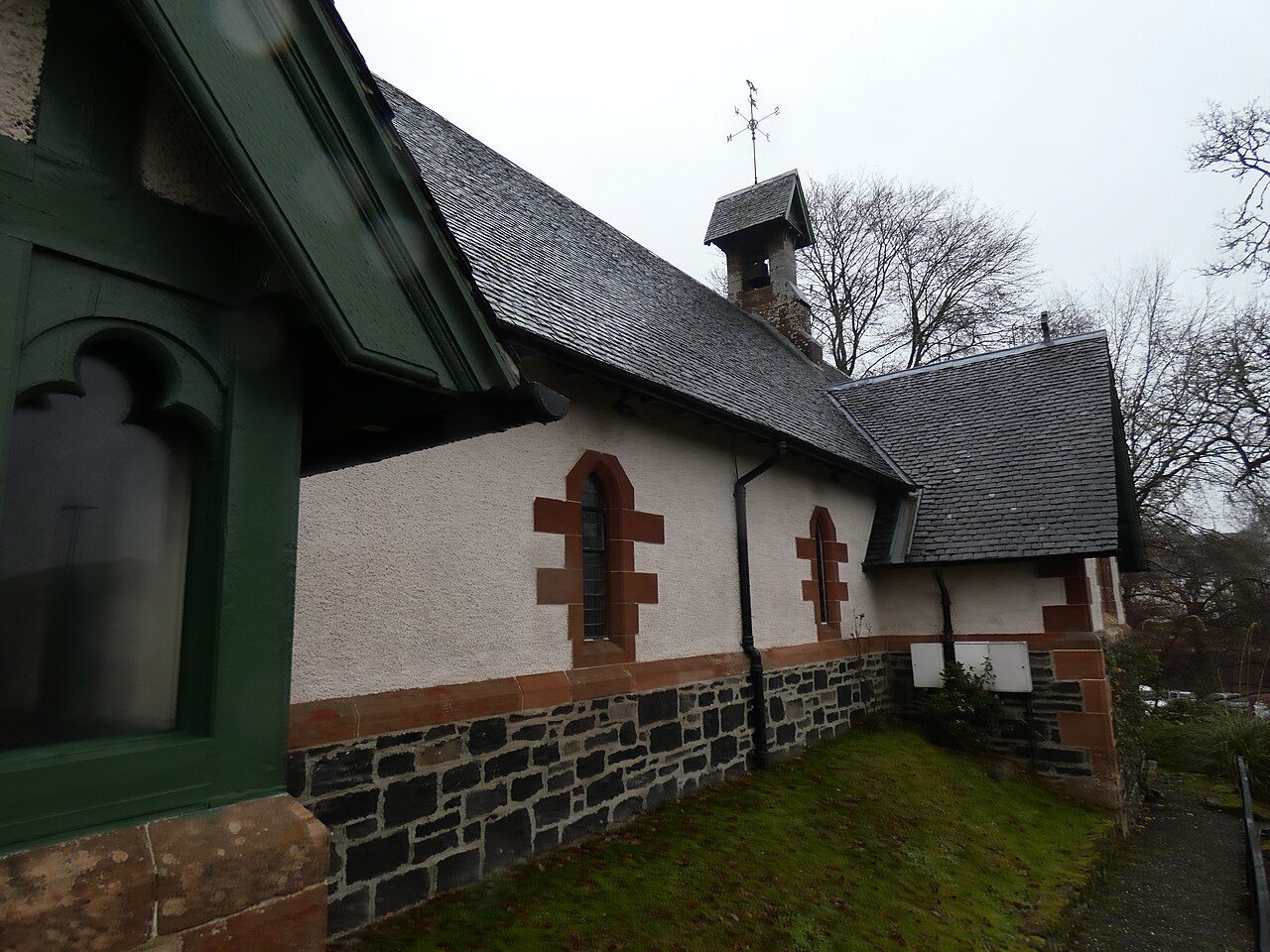
A Category C Gothic Arts and Crafts church designed by James Miller and built in 1893–94 by quarrymen working in their spare time without pay.
- Visit length
- Editorial estimate: allow around 30 minutes
- Locality
- Aberfoyle
Things to do
1 placeScottish Wool Centre
A large visitor-oriented clothing, gift and food hall selling Harris Tweed, outdoor and country clothing, Scottish food and gifts, wines, beers and more than 100 malt whiskies, with a restaurant on site.
- Visit length
- Editorial estimate: allow around 60 minutes
- Locality
- beside the riverside car park
- Access
- Collie-and-duck, sheep, spinning and sheepdog demonstrations are seasonal; verify whether a demonstration is scheduled rather than assuming one will run.
No places match this filter. Choose All places to reset the list.
Three ways to explore Aberfoyle
Signature outings
The Pine on Doon Hill
Climb from the riverside car park to the solitary Scots pine traditionally treated as the doorway to the Fairy Queen's underground palace and linked to Reverend Robert Kirk.
Kirk's Memorial and Mortsafes
The roofless Old Parish Church shares its burial ground with Reverend Robert Kirk's memorial, the village's oldest known dated stone and two iron mortsafes.
The Quarrymen's Church
Quarrymen recruited from Ballachulish and the Western Isles built St Mary's in their spare time without pay in 1893–94.
The town story
Aberfoyle Town Guide
From Main Street baking and the River Forth to fairy woodland, quarry history and the roads into the Trossachs.
Baking, Boundaries and the Old Clachan
At the Station Building on Main Street, Maggie bakes clootie dumpling and shortbread in small batches, no mixes and no microwaves, in a kitchen open enough that you can watch it happen. She opened the shop in spring 2019, when demand for her baking outgrew whatever she had been doing before, and took on Brenda, Helen and Nicola to keep up. The clootie dumpling and the shortbread are the two she names as favourites. It is the kind of place that tells you what sort of village this is before you have seen the rest of it.
The rest of it is a single main street on the north bank of the River Forth, with wooded hills rising directly behind the shops. This is where the Highland Boundary Fault runs through, and you can see it: to the south and east the land lies low and pastoral across Flanders Moss and the Carse of Stirling; to the north it stands up abruptly into forest and mountain. Arrive along the A81 from Glasgow and the approach is gentle. Leave northward on the A821 and the road curls straight up the Duke's Pass into Loch Ard Forest within a mile. A village stroll here can turn into a steep climb through trees in a matter of minutes, which is either the appeal or the warning depending on your footwear.
The Forth at this point is close to its source, and the old humped bridge that crosses it is the nearest bridge to that source anywhere on the river. It is an 18th-century two-span structure with a battered cutwater in the middle, and its narrow roadway once connected the inn-and-bridge settlement, the Clachan of Aberfoyle, on the north bank to Kirkton and the church on the south. The centre has since drifted north, following tourism, the railway and the quarry, and the old south-bank church now stands roofless.
The Faerie Tree Inn on Main Street is family-run, with a wood-burning stove, a pool table, a dartboard that hosts a Strathendrick league night, and weekend live music. Two Labradors, Marlie and Wispa, belong to the place, and there is a separate menu for visiting dogs. The food is broad: Cullen skink, haggis and black-pudding bonbons, steak pie, a "Twisted Balmoral" with boulangère potatoes and whisky cream, venison rigatoni, seafood linguine, a goat's-cheese and beetroot risotto, and ten-inch pizzas including one with black pudding and haggis. Timothy Taylor Landlord is the regular cask ale, and there is a long gin list. Forth Valley CAMRA named it Rural Stirlingshire Pub of the Year in 2016.
Main Street Food and Shops
A few doors along at number 16, the Aberfoyle Inn does traditional pub food — fish and chips, homemade soup, ham-and-cheese toasties — in a dark-wood bar hung with cabinets of curios, old cameras among them. It was built in the late 19th century as a temperance hotel with two shops attached, then traded for years as the Clachan Hotel before taking its present name. One of those original shops was a luxury chemist, and its floor-to-ceiling display shelving, counter and ceiling plasterwork survive; the building is listed at Category B partly for them. It keeps craft beers and local ales but no cask.
About a mile out, where the road meets the A81, the Rob Roy Hotel's Thistle Bar is open to passers-through as well as to its residents. The bar handles lunch and draught favourites; the adjoining Tartan Room takes booked dinners, and the ballroom runs dinner dances and tribute nights across its 103 bedrooms of trade. It is the large end of the local hospitality rather than the village-local end.
Food beyond the pubs is where a village this size slightly overperforms. The Aberfoyle Delicatessen and Trossachs Butcher at Dukes Court is one of the Trossachs' longest-serving businesses, selling Scottish meat, wild game, homemade pies and pasties, hot filled rolls and the makings of a packed lunch. St Mocha at The Station roasts its own coffee and keeps its café among railway photographs and memorabilia in the former station buildings; its parent uses a red squirrel as its emblem and supports Friends of Loch Lomond and The Trossachs. Aberfoyle Bike Co, run by Liam, hires everything from e-bikes to children's bikes, baby seats and trailers, and its café does Thomsons coffee, giant filled croissants and toasted sourdough bacon rolls. Liz MacGregor's, long a Main Street fixture for Italian coffee and homemade cakes, has more recently changed hands. There is a Co-op and a Post Office for everything else, a specialist tablet-and-fudge shop, and Walter & Betty, which sells locally themed gifts and is named for Walter, an Aberfoyle man with a long grey beard and a kilt who appeared in a Rob Roy film and now turns up on the postcards.
Beside the riverside car park, the Scottish Wool Centre is the largest shop in the village and the least like the rest of it: a gift and food hall selling Harris Tweed, outdoor clothing, Scottish food and more than a hundred malt whiskies, with a restaurant attached. In season it stages demonstrations in which collie dogs herd Indian Runner ducks, though whether one is on when you visit is worth checking first.
Riverside Facilities and Forest Trails
That riverside car park is the practical heart of a visit: toilets, blue-badge spaces, picnic tables, the Trossachs Discovery Centre next door, and the Doon Hill trail starting from its edge. In high summer the coaches fill it and the village can feel busier than its single street was built for; out of season it empties back to itself.
Walks begin at the door. Doon Hill is a loop of two and a quarter miles and about an hour and a half from the car park, climbing steeply over gravel, rock, mud and tree roots to a single Scots pine standing among oaks. The pine is traditionally the doorway to the Fairy Queen's underground palace, and people still tie ribbons and leave offerings around it. The story attaches to Robert Kirk, minister here from 1685, a Gaelic scholar who produced the first complete Gaelic metrical Psalms and, in 1691, a book called The Secret Commonwealth setting down what he had collected of fairy belief. He died on 14 May 1692, aged 48. Local tradition preferred a different account: that the fairies took him for giving away their secrets, and that he is with them still. His memorial stands in the old churchyard down by the river; the pine stands on the hill above.
For a gentler walk, The Lodge Forest Visitor Centre, a mile north, has a one-mile waterfall trail on firm gravel that passes a monument to the Women's Timber Corps and, on its longer loop, a hide for watching red squirrels. Harder options climb from the same centre: the four-mile Lime Craig trail follows part of an old gravity railway that once carried limestone down the hill, and reaches a summit that on a clear day takes in Ben Lomond, Ben Venue and Ben Ledi to the north and the Campsie Fells and the Carse of Stirling to the south. The nine-and-a-half-mile stretch of the Rob Roy Way from Aberfoyle to Callander climbs through the Menteith Hills to a lochan at 220 metres; there is no food anywhere between the two ends, so carry it. Two miles north, the Three Lochs Forest Drive runs a seven-mile forest road past its three lochs, with picnic places and short trails off it.
Recreation, Tourism and Industry
Aberfoyle Golf Club sits at the foot of the Menteith Hills, its eighteen holes laid along the natural contours so closely that it needs only eight bunkers, with views west to Ben Lomond and east down the Forth valley to Stirling Castle. Golf was played here before 1890, when the Duke of Montrose paid to extend it to nine holes; members took it to eighteen in the 1980s. At The Lodge, Go Ape strings zip wires and high ropes over the forest and a waterfall, with the usual age and height rules.
The Gaelic name, Obar Phuill, means "mouth of the muddy stream," for the burn that joins the Forth here. A mid-19th-century survey found not much more than an inn, a post office and a smithy, with moorland and mountain all around. What changed that was literature and then industry. Walter Scott's poem The Lady of the Lake made the Trossachs fashionable, and his novel Rob Roy set its most-quoted scene — Bailie Nicol Jarvie fighting a Highlander with a red-hot poker — in the Clachan of Aberfoyle. The Duke's Pass road opened in 1886, named for Rob Roy's rival, the Duke of Montrose, and carried horse-drawn Victorian tourists over the hills. Much of Main Street is their architecture.
Underneath the tourism was harder work. A band of blue, purple and green slate was found in 1765, and by 1900 the quarry was Scotland's third largest, producing 1.4 million slates in that year alone. Workers came from Ballachulish and the Western Isles to a purpose-built village of about eighty people, of which one house now survives; a tramway carried the slate down to the station until it closed in 1947. Before slate, this had been an iron-producing district, its coppiced oaks cut for charcoal. The railway itself reached Aberfoyle in 1882 and lost its passengers in 1951, after which the station was demolished and its ground became the car park. A bakery and a coffee shop still trade under the name of a station that is no longer there.
Churches, Nearby Excursions and Arrival
The quarrymen left one lasting building. Many were Episcopalian, and they built St Mary's Scottish Episcopal Church in their spare time and without pay in 1893–94, on a site given by the Duke of Montrose, using cheap stone from Ailsa Craig that a railway contractor had first brought in to test whether the new line across Gartmore Moss could bear the weight. Inside is a carved oak reredos dated 1683. The parish church down beside the Forth, by John Honeyman, is a little older, from 1869–70. Older still is the roofless kirk of 1744 in the south-bank burial ground: when the parish moved to the new church in 1870, its roof was taken off to stop people worshipping in the old one out of habit. Its graveyard holds the oldest dated stone in the village, from 1685, two iron mortsafes laid over graves to deter body-snatchers, and Robert Kirk's memorial.
There is more within a short drive. Three miles east, a small boat crosses the Lake of Menteith — the one sheet of water in Scotland called a lake rather than a loch — to the island priory of Inchmahome, an Augustinian house founded around 1238 where the four-year-old Mary, Queen of Scots was hidden for safety and where a boxwood arbour is still called Queen Mary's Bower. Seven miles over the Duke's Pass, the steamship Sir Walter Scott sails Loch Katrine, the loch that Scott's poem made famous in the first place.
Getting here is by road: there is no working railway, and the practical rail connection is Stirling, reached by the X10A bus that runs through the village between there and Glasgow. In 1951 the Railway Magazine's M. D. Greville, watching the old clachan turn into the modern resort, called Aberfoyle "a bright and clean holiday resort, standing on historic ground, where the Highlands and Lowlands meet." Out of season, with the coach traffic gone, it is quieter than that suggests. Walk up Doon Hill on a grey afternoon and you will still find fresh ribbons and small offerings left at the lone pine, for a minister who has been gone since 1692.
Stay around Loch Lomond
Make a longer stay of it
Travel Fox holiday homes around Loch Lomond, linked directly to their property pages.
For homeowners
Own a holiday home near Aberfoyle?
We manage holiday lets across the UK from 12% commission, charged after cleaning costs, with no lock-in. A co-founder visits before you decide.
How our holiday let management works →
A guide with a point of view
Written from research. Edited for real journeys.
Use the Official site links for live practical details, then use this guide for context, ideas and room to explore.
Photography credits & licences
Third-party photographs are credited to their named creators and reused under the linked Creative Commons licence or public-domain dedication. Travel Fox stores an optimised local copy; the file-specific changes and any browser-applied display crop are disclosed below. Reused photographs link both to the Wikimedia Commons source record and to the declared source image; Travel Fox's own photographs carry no such record and are marked as ours. These image licences do not cover Travel Fox text, branding or page design.
- File:00876 St Mary's Scottish Episcopal Church, Aberfoyle 003.jpg — photograph by WeeHolly; Own work. Source record on Wikimedia Commons. Declared source image. Licence: CC BY-SA 4.0. File changes: Downloaded from Wikimedia Commons, resized to a maximum 1920px edge and encoded as an optimised JPEG. Display changes: Displayed with responsive CSS cropping.
Sources
Every place on this page is checked against a published source. Each entry links the record we used and names who publishes it.
- Maggie's Aberfoyle Kitchen — forthvalleyfoodanddrink.org other published source
- The Faerie Tree Inn — thefaerietree.co.uk operator, sector body or destination organisation
- Doon Hill Trail — forestryandland.gov.scot statutory register or public authority
- Waterfall Trail at The Lodge — forestryandland.gov.scot statutory register or public authority
- Old Parish Church and Burial Ground — portal.historicenvironment.scot statutory register or public authority
- St Mary's Scottish Episcopal Church — portal.historicenvironment.scot statutory register or public authority
- Aberfoyle Parish Church — portal.historicenvironment.scot statutory register or public authority
- Scottish Wool Centre — visitscotland.com operator, sector body or destination organisation