
Castle and coast
Bamburgh
A coastal village where a basalt-set castle looks over the beach, dunes, cricket green and Front Street.
- Best for
- Castle history, coastal walks and Grace Darling heritage
- Give it
- A day for the castle, village and beach
- Don't miss
- Grace Darling's coble in the museum opposite St Aidan's
Photo: Stuart Shepherd · CC BY-SA 2.0 · cropped
The Fox verdict
A village arranged beneath its castle
Bamburgh brings together a major inhabited castle, a wide sandy beach, protected dunes and tightly grouped village history.
The strongest visit links the castle and coast with St Aidan's Church and the RNLI Grace Darling Museum, then leaves room for Front Street food or summer cricket on the Castle Green.
Where to go
Places in Bamburgh
Every place below is checked against a published source, listed with what it is and how long to give it.
Local signatures
3 placesRNLI Grace Darling Museum
The museum tells Grace Darling's story and holds her original coble from the 1838 Forfarshire rescue, alongside her personal belongings.
- Visit length
- Editorial estimate: allow around 1 hour
- Locality
- opposite St Aidan's Church
Bamburgh Dunes Circular
A short circular route around the castle that continues through the sand dunes and along the beach.
- Visit length
- Editorial estimate: allow around 90 minutes
- Locality
- around Bamburgh Castle, through the dunes and along the beach
The Lord Crewe
A contemporary inn and restaurant specialising in locally caught seafood, with a cosy bar serving cocktails, wine and local ales.
- Visit length
- Editorial estimate: allow around 75 minutes
- Locality
- Front Street, in the heart of the village
Food & drink
2 placesThe Middle Inn
A traditional English pub serving light lunches, sandwiches, House Favourites and desserts made with local, fresh produce.
- Visit length
- Editorial estimate: allow around 75 minutes
- Locality
- 7 Front Street
- Access
- The pub is explicitly dog-friendly and has a beer garden.
R Carter & Son
The village butcher for over 100 years, using meat from local farms and making its own pies, haggis, puddings and bread.
- Visit length
- Editorial estimate: allow around 15 minutes
- Locality
- Front Street
Walks & outdoors
2 placesBamburgh Beach
A wide sandy Blue Flag beach backed by the Bamburgh Dunes Site of Special Scientific Interest, with the castle above it.
- Visit length
- Editorial estimate: allow around 90 minutes
- Locality
- backed by Bamburgh Dunes
Bamburgh to Budle Point Walk
A walk to a viewpoint over Budle Bay and Holy Island, where the bay forms an important bird sanctuary within Lindisfarne National Nature Reserve.
- Visit length
- Editorial estimate: allow around 2 hours 30 minutes
- Locality
- through the golf course and past cottages to Budle Point
History & heritage
2 placesBamburgh Castle
A Norman castle built on an Anglo-Saxon fort, restored after William George Armstrong bought it in 1894 and still owned by the Armstrong family.
- Visit length
- Editorial estimate: allow around 2 hours
- Locality
- on a basalt outcrop of the Great Whin Sill
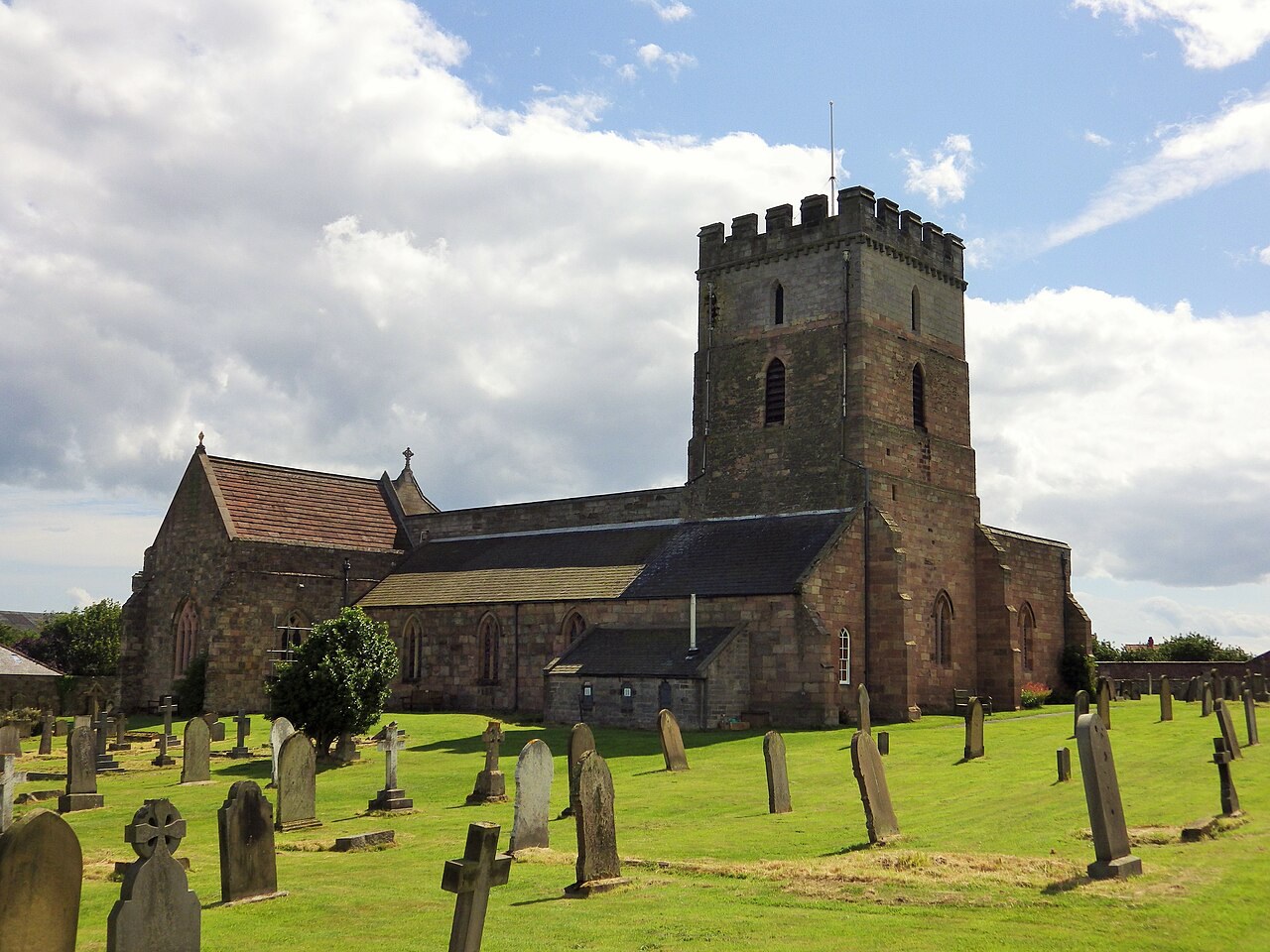
St Aidan's Church
A Grade I late-12th-century church with surviving pre-Conquest stonework, Grace Darling's effigy and a beam traditionally associated with St Aidan's death.
- Visit length
- Editorial estimate: allow around 45 minutes
- Locality
- outside the castle wall
- Access
- The crypt has been accessible to visitors since November 2019.
Things to do
1 placeBamburgh Pavilion and Castle Green
The Pavilion and Castle Green support cricket, tennis and pickleball, croquet, indoor bowls and other village activities.
- Visit length
- Editorial estimate: allow around 1 hour
- Locality
- Castle Green
- Access
- The cricket club plays friendlies on the Castle Green beneath the castle.
No places match this filter. Choose All places to reset the list.
Three ways to explore Bamburgh
Signature outings
The Castle on the Crag
See Bamburgh Castle rise from its Great Whin Sill outcrop above the beach and cricket green.
Aidan and Darling
Enter St Aidan's for the beam traditionally said to have supported him as he died, the long chancel and Grace Darling's weather-sheltered effigy.
Castle-backed Beach
Follow Bamburgh's wide sandy beach beneath the castle and beside the protected dunes.
The village story
Bamburgh Village Guide
Castle, coast, village food and the intertwined stories of St Aidan and Grace Darling.
The Castle Above Bamburgh
The castle is the first thing you see and it does not let you forget it. Bamburgh Castle sits on a basalt outcrop of the Great Whin Sill, dolerite that was shoved up through the ground about 295 million years ago, and it looms over the beach, the cricket green and most of Front Street. It is one of the largest inhabited castles in the country, still owned by the Armstrong family, who bought it in 1894. You arrive, you look up, and the village arranges itself in its shadow.
Front Street is where the eating happens. The Lord Crewe is the smart end — Lindisfarne oysters, lobster Thermidor and a fish pie, an AA Rosette, seven boutique bedrooms. Living North called it "a deserved reputation for its food" in "a cracking location both close to Bamburgh Castle and the beach." A few doors down is its sister pub, the Middle Inn, which is the more traditional of the two: sandwiches, light lunches, House Favourites, and a beer garden it is famous for. Dogs are welcome there.
Front Street Food and Provisions
The Castle Inn claims possibly the best value menu in the village, which is the sort of thing pubs say, though the reviews back it up. The Victoria overlooks the green with the castle behind it and serves all day. If it is fish you're after, the Mizen Head out on Lucker Road leans almost entirely on the North Sea.
For provisions there's R Carter & Son, the village butcher for over a hundred years, who makes his own pies, haggis, white and black pudding, and bakes his own bread. The Pantry, a deli that opened in 2001, does fresh crab rolls, dressed crab, Seahouses kippers and local cheeses to eat in or take away. There is also a grocer and a newsagent, which for a village of about 450 people is a decent showing.
Beach, Dunes and Coastal Paths
The beach is wide, sandy and Blue Flag, backed by dunes that are a Site of Special Scientific Interest. A two-mile circular loops around the castle through the dunes and along the sand. Go four miles north through the golf course to Budle Point and you get a viewpoint over Budle Bay and Holy Island — the bay is a bird sanctuary, best in winter when thousands of wildfowl and waders turn up. The St Oswald's Way and Northumberland Coast Path both run past the castle.
St Aidan and Grace Darling
St Aidan's is worth going into. Grade I listed, late twelfth century, with a chancel said to be the second-longest in the country at sixty feet. St Aidan built the first wooden church here in 635 and died in 652, and a beam inside is traditionally the one he was resting against when he did. Grace Darling, who rowed out from the Longstone Lighthouse in 1838 to pull nine survivors off the wrecked Forfarshire, is buried in the churchyard; her effigy was brought indoors to save it from the weather. The museum opposite holds her actual coble boat.
Arriving and Summer Cricket
Chathill station is 4.4 miles off but has almost no trains worth catching, so use Alnmouth or Berwick; the X18 bus runs through from Newcastle to Berwick. On summer Sunday afternoons the cricket club, going since 1860, plays friendlies on the Castle Green at one o'clock, the castle standing over them.
Stay around Northumberland
Make a longer stay of it
Travel Fox holiday homes around Northumberland, linked directly to their property pages.
A guide with a point of view
Written from research. Edited for real journeys.
Use the Official site links for live practical details, then use this guide for context, ideas and room to explore.
Photography credits & licences
Third-party photographs are credited to their named creators and reused under the linked Creative Commons licence or public-domain dedication. Travel Fox stores an optimised local copy; the file-specific changes and any browser-applied display crop are disclosed below. Reused photographs link both to the Wikimedia Commons source record and to the declared source image; Travel Fox's own photographs carry no such record and are marked as ours. These image licences do not cover Travel Fox text, branding or page design.
- File:St Aidan's Church, Bamburgh - geograph.org.uk - 4594426.jpg — photograph by Stuart Shepherd; St Aidan's Church, Bamburgh by Stuart Shepherd. Source record on Wikimedia Commons. Declared source image. Licence: CC BY-SA 2.0. File changes: Downloaded from Wikimedia Commons, resized to a maximum 1920px edge and encoded as an optimised JPEG. Display changes: Displayed with responsive CSS cropping.
Sources
Every place on this page is checked against a published source. Each entry links the record we used and names who publishes it.
- Bamburgh Castle — bamburghcastle.com operator, sector body or destination organisation
- St Aidan's Church — historicengland.org.uk statutory register or public authority record not machine-readable; publisher restricts automated access
- RNLI Grace Darling Museum — rnli.org operator, sector body or destination organisation record not machine-readable; publisher restricts automated access
- Bamburgh Beach — bamburgh.org.uk operator, sector body or destination organisation
- Bamburgh Dunes Circular — bamburgh.org.uk operator, sector body or destination organisation
- Bamburgh to Budle Point Walk — bamburgh.org.uk operator, sector body or destination organisation
- The Lord Crewe — lord-crewe.co.uk operator, sector body or destination organisation
- The Middle Inn — themiddleinnbamburgh.co.uk operator, sector body or destination organisation
- R Carter & Son — bamburgh.org.uk other published source
- Bamburgh Pavilion and Castle Green — bamburgh.org.uk operator, sector body or destination organisation