
Dreaming spires, two rivers
Oxford
A compact university city where a tourist-thronged historic core, canal-side Jericho and multicultural Cowley Road meet river meadows and free museums.
- Best for
- University set pieces, neighbourhood food and river meadows
- Give it
- A week across the city's distinct neighbourhoods
- Don't miss
- The historic core and a walk beside the rivers
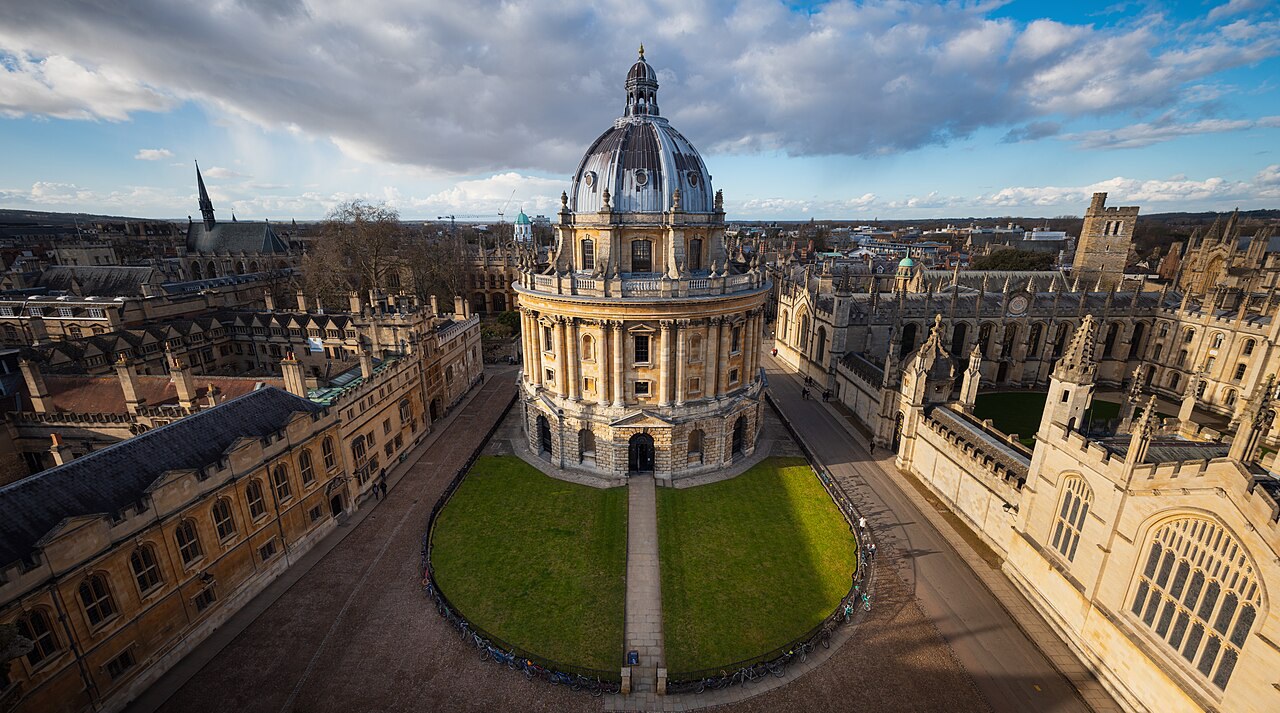
Photo: Julian Herzog ( Website ) · CC BY 4.0 · cropped
The Fox verdict
A compact city with more than one character
Oxford's honey-coloured university core is only the start: Jericho, Cowley Road, free museums and river meadows make it work for a longer stay.
The famous colleges and libraries sit close together, while canal-side Jericho and multicultural Cowley Road offer distinct changes of pace. The Thames and Cherwell bring meadows deep into the city, and the museums provide an unusually strong rainy-day plan.
Where to go
Places in Oxford
Every place below is checked against a published source, listed with what it is and how long to give it.
Local signatures
3 placesBodleian Library
One of Europe's oldest libraries, with 1480s fan vaulting in the Divinity School and Duke Humfrey's history of chained books and a reading booth built for Charles I.
- Visit length
- Editorial estimate: Allow around 90 minutes
- Locality
- City centre (OX1)
- Access
- Guided tours only for the historic rooms.
Oxford University Museum of Natural History
A neo-Gothic cast-iron-and-glass hall with dinosaur skeletons, hands-on family trails, touchable exhibits and the most complete dodo remains anywhere.
- Visit length
- Editorial estimate: Allow around 90 minutes
- Locality
- Oxford
The Story Museum
A children's and family museum celebrating stories and storytelling, with an immersive format suited to a rainy day with younger children.
- Visit length
- Editorial estimate: Allow around 75 minutes
- Locality
- Pembroke Street
Food & drink
1 placeOxford Covered Market
A trading market opened in 1774 with twenty butchers' shops, now combining long-established produce and butcher trade with cafés and the original Ben's Cookies shop.
- Visit length
- Editorial estimate: Allow around 60 minutes
- Locality
- City centre (OX1)
Walks & outdoors
4 placesPort Meadow
A vast ancient common said never to have been ploughed, with Bronze and Iron Age features preserved beneath grass grazed by free-roaming horses and cattle.
- Visit length
- Editorial estimate: Allow around 90 minutes
- Locality
- North of Jericho, along the Thames
Christ Church Meadow
A tranquil flood meadow with tree-lined walks, grazing longhorn cattle and college boathouses along the water.
- Visit length
- Editorial estimate: Allow around 75 minutes
- Locality
- Between the colleges and the river
Oxford Botanic Garden
Britain's oldest botanic garden, founded in 1621, with walled beds and glasshouses; a bench is associated with Philip Pullman's His Dark Materials.
- Visit length
- Editorial estimate: Allow around 60 minutes
- Locality
- By Magdalen Bridge
University Parks
A large landscaped park open to the public by day, with a first-class cricket ground and riverside picnic banks beside the Cherwell and its punts.
- Visit length
- Editorial estimate: Allow around 60 minutes
- Locality
- Northeast of the centre
History & heritage
2 places
Radcliffe Camera
A circular, domed Baroque rotunda built by James Gibbs between 1737 and 1749; its name uses the Latin word for room.
- Visit length
- Editorial estimate: Allow around 30 minutes
- Locality
- At the centre of the university
- Access
- Interior not generally open except on some guided tours.
Ashmolean Museum
Britain's first public museum and the world's first university museum, with Powhatan's Mantle and the ninth-century Alfred Jewel among its highlighted objects.
- Visit length
- Editorial estimate: Allow around 75 minutes
- Locality
- Oxford
Things to do
1 placePitt Rivers Museum
More than 500,000 objects are arranged by type rather than region in dim, densely packed Victorian cases.
- Visit length
- Editorial estimate: Allow around 60 minutes
- Locality
- Through the back of the Natural History Museum
No places match this filter. Choose All places to reset the list.
Three ways to explore Oxford
Signature outings
A market trading since 1774
Oxford Covered Market opened with twenty butchers' shops and still brings produce, butcher trade, cafés and the original Ben's Cookies shop under one roof.
Ancient grazing ground
Port Meadow is a vast common north of Jericho where horses and cattle roam over grass said never to have been ploughed.
The domed camera
James Gibbs's circular Baroque rotunda was built between 1737 and 1749, and its name simply uses the Latin word for room.
The city story
Oxford City Guide
From a pub wall of clipped ties to university set pieces, neighbourhood kitchens, river meadows and free museums, Oxford rewards looking beyond the postcard.
Ties, Taverns and the Historic Core
The Bear Inn keeps more than 4,500 neckties in glass cases on its walls, each one snipped off a customer. It started in the 1950s, when the landlord Alan Course began clipping the tie off anyone who could prove it came from a specific club, school, regiment, team or police force, in exchange for half a pint. The pub itself is down an alley off Alfred Street and claims a history back to 1242, which makes it one of the oldest in the city. The ties are labelled. People still come to look for theirs.
That's a fair introduction to central Oxford, which is small, ancient, and full of things that shouldn't quite work but have kept going anyway. The historic core sits in OX1 and you can walk across it in ten or fifteen minutes: the colleges, the Covered Market, the High Street (everyone calls it the High), Cornmarket, St Giles'. This is the touristy part, and for a first stay it's the obvious base — the famous set pieces are all within a few minutes of each other and you rarely need to get in a car.
For drinking, the centre is well supplied. The Kings Arms, on the corner of Holywell Street and Parks Road opposite the Bodleian, is the one students and academics call the KA and treat as the city's main pub. The Turf Tavern is harder to find on purpose: it's tucked down St Helens Passage, a narrow alley off Holywell Street that was originally called Hell Passage, and it grew up just outside the old city wall so it could escape the colleges' jurisdiction. It opened in the late 18th century as the Spotted Cow and became the Turf in the 1840s. Most of the seating is outdoor courtyards under low beams. A sign in one of them marks the spot where Bill Clinton, then a Rhodes Scholar, reportedly did not inhale.
Inklings, Markets and Late-Night Ice Cream
Over on St Giles' you'll find the Eagle and Child, known locally as the Bird and Baby, where the Inklings met from 1933 to 1962. Tolkien, C.S. Lewis, Charles Williams and the rest gathered in a back room called the Rabbit Room to read their work aloud — The Lord of the Rings and proofs of The Lion, the Witch and the Wardrobe were first heard here. A 1962 refurbishment knocked the private back room about and the group moved across the road to the Lamb & Flag, whose profits, at one time, funded graduate scholarships. The Eagle and Child has been closed for restoration in recent years, so it's worth checking whether it's reopened before you plan an evening around it.
The Covered Market is the other reason to stay central. It opened on 1 November 1774, built by John Gwynn — who also put up Magdalen Bridge — for about £916, specifically to get the "messy, untidy, and unsavoury" street stalls off the main streets. It started with twenty butchers' shops and still trades hard. M. Feller sells organic beef, lamb and pork, and in season venison, wild boar, quail, pheasant, pigeon, hare and goose. Bonners has been the family greengrocer here since 1952, selling produce from Oxfordshire farms. And Ben's Cookies started here as a stall in 1983, founded by the cookery writer Helge Rubenstein and named after her son; the shop in the market is the original.
For ice cream, the name to know is G&D's, opened in 1992 by a student called George Stroup. The ice cream is made at the Jericho shop and cycled over to the branches on Cowley Road and St Aldate's, and they stay open late.
Jericho, Cowley Road and River Meadows
Both of those neighbourhoods reward getting out of the centre. Jericho is about ten minutes' walk northwest, a grid of late-Georgian and Victorian workers' terraces beside the Oxford Canal, with newer canal-side flats mixed in. It's calmer and more local than the centre, with independent shops, cafés and restaurants strung along Walton Street and a population of students, professionals and young families. It isn't cheap. The Phoenix Picturehouse on Walton Street is one of the oldest cinemas in Britain. For eating, Mama Mia Pizzeria is one of Jericho's oldest and most reliable Italians, and Zheng does Chinese and Malay — sambal, rendang, satay. The Bookbinders, a backstreet pub on Victoria Street, runs a French-leaning menu of crêpes (Peking duck, smoked salmon, Mediterranean vegetables) alongside steaks and mussels, and the Rickety Press on Cranham Street does wood-fired pizzas and American diner sides.
Cowley Road, in East Oxford, is a different city again — about 0.7 miles from the centre, maybe thirteen minutes on foot. This is the multicultural strip, where Ethiopian, Lebanese, Vietnamese, Syrian, Afghan, South Indian and Caribbean kitchens sit side by side with vintage shops, live-music venues and student bars. One travel guide frames it as "younger, louder, and less curated… the best place to experience Oxford without the tourist lens," which is about right. Aleppo's Falafel is cash-only Syrian, fresh falafel squished into hummus flatbread with pickles, with halloumi or fried aubergine if you want it. Afghan Cuisine sells home-style curries by the half or full kilo, kabuli pilau with an optional lamb shank, and Afghan bread described as roughly the size of a toddler. Dosa Darlings does South Indian dosas that run from classic masala to blue cheese and fig. Oli's Thai is tiny and hard to book — confit-duck Penang curry, steamed seabass with lime and chilli — and widely rated among the best food in the city. Big Society does wings and pulled-pork burgers and banoffee pie, and Banana Tree runs pan-Asian with tamarind lamb and whole roasted snapper.
When you've eaten your way through that, the rivers are close. Oxford sits on the Thames — locally the Isis — and the Cherwell, and the meadows come surprisingly far into the city. Port Meadow is a vast common grazing land north of Jericho, along the Thames, said never to have been ploughed, which has preserved Bronze and Iron Age features under the grass. Horses and cattle roam free on it. You can walk the towpath up to the ruined Godstow Abbey and the riverside Trout Inn at Wolvercote, and there's open swimming at the Wolvercote end in summer. Christ Church Meadow is quieter and closer in, a flood meadow between the colleges and the water where the Cherwell meets the Isis, with tree-lined walks and grazing longhorn cattle and the college boathouses along the bank. University Parks, northeast of the centre, is a large landscaped park open in daylight, with a first-class cricket ground and picnic banks by the river. And the Oxford Botanic Garden, on the edge of Christ Church Meadow by Magdalen Bridge, is the oldest botanic garden in Britain, founded in 1621; a particular bench there turns up in Philip Pullman's His Dark Materials.
Punting, Set Pieces and Museums
The classic summer thing is punting. You can hire a flat-bottomed punt at Magdalen Bridge Boathouse and go down the Cherwell past the Botanic Garden, or from the Cherwell Boathouse up near the parks. It looks easy and is not.
The set pieces, when you get to them, are genuinely worth the crowds. The Radcliffe Camera is the domed rotunda at the centre of everything, built by James Gibbs between 1737 and 1749 — camera is just Latin for room. The Bodleian, one of the oldest libraries in Europe, is next door; its Divinity School has fan vaulting from the 1480s with over 400 carved bosses in the ceiling, and Duke Humfrey's Library is the old reading room where books were once chained to the shelves and a booth was built for Charles I. Harry Potter fans will recognise both as the Hogwarts infirmary and library, and the Great Hall at Christ Church as the model for the dining hall. Wren's first major building, the Sheldonian Theatre, went up in 1669 and still hosts graduations, which are conducted in Latin. The Bridge of Sighs, linking two halves of Hertford College over New College Lane, was finished in 1914 and is one of the most photographed things in the city — the Turf Tavern hides down the alley just past it.
The museums are all free and don't need booking, which makes them the best rainy-day plan going. The Ashmolean, opened in 1683, was Britain's first public museum and the world's first university museum; it holds Powhatan's Mantle, linked to Pocahontas's father, and the Anglo-Saxon Alfred Jewel, made for Alfred the Great. The Natural History Museum is a neo-Gothic hall of cast iron and glass with dinosaur skeletons and the most complete dodo remains anywhere — the same specimen that inspired the Dodo in Alice's Adventures in Wonderland. Charles Dodgson, who wrote as Lewis Carroll, was a maths lecturer at Christ Church and invented Alice for Alice Liddell, the dean's daughter, on a boat trip up the Thames. Through the back of the Natural History Museum is the Pitt Rivers, half a million objects arranged by type rather than region and packed into dim Victorian cases, once best known for its shrunken heads. For younger children the Story Museum on Pembroke Street is the gentler option, and Blackwell's on Broad Street has a vast underground room, the Norrington Room, that once held a Guinness record for the largest single room selling books.
Martyrs, Motor Works and Dreaming Spires
History here is mostly a matter of standing where things happened. A cross of cobblestones in the road outside Balliol College marks the spot, just outside the old city wall on what is now Broad Street, where the Protestant bishops Latimer and Ridley were burnt at the stake in October 1555, and Archbishop Cranmer the following March; the neo-Gothic Martyrs' Memorial stands nearby in St Giles'. Charles I ran the country from Christ Church during the Civil War while the queen lodged at Merton. And out at Cowley, mostly invisible to visitors, William Morris opened a car works in 1913; the plant made 42% of Britain's cars by 1926, built the Morris Minor and the original Mini, and — now owned by BMW and called Plant Oxford — still turns out the MINI, the oldest mass-production car plant in the country.
Getting here is easy enough. The railway station is a five-to-ten-minute walk west of the centre, with direct trains to London Paddington in about an hour, and the Oxford Tube coach runs to London around the clock, sometimes every ten minutes, from about £15. Driving in is the mistake — central parking is scarce and expensive, and the five Park & Ride sites ringing the city are the sensible way in by car. Once you're here, it's a walking and cycling city; Oxford has among the highest proportion of bike commuters of any authority in the country, and the centre is flat.
Matthew Arnold called it "that sweet City with her dreaming spires" in 1865, and the spires are still there, but the thing that stays with you is smaller — a man cycling tubs of ice cream across town to keep three shops stocked, or a wall of other people's ties in a pub down an alley, waiting for you to notice yours.
Stay around Oxfordshire
Make a longer stay of it
Travel Fox holiday homes around Oxfordshire, linked directly to their property pages.
A guide with a point of view
Written from research. Edited for real journeys.
Use the Official site links for live practical details, then use this guide for context, ideas and room to explore.
Photography credits & licences
Third-party photographs are credited to their named creators and reused under the linked Creative Commons licence or public-domain dedication. Travel Fox stores an optimised local copy; the file-specific changes and any browser-applied display crop are disclosed below. Reused photographs link both to the Wikimedia Commons source record and to the declared source image; Travel Fox's own photographs carry no such record and are marked as ours. These image licences do not cover Travel Fox text, branding or page design.
- File:Radcliffe Camera Oxford 2018 02.jpg — photograph by Julian Herzog ( Website ); Own work. Source record on Wikimedia Commons. Declared source image. Licence: CC BY 4.0. File changes: Downloaded from Wikimedia Commons, resized to a maximum 1920px edge and encoded as an optimised JPEG. Display changes: Displayed with responsive CSS cropping.
Sources
Every place on this page is checked against a published source. Each entry links the record we used and names who publishes it.
- Bodleian Library — historicengland.org.uk statutory register or public authority record not machine-readable; publisher restricts automated access
- Radcliffe Camera — visit.bodleian.ox.ac.uk other published source
- Ashmolean Museum — ashmolean.org operator, sector body or destination organisation
- Oxford University Museum of Natural History — historicengland.org.uk statutory register or public authority record not machine-readable; publisher restricts automated access
- Pitt Rivers Museum — prm.ox.ac.uk other published source
- The Story Museum — storymuseum.org.uk operator, sector body or destination organisation
- Oxford Covered Market — oxford.gov.uk statutory register or public authority
- Port Meadow — oxford.gov.uk statutory register or public authority
- Christ Church Meadow — chch.ox.ac.uk other published source
- Oxford Botanic Garden — botanic-garden.ox.ac.uk other published source
- University Parks — parks.ox.ac.uk other published source