
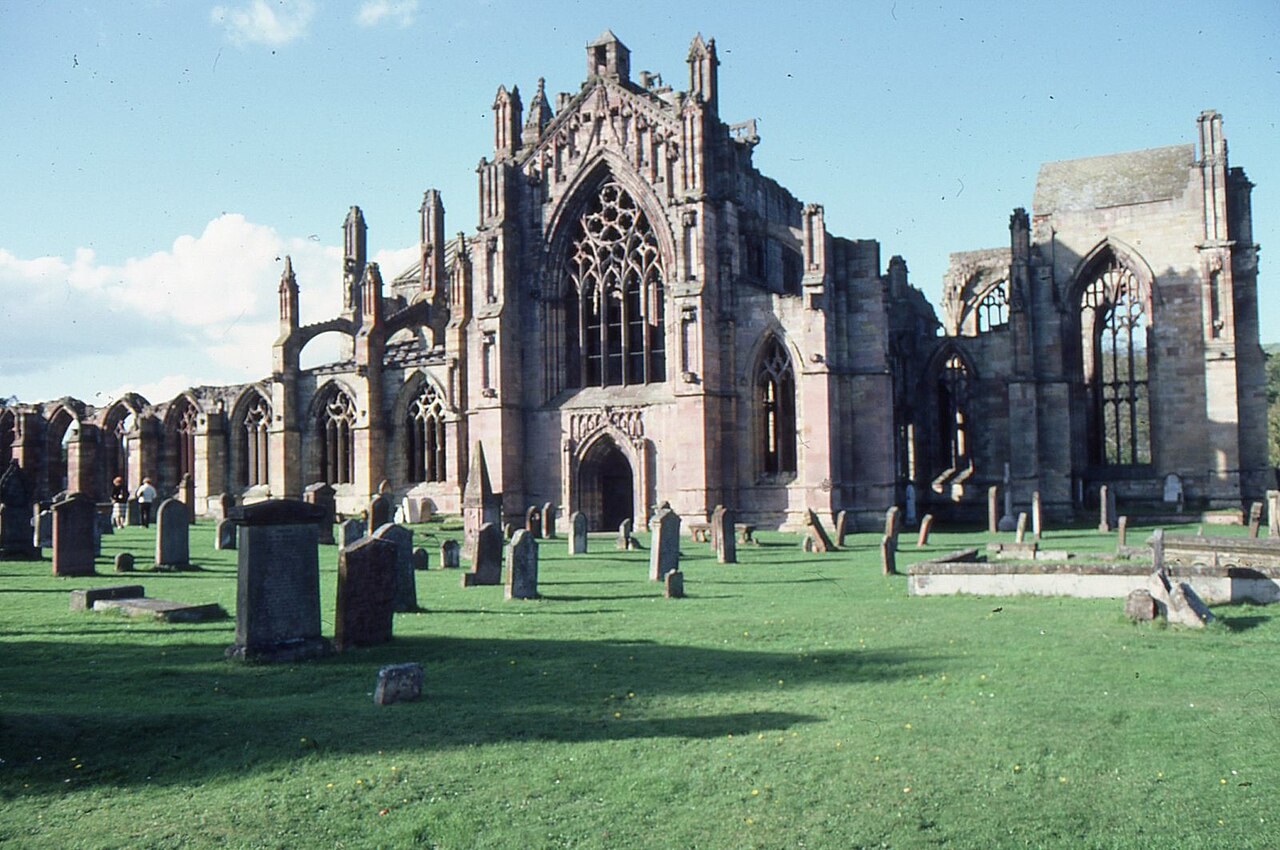
Abbey, hills and sevens
Melrose
Pink-sandstone abbey ruins, three volcanic peaks and a town still dominated by independent businesses.
- Best for
- Abbey history, hillwalking and independent shops
- Give it
- A half-day for the Eildon Hills circuit
- Don't miss
- The abbey's bagpipe-playing pig gargoyle
Photo: Richard Sutcliffe · CC BY-SA 2.0 · cropped
The Fox verdict
A pink-stone abbey town beneath three peaks
Melrose brings a major medieval ruin, steep hillwalking, rugby history and independent food shops into one small Borders town.
Begin with the abbey's carved stone and Robert the Bruce's buried heart, choose a garden or the Eildon Hills, then turn to the market-square bakery, Burts Hotel or the Greenyards story of rugby sevens.
Where to go
Places in Melrose
Every place below is checked against a published source, listed with what it is and how long to give it.
Local signatures
3 places
Start here
Melrose Abbey
A scheduled Cistercian ruin founded in 1136, with ornate carved stonework, the bagpipe-playing pig gargoyle and Robert the Bruce's heart buried here.
- Visit length
- Editorial estimate: allow around 75 minutes
- Locality
- Melrose
Harmony Garden
A walled garden with Harmony House, built in 1807 by Melrose native Robert Waugh, which hosts the Borders Book Festival each June.
- Visit length
- Editorial estimate: allow around 45 minutes
- Locality
- beside the rugby ground
Burts Hotel
An 18th-century hotel with a bistro and bar, a two-AA-Rosette restaurant and more than 50 single malts at the bar.
- Visit length
- Editorial estimate: allow around 90 minutes
- Locality
- the market square
Food & drink
1 placeTwelve Triangles
An Edinburgh bakery's second branch, combining a café, shop and bakery on Melrose's Market Square.
- Visit length
- Editorial estimate: allow around 45 minutes
- Locality
- Market Square, Melrose
Walks & outdoors
2 placesEildon Hills Path
A classic steep circuit over the three Eildon peaks, reaching 422 metres with views over the Tweed valley and the Trimontium site at Newstead.
- Visit length
- Editorial estimate: allow around 3 hours
- Locality
- from Melrose
- Access
- A steep half-day hillwalk.
Priorwood Garden
A garden historically dedicated to flowers for drying, with an orchard of historic apple, plum, pear, damson and greengage varieties.
- Visit length
- Editorial estimate: allow around 45 minutes
- Locality
- the ancient precinct of Melrose Abbey
History & heritage
1 placeThe Greenyards
The home of Melrose RFC and the annual Melrose Sevens, in the town where Ned Haig proposed the first seven-a-side tournament in 1883.
- Visit length
- Editorial estimate: allow around 45 minutes
- Locality
- Melrose
No places match this filter. Choose All places to reset the list.
Three ways to explore Melrose
Signature outings
Find the bagpipe-playing pig
Look through Melrose Abbey's ornate carved stonework for its famous bagpipe-playing pig gargoyle.
Trace Priorwood's garden history
Explore the garden once dedicated to flowers for drying and its orchard of historic fruit varieties.
Meet rugby's short game
Visit the Greenyards, home of Melrose RFC and the annual event in the town where rugby sevens was invented.
The town story
Melrose Town Guide
A town of pink abbey stone, three volcanic peaks, independent shops and the game that became rugby sevens.
Abbey Stone and Eildon Peaks
High on the ruined abbey at the centre of Melrose there is a gargoyle carved as a pig playing the bagpipes. It has been up there since the fourteenth century, when Cistercian masons apparently had a spare afternoon. The abbey itself is pink sandstone, roofless, and scheduled by Historic Environment Scotland, and it sits in the middle of the town rather than off to one side, so you tend to arrive facing it.
The three volcanic humps behind it are the Eildon Hills. They rise 422 metres over the Tweed valley, and Sir Walter Scott, who could see them from his house at Abbotsford a couple of miles west, called them his "delectable mountains." A steep half-day circuit takes in all three peaks and the views back over the river.
Independent Shops and Local Tables
The town underneath is still mostly its own shops. Locals sum it up as "a butcher, a baker and candlestick maker," which undersells it slightly. Martin Baird does the meat and is the place to go for ham. Purple Plum and W & A Williamson handle the fruit and veg, W.F. Anderson brings in fresh fish daily, and Country Kitchen the deli has a serious cheese counter. Abbey Fine Wines covers wine from around the world and Scottish whisky. Twelve Triangles, an Edinburgh bakery, opened its second branch on the market square.
For a drink, the Ship Inn on Eastport is the town's local, dog-friendly to the point of water and treats at the bar, with an award-winning enclosed beer garden that comes with heaters. One TripAdvisor reviewer went with "By far the best pub in Melrose!" Burts Hotel, on the market square, is the smarter option: the Henderson family have run it for over fifty years, the restaurant has held two AA Rosettes every year since 1995, and the bar keeps over fifty single malts. The kitchen runs from a twice-baked cheese soufflé and spiced tiger prawns to Highland venison and rump of Border lamb.
Sevens and the Bruce Heart
Rugby sevens was invented here. On 28 April 1883, Ned Haig, a local butcher who played for Melrose RFC, proposed a seven-a-side short-match tournament to raise money for the club. Eight teams turned up. The game spread worldwide, and the Rugby Sevens World Cup trophy is called the Melrose Cup. The Greenyards still hosts the Melrose Sevens on the second Saturday in April.
The abbey holds the embalmed heart of Robert the Bruce, buried under a memorial stone after being found in a lead casket in 1921 and reburied on 22 June 1998. His body went to Dunfermline; only the heart came here.
Pilgrim Paths and Arrivals
St Cuthbert's Way starts at the abbey and runs all the way to Holy Island off the Northumberland coast. Shorter riverside walks follow the Tweed east to Old Melrose, the bare peninsula where a sixth-century monastery stood before the town existed.
Trains run to Edinburgh Waverley from Tweedbank, just over a mile west; the town sits off the A6091. The old Melrose station, a Jacobean building with Dutch gables, closed in 1969 and was rescued by an architect who turned it into a restaurant and workshops. The abbey emblem, meanwhile, is a mason's mell and a rose: the town's name, spelled out in stone.
Stay around Scottish Borders
Make a longer stay of it
Travel Fox holiday homes around Scottish Borders, linked directly to their property pages.
A guide with a point of view
Written from research. Edited for real journeys.
Use the Official site links for live practical details, then use this guide for context, ideas and room to explore.
Photography credits & licences
Third-party photographs are credited to their named creators and reused under the linked Creative Commons licence or public-domain dedication. Travel Fox stores an optimised local copy; the file-specific changes and any browser-applied display crop are disclosed below. Reused photographs link both to the Wikimedia Commons source record and to the declared source image; Travel Fox's own photographs carry no such record and are marked as ours. These image licences do not cover Travel Fox text, branding or page design.
- File:Melrose Abbey - geograph.org.uk - 5632460.jpg — photograph by Richard Sutcliffe; Melrose Abbey by Richard Sutcliffe. Source record on Wikimedia Commons. Declared source image. Licence: CC BY-SA 2.0. File changes: Downloaded from Wikimedia Commons, resized to a maximum 1920px edge and encoded as an optimised JPEG. Display changes: Displayed with responsive CSS cropping.
Sources
Every place on this page is checked against a published source. Each entry links the record we used and names who publishes it.
- Melrose Abbey — historicenvironment.scot statutory register or public authority record not machine-readable; publisher restricts automated access
- Eildon Hills Path — scotlandstartshere.com other published source
- Priorwood Garden — nts.org.uk national body or asset manager
- Harmony Garden — nts.org.uk national body or asset manager
- The Greenyards — melroserugby.org other published source
- Burts Hotel — burtshotel.co.uk operator, sector body or destination organisation
- Twelve Triangles — twelvetriangles.co.uk operator, sector body or destination organisation