
Water, stone and stories
Bath
From the Sacred Spring and fan vault to Georgian set pieces, market stalls and high-level walks.
- Best for
- Roman history, Georgian architecture and green space
- Give it
- Time for the compact centre and one longer green-space stop
- Don't miss
- The Sacred Spring and the open-air rooftop thermal pool
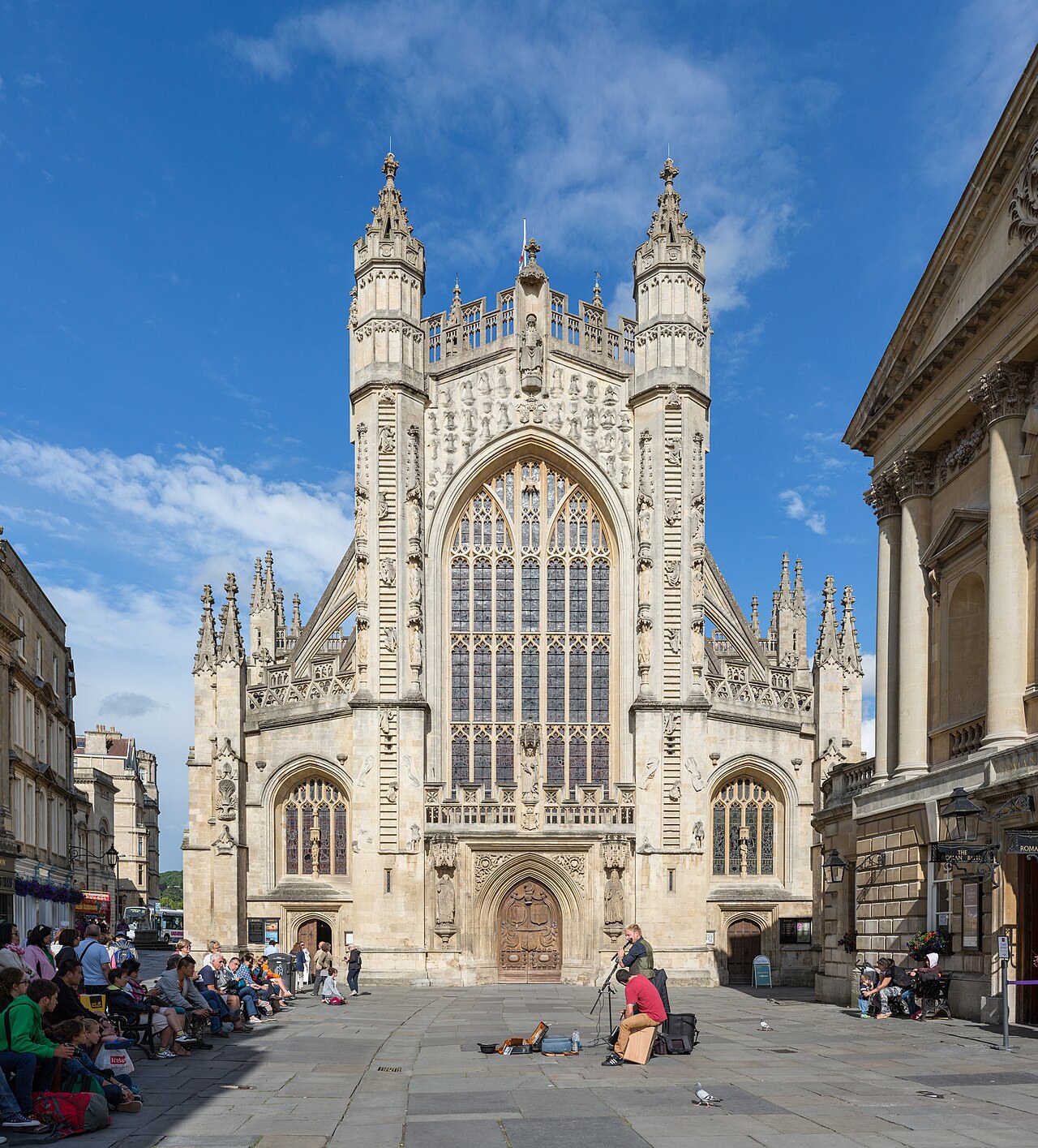
Photo: Diliff · CC BY-SA 3.0 · cropped
The Fox verdict
A city shaped by hot water and honey-coloured stone
Bath layers Roman ritual, medieval craft and Georgian ambition into a compact centre, with gardens and high ground beyond.
The Roman Baths, Bath Abbey and Georgian set pieces supply the history; Thermae Bath Spa keeps the spring part of a present-day visit. Markets, a historic bun, riverside gardens and the Bath Skyline give the city more than one pace.
Where to go
Places in Bath
Every place below is checked against a published source, listed with what it is and how long to give it.
Local signatures
3 placesThe Roman Baths
A Roman bathing complex grown over three centuries around the shrine to Sulis Minerva. The gilt bronze head of the goddess is on display.
- Visit length
- Editorial estimate: around 2 hours
- Locality
- City centre / Abbey & Old Town
Bath Abbey
The last great medieval cathedral built in England, with a fan-vaulted ceiling, carved ladders of angels on the West Front and the site of King Edgar's coronation in 973.
- Visit length
- Editorial estimate: around 1 hour
- Locality
- City centre / Abbey & Old Town
Bath Skyline
A circular National Trust high-level walk across limestone downs, prehistoric burial mounds and canal paths, with wide panoramas over the Avon Valley.
- Visit length
- Editorial estimate: around 3 hours
- Locality
- above the Georgian streets
Food & drink
2 placesSally Lunn's
A historic eating house serving the large brioche-like Sally Lunn bun, first recorded in Bath in 1780, in one of the city's oldest houses.
- Visit length
- Editorial estimate: around 1 hour
- Locality
- 4 North Parade Passage, formerly Lilliput Alley
Bath Farmers' Market
A Saturday market where producers sell seasonal cheeses, fruit and vegetables, breads and meat, almost all from within a 40-mile radius.
- Visit length
- Editorial estimate: around 1 hour
- Locality
- Green Park Station
Walks & outdoors
4 placesThermae Bath Spa
Britain's only natural thermal spa you can bathe in, centred on an open-air rooftop pool with views over the city.
- Visit length
- Editorial estimate: Allow the stated 2-hour session
- Locality
- City centre / Abbey & Old Town
Parade Gardens
A central Grade II-listed pleasure ground overlooking the Avon, known for views of Pulteney Bridge, flower beds and annual 3-D carpet bedding.
- Visit length
- Editorial estimate: around 45 minutes
- Locality
- Bath's most central pleasure ground
Sydney Gardens
Historic pleasure gardens beloved of Jane Austen, with a Jane Austen trail and the Kennet & Avon Canal running through.
- Visit length
- Editorial estimate: around 45 minutes
- Locality
- Bathwick
Prior Park Landscape Garden
A National Trust landscape garden associated with Ralph Allen, centred on a Grade I Palladian Bridge and wide views back over Bath.
- Visit length
- Editorial estimate: around 1 hour 15 minutes
- Locality
- on a hill overlooking the city
History & heritage
2 places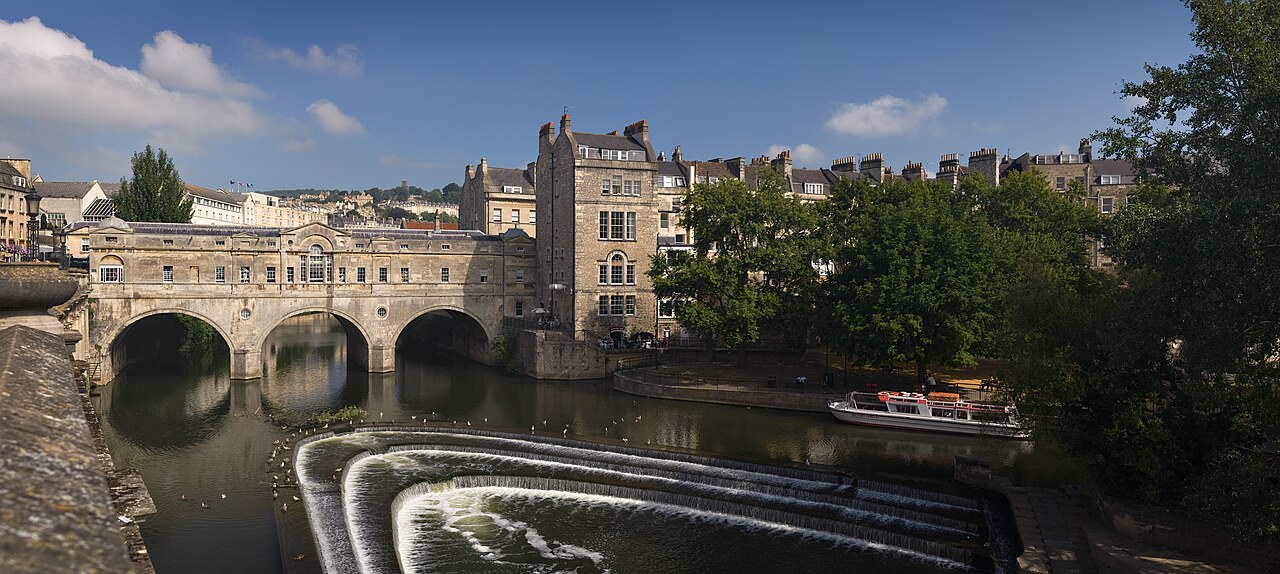
Pulteney Bridge
Robert Adam's Palladian bridge carries shops across its full span on both sides and overlooks the horseshoe weir.
- Visit length
- Editorial estimate: around 30 minutes
- Locality
- on the Avon
No. 1 Royal Crescent
A restored Georgian townhouse museum run by the Bath Preservation Trust, presenting a day in the life of a Georgian family and their servants.
- Visit length
- Editorial estimate: around 1 hour 15 minutes
- Locality
- the Royal Crescent
Things to do
1 placeRoyal Victoria Park
Bath's largest park combines botanical gardens, a boating lake and bandstand with a large adventure playground that includes a zip line and a red bus slide.
- Visit length
- Editorial estimate: around 1 hour
- Locality
- below the Royal Crescent
No places match this filter. Choose All places to reset the list.
Three ways to explore Bath
Signature outings
The fan vault
Bath Abbey's fan-vaulted ceiling was made by the Vertue brothers, who considered it the finest in England and France.
Bridge and weir
Pulteney Bridge carries shops along both sides of its full span and looks over the horseshoe weir on the Avon.
The Palladian bridge
Prior Park's Grade I Palladian Bridge is one of four of its design left in the world and the last in England.
The city story
Bath City Guide
Hot water, honey-coloured stone and a city that keeps opening outward from Roman remains to Georgian streets and green hills.
Springs, neighbourhoods and destination dining
The hot spring under Bath rises at 46°C and pushes out 240,000 gallons a day, which it has been doing without interruption since before anyone thought to build a city on top of it. The Romans channelled it into a bathing complex, the Georgians drank it for their health, and today you can still lower yourself into water from the same source on the rooftop pool at Thermae Bath Spa, looking out over a skyline of honey-coloured stone. A two-hour session runs about £42.50 on a weekday. It is the only natural thermal spa in Britain you can actually bathe in, which is the sort of fact that sounds invented until you are standing in the water.
Most people stay in the compact centre, the honey-stone core around the Abbey, the Roman Baths, the Pump Room and Guildhall Market. Everything here is walkable, and you can step out of your front door directly into the World Heritage set pieces. If you would rather sleep somewhere quieter, cross Pulteney Bridge into Bathwick, where Great Pulteney Street runs wide and grand between Georgian townhouses and Jane Austen once lived at number 4 Sydney Place. South of the river is Widcombe, a village-like stretch five minutes from the centre with its own parade of shops and pubs. Up the hill to the north is Lansdown, all curved terraces and green space, with the racecourse and golf club at the top on the edge of the Cotswolds. And north-east is Walcot, the bohemian end, where the antiques shops and indie cafés cluster and Landrace Bakery does its sourdough.
Bath takes its food seriously, and the range is wider than a city this size has any right to sustain. At the top end there is The Olive Tree at the Queensberry Hotel, which has held a Michelin star since 2018 and is Somerset's only four AA-rosette restaurant. Chris Cleghorn cooks there; his signature starter is chalk stream trout with carrot and orange, and the venison and black pudding gets singled out. A short walk away on South Parade is The Elder, Mike Robinson's game and wild-food restaurant in a Grade I listed Georgian terrace, where the seven-course dinner is built around venison from the chef's own estate, described as melt in the mouth. On Wellsway there is Menu Gordon Jones, where the tasting menu is a surprise and the dishes stay secret until they arrive at the table. If you like knowing what you are eating in advance, this is not the place.
Pubs, coffee and market halls
The less formal end is just as good. Noya's Kitchen on St James's Parade does Vietnamese home cooking in a Grade II listed building; the An's Chicken Curry comes from Noya Pawlyn's mother's recipe. The Marlborough Tavern, a stone's throw from the Royal Crescent, is a Georgian dining pub the local foodies rate for seasonal home cooking. Round the corner on Rivers Street, The Chequers has been serving food since 1776 and holds a Michelin Bib Gourmand, and its Sunday lunches have a following of their own. The Beckford Bottle Shop on Saville Row is a wine bar that does small plates to share, wild Cornish sea bass with charcuterie velouté and cornichons among them. Over in Widcombe, the Ring o' Bells puts on live jazz in the bar every Sunday evening, and up on Widcombe Hill the White Hart, which has appeared in the Michelin Guide, leans on local produce and closes on Mondays.
For coffee, Colonna & Small's on Chapel Row was crowned best coffee shop in Europe in 2016, having opened in 2009 with Melbourne on its mind. Landrace on Walcot Street mills its own South West grain, bakes sourdough, and runs a daily-changing menu upstairs with Round Hill Roastery coffee. And if you only eat one thing here, it is probably the Sally Lunn bun, a large brioche-like batter thing made with cream and eggs, first recorded in Bath in 1780 and still served at Sally Lunn's on North Parade Passage. The house is one of the oldest in the city; the lowest floor dates to the abbey's rebuilding after the great fire of 1137. There is a French Huguenot refugee origin story attached to the bun, involving a woman named Solange Luyon, which food historians regard as fiction apparently invented in the 20th century by a previous owner who bought the run-down townhouse in 1937.
Markets are worth planning around. The Bath Farmers' Market runs Saturday mornings at Green Park Station, a working railway terminus until the 1960s that now shelters stalls, indie shops and cafés under its old roof. Almost everything on sale comes from within a forty-mile radius, the cheeses and breads and meat sold directly by the people who made them. There is a Friday food market too. For a rainy day, the Guildhall Market has been trading, by its own reckoning, for eight hundred years, which makes it the oldest shopping venue in the city.
Roman water, medieval craft and Georgian theatre
Then there are the buildings, which is the reason most people come. The Roman Baths are one of the best-preserved Roman sites north of the Alps, grown up over three centuries around a shrine to the goddess Sulis, whom the Romans matched to Minerva rather than getting rid of. The Celts had worshipped her at the spring first. Visitors used to throw curse tablets into the water, inscribed sheets of lead and pewter carrying pleas for justice or curses against people who had wronged them, and more than 12,000 coins were pulled out, the largest votive coin deposit known from Britain. A gilt bronze head of Sulis Minerva, found nearby in 1727, is on display. Next door in the Pump Room you can drink the spa water while the Pump Room Trio plays, as some version of the band has done daily since 1709, when Beau Nash founded it. His statue stands at the east end.
Bath Abbey is the last great medieval cathedral built in England, begun around 1499, and its fan-vaulted ceiling by the Vertue brothers was considered by the Vertues themselves the finest in England and France. The West Front carries carved ladders of angels, taken from Bishop Oliver King's dream of angels going up and down. King Edgar was crowned King of All England on this spot at Whitsun in 973, and the service Archbishop Dunstan compiled for it has underpinned every English coronation since.
Up the hill are the two set pieces of Georgian town planning. The Circus, begun in 1754, is three curved segments forming a full circle; John Wood the Elder designed it and died less than three months after the first stone was laid, leaving his son to finish it in 1768. The younger Wood then built the Royal Crescent, thirty houses in a sweeping arc behind 114 Ionic columns, overlooking Royal Victoria Park. Historians reckon the Circus stands for the sun and the Crescent for the moon on the city's plan. Number 1 Royal Crescent is a restored townhouse museum you can walk through, laid out as a day in the life of a Georgian family and their servants. Down at the river, Pulteney Bridge carries shops across its full span on both sides, one of only four bridges in the world to do so, and overlooks the horseshoe weir.
Green spaces, city makers and wartime loss
For all the stone, Bath has a lot of green. Royal Victoria Park sits below the Royal Crescent with a boating lake, a bandstand, botanical gardens and a large adventure playground with a zip line and a red bus with a slide built in for the smaller ones. Parade Gardens, the most central of the pleasure grounds, looks across the Avon to Pulteney Bridge and is known for its flower beds and its annual 3-D carpet bedding. Sydney Gardens in Bathwick, which Jane Austen loved, has a Jane Austen trail and the Kennet & Avon Canal running through it; you can hire a punt, a canoe or a narrowboat and drift past the architecture. For something more strenuous, the National Trust's Bath Skyline is a circular high-level walk that lifts you above the streets onto limestone downs past prehistoric burial mounds, and Prior Park Landscape Garden climbs a hill south of the city to a Palladian bridge, one of only four of its design left in the world and the last in England, with wide views back over the honey-coloured roofs.
Bath was built on that honey colour. Ralph Allen owned the quarries at Combe Down and made his fortune on the stone that raised the Georgian city; he built Prior Park partly to show the stone off, and put up a folly called Sham Castle above the city apparently just because he could. It was Beau Nash, though, who made Bath fashionable in the first place, ruling its social life as self-styled King of Bath from 1706 until his death in 1761, setting the rules of who danced with whom and banning swords in the city to stop hot-headed men fighting duels.
Not everything survived. Over the weekend of 25 to 27 April 1942, around eighty German aircraft carried out three raids on the city, part of a campaign a Foreign Office spokesman had announced by threatening to bomb every building in Britain marked with three stars in the Baedeker guide. More than 400 people died. Many had not taken cover, assuming the bombers were headed for Bristol. The Assembly Rooms were gutted and later restored; they housed the Fashion Museum until 2022 and are now closed for a restoration due to reopen with a new Georgian visitor experience, the signage currently says, in 2027.
Arriving in Bath and Austen's last word
Getting here is easy. Bath Spa station, the busiest in Somerset, was built for the Great Western Railway by Brunel and opened in 1840; around 72 trains a day run to London Paddington, roughly one every half hour, in about an hour and twenty. Bristol is fifteen minutes the other way, described by one guide as Bath's cooler, livelier neighbour, with Banksy murals and a regenerated harbourside. Three park and ride sites ring the city with buses every fifteen minutes and free parking if you come back the same day. Wells, England's smallest city, is forty-five minutes by car, Cheddar Gorge a little beyond it, and Castle Combe, frequently called the prettiest village in England, about half an hour off.
Jane Austen set most of two novels here and had one of her characters ask, in Northanger Abbey, "Oh! Who can ever be tired of Bath?" The city puts her on the trail through Sydney Gardens all the same, and sells you the bun on the way out.
Stay around Somerset
Make a longer stay of it
Travel Fox holiday homes around Somerset, linked directly to their property pages.
A guide with a point of view
Written from research. Edited for real journeys.
Use the Official site links for live practical details, then use this guide for context, ideas and room to explore.
Photography credits & licences
Third-party photographs are credited to their named creators and reused under the linked Creative Commons licence or public-domain dedication. Travel Fox stores an optimised local copy; the file-specific changes and any browser-applied display crop are disclosed below. Reused photographs link both to the Wikimedia Commons source record and to the declared source image; Travel Fox's own photographs carry no such record and are marked as ours. These image licences do not cover Travel Fox text, branding or page design.
- File:Bath Abbey Exterior, Somerset, UK - Diliff.jpg — photograph by Diliff; Own work. Source record on Wikimedia Commons. Declared source image. Licence: CC BY-SA 3.0. File changes: Downloaded from Wikimedia Commons, resized to a maximum 1920px edge and encoded as an optimised JPEG. Display changes: Displayed with responsive CSS cropping.
- File:Pulteney bridge in Bath view from south before noon.jpg — photograph by Jürgen Matern; Own work (JMatern_060806_0993-1005_WC.jpg). Source record on Wikimedia Commons. Declared source image. Licence: CC BY-SA 3.0. File changes: Downloaded from Wikimedia Commons, resized to a maximum 1920px edge and encoded as an optimised JPEG. Display changes: Displayed with responsive CSS cropping.
Sources
Every place on this page is checked against a published source. Each entry links the record we used and names who publishes it.
- The Roman Baths — romanbaths.co.uk operator, sector body or destination organisation
- Bath Abbey — bathabbey.org operator, sector body or destination organisation
- Pulteney Bridge — historicengland.org.uk statutory register or public authority record not machine-readable; publisher restricts automated access
- Thermae Bath Spa — thermaebathspa.com operator, sector body or destination organisation
- No. 1 Royal Crescent — no1royalcrescent.org.uk operator, sector body or destination organisation
- Royal Victoria Park — bathnes.gov.uk statutory register or public authority
- Parade Gardens — bathnes.gov.uk statutory register or public authority
- Sydney Gardens — bathnes.gov.uk statutory register or public authority
- Bath Skyline — nationaltrust.org.uk national body or asset manager
- Prior Park Landscape Garden — nationaltrust.org.uk national body or asset manager
- Sally Lunn's — sallylunns.co.uk operator, sector body or destination organisation
- Bath Farmers' Market — bathfarmersmarket.co.uk operator, sector body or destination organisation