
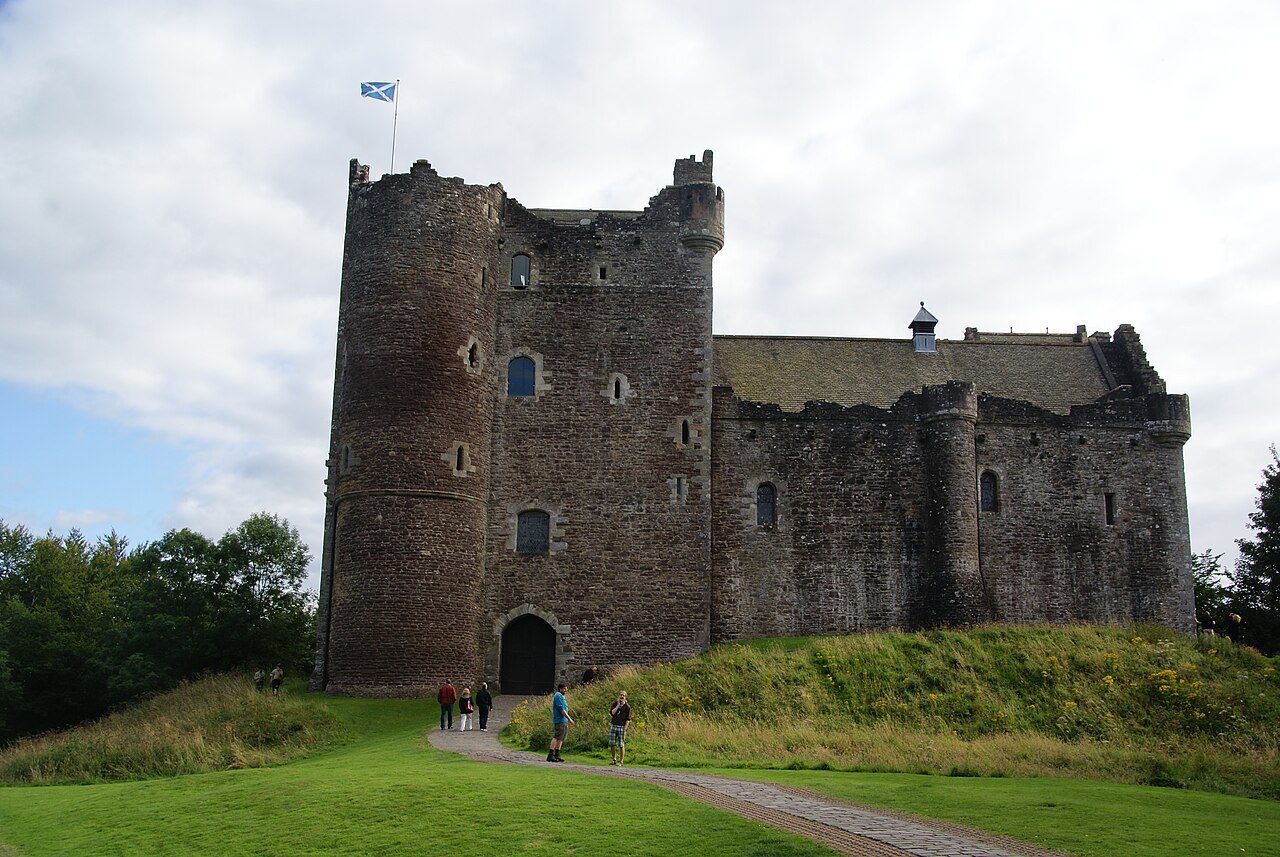
Castle, river and craft
Doune
A River Teith village shaped by a medieval castle, all-steel pistols, cattle fairs and the cotton mill at nearby Deanston.
- Best for
- Castle history, riverside walks and local heritage
- Give it
- Time for the village, river and nearby Deanston
- Don't miss
- Genuine 1700s Doune pistols at the heritage centre
Photo: Bill Boaden · CC BY-SA 2.0 · cropped
The Fox verdict
A castle village with more than one story
Doune pairs its famous late-medieval castle with riverside walking, pistol-making history and a compact collection of local stops.
Start with the Bridge of Teith view towards the castle, then follow the village's stories through the Mercat Cross, the heritage centre and the old pistol trade. Doune Ponds adds woodland and water, while the riverside connection to Deanston leads to a former cotton mill now used as a distillery.
Your picks, your pace
Make Doune yours
Choose a mood or build your own list. Your saved stops are an ordering aid, with a direct map route when you are ready.
Local signatures
3 placesRed Lion Inn
A traditional village inn of more than 200 years with a courtyard, pub food, locally sourced ales from Central Scotland and six bedrooms.
- Visit length
- Editorial estimate: allow around 75 minutes
- Locality
- centre of Doune
Kilmadock Information & Heritage Centre
The centre displays genuine 1700s Doune pistols and provides maps for the Doune and Deanston Heritage Trail.
- Visit length
- Editorial estimate: allow around 45 minutes
- Locality
- Doune
Doune and Deanston Heritage Trail
A heritage trail linking Doune and Deanston through indicator boards and plaques, with maps available from the Kilmadock Information & Heritage Centre.
- Visit length
- Editorial estimate: allow around 120 minutes
- Locality
- Doune and Deanston
Food & drink
1 placeDeanston Distillery
A 1785 cotton mill converted to a distillery in 1966, with a visitor centre and tours; it generates its own electricity from the River Teith.
- Visit length
- Editorial estimate: allow around 90 minutes
- Locality
- Deanston beside Doune
Walks & outdoors
1 placeDoune Ponds Nature Reserve
Forty acres of former gravel pits transformed into woodland and water, with an all-abilities path network, rare fungi, wild flowers and wild orchids.
- Visit length
- Editorial estimate: allow around 60 minutes
- Locality
- Doune
History & heritage
2 places
Doune Castle
Rebuilt in its present form in the late 14th century by Robert Stewart, Duke of Albany, the castle later served as a royal hunting lodge and appeared in Monty Python and the Holy Grail, Game of Thrones and Outlander.
- Visit length
- Editorial estimate: allow around 90 minutes
- Locality
- above the River Teith
Bridge of Teith
Robert Spittal had the bridge built in 1535 to replace a ferry. Its western side was widened in 1866, and the bridge gives views east towards Doune Castle.
- Visit length
- Editorial estimate: allow around 15 minutes
- Locality
- over the River Teith
No places match this filter. Choose All places to reset the list.
On the map
Doune at a glance
Tap a marker to jump to its guide card.
Three ways to explore Doune
Signature outings
Explore the castle
Walk through the late-14th-century castle rebuilt by Robert Stewart, Duke of Albany, and recognise settings used for Monty Python, Game of Thrones and Outlander.
Circle the ponds
Follow the all-abilities path network through forty acres of woodland and water at the former gravel pits of Doune Ponds.
Tour the distillery
Visit the 1785 cotton-mill buildings at Deanston, converted to a distillery in 1966 and still generating electricity from the River Teith.
The village story
Doune Village Guide
A village of castle walls, river crossings, pistol makers and paths towards Deanston.
Bridge and Castle
The Bridge of Teith is narrow enough that you notice it. Robert Spittal, royal tailor to James IV, paid for it in 1535 to replace a ferry, and though the western side was widened in 1866 it still only just does the job. The A84 crosses here now, into the middle of the village, and if you stand on the bridge you get the view east to Doune Castle sitting up above the river.
The castle dominates the town from that hill, and it earns most of the attention. Robert Stewart, Duke of Albany, rebuilt it in its present form in the late fourteenth century, and it has since worked as a royal hunting lodge, a dower house, and — more recently — a film set. It stood in for Castle Anthrax in Monty Python and the Holy Grail, for Winterfell in the first series of Game of Thrones, and for Castle Leoch across much of Outlander. Tight framing let one castle play several places at once.
The Cross and the Red Lion
The village focal point is the Mercat Cross, in a triangular space where the main streets meet. Public executions were moved here from the castle by order of Charles I, which is a lot of history for a road junction.
In the centre is the Red Lion Inn, a village inn of over 200 years with six bedrooms and a courtyard. The kitchen does a chicken, venison, cranberry and pistachio terrine at £4.95, a steak and ale pie at £9.95, chicken breast with haggis at £10.95, and an apple and bramble crumble to finish. It specialises in locally sourced ales from Central Scotland.
Main Street to the Riverside
For cake, the Buttercup Cafe at 7 Main Street has won a Scottish Home Baking Award and sits second of the seven places to eat in Doune on Tripadvisor. Also on the main street is Harvey Maps, a well-known maker of walking and outdoor maps, with its headquarters here.
You'll want those maps. Cross the bridge and a footpath runs parallel to the River Teith for about half a mile to Deanston, where the old cotton mill — Britain's first integrated one, built 1785 — is now a distillery that runs on electricity generated from the river. Doune Ponds, forty acres of former gravel pits turned woodland and water, has an all-abilities path network and wild orchids. There's a heritage trail with indicator boards linking Doune and Deanston.
Pistols and Practical Arrival
Doune once made pistols. In 1647 a blacksmith called Thomas Caddell settled here and began making all-steel weapons, borrowing pattern-welding from Viking swordsmithing. Four generations of Caddells worked the trade until Birmingham competition killed it around 1800. One contemporary judged that "no pistol made in Britain excelled or perhaps equalled those of his making, either for sureness or beauty." Genuine ones are displayed at the heritage centre.
There's no station — Dunblane, a short bus ride away, has the trains, seven minutes to Stirling. The A820 runs straight through the middle of the village, which Undiscovered Scotland describes as "at times, an excellent argument for the abolition of the motor vehicle."
Sweetie Lane
A mile south, past the safari park, Alexander Ferguson — the man who invented Edinburgh Rock — was born here and bought up the whole of Graham Street, which the village still calls Sweetie Lane.
Stay around Stirling
Make a longer stay of it
Travel Fox holiday homes around Stirling, linked directly to their property pages.
A guide with a point of view
Written from research. Edited for real journeys.
Use the Official site links for live practical details, then use this guide for context, ideas and room to explore.
Photography credits & licences
Third-party photographs are credited to their named creators and reused under the linked Creative Commons licence or public-domain dedication. Travel Fox stores an optimised local copy; the file-specific changes and any browser-applied display crop are disclosed below. Reused photographs link both to the Wikimedia Commons source record and to the declared source image; Travel Fox's own photographs carry no such record and are marked as ours. These image licences do not cover Travel Fox text, branding or page design.
- File:Doune Castle - geograph.org.uk - 3609858.jpg — photograph by Bill Boaden; Doune Castle by Bill Boaden. Source record on Wikimedia Commons. Declared source image. Licence: CC BY-SA 2.0. File changes: Downloaded from Wikimedia Commons, resized to a maximum 1920px edge and encoded as an optimised JPEG. Display changes: Displayed with responsive CSS cropping.
Sources
Every place on this page is checked against a published source. Each entry links the record we used and names who publishes it.
- Doune Castle — historicenvironment.scot statutory register or public authority record not machine-readable; publisher restricts automated access
- Bridge of Teith — trove.scot other published source record not machine-readable; publisher restricts automated access
- Red Lion Inn — redlion-doune.com operator, sector body or destination organisation
- Kilmadock Information & Heritage Centre — visitscotland.com operator, sector body or destination organisation
- Doune Ponds Nature Reserve — douneanddeanston.com operator, sector body or destination organisation
- Deanston Distillery — deanstonmalt.com operator, sector body or destination organisation
- Doune and Deanston Heritage Trail — douneanddeanston.com operator, sector body or destination organisation