
Castle, lough and layered history
Carrickfergus
John de Courcy's 1177 stronghold meets a level Belfast Lough waterfront, town museums and an Anglo-Norman centre rich in later stories.
- Best for
- Norman history and Belfast Lough walking
- Give it
- A day across the castle, museums and waterfront
- Don't miss
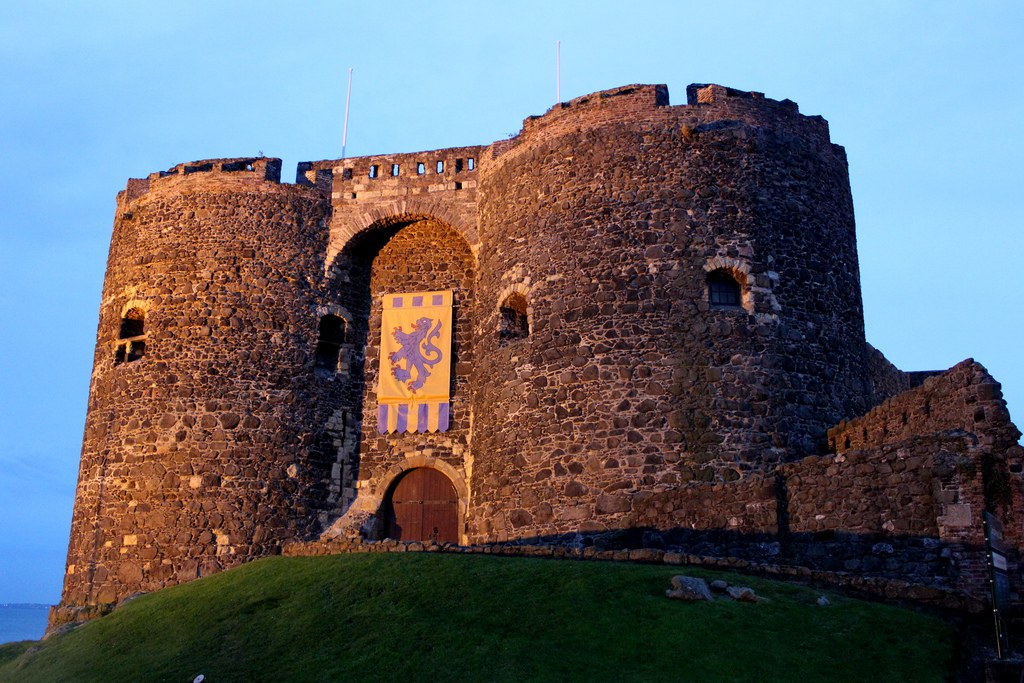
- The castle on its rock promontory
Photo: Sarah Samoraj · CC BY-SA 3.0 · cropped
The Fox verdict
A Norman stronghold with the lough at its feet
Carrickfergus brings a major medieval castle, a level waterfront and compact layers of local history together on Belfast Lough.
Start with the castle John de Courcy built in 1177, then follow the shoreline past the harbour and marina. Carrickfergus Museum, St Nicholas' Church, the Andrew Jackson Cottage and US Rangers Centre, and the preserved gasworks carry the story beyond the medieval capital.
Where to go
Places in Carrickfergus
Every place below is checked against a published source, listed with what it is and how long to give it.
Local signatures
3 places
Start here
Carrickfergus Castle
John de Courcy built this Norman castle in 1177; its museum includes a restored banqueting hall, medieval-life exhibits and cannons.
- Visit length
- Editorial estimate: allow around 90 minutes
- Locality
- on a rock promontory jutting into Belfast Lough
Carrickfergus Museum
A free museum with local-history displays at the Civic Centre.
- Visit length
- Editorial estimate: allow around 60 minutes
- Locality
- at the Civic Centre
Andrew Jackson Cottage and US Rangers Centre
A free museum in a thatched 1750s farmhouse linked to Andrew Jackson's parents, with the same site commemorating the US Rangers activated in Carrickfergus in 1942.
- Visit length
- Editorial estimate: allow around 60 minutes
- Locality
- Boneybefore, just outside Carrickfergus
History & heritage
2 placesSt Nicholas' Church
The Church of Ireland parish church was founded in the early 13th century by Hugh de Lacy; John MacNeice became Rector in late 1907.
- Visit length
- Editorial estimate: allow around 45 minutes
- Locality
- town centre near the Town Hall
Flame! The Gasworks Museum of Ireland
A preserved coal gasworks museum and rare survival of Victorian town-gas industrial heritage.
- Visit length
- Editorial estimate: allow around 60 minutes
- Locality
- Carrickfergus
- Access
- Verify opening details locally.
Things to do
1 placeCarrickfergus Marina
A modern waterfront and recreational complex on Belfast Lough, alongside the harbour and Rodgers Quay.
- Visit length
- Editorial estimate: allow around 45 minutes
- Locality
- on Belfast Lough
No places match this filter. Choose All places to reset the list.
Three ways to explore Carrickfergus
Signature outings
The castle in the lough
Explore the restored banqueting hall, medieval-life exhibits and cannons inside John de Courcy's 1177 castle.
Marina on the lough
Take in the small boats and harbour scene at this modern waterfront and recreational complex beside Belfast Lough.
The preserved gasworks
See Carrickfergus's preserved coal gasworks, a rare survival of Victorian town-gas industrial heritage.
The town story
Carrickfergus Town Guide
A castle on the lough, a harbour full of stories and a town whose history runs from de Courcy to MacNeice.
Castle, Harbour and Rodgers Quay
Carrickfergus Castle stands on a rock that pushes out into Belfast Lough, and it has been there since John de Courcy built it in 1177 as the headquarters of his conquest of eastern Ulster. The promontory was once three-quarters surrounded by water; later land reclamation cut that to about a third, but the castle still reads as something that belongs to the sea more than to the town behind it. Inside there is a restored banqueting hall, medieval-life exhibits and a line of cannons, adult entry around six pounds. It is one of the best-preserved Norman castles in Ireland.
Below it the harbour still shelters small boats, the bottle-neck harbour Louis MacNeice named, with the modern marina and Rodgers Quay running on alongside. Rodgers Quay is where you eat. Windrose is a marina-side bistro; Springsteen's Diner does American food; Kamakura is Japanese; Josh Macs and Papa Brown's are grills; Mayur and Little India cover the Indian end. The Rodgers Quay Shopping Centre has a Sainsbury's, which is the main place to stock up near the water.
High Street Hospitality and Loughshore Walks
In the old town the pubs sit on and around the High Street. The Central Bar is the Wetherspoon. Ownie's Bar is a traditional bar over at Joymount. The Dobbins Inn Hotel is a town-centre inn with a bar and rooms — one of the oldest hospitality buildings in Carrickfergus, a double around ninety pounds, and local lore attaches a resident ghost to it.
For walking, the Loughshore path runs level along the waterfront past marina, harbour and castle, the lough on one side the whole way. Inland the ground rises toward the Knockagh escarpment, and Slieve True, at about 312 metres, gives you the higher option above the town.
Arriving in the Medieval Capital
Trains from Carrickfergus station reach Belfast in about thirty-five minutes, roughly every half hour, and carry on toward Larne. The Ulsterbus 563 runs hourly from Belfast, and the A2 Shore Road brings you in by car, eleven miles out. Parking at the Harbour Car Park is free.
The town was Ulster's medieval capital. King John took the castle in 1210. William of Orange landed here on 14 June 1690 ahead of the Williamite campaign, still marked each year as Landing Day with around forty marching bands. In 1760 French forces under François Thurot briefly held the town; in 1778 John Paul Jones fought an hour-long engagement with HMS Drake just offshore; and in 1711 the place hosted Ireland's last witchcraft trial. Segments of the medieval town wall survive.
Boneybefore and St Nicholas'
Just outside town at Boneybefore, a thatched farmhouse from the 1750s survives as the Andrew Jackson Cottage — the parents of the seventh US president emigrated from here to South Carolina — and the same site remembers the 1st Battalion of the US Rangers, activated in Carrickfergus in 1942.
St Nicholas' Church, founded in the early thirteenth century by Hugh de Lacy, anchors the town centre near the Town Hall. In 1907 John MacNeice became its rector, and his son, the poet Louis MacNeice, grew up here between the ages of two and ten.
The Song of Carrickfergus
And there is the song. "I wish I was in Carrickfergus," it begins — a folk ballad translated from Munster Irish, and about the strongest thing the town's name carries, sung by a great many people who have never seen the lough.
Stay around Antrim
Make a longer stay of it
Travel Fox holiday homes around Antrim, linked directly to their property pages.
For homeowners
Own a holiday home near Carrickfergus?
We manage holiday lets across the UK from 12% commission, charged after cleaning costs, with no lock-in. A co-founder visits before you decide.
How our holiday let management works →
A guide with a point of view
Written from research. Edited for real journeys.
Use the Official site links for live practical details, then use this guide for context, ideas and room to explore.
Photography credits & licences
Third-party photographs are credited to their named creators and reused under the linked Creative Commons licence or public-domain dedication. Travel Fox stores an optimised local copy; the file-specific changes and any browser-applied display crop are disclosed below. Reused photographs link both to the Wikimedia Commons source record and to the declared source image; Travel Fox's own photographs carry no such record and are marked as ours. These image licences do not cover Travel Fox text, branding or page design.
- File:Carrickfergus Castle Northern Ireland.jpg — photograph by Sarah Samoraj; Own work. Source record on Wikimedia Commons. Declared source image. Licence: CC BY-SA 3.0. File changes: Downloaded from Wikimedia Commons, resized to a maximum 1920px edge and encoded as an optimised JPEG. Display changes: Displayed with responsive CSS cropping.
Sources
Every place on this page is checked against a published source. Each entry links the record we used and names who publishes it.
- Carrickfergus Castle — communities-ni.gov.uk statutory register or public authority
- Carrickfergus Museum — midandeastantrim.gov.uk statutory register or public authority
- Andrew Jackson Cottage and US Rangers Centre — discovernorthernireland.com operator, sector body or destination organisation
- St Nicholas' Church — saintnicholas.org.uk operator, sector body or destination organisation
- Carrickfergus Marina — midandeastantrim.gov.uk statutory register or public authority
- Flame! The Gasworks Museum of Ireland — communities-ni.gov.uk statutory register or public authority