
Senni Valley layers
Defynnog
Ancient yews, a late-medieval church and independent village food beside routes into the surrounding valley.
- Best for
- Ancient trees and church heritage
- Give it
- A relaxed half day for the churchyard and village food
- Don't miss
- The fifth- or sixth-century incised stone at St Cynog's
Photo: Jeff Gogarty · CC BY-SA 2.0 · cropped
The Fox verdict
A small village with unusually deep roots
Defynnog pairs internationally significant ancient yews and a late-15th-century church with a family-run pub, a rarebit café and routes into the Senni Valley.
Start with the church and ancient yews above the Senni, then walk down to the bridge for village food. The T6 also links Defynnog with Brecon and attractions to the south.
Where to go
Places in Defynnog
Every place below is checked against a published source, listed with what it is and how long to give it.
Local signatures
3 placesSt Cynog's Church
A Grade I church whose present fabric is largely late 15th century, with a fifth- or sixth-century incised stone in the porch, a disputed inscription on the font and six John Taylor bells.
- Visit length
- Editorial estimate: Allow around 45 minutes
- Locality
- on a river terrace about 100m from the Afon Senni
- Access
- The churchyard offers an outdoor visit; the church building is used for worship.
Defynnog Churchyard Yews
Four significant yews stand here. The best-known measured 10.06m in minimum girth in 2014; age estimates conflict, but the trees are recognised as ancient and internationally significant.
- Visit length
- Editorial estimate: Allow around 30 minutes
- Locality
- in St Cynog's churchyard
Tanners Arms
An independent, family-run country pub with accommodation, home-cooked food, a beer garden, two changing cask beers and a history of trading since 1870.
- Visit length
- Editorial estimate: Allow around 90 minutes
- Locality
- Defynnog
Food & drink
1 place
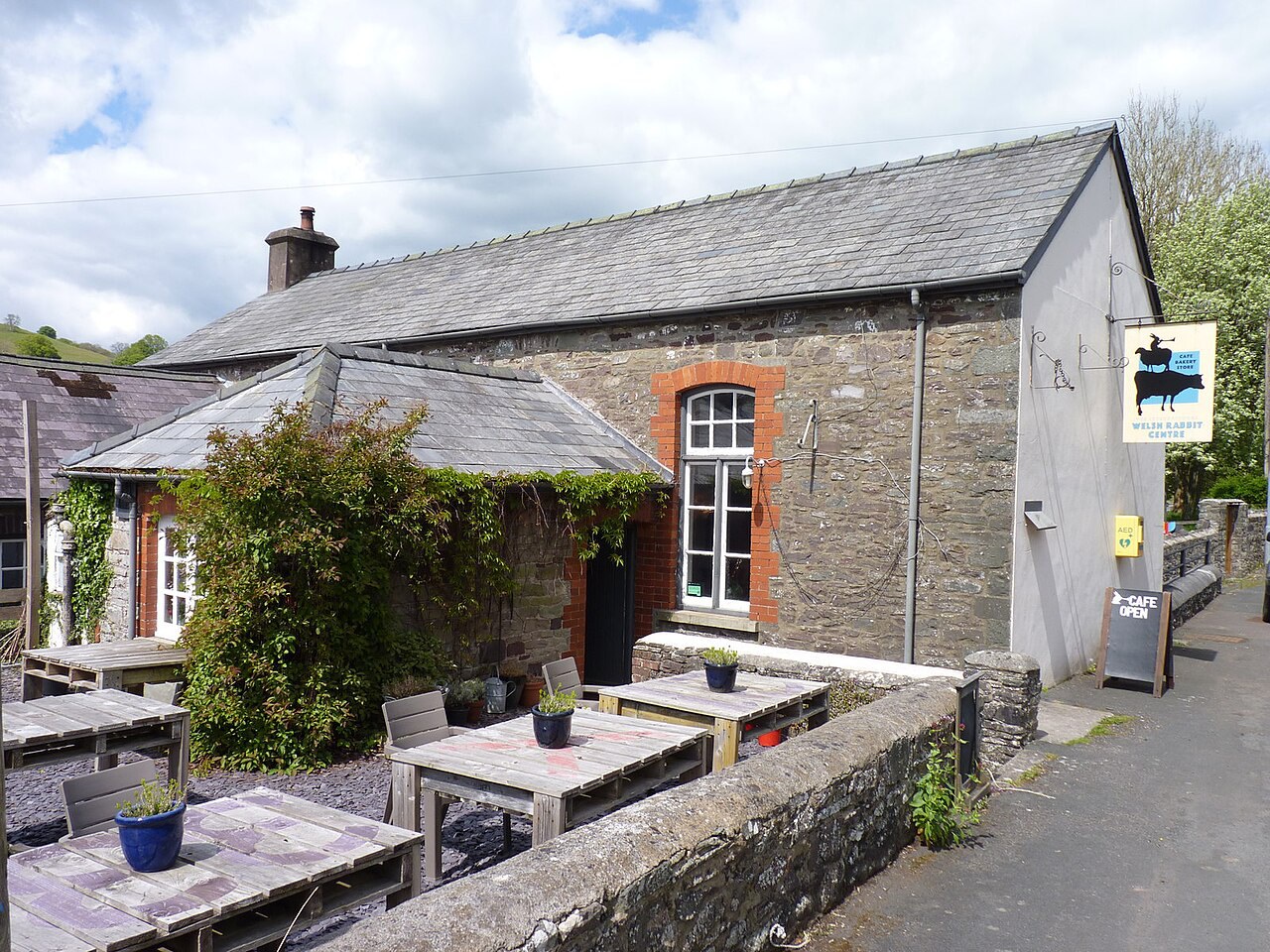
The International Welsh Rarebit Centre
A family-friendly café and shop centred on classic and imaginative Welsh rarebits, with seasonal soups, salads, daily specials, on-site bread and a wood-burning stove.
- Visit length
- Editorial estimate: Allow around 60 minutes
- Locality
- in Defynnog's Old School building
Things to do
1 placeDan-yr-Ogof, National Showcaves Centre for Wales
One ticket covers three show caves, a dinosaur park, Shire Horse Centre, Victorian farm, indoor and outdoor playgrounds, an Iron Age village and other displays.
- Visit length
- Editorial estimate: Allow around 2 hours 30 minutes
- Locality
- south of Defynnog
No places match this filter. Choose All places to reset the list.
Three ways to explore Defynnog
Signature outings
Meet the ancient yews
Meet four ancient churchyard yews, including one measured at 10.06 metres around in 2014.
Try Welsh rarebit
Choose from classic and imaginative rarebits in the Old School café, where the bread is baked on site.
Explore the show caves
Make a family visit of three show caves alongside the dinosaur park, farm displays and playgrounds.
The village story
Defynnog Village Guide
Ancient yews, layered church history and independent village food beside the Afon Senni.
Ancient Yews and St Cynog's
In St Cynog's churchyard stand four significant yews. The best-known had a minimum girth of 10.06 metres in 2014. Age estimates range from a projected minimum of 1,300 years to 2,000–3,000 years, though 3,000 is disputed and the claim of 5,000 has no support. The trees are ancient and internationally significant.
The church the yews surround sits on a terrace above the Afon Senni, about a hundred metres from the water. Most of what you see is late fifteenth century, tower included, though a church was recorded here as far back as 1254. In the porch is an incised stone reading "Rugniatio Livendoni," cut in the fifth or sixth century and marked later with two crosses and what may be Ogham. The font carries the letters "Siwurd + Gwlmer" and a long-standing claim to be the only Runic inscription in Wales, though specialists dispute it and read the lettering as Lombardic capitals instead. Six bells by John Taylor hang in the tower. A visitor in 1855, Sir Stephen Glynne, judged the whole thing "above par" for the district.
The Tanners Arms
Near the bridge, the Tanners Arms occupies three cottages built around 1806 for tannery workers. It has traded as a pub since 1870. The independent, family-run pub has a beer garden, log fires, two changing cask beers and real cider, and welcomes dogs. Boss and Grey Trees have featured among its ales; home-cooked dishes have included meat pies, sea bass, lamb and Sunday dinner.
Rarebit in the Old School
At the International Welsh Rarebit Centre in the Old School, bread is baked on site for rarebits that have included traditional, Patagonian, Korean, Spanish chorizo, stout and kimchi versions. Seasonal soups, salads, specials and cakes join them, with a wood-burning stove, a small shop and room for children.
From the Senni Valley to the Hills
Defynnog has two centres: the church and older houses on higher ground, and the buildings by the bridge over the Senni. An 8.36-kilometre circular crosses the surrounding fields, while a footway beside the A4067 connects the village with Sennybridge and the banks of the Usk. The T6 stops in Defynnog and runs to Brecon in one direction and past Dan-yr-Ogof's show caves in the other. Pen y Fan, southern Britain's highest hill at 886 metres, is a drive away; the climb from Pont ar Daf is steep.
Railway Memory and Show Day
The village kept its own railway station from 1867 until the passenger trains stopped in 1962; the nearest now is Llandovery, eleven miles off. On the first Saturday of September the neighbouring Sennybridge Show fills Dickson's Field with livestock, dogs, rural crafts and horticulture, the same fixture the Devynock Agricultural Society has run for years.
Stay around Brecon Beacons
Make a longer stay of it
Travel Fox holiday homes around Brecon Beacons, linked directly to their property pages.
For homeowners
Own a holiday home near Defynnog?
We manage holiday lets across the UK from 12% commission, charged after cleaning costs, with no lock-in. A co-founder visits before you decide.
How our holiday let management works →
A guide with a point of view
Written from research. Edited for real journeys.
Use the Official site links for live practical details, then use this guide for context, ideas and room to explore.
Photography credits & licences
Third-party photographs are credited to their named creators and reused under the linked Creative Commons licence or public-domain dedication. Travel Fox stores an optimised local copy; the file-specific changes and any browser-applied display crop are disclosed below. Reused photographs link both to the Wikimedia Commons source record and to the declared source image; Travel Fox's own photographs carry no such record and are marked as ours. These image licences do not cover Travel Fox text, branding or page design.
- File:The International Welsh Rarebit Centre, High Street, Defynnog (geograph 6154825).jpg — photograph by Jeff Gogarty; Jeff Gogarty. Source record on Wikimedia Commons. Declared source image. Licence: CC BY-SA 2.0. File changes: Downloaded from Wikimedia Commons, resized to a maximum 1920px edge and encoded as an optimised JPEG. Display changes: Displayed with responsive CSS cropping.
Sources
Every place on this page is checked against a published source. Each entry links the record we used and names who publishes it.
- St Cynog's Church — coflein.gov.uk statutory register or public authority
- Defynnog Churchyard Yews — coflein.gov.uk statutory register or public authority
- Tanners Arms — camra.org.uk operator, sector body or destination organisation
- The International Welsh Rarebit Centre — bannaubrycheiniog.org other published source
- Dan-yr-Ogof, National Showcaves Centre for Wales — showcaves.co.uk operator, sector body or destination organisation