
Sirhowy Valley stories
Blackwood
Cinema, live performance, Chartist memory and wooded valley walks give Blackwood several distinct ways to spend a visit.
- Best for
- Local culture and industrial history
- Give it
- A half day, or longer with a performance
- Don't miss
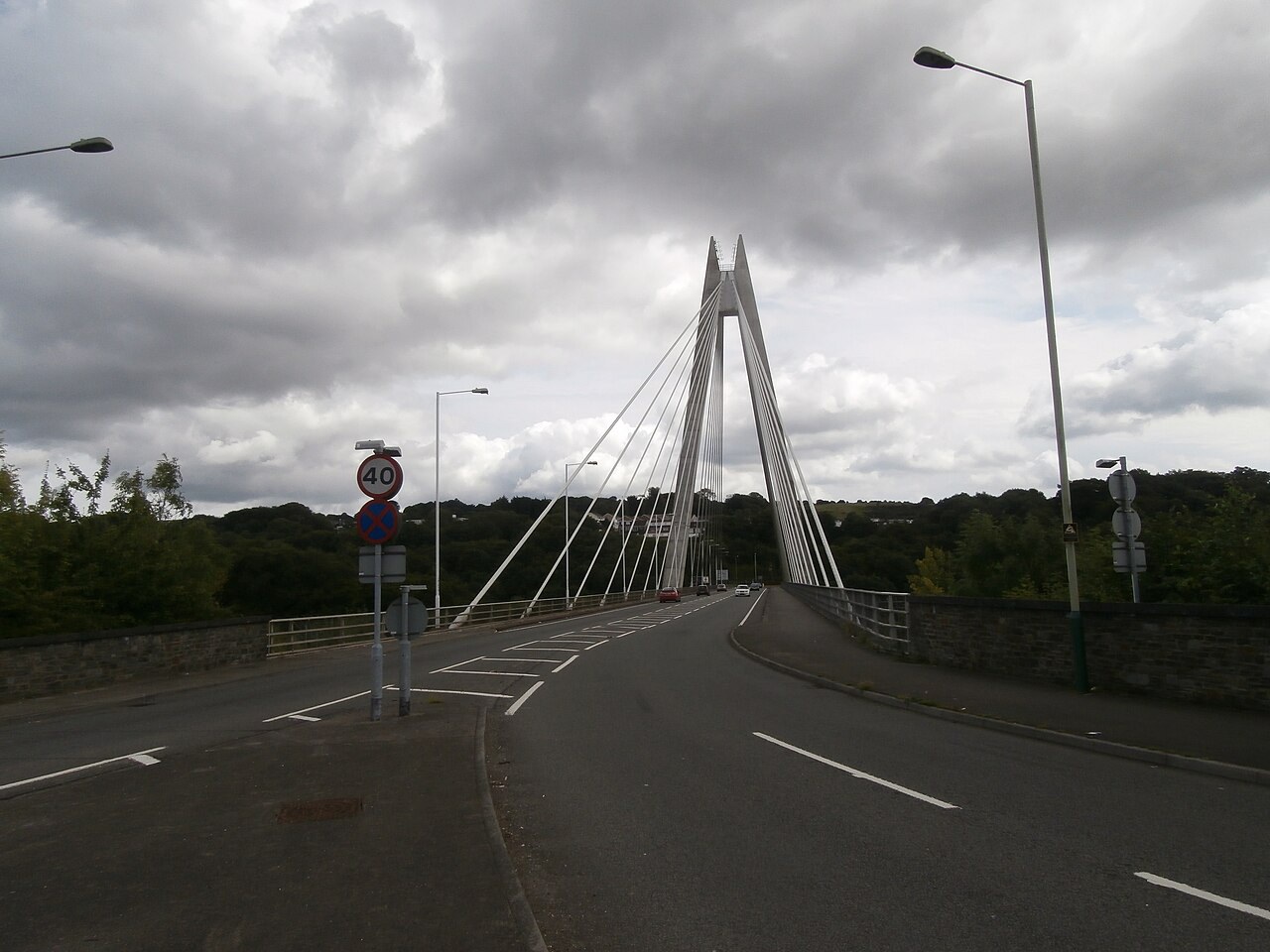
- The Chartist Bridge above the valley
Photo: John Lord · CC BY-SA 2.0 · cropped
The Fox verdict
A Valleys town with stories on stage and underfoot
Blackwood pairs a working high street and five-screen cinema with live venues, Chartist history and the wooded Sirhowy Valley.
The strongest visit connects the Maxime and the miners' institute with the town's Chartist legacy, then follows the river or crosses the valley on the cable-stayed bridge. Cwmcarn Forest Drive adds a nearby outdoor option.
Where to go
Places in Blackwood
Every place below is checked against a published source, listed with what it is and how long to give it.
Local signatures
3 placesMaes Manor Hotel
A hotel with bar and restaurant in the former manor house known as Maesrudded, once home to the Lord Lieutenant of Monmouthshire.
- Visit length
- Editorial estimate: around 90 minutes
- Locality
- Maesrudded, Blackwood
- Access
- Dining, accommodation and event availability vary; check the Official site before travel.
Chartist Bridge
A walkable cable-stayed crossing 30 metres above the valley floor, with a brass-ring statue honouring the Chartists.
- Visit length
- Editorial estimate: around 45 minutes
- Locality
- between Blackwood and Oakdale
- Access
- Use only a confirmed pedestrian approach and follow current bridge notices.
Cwmcarn Forest Drive
A seven-mile scenic forest drive on the flanks of Twmbarlwm, with mountain-biking trails and a visitor centre.
- Visit length
- Editorial estimate: around 2 hours
- Locality
- Cwmcarn in the Ebbw Valley
- Access
- Check the land manager's current visitor information and trail notices before travel.
Walks & outdoors
1 placeSirhowy Valley Country Park
Riverside and woodland walking through a valley landscape shaped by former collieries and railways.
- Visit length
- Editorial estimate: around 2 hours
- Locality
- south of Blackwood along the Sirhowy River
- Access
- The country park covers an extended area; use a confirmed public trail access point.
History & heritage
1 place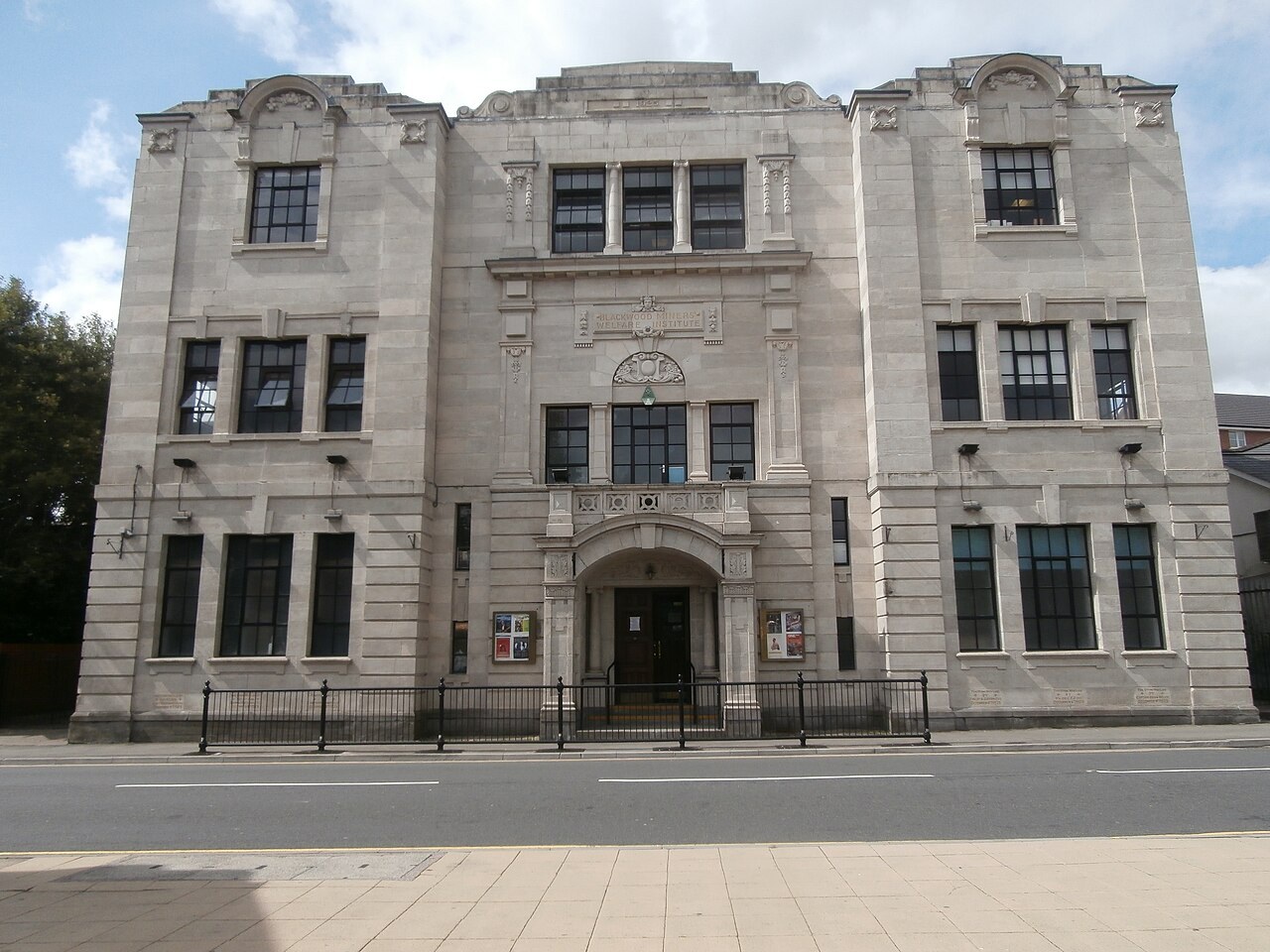
Blackwood Miners' Institute
Established in 1925 with contributions from Oakdale miners, this multi-entertainment venue also hosted some of the Manic Street Preachers' earliest gigs.
- Visit length
- Editorial estimate: around 90 minutes
- Locality
- Blackwood High Street
- Access
- The institute is a multi-entertainment venue on Blackwood High Street.
Things to do
1 placeThe Maxime
A five-screen cinema purpose-built in 1938, later used as a bingo hall, with its original foyer decoration preserved.
- Visit length
- Editorial estimate: around 2 hours
- Locality
- Blackwood
- Access
- Film times determine practical access; check the Official site before travel.
No places match this filter. Choose All places to reset the list.
Three ways to explore Blackwood
Signature outings
Walk the Chartist Bridge
Take the walkable cable-stayed crossing above the valley and see how Blackwood's Chartist story became a modern landmark.
See the miners' institute
Choose a performance at the venue built from Oakdale miners' weekly contributions and linked to the Manic Street Preachers' earliest gigs.
Walk into the Sirhowy Valley
Use a confirmed public access point for a riverside and woodland walk through former colliery and railway country.
The town story
Blackwood Town Guide
From cinema and live stages to Chartist history and the wooded Sirhowy Valley, Blackwood's story moves between culture and landscape.
Screens, Stages and the High Street
The Maxime is a five-screen cinema on the high street, purpose-built in 1938 and later a bingo hall, with its original foyer decoration still in place. A few doors along stands the Blackwood Miners' Institute, paid for from 1925 by the miners of Oakdale Colliery at threepence a week, extended by two floors within a decade and reopened in 1992 as a venue that has since hosted Jasper Carrott, Ken Dodd and Welsh National Opera. Some of the Manic Street Preachers' earliest gigs happened here. The four of them formed the band in 1986 at Oakdale Comprehensive, which they all attended, and a mural of James Dean Bradfield, Richey Edwards, Sean Moore and Nicky Wire by the street artist Paul Shepherd went up in the town in April 2024.
The high street itself follows the exact line of the old Sirhowy Railway, which carried passengers from 1865 until 1960. The station site is now a KFC, and no rail runs into Blackwood now; buses go from the bus station to Ystrad Mynach for trains on the Rhymney Line. The street remains the shopping and market centre for the wider Sirhowy Valley, running up to St Margaret's, the Anglican parish church at the top — the one established church in a town whose life ran to chapels instead. A 1904 Methodist chapel houses the Blackwood Little Theatre.
From Maesrudded to the Valley
For a meal and a bed, Maes Manor Hotel sits in the former manor house of Maesrudded, once home to the Lord Lieutenant of Monmouthshire.
The walking starts more or less where the streets end. The Sirhowy Valley Walk follows the river south through woodland toward Ynysddu and the site of Nine Mile Point Colliery, past the remains of former pits and railways. To cross the valley you can take the Chartist Bridge, a cable-stayed span 230 metres long and 30 metres above the valley floor, opened in 2005 and hung with a statue made of thousands of brass rings. Follow the river the other way and you reach Gelligroes Mill, a watermill of around 1625. In 1912 an amateur wireless enthusiast there, Artie Moore, picked up the Titanic's distress signals on a receiver he had built himself; he later went to work for Marconi.
Chartism and Nearby Excursions
Those brass rings are for the Chartists, and Blackwood was one of their strongholds. John Frost, Zephaniah Williams — a Blackwood man — and William Jones "met regularly at the Coach and Horses public house in Blackwood" to plan the 1839 march on Newport. South Wales was the only region to rise; the leaders were sentenced to death and transported to Tasmania instead. The Coach and Horses was demolished in 1958. Blackwood itself had been built barely a generation before, laid out from the early 1800s by the colliery owner John Hodder Moggridge as a model village.
Further afield lie Cwmcarn Forest Drive with its mountain-biking trails, and Caerphilly Castle, the largest in Wales, with its leaning tower and its moat.
A National Anthem from Blackwood
The best of Blackwood, though, belongs to two men in the weaving trade. Evan James was a weaver and wool merchant; with his son James he set down the words and tune of "Hen Wlad fy Nhadau," the Welsh national anthem, in 1856. It came out of an ordinary working household in a town not fifty years old.
Stay around Caerphilly
Make a longer stay of it
Travel Fox holiday homes around Caerphilly, linked directly to their property pages.
For homeowners
Own a holiday home near Blackwood?
We manage holiday lets across the UK from 12% commission, charged after cleaning costs, with no lock-in. A co-founder visits before you decide.
How our holiday let management works →
A guide with a point of view
Written from research. Edited for real journeys.
Use the Official site links for live practical details, then use this guide for context, ideas and room to explore.
Photography credits & licences
Third-party photographs are credited to their named creators and reused under the linked Creative Commons licence or public-domain dedication. Travel Fox stores an optimised local copy; the file-specific changes and any browser-applied display crop are disclosed below. Reused photographs link both to the Wikimedia Commons source record and to the declared source image; Travel Fox's own photographs carry no such record and are marked as ours. These image licences do not cover Travel Fox text, branding or page design.
- File:Chartist Bridge, Blackwood - geograph.org.uk - 5508832.jpg — photograph by John Lord; Chartist Bridge, Blackwood by John Lord. Source record on Wikimedia Commons. Declared source image. Licence: CC BY-SA 2.0. File changes: Downloaded from Wikimedia Commons, resized to a maximum 1920px edge and encoded as an optimised JPEG. Display changes: Displayed with responsive CSS cropping.
- File:Blackwood Miners' Welfare Institute - geograph.org.uk - 5508809.jpg — photograph by John Lord; Blackwood Miners' Welfare Institute by John Lord. Source record on Wikimedia Commons. Declared source image. Licence: CC BY-SA 2.0. File changes: Downloaded from Wikimedia Commons, resized to a maximum 1920px edge and encoded as an optimised JPEG. Display changes: Displayed with responsive CSS cropping.
Sources
Every place on this page is checked against a published source. Each entry links the record we used and names who publishes it.
- The Maxime — blackwood.picturedromecinemas.co.uk other published source
- Blackwood Miners' Institute — blackwoodminersinstitute.com operator, sector body or destination organisation
- Maes Manor Hotel — maesmanor.co.uk operator, sector body or destination organisation record not machine-readable; publisher restricts automated access
- Chartist Bridge — coflein.gov.uk statutory register or public authority
- Sirhowy Valley Country Park — caerphilly.gov.uk statutory register or public authority
- Cwmcarn Forest Drive — conversation.caerphilly.gov.uk statutory register or public authority