
Granite, glens and gathering ground
Braemar
A compact Cairngorms village where village history, independent food stops and mountain paths meet the Clunie Water and River Dee.
- Best for
- Mountain walks, community-run heritage and local food
- Give it
- Anything from a 15-minute waterfall walk to a four-to-five-hour summit
- Don't miss
- Braemar Castle, the Highland Games Pavilion and the community paths
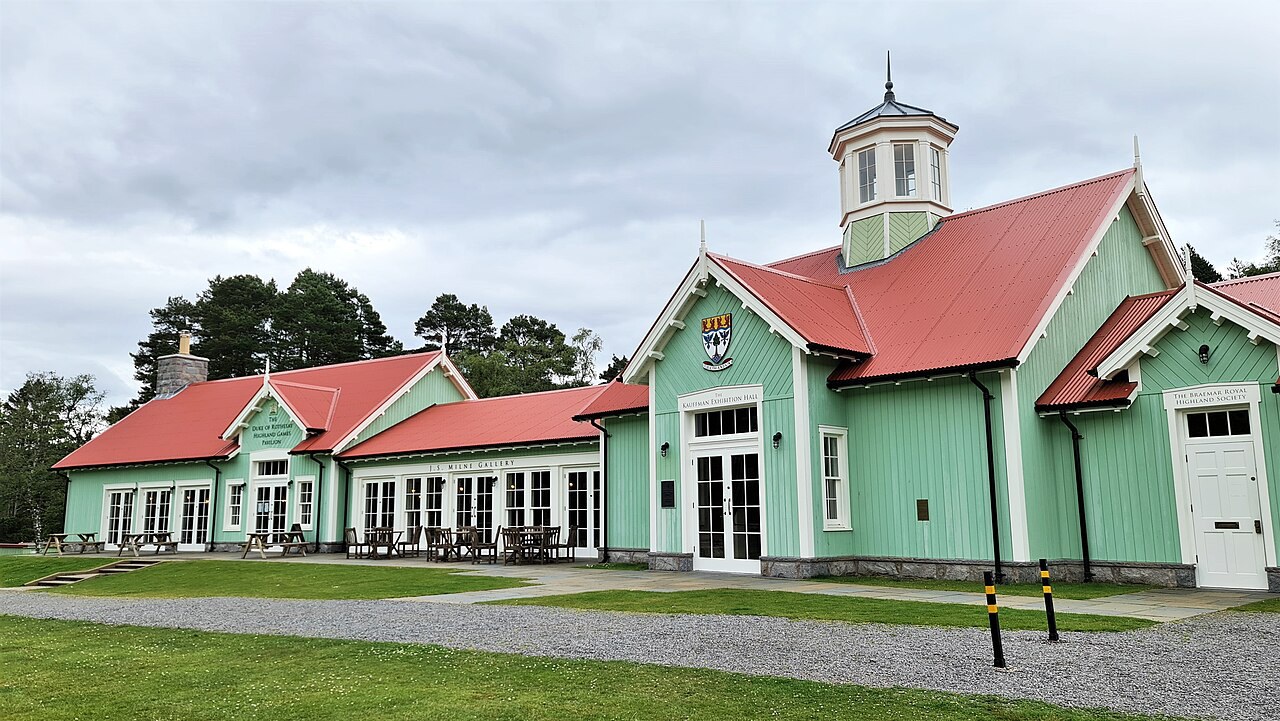
Photo: Chris Morgan · CC BY-SA 2.0 · cropped
The Fox verdict
A small village with the high country at its edge
Braemar brings together granite-built village character, paths into the Cairngorms and unusually strong community stewardship.
Use the village for a compact mix of castle history, Highland Games interpretation, independent food and routes ranging from a short waterfall walk to strenuous hill days. Braemar Castle is run by local volunteers, while the Gathering, play park and St Margaret's show how much of the visitor experience is tied to community effort.
Where to go
Places in Braemar
Every place below is checked against a published source, listed with what it is and how long to give it.
Local signatures
3 placesBraemar Castle
A 1628 defensible hunting lodge with furnished rooms, a star-like curtain wall and interpretation led by local volunteers.
- Visit length
- Editorial estimate: Allow around 2½ hours
- Locality
- about a quarter-mile east of the village
- Access
- The grounds can be visited throughout the year; interior visits follow a seasonal schedule. An accessible path crosses the grounds, while the furnished rooms are reached by a spiral staircase. Groups need to arrange their visit in advance.
Kindrochit Castle
Scheduled remains of a royal hunting seat, with a surviving tower probably built around 1390.
- Visit length
- Editorial estimate: Allow around 30 minutes
- Locality
- at a strategic Clunie crossing in the village
The Bothy
A licensed café for breakfasts, brunches, lunches, homemade cakes and bakes, with packed lunches for hill days and outdoor seating over the Clunie River.
- Visit length
- Editorial estimate: Allow around 1 hour
- Locality
- joined to Braemar Mountain Sports
Food & drink
1 placeBraemar Chocolate Shop
A small-batch chocolatier selling truffles, pralines and chocolate bars at its Auld Bank House shop. Its production kitchen is at 9 Invercauld Road.
- Visit length
- Editorial estimate: Allow around 20 minutes
- Locality
- at the Auld Bank House
Walks & outdoors
3 placesCreag Choinnich
A short, steep hill route whose Gaelic name means mossy hill, with views towards Ben Avon's granite tors.
- Visit length
- Editorial estimate: Allow 1–2 hours
- Locality
- Braemar
- Access
- A strenuous route climbing to 538 m.
River Dee riverside walk, Braemar
A moderate circuit following the Clunie Water and River Dee for views across the strath.
- Visit length
- Editorial estimate: Allow around 2 hours
- Locality
- along the Clunie Water and River Dee
- Access
- The narrow earthy path can be muddy.
Linn of Dee Walk
A short walk beside waterfalls cut through rock, with pines, rare wildflowers and the possibility of seeing salmon.
- Visit length
- Editorial estimate: Allow around 15 minutes
- Locality
- Mar Lodge Estate
History & heritage
2 places
Duke of Rothesay Highland Games Pavilion
A visitor centre using objects, costumes, photographs, documents, trophies and display panels to interpret piping, dancing, heavy events and the royal connection.
- Visit length
- Editorial estimate: Allow around 1 hour
- Locality
- Braemar
St Margaret's, Braemar
A Category A-listed Gothic Revival building by Sir John Ninian Comper, with polychrome granite, stained glass and strawberry motifs.
- Visit length
- Editorial estimate: Allow around 45 minutes
- Locality
- Braemar
- Access
- Now a performance, arts and heritage venue rather than an active church.
Things to do
1 placeBraemar Community Play Park
An inclusive outdoor meeting point created after a parent-led campaign, with modern equipment, a willow igloo and a willow tunnel.
- Visit length
- Editorial estimate: Allow around 45 minutes
- Locality
- within walking distance for residents and visitors
No places match this filter. Choose All places to reset the list.
Three ways to explore Braemar
Signature outings
See the Linn cut through rock
Take the short Linn of Dee walk beside waterfalls, pines and rare wildflowers, with salmon a possibility.
Trace piping, dancing and heavy events
Use the Pavilion's objects, costumes, photographs and trophies to follow the Highland Games and their royal connection.
Choose chocolate at the Auld Bank House
Browse the Braemar Chocolate Shop’s truffles, pralines and bars at its Auld Bank House retail shop. Its production kitchen is at 9 Invercauld Road.
The village story
Braemar between river, estate and high tops
Explore Braemar's pubs and independent shops, mountain paths, castle history and the Gathering, with the road journey into the village part of the visit.
Pubs beneath the mountains
On the wall of the public bar at the Fife Arms hangs a stag with the wings of a ptarmigan, made by the American artist James Prosek and surrounded by real antlers. The bar is called the Flying Stag, and for all the money spent on the hotel around it, it has stayed what a village pub is meant to be: the place walkers and skiers end up, dogs allowed inside, half-pints of dark ale moving steadily on a wet evening. The cask beer is Cairngorm Sheepshaggers Gold, with a second changing Cairngorm ale on the other handpull. You can drink here without being a guest.
Braemar is granite, low and compact, built where the Clunie Water runs into the River Dee and the mountains start almost at the last cottage. It sits near the middle of the Cairngorms National Park and works as the eastern way into the high tops. The village grew from two hamlets on opposite banks of the Clunie: Auchendryne to the west, mainly Catholic, on the Mar estate, and Castleton to the east, mainly Protestant, on the Invercauld estate. The two estates competed hard enough that the village once ran to duplicate hotels and duplicate village halls. Some of that doubling is still legible in the street.
Farquharson's Bar and Kitchen, on Invercauld Road, is a traditional village pub with a fire going in winter and a beer garden that looks over the Clunie Water. It calls itself a traditional wee pub and means it. The food is homemade and unfussy: soup of the day, grilled halloumi with sweet chilli, fried calamari, chicken bites, and haggis, neeps and tatties with a whisky sauce, the chips hand-cut. Invercauld Estate built it after the old Fife Arms shut in 2015 and the village found itself without an ordinary pub, extending the building and taking in a derelict property next door to do it.
Behind the Invercauld Hotel is a third, the Invercauld Mews, a separate stone building with a real fire, games, and sport on the television. It was long a favourite of skiers coming off Glenshee, and it keeps four handpulls: Cairngorm Stag and Cairngorm Trade Winds as the regulars, with changing Braemar Brewing Co and Cairngorm beers. It is one of only two places you can currently get Braemar Brewing Co cask ale, which is worth knowing if you have come this far. The original bar closed in 2002; a careful refurbishment put its old face back and it reopened in January 2020.
Art, food and village counters
The Fife Arms carries two more places to drink, neither of them a pub but both open to non-residents. Bertie's is a low-lit whisky room with more than five hundred bottles. Elsa's is a small Art Deco cocktail bar done in shocking pink, named for the fashion designer Elsa Schiaparelli, who was a friend of Frances Farquharson at Braemar Castle. If you want to eat properly, the hotel's Clunie Dining Room, under head chef Magnus Burstedt, does Scottish lobster and venison, a thirty-five-day dry-aged club steak, and Invercauld Estate venison with beetroot, pine, sloe berry and hazelnut, all under Murano chandeliers and a large cubist mural by Guillermo Kuitca.
The hotel itself is a thing to look at even if you never stay. Iwan and Manuela Wirth bought what had started around 1790 as a coaching inn; today the hotel has 47 rooms and suites and holds roughly fourteen thousand artworks and objects, Picasso and Louise Bourgeois among them. It is a great deal of art for a village of fewer than five hundred people, and the Flying Stag is the part that keeps its door onto the street.
For daytime food, The Bothy is joined to Braemar Mountain Sports and does breakfasts, brunches, lunches and homemade cakes, with seating out over the Clunie and packed lunches made up for a day on the hill.
The village punches oddly above its size for shopping. At the Auld Bank House, the Braemar Chocolate Shop sells handmade truffles, pralines and chocolate bars; its production kitchen is at 9 Invercauld Road. There is a separate sweet shop for old-fashioned sweets, and Gordon's Tearoom, where Mrs Sherry's scones are the thing people name.
Craft, provisions and paths
The butcher is N. G. Menzies, a traditional shop making its own haggis and sausages, and typically stocking venison burgers, venison-and-black-pudding sausages and meat pies. Braemar Brewing Co, a nano-brewery in the village centre, currently sells pale, golden and stout ales in bottles and on draught; to buy from the source you ask for Dave. The post office is on Mar Road. Braemar Mountain Sports opened in 1986 as a cross-country ski-hire shop and now covers walking gear, outerwear, alpine and Nordic skiing, and hires out mountain bikes.
Two shops trade on crafts that most places lost long ago. Lamont Sporrans is a bespoke sporran maker; Alasdair Colquhoun works in a craft the Heritage Crafts Association keeps a record of, and the business holds a Royal Warrant as leather repairers to the King. McLean of Braemar has run since 1968 and keeps two shops: the Horn Shop, which turns staghorn and cow horn into drinking horns, egg spoons, shoehorns, cheese knives, sgian dubhs, carving sets and walking sticks, and the Highlander, which sells silver and pewter Celtic and Charles Rennie Mackintosh jewellery, Heathergems and tartan.
The walking starts from the doorstep. Creag Choinnich, whose Gaelic name means mossy hill, is a mile and a half of steep going up to 538 metres, with the granite tors of Ben Avon visible from the way. The Queen's Drive follows part of a carriage route Queen Victoria was fond of; the River Dee circuit gives you the strath in about two hours; and Morrone, the big one at seven and a half miles, is a rough four-to-five-hour climb rewarded with the whole spread of the Cairngorms. Below Morrone the Birkwood is a remnant of old mountain woodland where birch gives way to juniper. Braemar Golf Club, laid out on the Clunie floodplain, calls itself the highest eighteen-hole course in the country, and you may share it with red deer.
Estate, castle and Gathering
Three miles west is the Mar Lodge Estate, more than twenty-nine thousand hectares of moor, Caledonian pinewood and mountain holding four of the five highest peaks in Britain, Ben Macdui among them. The Linn of Dee is a gorge where the river cuts through rock; a separate, easy half-mile walk beside it takes about fifteen minutes. The three-mile Quoich Loop starts at Linn of Quoich car park and passes the Earl of Mar's Punchbowl and Queen Victoria's restored picnic lodge. From here the old passes run for serious distances: the Lairig Ghru is nineteen miles through to Speyside, and it is not to be taken lightly, with little phone signal and real navigation required.
The history sits close to the surface. In the middle of the village, on a crossing of the Clunie, are the scheduled remains of Kindrochit Castle, a hunting seat Robert II used almost every year between 1371 and 1388, its surviving tower probably raised around 1390. A quarter of a mile east, walkable rather than a drive, is Braemar Castle, built in 1628 as a defensible hunting lodge and later used as a prison for cattle-raiders. In 1689 John Farquharson of Inverey, the Black Colonel, drove a government detachment out and burned it, and it stood ruined for about sixty years before being leased to the government as a redcoat garrison. Its rooms today recall the home made by the sixteenth laird and his wife Frances, an American fashion editor for Vogue and Harper's Bazaar; the pink rooms mark her friendship with Schiaparelli. It is now run by local volunteers. The grounds can be visited throughout the year, while interior visits follow a seasonal schedule. An accessible path leads through the grounds to the castle; reaching the furnished rooms involves a spiral staircase. Groups need to arrange their visit in advance.
Braemar's other inheritance is the Gathering. A meeting at the castle in 1832 set aside prize money for competitions and gave the modern games their start; Victoria came in 1848, granted the society royal status in 1866, and the Braemar Highland Society still calls itself the oldest surviving friendly society in the country. The heavy athletics, piping and dancing are held in the memorial park, and a pavilion opened in 2019 lays out the objects, trophies and photographs behind it. The Pavilion has its own seasonal visiting schedule, separate from the Gathering; visitors explore its exhibitions at their own pace, with a suggested donation.
Stevenson, the road and the willow park
Robert Louis Stevenson spent seven weeks here in the late summer of 1881. He drew a treasure map to entertain his stepson, Lloyd Osbourne, and started writing the book that became Treasure Island. The weather he complained about is a matter of record: on 10 January 1982 Braemar fell to −27.2°C, the lowest temperature ever measured in Britain, a figure it had also touched in 1895. Writing to a friend that summer, Stevenson admitted that "she has picked out the finest habitable spot in Britain. I wish however she had picked some other."
Getting here is part of the character. Braemar never got its railway: the line was meant to run on from Ballater, which became the terminus in 1866, but Queen Victoria did not want it crossing the royal estate, and the extension was abandoned. So you come by road on the A93, east down Royal Deeside towards Ballater and Aberdeen or south over the Glenshee pass. Buses run: the Stagecoach 201 down to Aberdeen in a little over two hours, and since 2025 Ember's electric E11 through Blairgowrie and Banchory.
The community play park opened in 2017 after parents campaigned for it. Among its equipment are a willow igloo and willow tunnel, and its village location puts it within walking distance for residents and visitors. It gives children a place to play close to Braemar's houses and paths.
Stay around Cairngorms
Make a longer stay of it
Travel Fox holiday homes around Cairngorms, linked directly to their property pages.
For homeowners
Own a holiday home near Braemar?
We manage holiday lets across the UK from 12% commission, charged after cleaning costs, with no lock-in. A co-founder visits before you decide.
How our holiday let management works →
A guide with a point of view
Written from research. Edited for real journeys.
Use the Official site links for live practical details, then use this guide for context, ideas and room to explore.
Photography credits & licences
Third-party photographs are credited to their named creators and reused under the linked Creative Commons licence or public-domain dedication. Travel Fox stores an optimised local copy; the file-specific changes and any browser-applied display crop are disclosed below. Reused photographs link both to the Wikimedia Commons source record and to the declared source image; Travel Fox's own photographs carry no such record and are marked as ours. These image licences do not cover Travel Fox text, branding or page design.
- File:Duke of Rothesay Highland Games Pavilion, Braemar - geograph.org.uk - 7217276.jpg — photograph by Chris Morgan; Duke of Rothesay Highland Games Pavilion, Braemar by Chris Morgan. Source record on Wikimedia Commons. Declared source image. Licence: CC BY-SA 2.0. File changes: Downloaded from Wikimedia Commons, resized to a maximum 1920px edge and encoded as an optimised JPEG. Display changes: Displayed with responsive CSS cropping.
Sources
Every place on this page is checked against a published source. Each entry links the record we used and names who publishes it.
- Braemar Castle — braemarcastle.co.uk operator, sector body or destination organisation
- Kindrochit Castle — her.aberdeenshire.gov.uk statutory register or public authority
- Duke of Rothesay Highland Games Pavilion — braemargathering.org other published source
- St Margaret's, Braemar — stmargaretsbraemar.org.uk operator, sector body or destination organisation
- The Bothy — visitabdn.com operator, sector body or destination organisation
- Braemar Chocolate Shop — braemarchocolateshop.co.uk operator, sector body or destination organisation
- Creag Choinnich — cairngorms.co.uk other published source
- River Dee riverside walk, Braemar — walkhighlands.co.uk operator, sector body or destination organisation
- Linn of Dee Walk — nts.org.uk national body or asset manager
- Braemar Community Play Park — cairngormstrust.org.uk other published source