
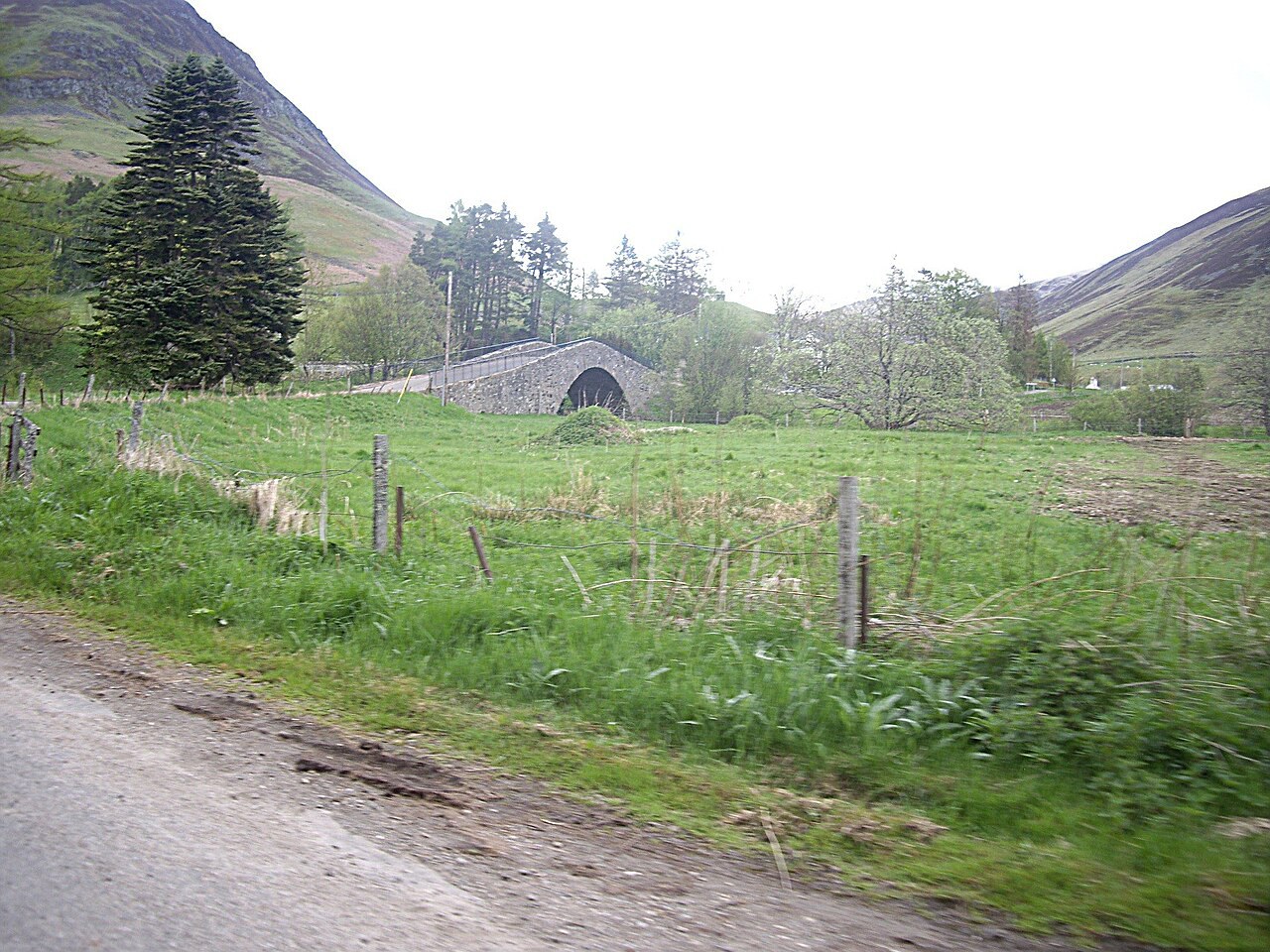
At the head of Glen Shee
Spittal of Glenshee
A small settlement where two glens meet beneath Ben Gulabin, with glacier-shaped ground, historic crossings and paths leading into the hills.
- Best for
- Glacial landforms and hill walking
- Give it
- One to two hours for the short geology circuit
- Don't miss
- The old bridge, standing stone and Grave of Diarmid
Photo: Stanley Howe · CC BY-SA 2.0 · cropped
The Fox verdict
A compact base for a much bigger landscape
Spittal rewards visitors who plan around its dispersed food stops and choose a walk to match the time and conditions.
The immediate appeal is the glacier-shaped meeting of Glen Lochsie and Gleann Beag. A short interpreted circuit, listed church and military bridge provide manageable stops, while the Cateran Trail, Dalmunzie railway walk and Cairnwell activities extend the day.
Where to go
Places in Spittal of Glenshee
Every place below is checked against a published source, listed with what it is and how long to give it.
Local signatures
3 placesDalmunzie Castle Hotel Restaurant and Bar
Country-house dining and a bar in a former laird's mansion on a 6,500-acre estate, with Scottish cooking shaped by seasonal produce.
- Visit length
- Editorial estimate: Allow around 90 minutes
- Locality
- a side road into Glen Lochsie
Glenshee Snowsports Centre
A winter skiing and snowboarding centre whose summer offer includes the Cairnwell chairlift, sightseeing, walking access, geocaching and nature spotting.
- Visit length
- Editorial estimate: Allow around 3 hours
- Locality
- at the Cairnwell
- Access
- The summer Cairnwell chairlift is weather-dependent.
Glenshee Cafe and Gift Shop
Freshly prepared food, homemade bakes and hot drinks alongside local produce, everyday essentials, Glenshee keepsakes and a tourist-information point.
- Visit length
- Editorial estimate: Allow around 60 minutes
- Locality
- elsewhere in Glen Shee
- Access
- Dogs are welcome in the café.
Food & drink
1 placeTea@TheShee
A licensed cafe serving breakfasts, pies, soups, burgers, salads, sandwiches and cakes or traybakes, with gluten-free, vegetarian and vegan options.
- Visit length
- Editorial estimate: Allow around 60 minutes
- Locality
- at Glenshee Snowsports Centre
Walks & outdoors
3 placesThe Last Glaciers in Glenshee
An easy self-guided circuit interpreting the U-shaped glen, kame terraces, kettle holes and moraines, with the Grave of Diarmid on the route.
- Visit length
- Editorial estimate: Allow 1-2 hours
- Locality
- from Spittal
- Access
- The circuit mixes paths with some pathless ground, and there are no facilities on the route.
Glenlochsie Lodge and Old Railway Walk
A route to the ruined shooting lodge, returning along the formation of the 1920s narrow-gauge railway and passing an old bridge over a waterfall.
- Visit length
- Editorial estimate: Allow 1.5-2 hours
- Locality
- from Dalmunzie Castle Hotel
- Access
- River crossings can be difficult after heavy rain.
Cateran Trail: Kirkmichael to Spittal
A Cateran Trail stage reaching the circuit's 648 m high point at An Lairig before descending into wild Glenshee.
- Visit length
- Editorial estimate: allow around 5 hours
- Locality
- Kirkmichael to Spittal of Glenshee
History & heritage
3 placesGlenshee Church of Scotland
A Category B listed rubble-built church erected in 1831, with round arches and a bellcote; the churchyard wall carries a bronze memorial with 27 names from Persie and Glenshee.
- Visit length
- Editorial estimate: Allow around 30 minutes
- Locality
- Spittal of Glenshee
Spittal of Glenshee Standing Stone
A prehistoric stone standing 1.8 m high, with shallow semicircular notches cut into its edges for an unknown purpose.
- Visit length
- Editorial estimate: Allow around 15 minutes
- Locality
- about 17.5 m west of Glenshee Church
Glenshee Bridge
A Category A listed, single-arch, rubble-built and hump-backed bridge, probably built for the military road between 1749 and 1763 under Major William Caulfeild's programme.
- Visit length
- Editorial estimate: Allow around 20 minutes
- Locality
- the old route through the village
- Access
- The bridge remains in vehicular use.
No places match this filter. Choose All places to reset the list.
Three ways to explore Spittal of Glenshee
Signature outings
A Landscape Shaped by Glaciers
Take the Ecomuseum's self-guided geology walk with Dr Richard Tipping's audio commentary, tracing evidence of the glaciers through the glen.
Caulfeild's Military Bridge
Stand above the Shee Water on the former Braemar–Blairgowrie military route; bridges of this design were built to carry troops, horses and wagons.
The Line to Glenlochsie
After heavy rain, follow the old railway line both ways to avoid difficult river fords on the Glenlochsie Lodge walk.
The village story
At the Head of Glen Shee: Walks, Old Roads and Glacial Ground
Glacier-cut slopes, old routes and dispersed stops at the head of Glen Shee.
Mountain Setting and Estate Dining
Ben Gulabin rises straight out of the village to 806 metres, and from the south-east it shows the profile that gave it its name: a snout, the snouty mountain. Spittal sits at its foot, at the head of Glen Shee, where Glen Lochsie and Gleann Beag come together and their streams become the Shee Water. The slopes around you are steep and glacier-cut.
Food stops are scattered along the glen, so plan where to eat. The old Spittal of Glenshee Hotel burned down in 2014, leaving little accommodation in the settlement. Dalmunzie Castle Hotel, up a side road into Glen Lochsie, is a turreted, crow-stepped shooting lodge in Scots Baronial style on a 6,500-acre estate. Its sample dinner menu ranges from pheasant, mushroom and truffle pithivier and Persie Gin-cured sea trout to venison loin with fondant potato and miso-braised celeriac, with brandy-soaked raspberry panna cotta for dessert.
Cafes and Walking Routes
For a café meal, drive north on the A93 to the snowsports centre, where Tea@TheShee is licensed and serves breakfasts, pies, soups, burgers and traybakes, with meat from Braemar butcher Neil Menzies and baking from Tower Bakery in Perth. Further down the glen, the Glenshee Café pairs homemade bakes and hot drinks with a gift shop, a small farm shop and a tourist-information point, and welcomes dogs.
Walking routes start in and around Spittal. The Cateran Trail passes through: eight miles from Kirkmichael over An Lairig, then fourteen miles on to Kirkton of Glenisla past Forter Castle and Auchintaple Loch. For a shorter outing, the Last Glaciers circuit runs three kilometres from the village past kame terraces, kettle holes, moraines and the four-stone Grave of Diarmid. The four-mile Glenlochsie Lodge walk begins at the estate hotel driveway in Glen Lochsie, reaches the lodge ruins and returns along the bed of a railway built into the hillside in the 1920s. After heavy rain, follow the railway line both ways to avoid difficult river crossings.
Church, Standing Stone and Place Name
Glenshee Church, plain and rubble-built with a bellcote, went up in 1831 on the site of an earlier chapel of ease. Set into its churchyard wall is a bronze memorial carrying twenty-seven names from Persie and Glenshee, moved here from the disused Cray Church in 2009. About seventeen metres west of the church stands a prehistoric stone, 1.8 metres high, its edges cut with shallow semicircular notches that no one has been able to explain. The village name itself records a hospice, an inn for travellers on the Blairgowrie–Braemar road; the earliest written form found is from 1542, and Glen Shee has been read as either the glen of peace or the glen of fairies.
Roads, Bridge and Public Transport
The A93 still climbs north over the Cairnwell, with snow gates at Spittal that close the road in bad weather, and the current route bypasses the village and its old bridge. The notorious double hairpin, the Devil's Elbow, lay further up the climb on the road's former line; the Earl of Dundee recalled attempting it in the House of Lords in 1968: "I got so flummoxed that I went into reverse." Below the village, Glenshee Bridge—single-arch, hump-backed and still carrying traffic—was built for the military road between 1749 and 1763. No railway reaches Spittal; Pitlochry is the nearest railhead. Ember's E11 links Spittal of Glenshee Road End with Blairgowrie, Dundee and Aberdeen; the Spittal stop requires advance booking.
The Summer Chairlift
The Cairnwell chairlift carries summer visitors up the hill when weather allows, and dogs can ride too.
Stay around Cairngorms
Make a longer stay of it
Travel Fox holiday homes around Cairngorms, linked directly to their property pages.
For homeowners
Own a holiday home near Spittal of Glenshee?
We manage holiday lets across the UK from 12% commission, charged after cleaning costs, with no lock-in. A co-founder visits before you decide.
How our holiday let management works →
A guide with a point of view
Written from research. Edited for real journeys.
Use the Official site links for live practical details, then use this guide for context, ideas and room to explore.
Photography credits & licences
Third-party photographs are credited to their named creators and reused under the linked Creative Commons licence or public-domain dedication. Travel Fox stores an optimised local copy; the file-specific changes and any browser-applied display crop are disclosed below. Reused photographs link both to the Wikimedia Commons source record and to the declared source image; Travel Fox's own photographs carry no such record and are marked as ours. These image licences do not cover Travel Fox text, branding or page design.
- File:Old stone bridge at Spittal of Glenshee - geograph.org.uk - 3510984.jpg — photograph by Stanley Howe; Old stone bridge at Spittal of Glenshee by Stanley Howe. Source record on Wikimedia Commons. Declared source image. Licence: CC BY-SA 2.0. File changes: Downloaded from Wikimedia Commons, resized to a maximum 1920px edge and encoded as an optimised JPEG. Display changes: Displayed with responsive CSS cropping.
Sources
Every place on this page is checked against a published source. Each entry links the record we used and names who publishes it.
- The Last Glaciers in Glenshee — cateranecomuseum.co.uk other published source
- Glenshee Church of Scotland — trove.scot other published source record not machine-readable; publisher restricts automated access
- Spittal of Glenshee Standing Stone — trove.scot other published source record not machine-readable; publisher restricts automated access
- Glenshee Bridge — trove.scot other published source record not machine-readable; publisher restricts automated access
- Dalmunzie Castle Hotel Restaurant and Bar — dalmunzieestate.com operator, sector body or destination organisation
- Glenlochsie Lodge and Old Railway Walk — dalmunzieestate.com operator, sector body or destination organisation
- Cateran Trail: Kirkmichael to Spittal — pkct.org other published source
- Glenshee Snowsports Centre — ski-glenshee.co.uk operator, sector body or destination organisation
- Tea@TheShee — ski-glenshee.co.uk other published source
- Glenshee Cafe and Gift Shop — glensheecafe.com operator, sector body or destination organisation