
At the edge of the High Moor
Gidleigh
A scattering of farmsteads and cottages around a granite church, with the upper Teign and open moorland close by.
- Best for
- Moorland walks and prehistoric sites
- Walking pick
- The 2–2½-hour Kestor Rocks circular
- Don't miss
- Scorhill Stone Circle
Photo: Andrewrabbott · CC BY-SA 4.0 · cropped
The Fox verdict
A quiet springboard for the High Moor
Gidleigh is a scattered parish at the wooded edge of the moor, where the strongest reasons to linger are its church, upper-Teign landscape and nearby prehistoric sites.
Start with Holy Trinity's granite fabric and ornate rood screen, then choose between the rustic Northmore Arms, fine dining at Gidleigh Park, or a climb onto Gidleigh Common for Scorhill Stone Circle and the North Teign landmarks below it.
Where to go
Places in Gidleigh
Every place below is checked against a published source, listed with what it is and how long to give it.
Local signatures
3 placesNorthmore Arms
An unspoilt rustic country pub with home-cooked food, a terraced garden, Dartmoor IPA and Dartmoor Jail Ale served straight from the cask, and two local real ciders.
- Visit length
- Editorial estimate: Allow around 90 minutes
- Locality
- Wonson, Throwleigh parish
- Access
- Booking is advised for food, especially in summer.
Gidleigh Park
A luxury country house hotel with a Michelin-starred restaurant, where seasonal fine dining draws on produce from its own kitchen garden.
- Visit length
- Editorial estimate: Allow around 2 hours
- Locality
- Upper River Teign at the edge of the moor
Teign-e-Ver Bridge and the Tolmen Stone
A clapper bridge over the North Teign and a nearby holed Tolmen stone associated in local legend with healing and fertility rituals.
- Visit length
- Editorial estimate: Allow around 30 minutes
- Locality
- North Teign near Scorhill Stone Circle
Walks & outdoors
1 placeKestor Rocks, Scorhill and Gidleigh Circular
A moderate moorland loop of about 6.9 kilometres with roughly 269 metres of ascent, linking Kestor Rock, Scorhill Stone Circle and brooks used for wild swimming.
- Visit length
- Editorial estimate: Allow 2–2½ hours
- Locality
- Kestor Rock, Scorhill and Gidleigh
History & heritage
2 places
Holy Trinity Church
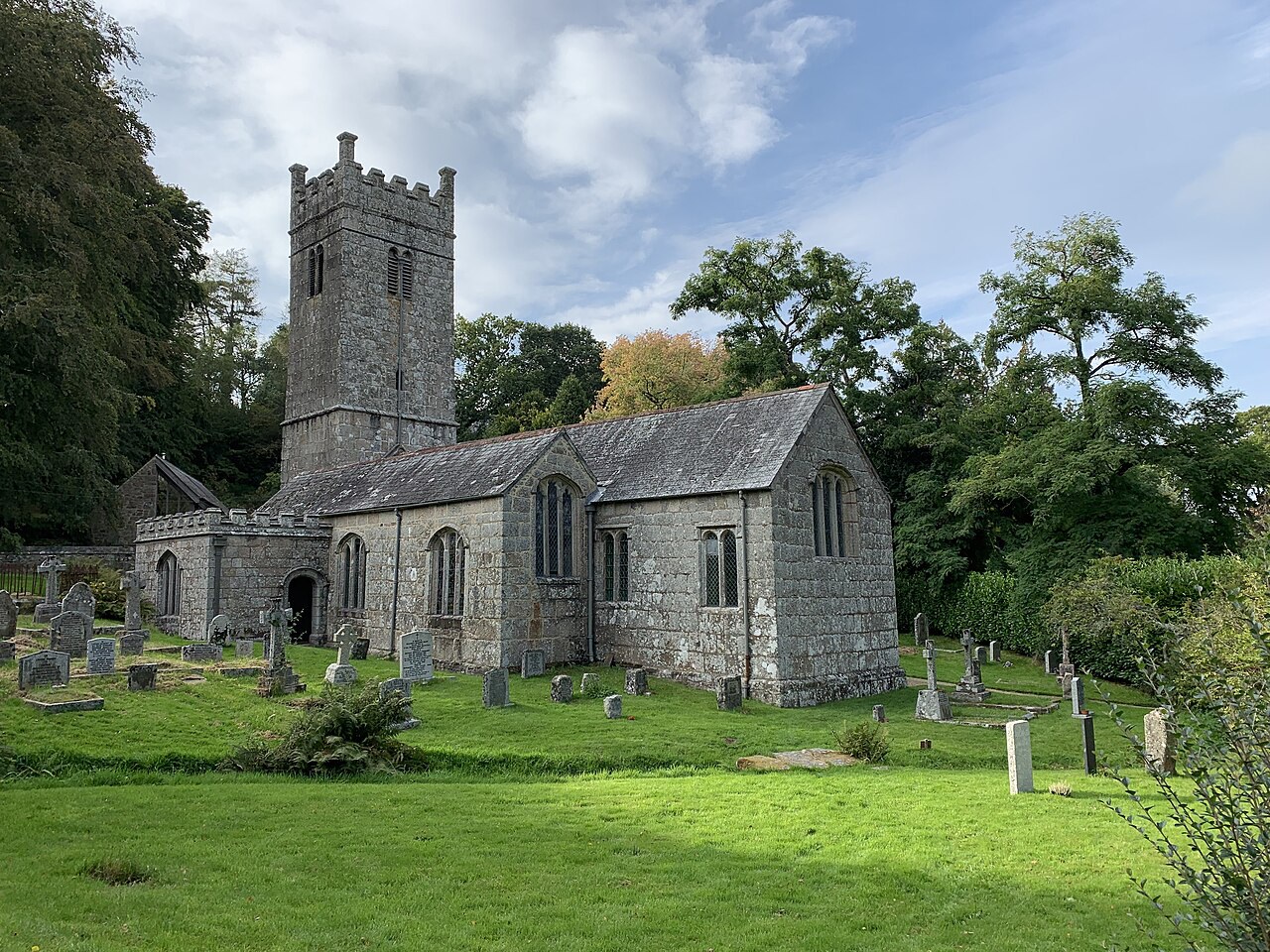
A late-15th- to early-16th-century granite parish church with an ornate rood screen, a 15th-century font and a coffin-shaped churchyard stone carved with a Cross of Lorraine.
- Visit length
- Editorial estimate: Allow around 30 minutes
- Locality
- Around Holy Trinity church
Scorhill Stone Circle
A Bronze Age circle 26.8 metres across, with 34 stones remaining from an estimated original 65–70; it is the only unrestored Dartmoor circle and is described as the finest example in Devon.
- Visit length
- Editorial estimate: Allow around 45 minutes at the circle
- Locality
- Gidleigh Common
- Access
- The approach is a steep ascent onto open moorland.
No places match this filter. Choose All places to reset the list.
Three ways to explore Gidleigh
Signature outings
See Dartmoor's unrestored circle
Scorhill's 34 surviving stones form an 88-foot Bronze Age ring on Gidleigh Common.
Find colour in Holy Trinity
The ornate 15th-century rood screen was repainted in red, gold and blue in 1853.
Walk by Kestor and Scorhill
The moderate 6.9-kilometre circular links Kestor Rock, the stone circle and moorland brooks in around 2–2½ hours.
The village story
Gidleigh Village Guide
From a ruined medieval keep and granite church to Scorhill's standing stones, Gidleigh's story follows the young Teign towards the High Moor.
Castle, church and the village
Next to Holy Trinity church stands a crumbling granite tower, which is all that is left of Gidleigh Castle. It was a small fortified manor rather than a castle in any grand sense — the solosophie travel guide calls the name "a bit of a misnomer... all that remains of the original building is a crumbling tower." The Prouz family built it and held the manor from William the Conqueror to Edward II. It is in private hands now, keeping the church company.
That is more or less the centre of Gidleigh, which is less a village than a scattering of farmsteads and cottages tucked into a wooded copse on the very edge of the High Moor. It sits on the upper River Teign, where the water is still shallow and fast. There is no shop. There is no pub. For both you go to Chagford, a stannary town about two miles off.
Two places to eat
The nearest pub is the Northmore Arms, a mile away at Wonson, over the parish boundary and roughly a twenty-minute walk from the church. CAMRA calls it "an unspoilt rustic pub with traditional values and a hospitable welcome." Dartmoor IPA and Dartmoor Jail Ale come straight from the cask, alongside two local ciders, Sam's Medium and Sam's Autumn Scrumpy. Home-cooked food is on again, though you will want to book in summer. There is a terraced garden.
At the other end of things entirely is Gidleigh Park, a Relais & Châteaux country house hotel in 107 acres on the upper Teign, with a Michelin star it held onto in 2025. The restaurant opens Tuesday to Saturday, six till nine, much of what reaches the plate grown in the hotel's own kitchen garden. Ian Webber, who trained here under Michael Caines, came back as chef in early 2025.
Stone circle and river crossings
The real reason to come is the moor above the village. A steep climb onto Gidleigh Common brings you to Scorhill Stone Circle, a Bronze Age ring 88 feet across with 34 stones remaining of an estimated 65 or 70. It is the only unrestored circle on Dartmoor and generally reckoned the finest in Devon. Wild ponies graze around it.
Below the circle a clapper bridge crosses the North Teign at Teign-e-Ver, and near it sits the Tolmen Stone, a holed rock people once crawled through for healing and fertility. The tradition survives as legend. The Kestor Rocks circular, about seven kilometres, takes in the tor, the circle and the moorland brooks, which are popular for wild swimming.
Holy Trinity and Gidleigh's past
Holy Trinity itself is granite, fifteenth-century, with an ornate rood screen repainted in red, gold and blue in 1853. The font cover was made in 1843 by the parish clerk, Charles Finch. Somewhere in the churchyard is a moss-covered, coffin-shaped tombstone carved with a Cross of Lorraine, which may mark a Crusader knight.
The Domesday surveyors valued the whole place at five shillings. It was held then by Godwin the priest. The population peaked at 180 in the mid-1800s and stood at 116 in 2001. A youth hostel ran here from 1932 to 1988.
The village today
Michael Jecks set a medieval murder here, "The Mad Monk of Gidleigh." The village hall still serves the hundred-odd people who live around the church, the ruined keep, and the sound of the young Teign going past.
Stay around Dartmoor
Make a longer stay of it
Travel Fox holiday homes around Dartmoor, linked directly to their property pages.
A guide with a point of view
Written from research. Edited for real journeys.
Use the Official site links for live practical details, then use this guide for context, ideas and room to explore.
Photography credits & licences
Third-party photographs are credited to their named creators and reused under the linked Creative Commons licence or public-domain dedication. Travel Fox stores an optimised local copy; the file-specific changes and any browser-applied display crop are disclosed below. Reused photographs link both to the Wikimedia Commons source record and to the declared source image; Travel Fox's own photographs carry no such record and are marked as ours. These image licences do not cover Travel Fox text, branding or page design.
- File:Holy Trinity Church, Gidleigh.jpg — photograph by Andrewrabbott; Own work. Source record on Wikimedia Commons. Declared source image. Licence: CC BY-SA 4.0. File changes: Downloaded from Wikimedia Commons, resized to a maximum 1920px edge and encoded as an optimised JPEG. Display changes: Displayed with responsive CSS cropping.
Sources
Every place on this page is checked against a published source. Each entry links the record we used and names who publishes it.
- Holy Trinity Church — historicengland.org.uk statutory register or public authority record not machine-readable; publisher restricts automated access
- Northmore Arms — camra.org.uk operator, sector body or destination organisation
- Gidleigh Park — gidleigh.co.uk operator, sector body or destination organisation
- Scorhill Stone Circle — historicengland.org.uk statutory register or public authority record not machine-readable; publisher restricts automated access
- Teign-e-Ver Bridge and the Tolmen Stone — historicengland.org.uk statutory register or public authority record not machine-readable; publisher restricts automated access
- Kestor Rocks, Scorhill and Gidleigh Circular — dartmoor.gov.uk statutory register or public authority record not machine-readable; publisher restricts automated access