
The hidden toun
Haddington
A Royal Burgh and market town on the River Tyne, with Scotland's longest parish church, level riverside paths and nearby hillfort and castle ruins.
- Best for
- Medieval history, riverside walking and independent shops
- Give it
- A town visit, or longer with the nearby walks
- Don't miss
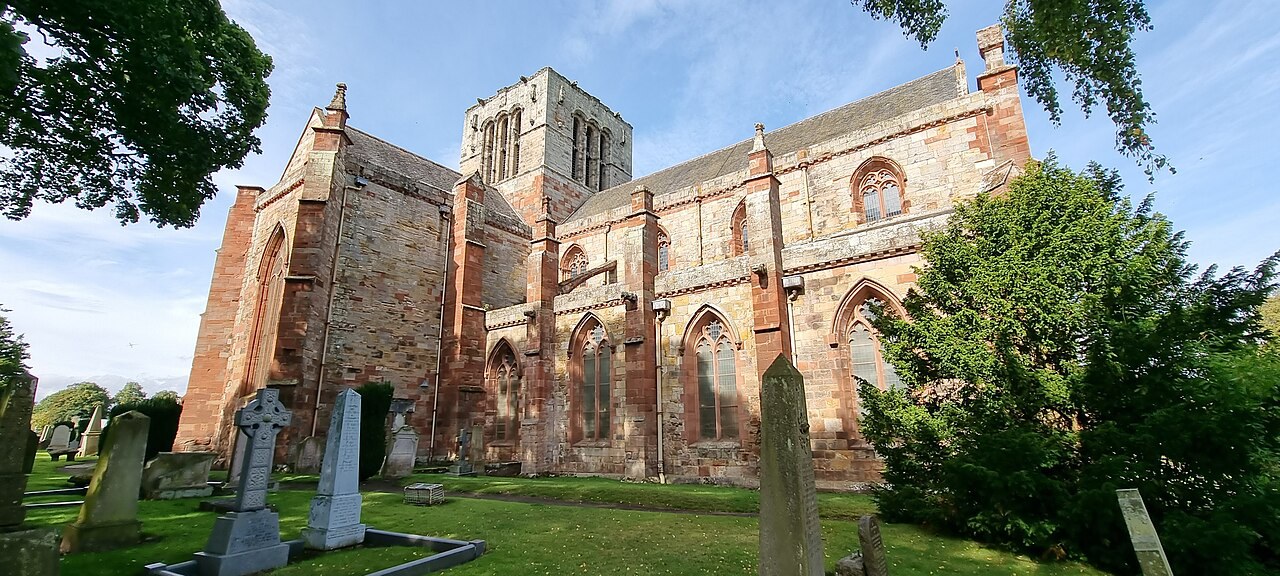
- St Mary's, Scotland's longest parish church
Photo: Auldcathy · CC BY-SA 4.0 · cropped
The Fox verdict
A market town shaped by the Tyne
Haddington brings together a Royal Burgh story, a broad independent-shopping core and gentle riverside walking.
Start with the River Tyne and St Mary's Collegiate Church, then choose between the monthly producers' market, a restored garden and the John Gray Centre. Traprain Law and Hailes Castle extend the visit into the surrounding landscape and history.
Where to go
Places in Haddington
Every place below is checked against a published source, listed with what it is and how long to give it.
Local signatures
3 placesHaddington Farmers' Market
A regular producers' market reflecting Haddington's long agricultural heritage as the county town of a rich farming county.
- Visit length
- Editorial estimate: around 60 minutes
- Locality
- Haddington
- Access
- Held on the last Saturday of every month.
St Mary's Pleasance
A restored 17th-century-style garden adjacent to Haddington House, which dates from 1648.
- Visit length
- Editorial estimate: around 45 minutes
- Locality
- adjacent to Haddington House
John Gray Centre
A museum, library, archive and tourist information point gathered under one roof.
- Visit length
- Editorial estimate: around 60 minutes
- Locality
- Haddington
Walks & outdoors
2 placesRiver Tyne Riverside Walk
A gentle, level town-and-river walk following the Tyne through and around Haddington, with wildlife along the way.
- Visit length
- Editorial estimate: around 60 minutes
- Locality
- along the Tyne through and around Haddington
Traprain Law
A walkable Iron Age hillfort rising to 220 metres, with panoramic views over the Lothian plain and coast.
- Visit length
- Editorial estimate: around 120 minutes
- Locality
- east of Haddington
History & heritage
2 places
St Mary's Collegiate Church
Scotland's longest parish church at 206 feet, with a choir, transepts and tower that stood roofless for over 400 years before the 1971-73 restoration.
- Visit length
- Editorial estimate: around 60 minutes
- Locality
- at the edge of the medieval core
Hailes Castle
A riverside medieval ruin on the Tyne, about five miles away and reachable via Tyne-side paths.
- Visit length
- Editorial estimate: around 75 minutes
- Locality
- on the banks of the Tyne
No places match this filter. Choose All places to reset the list.
Three ways to explore Haddington
Signature outings
Scotland's longest parish church
See the 206-foot church whose tower, transepts and choir stood roofless for over 400 years before their 1970s restoration.
Traprain Law's hillfort views
Walk up the 220-metre Iron Age hillfort for panoramic views over the Lothian plain and coast.
A riverside castle ruin
Find Hailes Castle on the banks of the Tyne, about five miles from Haddington and reachable by Tyne-side paths.
The town story
Haddington Town Guide
A market-town story moving from the Waterside and High Street to the Tyne, St Mary's and the flood marks of 1948.
Waterside food and old coaching names
The Waterside Bistro sits in an old riverside building on the Waterside, directly beneath the 12th-century Nungate Bridge, in the quarter of Haddington that lies across the River Tyne. It is one of the town's best-known places to eat, and the river runs a few feet from the door. This is the low, old part of town, and it is a good place to start before crossing back over the water to the High Street.
The town keeps a fair number of pubs. The Tyneside Tavern stands at 10 Poldrate, near the old Poldrate Mill, and the Victoria Inn is a traditional pub at 9 Court Street. Maitlandfield House Hotel on Sidegate has a bar and restaurant. Along the broad High Street the old coaching names survive on the buildings — the Mercat Hotel, the George Hotel, the Golf Tavern on Bridge Street — a reminder that this was a stop on the road north long before the A1 was pushed round the edge of town.
Market streets and Tyne-side walks
The centre runs along the High Street and Market Street, wide streets with an agricultural-market feel and a good mix of independent shops, cafes and restaurants. On the last Saturday of every month a farmers' market fills part of it, which fits a place that spent centuries as the county town of some of Scotland's richest farmland.
The Tyne shapes the walking as much as the town. Level riverside paths follow the water past the Nungate Bridge, the Waterside and Poldrate, good for an easy hour with children or a dog. The John Muir Way, the coast-to-coast route named for the Dunbar-born naturalist, passes close by. For something more ambitious, Traprain Law rises four miles east — an Iron Age hillfort at 220 metres with long views over the Lothian plain to the coast. Hailes Castle, a riverside ruin, sits about five miles off along the Tyne.
St Mary's and the Royal Burgh
St Mary's Collegiate Church stands at the edge of the medieval core. At 206 feet it is the longest parish church in Scotland, longer than St Giles' in Edinburgh by a couple of feet. Damaged in the English siege of 1548, its tower, transepts and choir stood roofless for over four hundred years until a restoration in the early 1970s set clear glass in the choir. Jane Welsh Carlyle is buried inside. John Knox, who was probably born just across the river in the Nungate, trained here as a priest.
Haddington was made a Royal Burgh under David I and was once the fourth-biggest town in Scotland; Alexander II was born here in 1198. It burnt down more than once, including in 1598, when the fire was blamed on a careless maidservant.
Connections, Lennoxlove and flood memory
The nearest station is Drem, four miles north, and East Coast and Borders buses serve the town. Lennoxlove House, half a mile south, keeps Mary, Queen of Scots' death mask and silver casket.
On the walls of the town centre, painted marks record how high the Tyne rose in the flood of 1948. People still point them out.
Stay around East Lothian
Make a longer stay of it
Travel Fox holiday homes around East Lothian, linked directly to their property pages.
For homeowners
Own a holiday home near Haddington?
We manage holiday lets across the UK from 12% commission, charged after cleaning costs, with no lock-in. A co-founder visits before you decide.
How our holiday let management works →
A guide with a point of view
Written from research. Edited for real journeys.
Use the Official site links for live practical details, then use this guide for context, ideas and room to explore.
Photography credits & licences
Third-party photographs are credited to their named creators and reused under the linked Creative Commons licence or public-domain dedication. Travel Fox stores an optimised local copy; the file-specific changes and any browser-applied display crop are disclosed below. Reused photographs link both to the Wikimedia Commons source record and to the declared source image; Travel Fox's own photographs carry no such record and are marked as ours. These image licences do not cover Travel Fox text, branding or page design.
- File:St. Mary's Collegiate Church, Haddington 05.jpg — photograph by Auldcathy; Own work. Source record on Wikimedia Commons. Declared source image. Licence: CC BY-SA 4.0. File changes: Downloaded from Wikimedia Commons, resized to a maximum 1920px edge and encoded as an optimised JPEG. Display changes: Displayed with responsive CSS cropping.
Sources
Every place on this page is checked against a published source. Each entry links the record we used and names who publishes it.
- St Mary's Collegiate Church — scotlandschurchestrust.org.uk other published source
- River Tyne Riverside Walk — eastlothian.gov.uk statutory register or public authority
- Haddington Farmers' Market — visiteastlothian.org operator, sector body or destination organisation
- St Mary's Pleasance — portal.historicenvironment.scot statutory register or public authority
- John Gray Centre — eastlothian.gov.uk statutory register or public authority
- Traprain Law — eastlothian.gov.uk statutory register or public authority
- Hailes Castle — historicenvironment.scot statutory register or public authority record not machine-readable; publisher restricts automated access