
Roman capital, Norman keep
Colchester
Follow first-century walls, explore the castle above the Temple of Claudius and find Civil War scars among Colchester's historic buildings.
- Best for
- Roman and Norman history
- Give it
- The castle, wall and riverside park
- Don't miss
- The Norman keep above the Temple of Claudius vaults
Photo: Neil Theasby · CC BY-SA 2.0 · cropped
The Fox verdict
Britain's first Roman capital in plain sight
Colchester layers a Norman keep over a Roman temple and sets both beside surviving town walls, a Victorian park and the River Colne.
The castle and its Roman collections are the reason to slow down, but the two-mile wall circuit, Balkerne Gate and the reused Roman brick of St Botolph's Priory make the wider town part of the visit. Historic pubs add theatrical interiors, real ales and traces of the 1648 siege.
Where to go
Places in Colchester
Every place below is checked against a published source, listed with what it is and how long to give it.
Local signatures
3 placesCastle Park
An award-winning Victorian park with gardens, events and riverside paths that lead down to the River Colne.
- Visit length
- Editorial estimate: allow around 1 hour
- Locality
- below the castle
The Purple Dog
One of the older town-centre taverns, serving traditional pub food with an award-winning selection of ales, lagers and wines.
- Visit length
- Editorial estimate: allow around 75 minutes
- Locality
- in the heart of the town
Colchester Zoo
A major visitor attraction on the edge of Colchester.
- Visit length
- Editorial estimate: allow around 3 hours
- Locality
- on the town's edge
Food & drink
2 placesThe Victoria Inn
A traditional pub specialising in rotating guest ales, real cider and craft beer, with live music and a large all-year-round beer garden.
- Visit length
- Editorial estimate: allow around 75 minutes
- Locality
- Colchester
The Playhouse
A Wetherspoon pub in a converted theatre building that retains the original stage and balcony.
- Visit length
- Editorial estimate: allow around 75 minutes
- Locality
- Colchester
History & heritage
4 placesColchester Castle Museum
The largest Norman keep ever built in Europe houses extensive Roman collections above the surviving vaults of the Temple of Claudius.
- Visit length
- Editorial estimate: allow around 2 hours
- Locality
- in the Norman keep
Roman Wall Circuit
A walk following the line of the Roman defences, with substantial upstanding wall sections along Balkerne Hill and behind Castle Park.
- Visit length
- Editorial estimate: allow around 2 hours
- Locality
- along Balkerne Hill and behind Castle Park
Balkerne Gate
The largest and oldest surviving Roman gateway in Britain forms part of Colchester's first-century town walls.
- Visit length
- Editorial estimate: allow around 30 minutes
- Locality
- on the first-century town walls
St Botolph's Priory
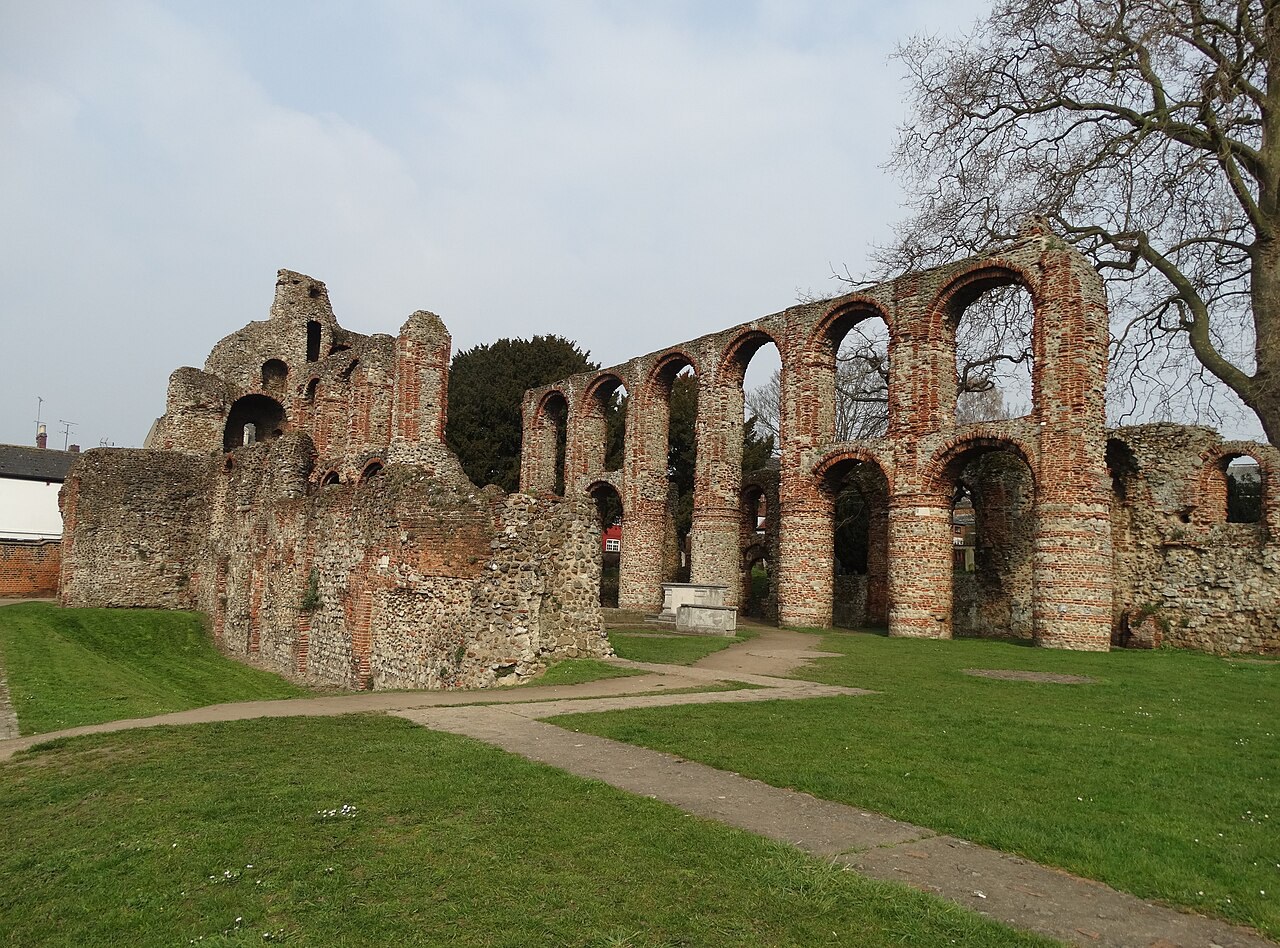
The Grade I ruins preserve a striking Early Norman west front built largely from reused Roman brick and damaged during the 1648 siege.
- Visit length
- Editorial estimate: allow around 45 minutes
- Locality
- Colchester
No places match this filter. Choose All places to reset the list.
Three ways to explore Colchester
Signature outings
Castle over temple
Explore the largest Norman keep ever built in Europe and its Roman collections above the Temple of Claudius vaults.
Norman priory, Roman brick
Examine the Early Norman west front of St Botolph's Priory, built largely with reused Roman brick and later ruined in the 1648 siege.
Walk the Roman wall
Follow the roughly two-mile line of the Roman town wall, including substantial upstanding sections along Balkerne Hill and behind Castle Park.
The town story
Colchester Town Guide
Musket scars, Roman walls, a Norman keep and a Victorian water tower tell Colchester's story across seven locked paragraphs.
Siege Marks and Colchester Pubs
The timber frame of the Old Siege House is pocked with musket-ball holes from the 1648 siege. Someone has ringed and marked them around the doorway, so you can stand in the street and count the places the fighting reached. Inside it is now a bar and brasserie serving modern European food with English influences, in a half-timbered building that has been standing since the seventeenth century.
Colchester gives you more pubs than a weekend can reasonably work through. The Victoria Inn runs rotating guest ales and real cider, with a large beer garden that hosts live music outside in summer. The Purple Dog, one of the older taverns in the centre, keeps an award-winning selection of ales, lagers and wines and welcomes dogs. Church Street Tavern puts a bar downstairs and a Michelin-recommended restaurant upstairs, and is known for its Sunday roasts. If you want to see where the beer is made, Other Monkey Brewing pours its own pale ale from a contemporary taproom, and Three Wise Monkeys runs a weekend bottomless brunch of prosecco, craft beer and G&T. The Playhouse, the local Wetherspoon, occupies a converted theatre and has kept the original stage and balcony.
Oysters, Lanes and Roman Walls
The town was famous for its oysters long before any of this. Native oysters from the Colne fishery and nearby Mersea Island have been prized since Roman and Tudor times, prised open and eaten for so many centuries that the Romans burned the shells in their lime kilns. For less historic shopping, the Dutch Quarter and the lanes around Eld Lane and Trinity Street hold the independent shops, alongside a full market and high street.
For walking, the Roman wall circuit follows the line of the first-century town defences for roughly two miles, with substantial upstanding stretches along Balkerne Hill and behind Castle Park. The Balkerne Gate at one end is the largest and oldest surviving Roman gateway in Britain. From Castle Park the riverside paths drop down to the Colne, below the Norman castle and the wall remains.
Castle Above the Temple
That castle is the reason to slow down. Begun around 1076 and finished by about 1100, it is the largest Norman keep ever built in Europe, and it sits on the vaulted foundations of the Temple of Claudius — Britain's largest classical temple, which Tacitus called the "stronghold of everlasting domination." The keep now houses the town's Roman collections. All of this stands on Camulodunum, the first capital of Roman Britain and the oldest recorded town in the country, which Boudica's rebels burned to the ground around AD 60. Archaeologists still find the ash.
Arriving and Looking North
Trains from the mainline station reach London Liverpool Street in about an hour, and the A12 bypasses the town on its way between London and Ipswich. Dedham Vale, the Constable country of Flatford Mill, is a short drive north.
Jumbo Above the Town
Above it all stands Jumbo, a 110-foot red-brick water tower finished in 1883, named for its size and once topped with an elephant weathervane. It has outlasted the elephant.
Stay around Essex
Make a longer stay of it
Travel Fox holiday homes around Essex, linked directly to their property pages.
For homeowners
Own a holiday home near Colchester?
We manage holiday lets across the UK from 12% commission, charged after cleaning costs, with no lock-in. A co-founder visits before you decide.
How our holiday let management works →
A guide with a point of view
Written from research. Edited for real journeys.
Use the Official site links for live practical details, then use this guide for context, ideas and room to explore.
Photography credits & licences
Third-party photographs are credited to their named creators and reused under the linked Creative Commons licence or public-domain dedication. Travel Fox stores an optimised local copy; the file-specific changes and any browser-applied display crop are disclosed below. Reused photographs link both to the Wikimedia Commons source record and to the declared source image; Travel Fox's own photographs carry no such record and are marked as ours. These image licences do not cover Travel Fox text, branding or page design.
- File:St Botolph's Priory, Colchester - geograph.org.uk - 4419982.jpg — photograph by Neil Theasby; St Botolph's Priory, Colchester by Neil Theasby. Source record on Wikimedia Commons. Declared source image. Licence: CC BY-SA 2.0. File changes: Downloaded from Wikimedia Commons, resized to a maximum 1920px edge and encoded as an optimised JPEG. Display changes: Displayed with responsive CSS cropping.
Sources
Every place on this page is checked against a published source. Each entry links the record we used and names who publishes it.
- Colchester Castle Museum — colchester.cimuseums.org.uk other published source
- Castle Park — new.colchester.gov.uk statutory register or public authority
- Roman Wall Circuit — historicengland.org.uk statutory register or public authority record not machine-readable; publisher restricts automated access
- Balkerne Gate — historicengland.org.uk statutory register or public authority record not machine-readable; publisher restricts automated access
- St Botolph's Priory — english-heritage.org.uk national body or asset manager
- The Victoria Inn — victoriainncolchester.co.uk operator, sector body or destination organisation
- The Purple Dog — visitcolchester.com operator, sector body or destination organisation
- The Playhouse — jdwetherspoon.com other published source
- Colchester Zoo — colchesterzoologicalsociety.com operator, sector body or destination organisation