
Lochside village, paths and history
Luss
Pier Road leads through Luss’s close-grained planned village to the pier, Loch Lomond, Ben Lomond and wooded islands, while signed paths, the parish church and the beach widen a short visit.
- Village paths
- 15 minutes to one hour
- Circular cruise
- 90 minutes from Luss Pier
- Nearest railway
- Balloch, eight miles south
Photo: Chris McAuley · CC BY-SA 2.0 · cropped
The Fox verdict
Come for the loch axis; stay for the paths, church and village detail.
Luss fits a loch view, signed walks, a nationally important burial ground, local food and a seasonal boat trip into a compact visit.
The strongest visit joins Pier Road and the shore to one or two specific stops rather than treating the flower-fronted settlement as scenery alone. The research also describes Luss as a heavily visited working settlement, so the village’s intimacy and its visitor pressure belong in the same picture.
Where to go
Places in Luss
Every place below is checked against a published source, listed with what it is and how long to give it.
Local signatures
3 placesLuss Pier and circular cruise
The circular sailing has live commentary, open and enclosed decks and a licensed bar. Seasonal explorer and waterbus links also run from Luss, with schedules dependent on season and weather.
- Visit length
- Editorial estimate: 1 hour 30 minutes
- Locality
- Luss Pier
Luss Parish Church (St Mackessog’s)
The Category B-listed 1875 church stands with a separately scheduled old burial ground. Its interior and monuments include Scots-pine roof timbers, stained glass, early-medieval crosses, a medieval font and the 1612 MacFarlane stone; the burial ground contains a rare 11th-century hogback.
- Visit length
- Editorial estimate: 45 minutes
- Locality
- Luss
Luss Distillery
The working gin distillery, shop and visitor centre opened on the repurposed historic Luss Smokehouse site. Ben Lomond Gin is distilled here, and booked options include gin tours, botanical blending, cocktail classes and whisky tastings.
- Visit length
- Editorial estimate: 1 hour 30 minutes
- Locality
- At the south end of the village
Food & drink
1 placeThe Village Rest
This relaxed café/bistro serves homemade, seasonally changing food made with locally sourced produce. The evidenced menus include a full Scottish breakfast, soups, haggis dishes, battered haddock, cakes and scones; well-behaved dogs are allowed and have a dedicated menu.
- Visit length
- Editorial estimate: 1 hour
- Locality
- Luss village
Walks & outdoors
1 placeLuss Village Paths
The full Heritage Path links the village, Luss Water and countryside. A short Glebe Loop addition crosses meadows, old oakwoods and the loch shore.
- Visit length
- Editorial estimate: 1 hour
- Locality
- Behind the church
History & heritage
1 place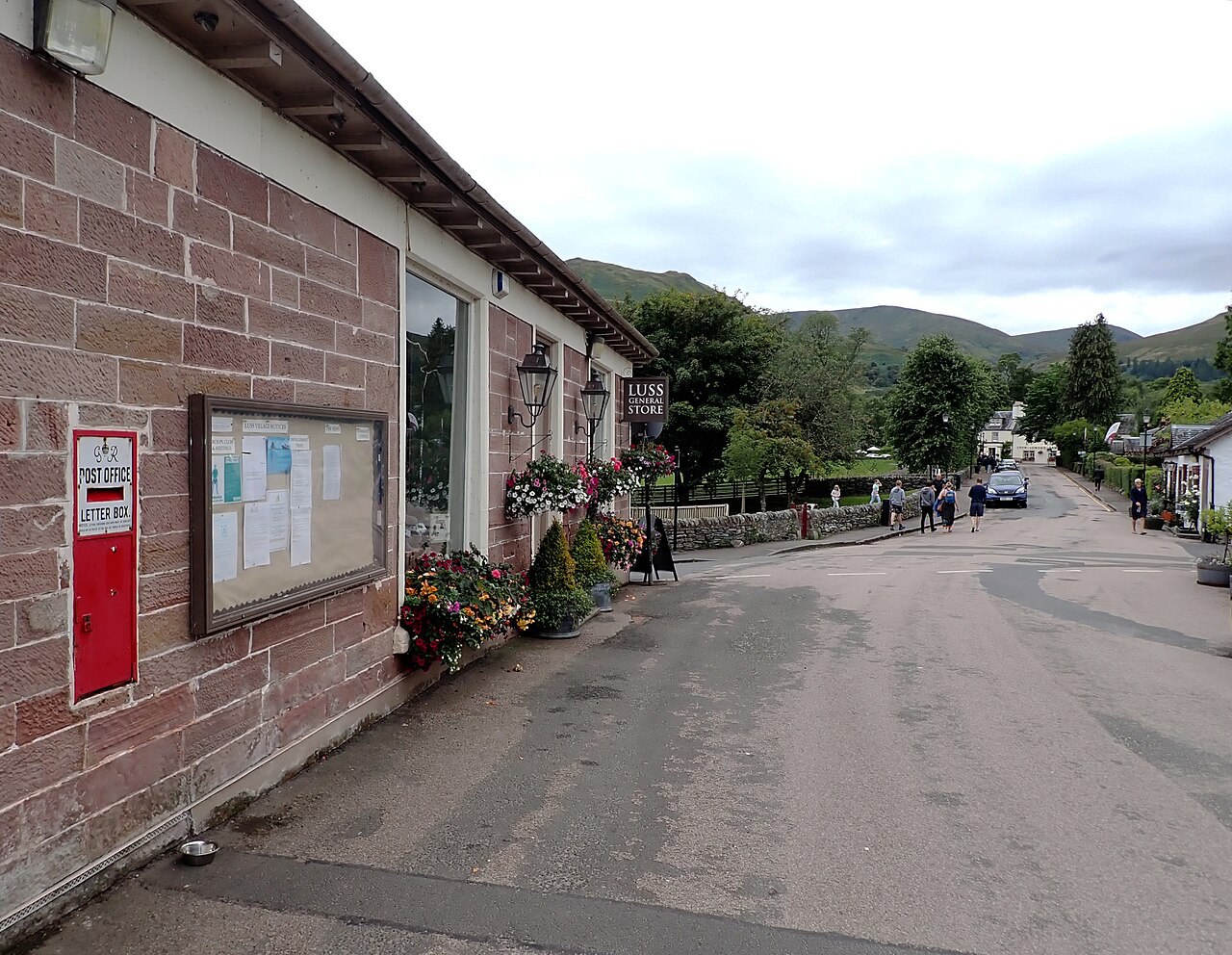
Luss General Store
The Scottish craft, gift and food shop occupies a Category C-listed, single-storey pink-sandstone former post office that appears on the 1864 first-edition Ordnance Survey map. Its range includes Clan Colquhoun goods, leather, cashmere, art, blankets, books, chutneys and preserves.
- Visit length
- Editorial estimate: 20 minutes
- Locality
- Pier Road
Things to do
1 place
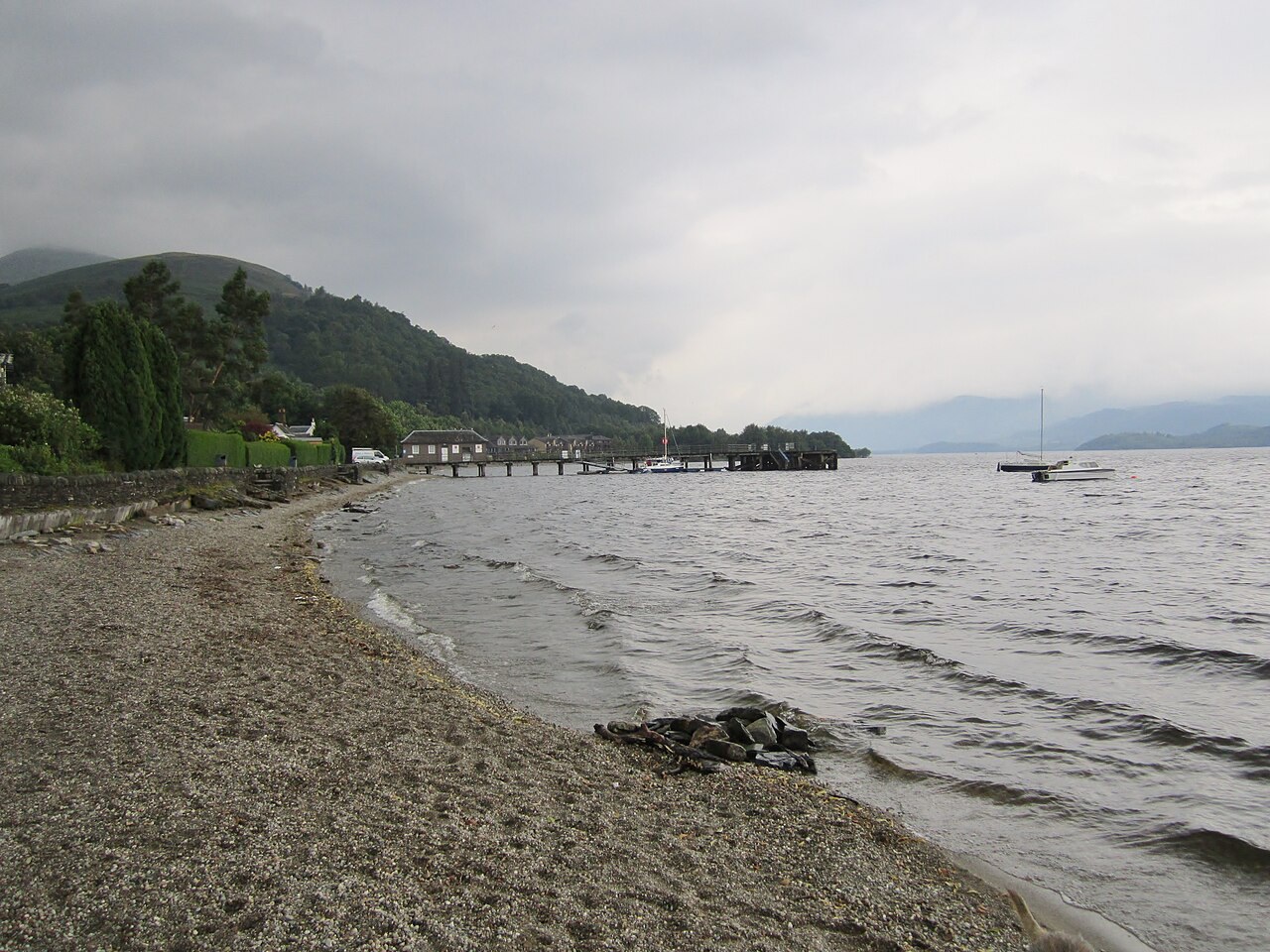
Luss beach
The loch edge mixes sandy and shingle beach with views across the water. The water stays cold, and open-water swimming requires loch-specific caution rather than being treated as supervised.
- Visit length
- Editorial estimate: 45 minutes
- Locality
- Luss beach
No places match this filter. Choose All places to reset the list.
Three ways to explore Luss
Signature outings
A church site with early-medieval depth
The 1875 pink-sandstone church is the third known church on the site, while the scheduled burial ground preserves cross-slabs and a rare 11th-century hogback.
The long beach beneath the loch view
Luss’s sandy and shingle shore works for a picnic or paddle, with the National Park’s cold-water warning kept firmly in view.
The former post office as a village shop
The General Store’s single-storey pink-sandstone building is Category C listed and appears on the first-edition Ordnance Survey map of 1864.
The village story
Luss between the hills and Loch Lomond
The locked article follows the village from Pier Road and its eating places through the planned-village story, church, walking routes, transport and the remembered bay.
A village aimed at the loch
Pier Road runs straight down to the water and aims the eye deliberately: past the last of the cottages, over the pier, across Loch Lomond to Ben Lomond and the wooded islands beyond. You come in from the car park behind, walk down through a close circuit of low rubble cottages — hipped slate roofs, ornate chimneys, small diamond-pane windows, fronts crowded with flowers — and the whole village lays itself out in a short, close-grained sweep. The A82, the trunk road from Glasgow to Fort William, passes behind rather than through the old core, which gives the place a seclusion it has no real right to given the traffic a field away. The hills rise sharply on the west side, conical and smooth with birch filling the gullies; the loch and its beach fill the east. Between them Luss sits on a narrow, almost flat shelf, with Luss Water closing it off to the south.
Most people are here to eat, drink, walk and look at the loch, so it is worth knowing what the village can actually feed you. The single pub is the Loch Lomond Arms, an early nineteenth-century coaching inn whose public bar now trades as The Stag & Two Hounds. There is a fire, a drinks shelf weighted towards local products and spirits from the new Luss Distillery, and cooking sourced from the surrounding estate. Three changing cask ales are typically on, often from Loch Lomond Brewery, though which pumps are pouring is a matter for the day you arrive. Dogs are welcome, and there is a garden — the inn calls the outdoor eating area The Gathering, for use in the fair weather that the west of Scotland distributes sparingly. Above the fire hangs a portrait of John Colquhoun, a member of the local family who wrote The Moor and the Loch, a nineteenth-century account of Highland sport and nature.
For everyday eating, The Village Rest does homemade, seasonally changing food using locally sourced produce. Breakfast is a full Scottish built around a Lorne sausage; through the day there is lentil and smoked-bacon soup, black-pudding fritters, haggis pakora, a haggis burger with Scottish cheddar, steak-and-mushroom pie, macaroni cheese with smoked bacon, battered haddock, and cakes and scones made on the premises. Well-behaved dogs are allowed, and there is a dog menu that runs to Lorne sausage, chicken, vegetables, a pup-accino and dog ice cream. One reviewer, Andrew G, called it the best restaurant of his week at Loch Lomond, and a member of staff named Linda gets named credit for the welcome.
Where to eat, drink and shop
The Coach House Coffee Shop and Store, on Church Road, handles coffee, sandwiches, soup, scones, cakes and afternoon tea. At the south end of the village, the Luss Distillery opened in October 2025 on the site of the old smokehouse and is a working gin distillery as well as a shop and visitor centre. Ben Lomond Gin is made on site; the Luss gin is built on juniper with birch leaf, nettle and blackberry leaf, and you can book gin tours, botanical blending, cocktail classes and whisky tastings. Its café, Scoff & Patter, does home-baked focaccia, brunch plates and cakes from local bakers. Down on the beach itself, Colquhoun's, the restaurant and bar at the Lodge on Loch Lomond, has panoramic windows facing Ben Lomond and outdoor seating on the private shore when the weather cooperates.
Two shops cover the rest. The Luss Village Shop, in the main car park, is the practical one: bread, milk, eggs, fresh meat, frozen meals, beer and wine, alongside fresh sandwiches, burgers, vegan soup or chilli, ground coffee and Scottish ice cream, plus fishing rods and nets, tartan blankets, toys and candles for whatever the holiday requires. The Luss General Store, on Pier Road in a single-storey pink-sandstone building that was the village post office and appears on the first Ordnance Survey map of 1864, is the other kind of shop entirely — Clan Colquhoun goods and books, Luss Fine Leather, cashmere, prints, blankets, chutneys and preserves, chosen to sit above the usual tourist merchandise.
The cottages you walk between are younger than they look. Around 1850 the laird cleared the old turf-thatched dwellings and rebuilt Luss as a model estate village for the men working the slate quarries and the mills, and the neat single-storey terraces largely date from then, though the street pattern is older. The dark-blue Luss slate fed a building boom well beyond the village and still roofs a good many Glasgow tenements. When William and Dorothy Wordsworth passed through with Samuel Taylor Coleridge in August 1803, they saw the earlier village: thatched cottages with smoke holes instead of glazed windows, potatoes and cabbages but few gardens, and wild plants growing across the roofs. They lodged at the roadside inn and found the view pleasant, the dinner poor and the ale sour. The party stayed the night of 24 August; Queen Victoria later changed horses at the same inn on her way from Inveraray to Balloch.
The model village and its restoration
Luss became a conservation area in 1971, and by 1981 depopulation had left five of the central cottages empty. A restoration project run by the National Trust for Scotland and the World Property Housing Trust put the village properties back into use, finishing in 1993 at a cost of a million pounds; many of the diamond-pane windows and the uniform details you notice today come from that work rather than from the nineteenth century. For twenty-three years, from 1980 to 2003, the village also led a double life as fictional Glendarroch in the television serial Take the High Road, filmed here beside the loch.
The church earns its own walk. Luss Parish Church, also known as St Mackessog's, is a Category B listed building of 1875, put up by Sir James Colquhoun in memory of his father and replacing a church of 1771 — the third known church on the ground. It is Gothic and T-plan, in squared pink sandstone rubble with honey-coloured dressings, plate tracery and an apsed east end, and its open-timber belfry carries a steep pyramidal roof. Inside are Scots-pine roof timbers, Victorian stained glass, a medieval font, two early-medieval incised crosses, a recumbent bishop's effigy and Colquhoun funeral hatchments above the Laird's Loft. A MacFarlane stone carried over from the previous building is dated 1612 and reads "After death remains virtue." The old burial ground around it is a scheduled monument in its own right, with cross-slabs pointing to use from around the sixth century and a rare eleventh-century hogback stone carved with four rows of roof tiles, its sides later recut with a Romanesque arcade — read as the marker of high-status people with Anglo-Scandinavian tastes on a route between York and Ireland.
Church, saint and clan
The saint behind the name is St Kessog, an Irish missionary whose martyrdom tradition places at Bandry, just south of Luss, around AD 520. His cult made the village a pilgrimage centre, and the story that Robert the Bruce called on Kessog before Bannockburn belongs to tradition rather than record — as does the tale that the village, once Clachan Dhu or "dark village," took its present name from the sweet herbs said to have grown over the saint's grave. The lands have been Colquhoun for a very long time: Sir John Colquhoun took the barony of Luss from James II in 1457, with the "pit and gallows" powers that came with it, and the current chief is Sir Malcolm Colquhoun. In February 1603 about four hundred MacGregors defeated the Colquhouns at nearby Glen Fruin, killing more than a hundred; an Act of Council proscribed Clan Gregor in response, forbidding even the use of the surname. The two chiefs eventually shook hands at the battle site, close to three centuries after the fight.
The walking starts gently. The signed Luss Village Paths run from a level fifteen-minute stroll to an hour's circuit, with the Lochside, Riverside and Heritage routes meeting behind the church; from the same bridge you can pick up the Glebe Loop across meadows, old oakwoods and the loch shore. The Quarry Path, taken anti-clockwise, crosses the A82 on a footbridge behind the primary school and heads up the quiet glen road past mounds of slate spoil left by the old workings. For something with genuine effort, the Beinn Dubh and Glen Striddle horseshoe is a proper grassy hillwalk — 11.5 kilometres, 725 metres of ascent and something like three and a half to five hours from the car park, with peat underfoot on the plateau and views over the islands, Ben Lomond and the Arrochar Alps. The beach is for gentler days: good for a picnic and a paddle, though the loch water stays cold and asks for the usual caution.
Paths, beach and boats
Getting here and away is mostly by the A82, with all the summer congestion and parking pressure the village would rather it did not have; the nearest railway is at Balloch, eight miles south, from where trains reach Glasgow Queen Street in under an hour, and local buses stop in the village too. The best arrivals and departures, though, are by water. Cruise Loch Lomond runs ninety-minute circular sailings from the pier, with commentary and a licensed bar, and seasonal boats that will drop you at Inchcailloch for woodland and a beach or at Rowardennan for the east shore, so a walking day need not involve the car at all.
Dorothy Wordsworth came back to Luss by steamer in 1822 and found the bay more beautiful than she had kept it in memory — "the little chapel, the sweet brook, and the pebbly shore, so well remembered." The blue-pebble bed of Luss Water is still there where it runs into the loch, and on a still evening, with the boats in and the day trippers gone, it is easy enough to see what she meant.
Stay around Loch Lomond
Make a longer stay of it
Travel Fox holiday homes around Loch Lomond, linked directly to their property pages.
For homeowners
Own a holiday home near Luss?
We manage holiday lets across the UK from 12% commission, charged after cleaning costs, with no lock-in. A co-founder visits before you decide.
How our holiday let management works →
A guide with a point of view
Written from research. Edited for real journeys.
Use the Official site links for live practical details, then use this guide for context, ideas and room to explore.
Photography credits & licences
Third-party photographs are credited to their named creators and reused under the linked Creative Commons licence or public-domain dedication. Travel Fox stores an optimised local copy; the file-specific changes and any browser-applied display crop are disclosed below. Reused photographs link both to the Wikimedia Commons source record and to the declared source image; Travel Fox's own photographs carry no such record and are marked as ours. These image licences do not cover Travel Fox text, branding or page design.
- File:Luss beach - geograph.org.uk - 3249181.jpg — photograph by Chris McAuley; Luss beach by Chris McAuley. Source record on Wikimedia Commons. Declared source image. Licence: CC BY-SA 2.0. File changes: Downloaded from Wikimedia Commons, resized to a maximum 1920px edge and encoded as an optimised JPEG. Display changes: Displayed with responsive CSS cropping.
- File:Luss General Store, Pier Road, Luss - geograph.org.uk - 7263582.jpg — photograph by habiloid; Luss General Store, Pier Road, Luss by habiloid. Source record on Wikimedia Commons. Declared source image. Licence: CC BY-SA 2.0. File changes: Downloaded from Wikimedia Commons, resized to a maximum 1920px edge and encoded as an optimised JPEG. Display changes: Displayed with responsive CSS cropping.
Sources
Every place on this page is checked against a published source. Each entry links the record we used and names who publishes it.
- Luss Pier and circular cruise — cruiselochlomond.co.uk operator, sector body or destination organisation
- Luss Parish Church (St Mackessog’s) — portal.historicenvironment.scot statutory register or public authority
- Luss Village Paths — lochlomond-trossachs.org other published source
- Luss beach — lochlomond-trossachs.org other published source
- Luss Distillery — lussdistillery.com operator, sector body or destination organisation
- The Village Rest — the-village-rest.co.uk operator, sector body or destination organisation
- Luss General Store — lussgeneralstore.com operator, sector body or destination organisation