
Deep in the New Forest
Bank
A scatter of roughly thirty houses, bounded by woodland and centred on a country pub where ponies gather at the porch.
- Best for
- Forest walking and a country-pub stop
- Give it
- A half day, or longer for the seven-mile circuit
- Don't miss
- New Forest ponies at the Oak Inn porch
Photo: Mike Faherty · CC BY-SA 2.0 · cropped
The Fox verdict
A tiny hamlet with the Forest at the door
Bank has no shops and almost no conventional visitor infrastructure, but the Oak Inn, roaming ponies and woodland setting give it a clear sense of place.
Come for a country-pub stop or make Bank part of a longer Forest day. The roughly seven-mile Bank and Gritnam circuit supplies the substantial walk, while ancient oaks, native reptiles and the parish church in Lyndhurst broaden the nearby choices.
Where to go
Places in Bank
Every place below is checked against a published source, listed with what it is and how long to give it.
Local signatures
3 places
Start here
The Oak Inn
A traditional New Forest country pub and dining pub serving locally sourced food and real ales, with a small lawned beer garden and a covered area.
- Visit length
- Editorial estimate: around 75 minutes
- Locality
- Pinkney Lane, Bank, SO43 7FD
- Access
- Dog friendly; booking is recommended.
Eagle Oak
An oak with a girth of about 5.4 metres, named for the story that southern England's last sea eagle was shot from its branches in the early 19th century.
- Visit length
- Editorial estimate: around 30 minutes
- Locality
- Knightwood Inclosure
New Forest Reptile Centre
Open-air pens present native snakes, lizards, frogs, toads and newts, with a woodland Wild Walk.
- Visit length
- Editorial estimate: around 60 minutes
- Locality
- just off the A35 near Bank
- Access
- Free entry.
Walks & outdoors
3 placesBank and Gritnam circular
A roughly seven-mile circular through forest inclosures and beside Highland Water, passing a deer sanctuary and 19th-century bricks in the path at Brick Kiln Inclosure.
- Visit length
- Editorial estimate: around 210 minutes
- Locality
- Bank and Gritnam
- Access
- A moderate route on forest paths, gravel tracks and footbridges.
Knightwood Oak
The New Forest's most famous oak, more than 500 years old and recorded in the brief with a girth of 7.38 metres.
- Visit length
- Editorial estimate: around 40 minutes
- Locality
- south-west near the A35
Bolderwood Deer Sanctuary
A fallow-deer sanctuary with a viewing platform, set among some of the oldest Douglas firs in the Forest.
- Visit length
- Editorial estimate: around 60 minutes
- Locality
- west of Bank
History & heritage
1 placeSt Michael and All Angels
A Grade I-listed red-brick Gothic Revival church built in 1858–69, with Victorian art and the churchyard grave of Alice Liddell.
- Visit length
- Editorial estimate: around 45 minutes
- Locality
- Lyndhurst
No places match this filter. Choose All places to reset the list.
Three ways to explore Bank
Signature outings
The Oak Inn
Stop for locally sourced food or real ale at Bank's only inn, where New Forest ponies regularly take shade by the front porch.
Knightwood Oak
See the New Forest's most famous oak, more than 500 years old and measured at 7.38 metres around.
Victorian art in Lyndhurst
Visit Bank's Grade I-listed parish church for its red-brick Gothic Revival architecture and collection of Victorian art.
The village story
Bank Village Guide
Ponies at the pub, forest paths at the door and a small hamlet with a surprisingly literary past.
Ponies, pub and telephone box
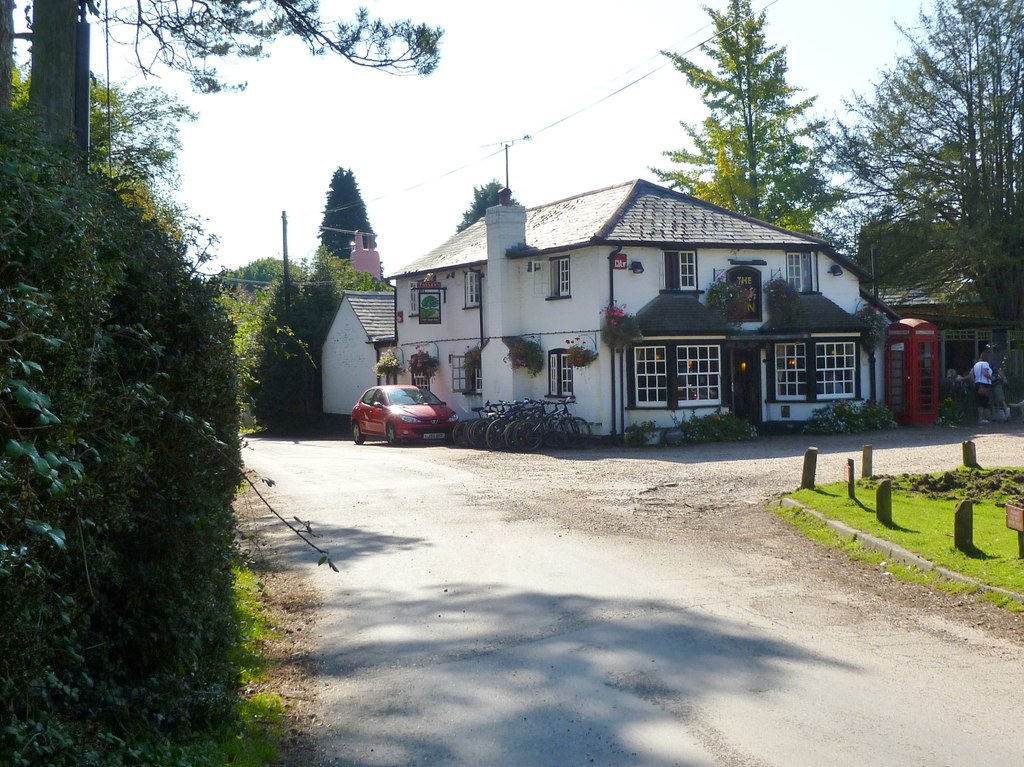
New Forest ponies wander freely through Bank, and one of their preferred spots is the front porch of the pub, where they stand in the shade and peer over the fence into the beer garden. The pub is the Oak Inn, and it is more or less the only thing in Bank — no shop, no post office, no other community facility. The nearest of those is Lyndhurst, about a mile north-east.
Bank is a scatter of roughly thirty houses just south of the A35, deep inside the National Park, bounded on almost every side by woodland. A red K6 telephone box stands outside the pub. That, the ponies, and the Oak Inn are the centre of things.
Food and ale at the Oak
The Oak is a two-storey painted-brick building from around 1719, thought to have started life as a cider house. It's Fuller's-owned, and the menu specialises in game and seafood — venison casserole, a fish platter of smoked salmon, goujons and prawns, peanut-crusted chicken, spiced-yoghurt shoulder of South Coast lamb, and a chickpea, spinach and sweet potato curry for anyone not in the mood for either. The Sharing Sunday Roast, at around £69.95, comes with pork or beef plus lamb cutlets and chicken and all the trimmings. Booking is recommended.
The beer is worth a paragraph of its own. Gales HSB, Gales Seafarers and London Pride are the regulars, with a rotating guest, and the cask ales come out of taps set into wooden cask-ends, propelled by a gas-powered pump arranged so the gas never touches the beer. Cyclists, walkers and horse riders all end up here, which is roughly the entire population of a New Forest afternoon.
Forest paths and ancient oaks
The walking starts at the door. The Bank and Gritnam circular runs about seven miles on forest paths and gravel tracks, past a deer sanctuary early on, through inclosures of beech, oak and sweet chestnut that carpet with bluebells in late spring, then follows the Highland Water down into the trench it has carved through Brinken Wood. The Oak Inn is the half-way food stop, which is either good planning or good luck. A short drive south-west brings you to the Knightwood Oak, over five hundred years old with a girth of 7.38 metres, and the Eagle Oak nearby, named because the last sea eagle in southern England was reportedly shot from its branches.
A late Forest settlement
Bank is a latecomer as settlements go — a sixteenth-century encroachment on the open Forest, originally called Annis' Bank, and still recorded as "Annesley Bank" in the 1861 Census. Japonica Cottage, the oldest survivor, is sixteenth century; Old Cottage on Pinkney Lane carries the date 1600 on an outside wall. Later it drew writers looking for a country retreat. Mary Elizabeth Braddon built a house here in the 1880s, Virginia Woolf spent Christmas 1904 at Lane End House, and the poet Rupert Brooke stayed nearby at Gritnam, writing afterwards to a friend: "And then for a few days it all dropped completely away, and — oh! how lovely Bank was!"
Reaching Bank
There's no station; Ashurst and Brockenhurst are each about four miles off, on the Waterloo line. But most people come by car, park at the Oak, and let the ponies get on with running the place.
Stay around New Forest
Make a longer stay of it
Travel Fox holiday homes around New Forest, linked directly to their property pages.
A guide with a point of view
Written from research. Edited for real journeys.
Use the Official site links for live practical details, then use this guide for context, ideas and room to explore.
Photography credits & licences
Third-party photographs are credited to their named creators and reused under the linked Creative Commons licence or public-domain dedication. Travel Fox stores an optimised local copy; the file-specific changes and any browser-applied display crop are disclosed below. Reused photographs link both to the Wikimedia Commons source record and to the declared source image; Travel Fox's own photographs carry no such record and are marked as ours. These image licences do not cover Travel Fox text, branding or page design.
- File:Bank, The Oak Inn - geograph.org.uk - 2625358.jpg — photograph by Mike Faherty; Bank, The Oak Inn by Mike Faherty. Source record on Wikimedia Commons. Declared source image. Licence: CC BY-SA 2.0. File changes: Downloaded from Wikimedia Commons, resized to a maximum 1920px edge and encoded as an optimised JPEG. Display changes: Displayed with responsive CSS cropping.
Sources
Every place on this page is checked against a published source. Each entry links the record we used and names who publishes it.
- The Oak Inn — visit-hampshire.co.uk operator, sector body or destination organisation
- Bank and Gritnam circular — newforestwalks.co.uk other published source
- Knightwood Oak — forestryengland.uk national body or asset manager
- Eagle Oak — newforestnpa.gov.uk statutory register or public authority
- New Forest Reptile Centre — forestryengland.uk national body or asset manager
- Bolderwood Deer Sanctuary — newforestnpa.gov.uk statutory register or public authority
- St Michael and All Angels — historicengland.org.uk statutory register or public authority record not machine-readable; publisher restricts automated access