
New Forest National Park
Brockenhurst
A rail-accessible village where open forest, local food and centuries of history meet around the station, Brookley Road and Church Hill.
- Rail access
- Main-line station plus the Lymington Pier branch
- Forest trail
- Tall Trees Trail: about 1.5 miles
- Historic anchor
- St Nicholas: Grade II* listed
Photo: David Martin · CC BY-SA 2.0 · cropped
The Fox verdict
Come for a village that works without a car and opens straight onto the Forest
Brockenhurst combines direct rail links with open heath, forest lawns, ancient woodland, local food and a church whose story reaches back to Domesday.
The strongest visit pairs one of the village's food stops with the watersplash, St Nicholas or a forest walk. The station makes the village unusually easy to reach, while the pubs, shops and surrounding landscape give a short stay several distinct directions.
Where to go
Places in Brockenhurst
Every place below is checked against a published source, listed with what it is and how long to give it.
Local signatures
3 placesThe Snakecatcher
A traditional family-friendly village pub named for local snake-catcher Harry 'Brusher' Mills. Its menu includes cook-your-own hot-stone dishes and pub classics; there is a dog-friendly garden bar, outdoor play area and pool table.
- Visit length
- Editorial estimate: About 1 hour
- Locality
- Two minutes' walk from Brockenhurst station
The Filly Inn
A restored 16th-century country inn with open fireplaces, cosy corners and seven en-suite bedrooms. It serves home-cooked food and locally sourced seafood specials, and dogs are welcome inside, outside and in all seven bedrooms.
- Visit length
- Editorial estimate: About 1 hour 15 minutes
- Locality
- On the Lymington Road, on the Setley side of the village
Setley Ridge Farm Shop and Tea Rooms
A farm shop and tea rooms focused on local produce at a working vineyard site. The vineyard grows, makes and bottles its own wine on site, alongside a garden centre and the Rosie Lea tea room.
- Visit length
- Editorial estimate: About 1 hour 30 minutes
- Locality
- About 1 mile from the village
Food & drink
2 placesThe Foresters Arms
A traditional home-cooked-food pub and cyclists' haunt by the station, with a sports bar. The research highlights its dirty fries and homemade steak and Guinness pie, along with a pool table, real ales and a dog-friendly beer garden.
- Visit length
- Editorial estimate: About 1 hour
- Locality
- Near Brockenhurst train station
The Huntsman of Brockenhurst
A traditional country pub with 13 bedrooms, relaxed dining, cask ales, cocktails and an extensive wine list. Its spacious pub garden and some dog-friendly bedrooms give it a different role from the station's other pubs.
- Visit length
- Editorial estimate: About 1 hour 15 minutes
- Locality
- Moments from Brockenhurst station
Walks & outdoors
2 places
Tall Trees Trail
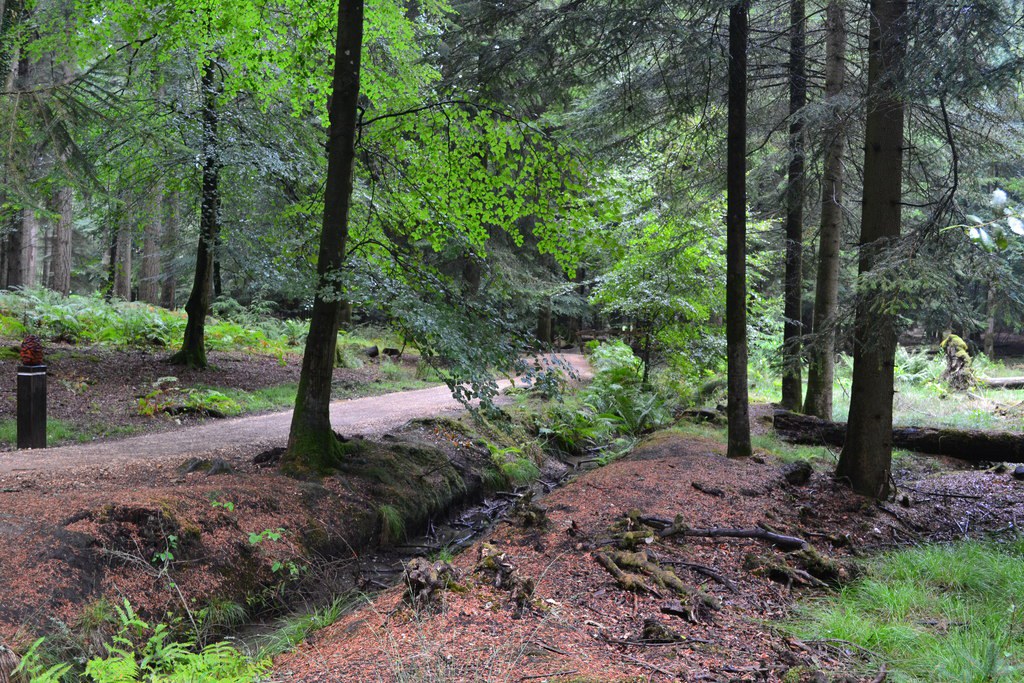
A roughly 1.5-mile level graded-gravel trail through redwoods and firs planted in the late 1850s, including coast redwoods, Douglas firs and two giant sequoias. The route passes Blackwater Arboretum, with benches and trees sourced worldwide.
- Visit length
- Editorial estimate: About 1 hour
- Locality
- Rhinefield Ornamental Drive, just west of the village
- Access
- Starts from Blackwater or Brock Hill car parks on level graded gravel.
Brockenhurst Watersplash
A picturesque ford where the North and South weirs meet. Free-roaming ponies, donkeys and cattle can pass through the main shopping street and drink here on their way to graze.
- Visit length
- Editorial estimate: About 20 minutes
- Locality
- At the western end of Brookley Road
- Access
- Gentle most of the year but daunting to cars and bikes after heavy rain.
History & heritage
1 placeChurch of St Nicholas
A Grade II* church with a 12th-century core, surviving Saxon herring-bone masonry and a late-12th-century Purbeck font. Its churchyard contains Brusher Mills's grave and the New Zealand and ANZAC war graves, beside a yew dated to more than 1,000 years old.
- Visit length
- Editorial estimate: About 1 hour
- Locality
- On Church Hill, away from the modern village centre
No places match this filter. Choose All places to reset the list.
Three ways to explore Brockenhurst
Signature outings
The watersplash and the animals that use it
At the western end of Brookley Road, the North and South weirs meet at a picturesque ford. Ponies, donkeys and cattle roam the surrounding open forest lawns and can drink here on their way to graze.
St Nicholas, its ancient yew and the ANZAC graves
The Grade II* church has a 12th-century core and is reputedly the oldest in the New Forest. Its churchyard brings together Brusher Mills's ornate grave, the New Zealand and ANZAC war graves and a yew dated to more than 1,000 years old.
Redwoods and sequoias on the Tall Trees Trail
The roughly 1.5-mile trail follows level graded gravel through redwoods and firs planted in the late 1850s, including coast redwoods, Douglas firs and two giant sequoias.
The village story
Brockenhurst: ponies, railways and Forest history
The locked Travel Fox article moves from commoners' animals and rail access through village food and forest outings to Domesday, Brusher Mills and Brockenhurst's ANZAC story.
Ponies, trains and station-side pubs
The ponies have right of way. They wander down Brookley Road, the village's main shopping street, stop to drink at the watersplash where the North and South Weirs meet, and carry on to graze. Donkeys do the same. So, in autumn, do the pigs, turned out to eat the fallen acorns that would poison the ponies. None of them are wild. They belong to commoners — local people whose rights of pasture on the open Forest go back to William the Conqueror, who took the land as a royal hunting ground and left the grazing as compensation. The animals keep the heath open by eating it. They also keep the traffic slow.
Brockenhurst sits deep in the New Forest, about thirteen miles north-east of Southampton, with a population of around 3,500. What sets it apart from the other Forest villages is the railway. The station is a mainline stop — direct trains to London Waterloo, Southampton and Bournemouth, plus the branch line down to Lymington Pier for the Isle of Wight ferry — and most of the pubs and shops are a few minutes' walk from the platform. You can arrive here without a car and not miss one.
The station is also where you hire a bike. Cyclexperience runs the New Forest Bike Hire Centre from the station building; session hire starts at £27 for adults and £10 for children, helmet and lock included. From there it is about five minutes' ride to the gravel tracks, and the tracks run for miles, level and dry-footed, which is the main reason families keep coming back to this village rather than the hillier parts of the Forest.
Two minutes from the platform is the Snakecatcher. It was the Railway Inn until it was renamed for Harry "Brusher" Mills, the village snake-catcher, who drank here. The kitchen does a hot-stone thing: you sear your own steak, mixed grill, fish or wild boar sausages on a heated rock at the table, each dish coming with two sides. Reviewers seem to enjoy the control it gives them over how the meat is done. There is a garden bar, a pool table, and dogs are welcome.
Pubs, kitchens and local produce
The Foresters Arms, also by the station, is where the cyclists end up. Home-cooked food, a sports bar, and its "famous dirty fries" — chilli and cheese, sour cream, guacamole — alongside a homemade steak and Guinness pie. It has the worn-in feel of a pub that hasn't been redecorated to impress anyone.
The Filly Inn, out on the Lymington Road on the Setley side of the village, had a million pounds spent on it — open fireplaces, cosy corners, a large rear garden and seven new en-suite bedrooms. All seven rooms take dogs, and dogs are allowed at breakfast. The food is home-cooked with locally sourced seafood specials; the farmers' platter and the Sunday roast are the dishes people mention.
The Huntsman, near the station, joined Young's estate and reopened in 2016 with thirteen bedrooms, each named after a New Forest animal. The refit kept the pub's old skittle alley and added an outdoor wood-fired pizza oven in the garden. Some rooms take up to two dogs at £25 a night.
Out on the Beaulieu Road is The Pig, which is not a pub but a restaurant with rooms and the flagship of the group Robin Hutson built after founding Hotel du Vin. The kitchen works a twenty-five-mile menu: every morning head chef James Golding meets his forager, Garry Eveleigh, and kitchen gardener Alex to see what's ready in the walled garden, then writes the day's dishes around it, using nothing that has travelled more than twenty-five miles. The "Piggy Bits" board — scotch eggs, air-dried ham, crispy lardo, devils on horseback, long pieces of crackling to dunk in apple sauce — is the thing to order, and the quail scotch eggs are made with eggs the Pig's own quails laid that morning. It is not inexpensive. One reviewer paid £130 for two aperitifs and a single dessert. For French cooking there's Le Blaireau — the name is French for the badger — inside Careys Manor, doing escargots, baked camembert, Lymington crab with avocado, boeuf bourguignon and tarte Tatin.
Village food and forest trails
Brookley Road runs a small closed loop of its own food supply. The Village Butcher at number 74 sells freshly prepared BBQ goods and a wide range of English and Continental cheeses, and supplies the ham, sausages and pork to the Bakehouse a little way along at number 45. The Bakehouse — run by master baker Steve Jose, who began training toward the trade in 1959, now joined by his son James, daughter Nicola and baker Steve White — has been named the best bakery in Hampshire two years running. Its salads come from Village Veg, the greengrocer. Butcher to baker, greengrocer to baker, all within a few hundred yards of pavement.
For tea there is the Buttery, inside the Brock & Bruin in the centre of the village, which has committed entirely to its own name: a large teddy bear in the window, more bears on the shelves, and badger figurines throughout — brock is a badger, bruin a bear. The signature is the Big Brock, a full English of two fried eggs, two sausages, two fried tomatoes, two hash browns, beans and two slices of toast, and the tea comes in large white pots. Esme's Tea Rooms, in the sixteenth-century Thatched Cottage Hotel, is run by Phil and Helen, who started out in 2022 running a converted horse box with a wood-fired pizza oven at a local campsite before taking over the hotel's tea rooms and then the hotel itself. The Paddle in the Forest does speciality coffee, brunch and homemade cakes. A mile south, Setley Ridge is a working vineyard that grows, makes and bottles its own wine on site, with a farm shop, a garden centre and the Rosie Lea tea room, where you can drink the wine looking out over the plants.
The walking starts at the edge of the village and mostly ends up muddy. The recurring note across every route is wet ground — the paths cross forest lawns, stream valleys and inclosure floors, and even the level ones go boggy after rain — so waterproof boots are the standard local advice. The official village walk is a five-mile circuit from the station, out past the watersplash and St Anne's church, across open heath and back through the woods, in two to three hours. The Ober Water and Puttles Bridge loop is a gentler two miles, with a bridge that is a reliable place to play Pooh Sticks.
West of the village is the Tall Trees Trail through Rhinefield Ornamental Drive: about a mile and a half of level gravel through coast redwoods, Douglas firs and two giant sequoias, planted in 1859 by John Nelson, then head nurseryman of the Forest, and now the tallest trees in it. The trail runs through Blackwater Arboretum, which holds over a hundred tree species and a scattering of benches. To reach the drive on foot, follow Brookley Road to the watersplash, turn right past the ford and keep going past Rhinefield House.
Family outings and older Brockenhurst
There is more for children than the bikes. Bolderwood Deer Sanctuary, along the Ornamental Drive, has a viewing platform where the keeper feeds the fallow deer daily from April to September, roughly noon to three. The New Forest Reptile Centre near Lyndhurst keeps every one of Britain's native reptiles and amphibians, including the adder — the snake Brusher Mills used to catch — and the rare sand lizard. At Setley Pond, a flooded Victorian gravel pit south of the village, the model-boat club sails scale ships on Thursday and Sunday mornings, year round, for free. And on the short turf of Balmer Lawn, in front of the Balmer Lawn Hotel, the cricket club plays its Saturday matches on one of the more scenic grounds in Hampshire.
Getting further afield is easy. The Bluestar 6 runs year round between Southampton, Lyndhurst, Brockenhurst and Lymington; in summer the open-top New Forest Tour stops here too, with dogs and bikes allowed aboard. Lymington — Georgian quay, Saturday market, marinas — is five miles away, or one stop on the branch line. Beaulieu, with its National Motor Museum and abbey ruins, is about six miles. Lyndhurst, the Forest's unofficial capital, is four.
When John Wise surveyed the Forest in 1863, he found that Brockenhurst "consists of one long straggling street, and a few scattered houses, with one or two village inns." The railway had already arrived, in 1847, and would fill the street in over the following decades; the Lymington branch followed in 1858.
The Domesday surveyors got here well before the trains, in 1086. They recorded the place as Broceste — one of four Saxon manors, and the one that gave the village its name — with ten households, six smallholders and four slaves, woodland enough for twenty pigs, and a value of four pounds. It was held on the condition that its lord provide the King with somewhere to stay when he came to hunt. The tenant, Aelfric, kept his holding after the Conquest, which for an Anglo-Saxon in 1086 was unusual.
Church Hill, Brusher Mills and the ANZAC graves
Up on Church Hill, away from the modern centre, stands St Nicholas — reputedly the oldest church in the Forest and the only one recorded in Domesday. Saxon herring-bone masonry survives in the south wall of the old nave; the font is late-twelfth-century Purbeck marble, a square bowl with round-headed arcading; the brick tower went up in the 1760s. Beside the church grows a yew carbon-dated in the 1980s to over a thousand years old.
The churchyard is where Brusher Mills is buried. Mills caught snakes across the Forest with a forked stick, a sack and a can, sent consignments to London Zoo to feed the king cobras, and boiled the rest down into a cure-all he sold as "Adder's Fat." He got his nickname from sweeping — brushing — the cricket wicket at Balmer Lawn. He lived in a charcoal-burner's hut in the woods north of the village, and on 1 July 1905 he walked out of the Railway Inn after a tipple of rum and a few pickles, collapsed in a nearby outhouse, and died. He was 65. His death made the national papers, and a public subscription paid for the ornate Sicilian-marble headstone that shows him with his snakes, his cleft stick, his can and his hut.
The same churchyard holds ninety-three New Zealand war graves, one Australian, three Indian and three unidentified Belgian civilians. In 1914 the War Office chose Brockenhurst as a hospital centre for its rail links and its nearness to the south-coast ports. A 500-bed complex of tented and galvanised huts went up on Church Hill — locals called it "Tin Town" — while the commandeered Balmer Lawn and Forest Park hotels took wounded Indian soldiers as the Meerut General Hospital. From 1916 it became No. 1 New Zealand General Hospital and treated over 21,000 casualties before it closed in January 1919. The huts have vanished completely. What is left is the graves, an annual service, and one of the church bells — the fourth, bought in 1924 by the relatives of New Zealand soldiers — that is tolled every April on the Sunday nearest Anzac Day.
By autumn the pigs are usually out. For a few weeks each year the commoners turn them onto the lawns to clear the fallen acorns before the ponies can reach them, and they work along the verges and the edge of the watersplash, unhurried, with right of way over everything, including you.
Stay around New Forest
Make a longer stay of it
Travel Fox holiday homes around New Forest, linked directly to their property pages.
A guide with a point of view
Written from research. Edited for real journeys.
Use the Official site links for live practical details, then use this guide for context, ideas and room to explore.
Photography credits & licences
Third-party photographs are credited to their named creators and reused under the linked Creative Commons licence or public-domain dedication. Travel Fox stores an optimised local copy; the file-specific changes and any browser-applied display crop are disclosed below. Reused photographs link both to the Wikimedia Commons source record and to the declared source image; Travel Fox's own photographs carry no such record and are marked as ours. These image licences do not cover Travel Fox text, branding or page design.
- File:Stream by the Tall Trees Trail, Blackwater Arboretum - geograph.org.uk - 5875192.jpg — photograph by David Martin; Stream by the Tall Trees Trail, Blackwater Arboretum by David Martin. Source record on Wikimedia Commons. Declared source image. Licence: CC BY-SA 2.0. File changes: Downloaded from Wikimedia Commons, resized to a maximum 1920px edge and encoded as an optimised JPEG. Display changes: Displayed with responsive CSS cropping.
Sources
Every place on this page is checked against a published source. Each entry links the record we used and names who publishes it.
- Church of St Nicholas — historicengland.org.uk statutory register or public authority record not machine-readable; publisher restricts automated access
- Tall Trees Trail — forestryengland.uk national body or asset manager
- Brockenhurst Watersplash — newforestnpa.gov.uk statutory register or public authority
- The Snakecatcher — thesnakecatcher.co.uk operator, sector body or destination organisation record not machine-readable; publisher restricts automated access
- The Foresters Arms — forestersarms-brockenhurst.co.uk operator, sector body or destination organisation
- The Huntsman of Brockenhurst — thehuntsmanofbrockenhurst.com operator, sector body or destination organisation
- The Filly Inn — fillyinn.com operator, sector body or destination organisation
- Setley Ridge Farm Shop and Tea Rooms — setleyridge.co.uk operator, sector body or destination organisation