
Ships, street and river
Bucklers Hard
A preserved Georgian shipbuilding settlement where one broad street runs down to old slipways on the tidal Beaulieu River.
- Best for
- Maritime history and riverside walking
- Give it
- Half a day
- Don't miss
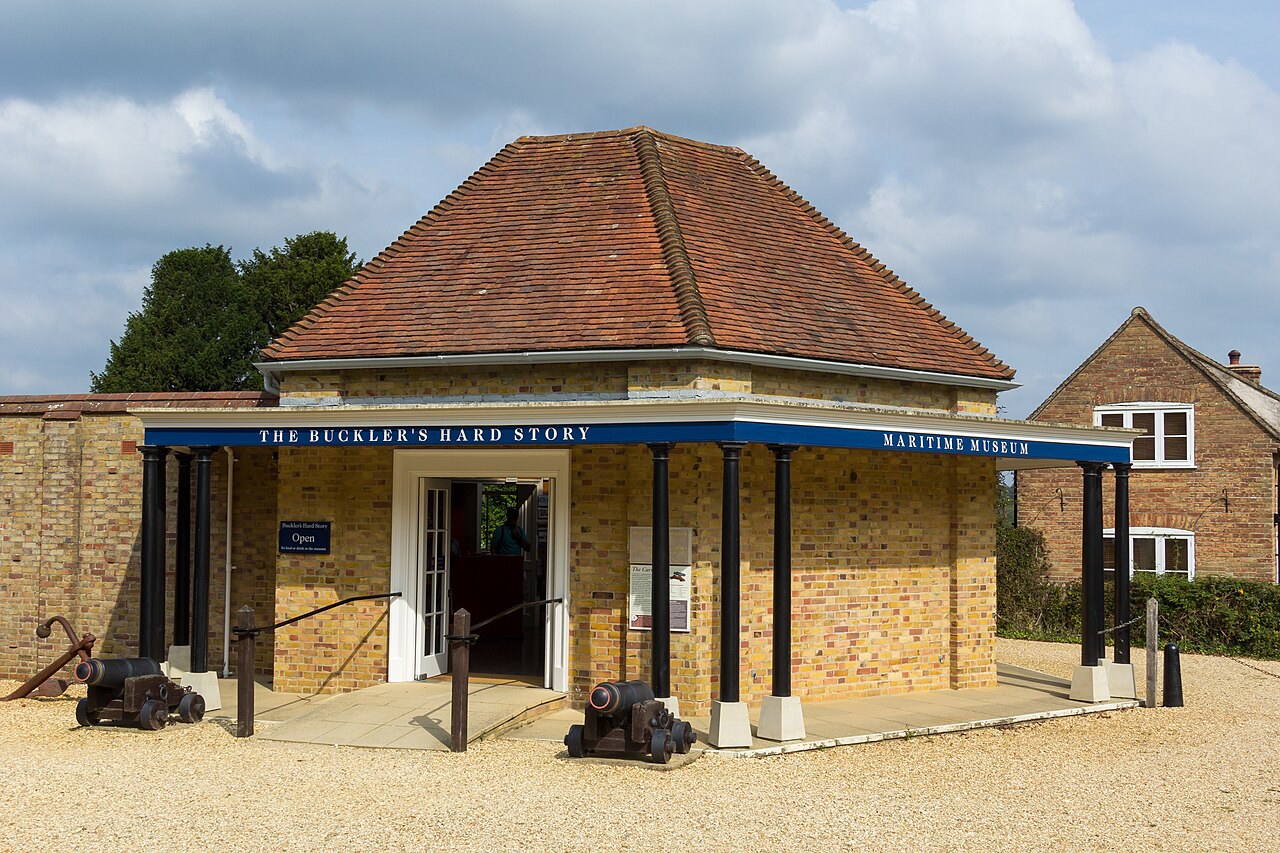
- The museum's Buckler's Hard shipbuilding story
Photo: Photograph by Mike Peel ( www.mikepeel.net ). · CC BY-SA 4.0 · cropped
The Fox verdict
A shipbuilding village held between one street and the river
Come for the Georgian setting, then use the museum, cottage, chapel and river to understand why the settlement survives.
Buckler's Hard is compact but not short of substance: its preserved street leads to the slipways where Royal Navy ships were built, while the museum and Shipwright's Cottage interpret the people and craft behind them. The Beaulieu River adds a two-and-a-quarter-mile riverside walk, a seasonal cruise and a waterside place to eat.
Where to go
Places in Bucklers Hard
Every place below is checked against a published source, listed with what it is and how long to give it.
Local signatures
3 places
Start here
Buckler's Hard Maritime Museum
Opened in 1963 as a memorial to the men who built men-of-war here, with the shipbuilding story and a reconstruction of an evening at the New Inn in the 1790s.
- Visit length
- Editorial estimate: around 60 minutes
- Locality
- in the former New Inn
- Access
- A small admission charge applies.
Beaulieu to Buckler's Hard Riverside Walk
A largely flat gravel, grass and boardwalk route beside reedbeds and wildlife-rich saltmarsh, forming part of the Solent Way.
- Visit length
- Editorial estimate: Roughly 120 minutes return
- Locality
- along the tidal Beaulieu River
- Access
- The riverside path can be muddy in wet weather; a more direct gravel track is the alternative.
The Master Builder's House Hotel
Henry Adams's former home is now a hotel with pub food, three real ales, a riverside terrace and views across the river and slipways.
- Visit length
- Editorial estimate: around 90 minutes
- Locality
- at the head of the terrace
- Access
- Dogs are welcome in the pub on a lead.
Food & drink
1 placeThe Captain's Table
A tea room serving light meals, cakes and refreshments for day visitors.
- Visit length
- Editorial estimate: around 45 minutes
- Locality
- at the top of the street
Walks & outdoors
1 placeBeaulieu River Cruise
A peaceful half-hour boat trip on the privately owned tidal Beaulieu River, which is rich in wildlife.
- Visit length
- Editorial estimate: Around 30 minutes
- Locality
- on the Beaulieu River
- Access
- Runs roughly from Easter to late September; a small charge applies.
History & heritage
2 placesShipwright's Cottage
A furnished 18th-century shipwright's home showing village life and craft.
- Visit length
- Editorial estimate: around 30 minutes
- Locality
- next door to the Maritime Museum
- Access
- Free to enter.
St Mary's Chapel
A tiny chapel developed from an infants' school and dedicated to St Mary in 1886; it seats about 40 and is said to conceal a smugglers' cellar.
- Visit length
- Editorial estimate: around 20 minutes
- Locality
- converted from a shipyard worker's terraced cottage
No places match this filter. Choose All places to reset the list.
Three ways to explore Bucklers Hard
Signature outings
The warship-building story
Use the museum in the former New Inn to follow the people, ships and craft that made Buckler's Hard nationally important.
Thirty minutes on the Beaulieu River
See the tidal river from a peaceful half-hour cruise during its seasonal operating period.
A chapel inside a cottage
This former shipyard worker's cottage became an infants' school in 1846 and was dedicated as St Mary's Chapel in 1886.
The village story
Bucklers Hard Village Guide
A failed free-port plan, a Royal Navy shipyard and a preserved Georgian street beside the Beaulieu River.
A Failed Free Port by the River
The street at Buckler's Hard is about eighty feet wide, laid out for fairs and markets that were never held. It runs downhill in a single gravelled avenue to the Beaulieu River, two rows of Georgian brick cottages facing each other across a gap far too generous for anything that ever used it. The village was meant to be a town — a free port shipping West Indies sugar for the Duke of Montagu — but the French took St Vincent and St Lucia before the trade could start, and the scheme collapsed. What's left is the one street, the two terraces, and the river at the bottom.
The two rows don't match. The west terrace is the taller of the pair, with a run of hipped dormers and big shared chimney stacks; the east row, mostly built for labourers, sits lower and plainer. The brickwork is Flemish bond with blue headers, the windows are paired casements, and every front door is a numbered plank of wood. Many of the cottages are still privately owned and lived in, which is worth knowing before you go peering through anyone's window. At the foot of the street the old slipways line the foreshore, and a modern yacht harbour sits just downstream. The whole place belongs to the 9,000-acre Beaulieu Estate, still held by the Montagu family, and the tidal Beaulieu River is one of the very few privately owned rivers left in Britain.
At the head of the street stands the Master Builder's House, which was once exactly that — the home of Henry Adams, the man who ran the shipyard for sixty years. It is now a four-star hotel, but the pub inside it, Henry's, is pubby and traditional and keeps three real ales on tap, two of them from Hampshire's Ringwood Brewery: Ringwood Best, Old Thumper, and a rotating Forty Niner. Bar food runs all day from noon — pizzas, fishcakes, sun-blushed tomato and spinach gnocchi, sandwiches to go with a pint. Old Thumper is worth a word: it was CAMRA's Champion Beer of Britain in 1988, and it was named by a Dorset man called Joe Leedham who won a newspaper competition to do so.
Food at the Head of the Street
The more serious cooking happens in the Riverview Restaurant, which looks out over the water and the slipways and holds one AA Rosette. The kitchen, under head chef Ben Cartwright, leans on south-coast fish and Hampshire meat: Poole Quay mackerel with a pickled fennel and tomato terrine, pan-seared sea bass with a crab dumpling, pan-fried chalk stream trout, a tikka-spiced Brixham monkfish skewer that a waitress named Elise Cottrell will tell you is the most popular thing they do. Puddings run to dark chocolate and amaretto mousse with coffee ice cream, and a lemon posset with raspberries and honeycomb. On Sundays it's roast Hampshire beef with a Yorkshire pudding, or roast loin of pork with apple sauce. Dogs are welcome in the bar and the Henry Adams room on a lead; stay the night and they get their own bed, a treat pack, and a room-service menu that includes sausages and casseroles, which is more than some hotels offer people.
The other option is the Captain's Table, the café at the top of the street, which serves breakfasts, cream teas and New Forest Ice Cream from ten each morning and is honest enough to have earned two stars out of five on TripAdvisor — ranked, at the last count, thirteenth of thirteen restaurants in Beaulieu. The complaints are consistent: short-staffed, slow, one visitor clocking a twenty-five-minute wait for a panini to be warmed. The praise is narrower but real, most of it aimed at the coffee and the teacakes and a server called Ashley. If you want the ceremony, there's an Admiral's Cream Tea built on cheese scones and a Captain's Cream Tea with the usual jam and clotted cream. If you don't, there are river-view benches and picnic areas, and you can bring your own.
Most people arrive on foot, and the best way in is the riverside walk from Beaulieu village — about two and a quarter miles each way along the tidal west bank, part of the Solent Way, largely flat gravel and grass with boardwalk sections. It passes through woodland, then river-edge grassland, then saltmarsh, a gradual handover between habitats that's rare in England and good for birds. There's a hide at Keeping Marsh where you'll see shelduck, Canada geese and oystercatchers, and you pass Duke's Bath House, a thatched cottage built around 1760 for the Duke of Montagu's son, who came here to treat his arthritis with salt water drawn from the river. The riverside detour can be wet underfoot; a drier gravel track runs alongside if the mud puts you off. The same route works by bike — two miles, flagged by the National Park as good for little legs — with hire available at the yacht harbour.
Arriving on Foot or Water
You can also come by water. New Forest Activities runs kayaks and canoes on the Beaulieu — a single is £32 for two hours, a double £64 — and one of their trips, the paddle to the pub, lands you at the Master Builder's, which is a civilised way to earn a pint. From the village itself there's a thirty-minute river cruise between late March and the end of October, tickets bought as you board. Village entry is free; you pay for the car park, the museum and the boat. Children get a family trail with knot-tying and caulking to try, and a lot of open grass to run off. Driving in, the car park opens at ten and the gates are locked at eight, with no overnight parking — reached on the B3054, two and a half miles down from Beaulieu. The nearest station is Brockenhurst on the Waterloo line, and a taxi from there runs to about £20.
The reason any of this exists is warships. A Hythe timber merchant named James Wyatt set up a private yard here in the 1740s and built HMS *Surprize* and HMS *Scorpion*, then handed the operation to Henry Adams, who had come down from Deptford as naval overseer and took the yard over in 1748. His first Admiralty contract was HMS *Mermaid* in 1749, and over the next sixty years he oversaw more than forty Royal Navy ships from this muddy stretch of riverbank. The most famous of them was HMS *Agamemnon*, a 64-gun ship of the line ordered in 1777 and launched on 10 April 1781. She became Nelson's first ship of the line and, by most accounts, his favourite; he captained her from January 1793 for three years and three months. When the fleet met the combined French and Spanish at Trafalgar in 1805, three of the ships in the line — *Agamemnon*, *Euryalus* and *Swiftsure* — had been built on this eighty-foot street.
Warships, Decline and the River's Memory
Adams handed the yard to his sons Balthazar and Edward, and the two of them ran it down through a shrinking order book. The end of the Napoleonic wars took away the demand, iron hulls made timber yards obsolete, and the skilled men drifted off to town work. The settlement had reached nearly forty houses at its peak; most were pulled down over the second half of the century. A third row once stood at right angles to the two that survive — Slab Row, so called because the cottages were built of slabs of wood — offering conditions squalid enough that no one mourned its demolition.
The river held the story better than the land did. In the summer of 2025 archaeologists from the University of Southampton spent three weeks digging on the foreshore and fully uncovered an 18th-century timber slipway — one of the launchways the warships slid down — reckoned to be the first of its kind fully exposed in the UK. The find was the structure itself: massive oak timbers forming the base and sides, preserved in the tidal mud, along with iron nails and copper plate and clay pipes and, higher up, wartime debris from when the slipway was used again. Dr Rodrigo Ortiz Vazquez, who led the work, called it a rare chance to uncover the remains of 18th-century shipbuilding infrastructure. The finds are kept in the village museum, and more digging is planned. Because the war did come back: in the 1940s Buckler's Hard built motor torpedo boats, sections of the Mulberry harbours were assembled nearby in the old oyster beds, and the river sheltered hundreds of landing craft waiting for D-Day.
Museum, Voyages and St Mary's Chapel
The Maritime Museum sits in what used to be the New Inn, one of the village's two lost pubs, and opened in 1963 as a memorial to the men of Buckler's Hard who built men-of-war. Inside it tells the shipbuilding story and reconstructs an evening at the New Inn in the 1790s; the small admission charge also gets you the free-to-enter Shipwright's Cottage next door, furnished as an 18th-century craftsman's home. In 1966 the yacht harbour saw off one more voyage of note, when Sir Francis Chichester sailed from here in *Gipsy Moth IV* and came back the following year having gone round the world alone — 29,360 miles in nine months and a day. The boat is long gone from the river, but the museum keeps some of what she carried.
Halfway down the terrace, behind an ordinary numbered door, is a chapel. It was a shipyard worker's cottage, then an infants' school from 1846, and in 1886 someone installed an altar and dedicated it to St Mary, protector of all who sail. It seats about forty, and there's said to be a smugglers' cellar beside the altar. On the wall inside there is a memorial to Chichester, who is buried elsewhere but remembered here among the men who built ships. He was once asked why he'd bothered to sail round the world at his age, alone, and he said: "Because it intensifies life."
Stay around New Forest
Make a longer stay of it
Travel Fox holiday homes around New Forest, linked directly to their property pages.
A guide with a point of view
Written from research. Edited for real journeys.
Use the Official site links for live practical details, then use this guide for context, ideas and room to explore.
Photography credits & licences
Third-party photographs are credited to their named creators and reused under the linked Creative Commons licence or public-domain dedication. Travel Fox stores an optimised local copy; the file-specific changes and any browser-applied display crop are disclosed below. Reused photographs link both to the Wikimedia Commons source record and to the declared source image; Travel Fox's own photographs carry no such record and are marked as ours. These image licences do not cover Travel Fox text, branding or page design.
- File:Buckler's Hard Maritime Museum 01.jpg — photograph by Photograph by Mike Peel ( www.mikepeel.net ).; Photograph by Mike Peel ( www.mikepeel.net ).. Source record on Wikimedia Commons. Declared source image. Licence: CC BY-SA 4.0. File changes: Downloaded from Wikimedia Commons, resized to a maximum 1920px edge and encoded as an optimised JPEG. Display changes: Displayed with responsive CSS cropping.
Sources
Every place on this page is checked against a published source. Each entry links the record we used and names who publishes it.
- Buckler's Hard Maritime Museum — bucklershard.co.uk operator, sector body or destination organisation
- Shipwright's Cottage — bucklershard.co.uk other published source
- St Mary's Chapel — bucklershard.co.uk other published source
- Beaulieu to Buckler's Hard Riverside Walk — newforestnpa.gov.uk statutory register or public authority
- Beaulieu River Cruise — bucklershard.co.uk other published source
- The Master Builder's House Hotel — themasterbuilders.co.uk operator, sector body or destination organisation
- The Captain's Table — bucklershard.co.uk other published source