
Hilltop New Forest
Emery Down
A small village above Swan Green, shaped by Victorian patronage and surrounded by forest walks.
- Best for
- Forest walks, Victorian history and a country inn
- Give it
- A village stop paired with a circular walk
- Don't miss
- Butterfield's red-and-blue-brick Christ Church
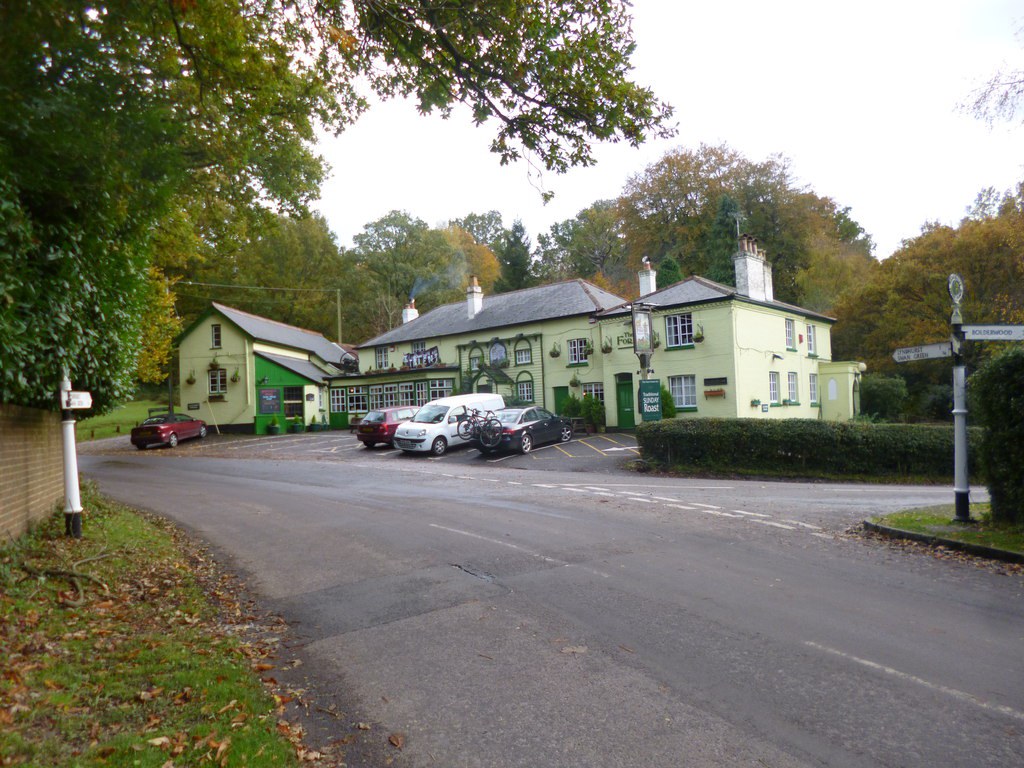
Photo: Mike Faherty · CC BY-SA 2.0 · cropped
The Fox verdict
A hilltop village with the Forest at its door
Emery Down pairs a traditional inn and Butterfield church with routes into the surrounding New Forest.
Come for the New Forest Inn, Christ Church and the view towards Swan Green; stay for the Emery Down circular or the short waymarked walks at Bolderwood.
Where to go
Places in Emery Down
Every place below is checked against a published source, listed with what it is and how long to give it.
Local signatures
3 places
Start here
The New Forest Inn
A traditional country inn with a seasonal menu, Sunday roasts, real ales, a covered patio and a sloped wooded garden.
- Visit length
- Editorial estimate: Allow around 90 minutes
- Locality
- Emery Down
Christ Church
William Butterfield's Grade II church of 1863–64, built in red brick with blue-brick diaperwork, stone bands and a west bellcote.
- Visit length
- Editorial estimate: Allow around 30 minutes
- Locality
- Emery Down
Walking trails at Bolderwood
Graded waymarked walks of half a mile, one mile and two miles through tall timber, with a large picnic area.
- Visit length
- Editorial estimate: Allow around 60 minutes
- Locality
- Bolderwood
Walks & outdoors
1 placeEmery Down and Pikes Hill Circular
A circular through Pikes Hill, Emery Down, Allum Green, Swan Green, the Cut Walk and Highland Water.
- Visit length
- Editorial estimate: Allow around 2 hours 30 minutes
- Locality
- From Lyndhurst
- Access
- Side-streams must be stepped or jumped; floods can make it hard going.
Things to do
1 placeSwan Green Cricket Pitch
A cricket pitch beside the group of thatched cottages at Swan Green.
- Visit length
- Editorial estimate: Allow around 30 minutes
- Locality
- Swan Green
No places match this filter. Choose All places to reset the list.
Three ways to explore Emery Down
Signature outings
Seasonal food and real ales
The New Forest Inn serves a seasonal menu and Sunday roasts alongside regular and changing real ales.
Streams, greens and old tracks
The Emery Down and Pikes Hill circular links Allum Green, Swan Green, the Cut Walk and Highland Water, with side-streams to step or jump.
Cricket and thatch
Swan Green's cricket pitch sits beside a group of thatched cottages.
The village story
Emery Down Village Guide
An inn-led introduction to a hilltop village, its Forest routes and the people who shaped it.
The Inn and Its Roasts
Ponies, donkeys, cows and pigs amble past the front door of the New Forest Inn, which is roughly what you'd expect from a pub where the road out the back leads to a deer sanctuary. The animals have right of way here, being the Forest's and not anyone's. The pub sits on the road up from Lyndhurst, its wooden floors split over several levels, spacious but arranged so that no part of it feels like a corridor.
It was the New Inn once, and it goes back to at least the first half of the nineteenth century. The kitchen does a seasonal menu plus a specials board — hearty pies, fresh fish, vegetarian and vegan and gluten-free options — but the thing it's known for is the Sunday roast. Reportedly around 200 of them, week in and week out, which for a village on a hilltop is a considerable number of roasts. Tripadvisor gives it 4.3, mostly for the atmosphere and the roasts.
Ales, Gardens and Swan Green
The beer is taken seriously. It's Cask Marque five-star rated, with Flack Manor's Double Drop and Ringwood Fortyniner as the regulars, a couple of changing ales and Purbeck No. 10 cider. There's a covered patio that leads down to a sloped wooded garden, and a beer and music festival every July. Visit the New Forest calls it "the ideal pub for dog walkers, cyclists and horse riders," and it's hard to argue when the horse riders are outnumbered by the free-roaming pigs.
Emery Down is the highest part of Lyndhurst, clustered on a hilltop about 1.4 miles north-west of the town, with views over the Forest toward the Solent. Below it sits Swan Green, a cricket pitch beside a group of thatched cottages that the New Forest Explorers Guide describes as "perhaps the most photographed thatched cottages in the whole of England." Apartments there have recently gone for between £550,000 and £799,950, which is a lot for somewhere this quiet.
Forest Walks and Wildlife
The walking starts more or less from the pub door. The Bolderwood road runs to the deer sanctuary, where a platform looks over a meadow and keepers feed the fallow deer daily from April to September. Closer to hand there's the Emery Down and Pikes Hill circular, taking in Allum Green, Swan Green, the eighteenth-century Cut Walk and Highland Water — crossed by an old bridge the locals call the Roman Bridge. You step or jump the side-streams, and when it floods you earn the walk. About two miles west is the Reptile Centre at Holidays Hill, free to get in, with open-air pens of adders and grass snakes and a mile-and-a-half trail through the old woodland.
Boultbee and Brusher Mills
The whole village bears one man's stamp. Admiral Frederick Moore Boultbee lived here from 1856 until 1876 and paid for the lot — Christ Church, built by William Butterfield in 1864, the village school that ran until 1950, and five almshouses. Harry "Brusher" Mills, the Forest's snake catcher, grew up here before moving to a charcoal-burner's hut and sweeping the cricket pitch at Balmer Lawn between innings.
Conan Doyle's Forest Year
Conan Doyle stayed a year while writing The White Company. The Forest, unsurprisingly, is in the book.
Stay around New Forest
Make a longer stay of it
Travel Fox holiday homes around New Forest, linked directly to their property pages.
A guide with a point of view
Written from research. Edited for real journeys.
Use the Official site links for live practical details, then use this guide for context, ideas and room to explore.
Photography credits & licences
Third-party photographs are credited to their named creators and reused under the linked Creative Commons licence or public-domain dedication. Travel Fox stores an optimised local copy; the file-specific changes and any browser-applied display crop are disclosed below. Reused photographs link both to the Wikimedia Commons source record and to the declared source image; Travel Fox's own photographs carry no such record and are marked as ours. These image licences do not cover Travel Fox text, branding or page design.
- File:Emery Down, New Forest Inn - geograph.org.uk - 3740330.jpg — photograph by Mike Faherty; Emery Down, New Forest Inn by Mike Faherty. Source record on Wikimedia Commons. Declared source image. Licence: CC BY-SA 2.0. File changes: Downloaded from Wikimedia Commons, resized to a maximum 1920px edge and encoded as an optimised JPEG. Display changes: Displayed with responsive CSS cropping.
Sources
Every place on this page is checked against a published source. Each entry links the record we used and names who publishes it.
- The New Forest Inn — thenewforestinn.co.uk operator, sector body or destination organisation
- Christ Church — historicengland.org.uk statutory register or public authority record not machine-readable; publisher restricts automated access
- Swan Green Cricket Pitch — newforestnpa.gov.uk statutory register or public authority
- Emery Down and Pikes Hill Circular — newforestexplorersguide.co.uk other published source
- Walking trails at Bolderwood — forestryengland.uk national body or asset manager