
Forest-edge Pilley
Pilley
A small Boldre parish village with roaming ponies, old woodland, a wildlife-rich pond and a historic thatched inn.
- Best for
- Forest walks, parish history and a historic inn
- Give it
- A village wander with time for a meal
- Don't miss
- Pilley Bailey pond in spring
Photo: Mike Smith · CC BY-SA 2.0 · cropped
The Fox verdict
A small village with several layers to explore
Pilley links a historic inn and community facilities with paths into woodland and heath.
The Fleur de Lys supplies the long landlord record and the meal; Pilley Bailey supplies roaming ponies, cattle and donkeys around a pond known for spring water-crowfoot and Great Crested Newts. A path through Royden Woods and the parish church in the Boldre valley extend the visit beyond the village stops.
Where to go
Places in Pilley
Every place below is checked against a published source, listed with what it is and how long to give it.
Local signatures
3 places
Start here
Fleur de Lys
A historic thatched inn with a displayed list of landlords reaching back to 1498, inglenook fires and a garden well.
- Visit length
- Editorial estimate: around 90 minutes
- Locality
- Pilley
- Access
- Dogs are welcome in the bar, snug room and garden, but not the main restaurant.
Pilley Community Shop
A volunteer-run village shop for everyday local provisions.
- Visit length
- Editorial estimate: around 20 minutes
- Locality
- attached to the war memorial hall in Pilley
Boldre War Memorial Hall play area
A children's play area with swings, a ball-kicking wall and a netball practice wall.
- Visit length
- Editorial estimate: around 45 minutes
- Locality
- next to Boldre War Memorial Hall
Walks & outdoors
1 placePilley Bailey pond and lanes
Open heath and lanes used by free-roaming ponies, cattle and donkeys, with a pond that fills with white water-crowfoot in spring and supports spawning Great Crested Newts.
- Visit length
- Editorial estimate: around 60 minutes
- Locality
- Pilley Bailey
History & heritage
1 placeChurch of St John the Baptist, Boldre
A Grade II* parish church of Norman origin with a corner memorial to the 1,415 men lost when HMS Hood was sunk.
- Visit length
- Editorial estimate: around 45 minutes
- Locality
- an isolated spot in the River Boldre valley
No places match this filter. Choose All places to reset the list.
Three ways to explore Pilley
Signature outings
The landlords at the door
Read the landlords list by the entrance, then settle in among the inglenook fires or by the garden well.
The HMS Hood memorial
Find the corner memorial to the 1,415 men lost when HMS Hood was sunk, in the church where Vice-Admiral Holland worshipped.
Ponies around the pond
Walk the lanes around Pilley Bailey, where free-roaming animals wander and the pond fills with white water-crowfoot in spring.
The village story
Pilley Village Guide
An old inn, community life, forest paths and parish history at the New Forest edge.
The Forest's Old Inn
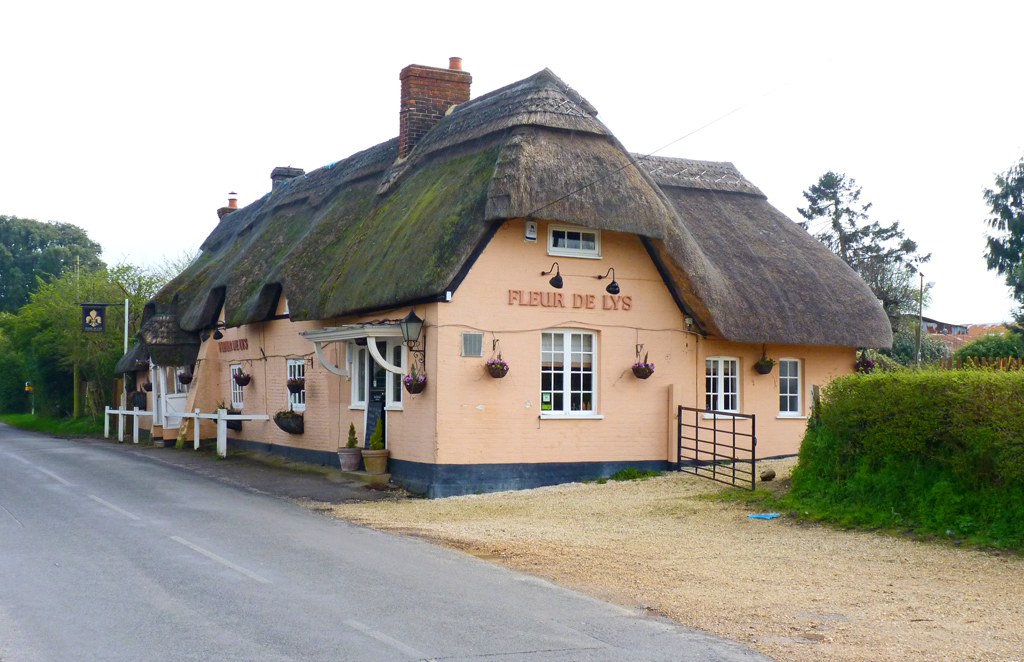
By the entrance to the Fleur de Lys there is a list of the pub's landlords going back to 1498. It is one of the longest documented records of its kind in England, and the pub uses it to support a larger claim: that this is the oldest pub in the New Forest, with a first pint traced to 1096. The building is a thatched, painted-brick house of the late sixteenth or early seventeenth century, with a roaring inglenook fire in each room and a stone well in the back garden.
The name comes from a stained-glass window that no longer exists — a thirteenth-century one in Boldre church, showing the arms of the Dauphin of France.
Food and Village Provisions
The food has moved a long way from its origins. The kitchen runs to blue cheese soufflé, salt and pepper squid, and sticky Korean chicken to start, then Beef Wellington at £40, a whole dressed crab, or halibut. There is a sharing fish board for £50 and, on Wednesdays, a burger and a drink for £15. It holds 4.6 out of 5 across roughly 701 Tripadvisor reviews and ranks fourteenth of ninety-one restaurants in Lymington, which is a lot of competition to sit near the top of. Dogs are welcome in the bar, the snug and the garden by the well, though not the restaurant.
For everyday provisions there is a volunteer-run community shop attached to the Boldre War Memorial Hall. The hall handles village events; the play area next to it has swings, a wall for kicking balls against and another for practising netball, and there is a recreation field with football pitches.
Paths, Ponies and Parish History
The walking starts at the door. One well-signposted path runs to Brockenhurst through Royden Woods, past ancient oaks, wildflower grassland and open heath. Closer to home, the lanes around Pilley Bailey and its pond are where the free-roaming ponies, cattle and donkeys wander. In spring the pond fills with white water-crowfoot, and it is a spawning site for a large population of Great Crested Newts.
Pilley sits in the parish of Boldre, two miles north of Lymington, with Pilley Hill at one end and the hamlet of Bull Hill at the other. The village chapel is dedicated to St Nicholas, but the parish church proper, St John the Baptist, stands about a mile off in the Boldre valley. It is Grade II* listed, Norman in origin, and holds a corner memorial to the 1,415 men lost when HMS Hood was sunk on 23 May 1941; Vice-Admiral Holland worshipped here. Robert Southey married his second wife in the same church in 1839.
Domesday Roots and Onward Connections
The Domesday surveyors listed Pilley three times, then took nearly all of it into William the Conqueror's new hunting forest — everything except six acres of meadow that Hugh de Quintin was allowed to keep.
Lymington Town station is about two miles away on the branch line, with Brockenhurst and the London mainline ten minutes beyond it; the A337 runs close by.
Following Pilley's Ponies
The ponies are enough of a fixture that the village keeps a Facebook page, Pilleybailey New Forest Ponies, to track where they have got to.
Stay around New Forest
Make a longer stay of it
Travel Fox holiday homes around New Forest, linked directly to their property pages.
A guide with a point of view
Written from research. Edited for real journeys.
Use the Official site links for live practical details, then use this guide for context, ideas and room to explore.
Photography credits & licences
Third-party photographs are credited to their named creators and reused under the linked Creative Commons licence or public-domain dedication. Travel Fox stores an optimised local copy; the file-specific changes and any browser-applied display crop are disclosed below. Reused photographs link both to the Wikimedia Commons source record and to the declared source image; Travel Fox's own photographs carry no such record and are marked as ours. These image licences do not cover Travel Fox text, branding or page design.
- File:Fleur de Lys, Pilley - geograph.org.uk - 3910934.jpg — photograph by Mike Smith; Fleur de Lys, Pilley by Mike Smith. Source record on Wikimedia Commons. Declared source image. Licence: CC BY-SA 2.0. File changes: Downloaded from Wikimedia Commons, resized to a maximum 1920px edge and encoded as an optimised JPEG. Display changes: Displayed with responsive CSS cropping.
Sources
Every place on this page is checked against a published source. Each entry links the record we used and names who publishes it.
- Fleur de Lys — historicengland.org.uk statutory register or public authority record not machine-readable; publisher restricts automated access
- Pilley Community Shop — newforestnpa.gov.uk statutory register or public authority
- Church of St John the Baptist, Boldre — historicengland.org.uk statutory register or public authority record not machine-readable; publisher restricts automated access
- Pilley Bailey pond and lanes — newforestnpa.gov.uk statutory register or public authority
- Boldre War Memorial Hall play area — boldrehall.org.uk operator, sector body or destination organisation