
Castle, church and market town
Ludlow
Norman power, medieval streets, independent food and River Teme views meet in a town shaped by more than nine centuries of history.
- Best for
- Castle history, independent food and riverside walking
- Give it
- Time for the castle, church and River Teme
- Don't miss
- The castle-and-church view from Whitcliffe Common
Photo: DeFacto · CC BY-SA 4.0 · cropped
The Fox verdict
A market town built around castle, church and food
Ludlow combines a Norman stronghold, the largest parish church in Shropshire and a long-lived market tradition above the River Teme.
The castle explains the town's beginnings and its centuries as the seat of the Council of the Marches; the market, food shops and historic inns explain its living character. Across the Teme, Whitcliffe Common supplies the classic view back to castle and church, while Mortimer Forest opens longer walking country beyond the river.
Where to go
Places in Ludlow
Every place below is checked against a published source, listed with what it is and how long to give it.
Local signatures
3 placesLudlow Market
A traditional open-air market in Castle Square, continuing a Ludlow market tradition recorded outside the castle's outer bailey as early as 1086.
- Visit length
- Editorial estimate: Allow around 45 minutes
- Locality
- in Castle Square
Linney Riverside Park
A River Teme park behind the castle with a play area, picnic benches and a gated floating jetty for canoeing, paddle-boarding, kayaking and wild swimming.
- Visit length
- Editorial estimate: Allow around 60 minutes
- Locality
- by the River Teme behind the castle
Mortimer Forest
Forest trails climb to High Vinnalls, the local high point at about 1,200 feet, with the circular Climbing Jack Trail reaching the viewpoint.
- Visit length
- Editorial estimate: Allow around 120 minutes
- Locality
- on the far bank from Ludlow
Food & drink
3 placesThe Rose & Crown
Ludlow's oldest pub, with an ale house documented on the site in 1102, a 13th-century mullioned window and restored medieval character.
- Visit length
- Editorial estimate: Allow around 75 minutes
- Locality
- in an ancient courtyard off Church Street, near St Laurence's church
Ludlow Food Centre
A farm shop and food hall bringing farming, food production and retail together, with estate-reared meat, a deli and an on-site coffee roasting room.
- Visit length
- Editorial estimate: Allow around 60 minutes
- Locality
- on the Oakly Park estate just outside town
The Feathers Hotel
A Grade I listed coaching inn with an imposing half-timbered Jacobean frontage built in 1619 and Prince of Wales's feathers worked into the façade.
- Visit length
- Editorial estimate: Allow around 60 minutes
- Locality
- in Ludlow
Walks & outdoors
1 placeWhitcliffe Common and the Breadwalk
A nature reserve with the classic view back to Ludlow Castle and St Laurence's, crossed by the roughly mile-long Breadwalk along the river.
- Visit length
- Editorial estimate: Allow around 75 minutes
- Locality
- across the Teme
History & heritage
3 places
Ludlow Castle
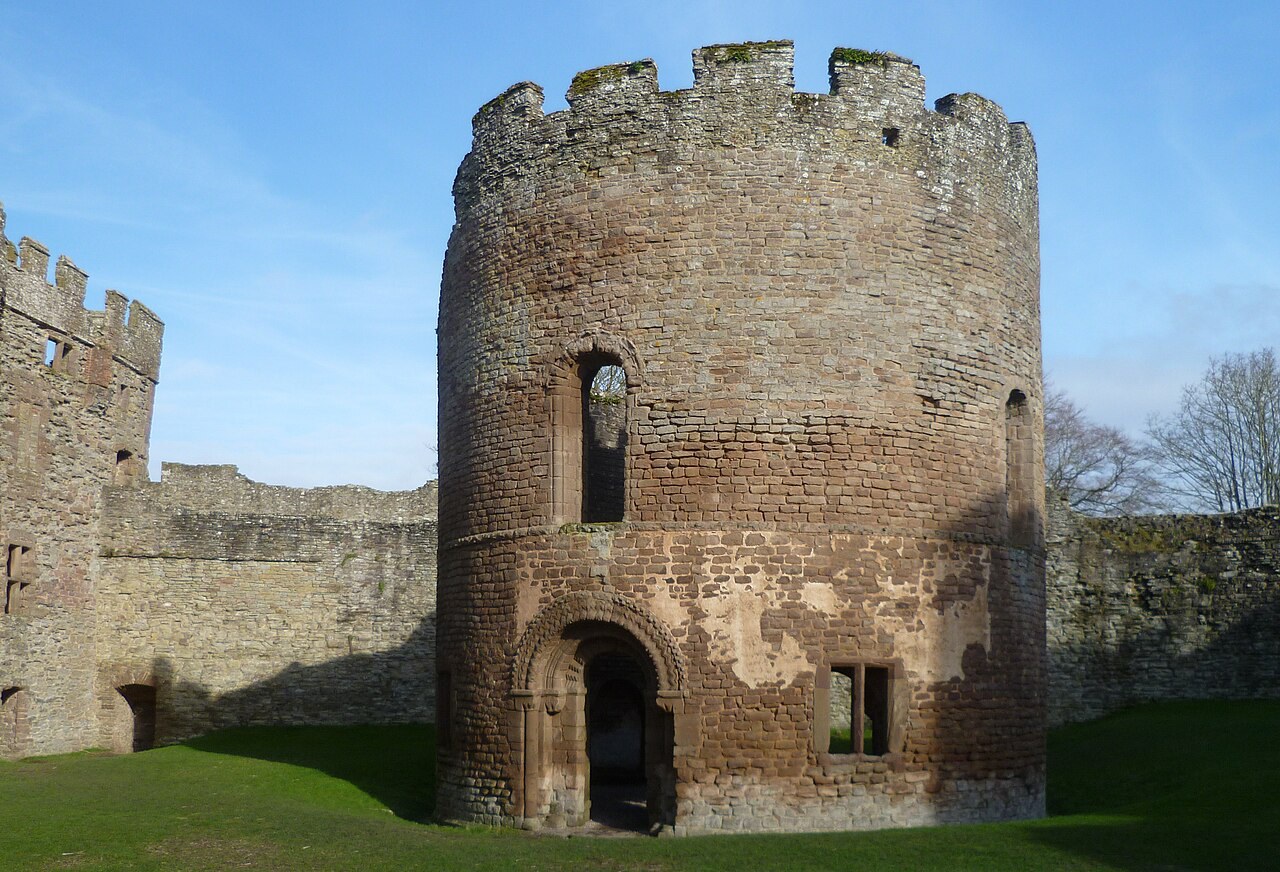
A Norman castle begun by the de Lacy family around 1075 and later the seat from which the Council of the Marches administered Wales and five adjacent English counties.
- Visit length
- Editorial estimate: Allow around 90 minutes
- Locality
- on a cliff above the River Teme
St Laurence's Church
Shropshire's largest parish church, with a late-11th-century Norman foundation, 28 choir stalls bearing medieval misericords and the ashes of A.E. Housman in the churchyard.
- Visit length
- Editorial estimate: Allow around 60 minutes
- Locality
- atop the hill around which the medieval town grew
Broadgate
The sole survivor of the seven gates in Ludlow's medieval town walls, which were built between 1233 and 1304.
- Visit length
- Editorial estimate: Allow around 20 minutes
- Locality
- at the foot of Broad Street
No places match this filter. Choose All places to reset the list.
Three ways to explore Ludlow
Signature outings
Norman walls and Welsh power
Explore the castle begun by the de Lacy family around 1075 and later used to govern Wales and five English counties through the Council of the Marches.
Misericords and Marches memory
See 28 choir stalls carved with medieval misericords before finding A.E. Housman's resting place beneath a cherry tree in the churchyard.
The classic Ludlow skyline
Follow the Breadwalk across Whitcliffe Common for the established view back to Ludlow Castle and St Laurence's Church.
The town story
Ludlow Town Guide
Ancient pubs, local food, the parish church, Norman castle and River Teme walks reveal how Ludlow grew and why its character has endured.
Ancient pubs and Jacobean timber
There has been an ale house on the site of the Rose & Crown since 1102, which makes it Ludlow's oldest pub. You reach it through an ancient courtyard off Church Street, near St Laurence's. Joule's Brewery restored it fully in 2016, turning up a fireplace and beams hidden since the 1960s. The 13th-century mullioned window in the rear stone wall was never lost — it just kept being there.
The Feathers Hotel has a half-timbered Jacobean frontage built in 1619 by Rees Jones, an attorney at the Council of the Marches. The timber carries the Prince of Wales's feathers, which is where the name comes from. The New York Times called it "the most handsome inn in the world" in 1983.
Historic inns and Ludlow food
The Church Inn, a 14th-century building near St Laurence's, was called "probably the best pub in Ludlow" by one TripAdvisor reviewer. The Wheatsheaf is built into Broadgate, the last of the town's seven medieval gates — single bar, real fire, four handpumps.
The food is the reason people come. Ludlow calls itself the food capital of the Marches, and it once had more Michelin-starred restaurants per head than anywhere in England outside London. What has endured is the shops. AH Griffiths on the Bull Ring makes prize-winning pork and a hawthorn-berry and ginger sausage. Just outside town, the Ludlow Food Centre on the Oakly Park estate sells estate-reared meat and roasts its own coffee on site.
Market tradition and St Laurence's
There is an open-air market in Castle Square four days a week, and a market has been held here for over 700 years — one was recorded outside the castle bailey in 1086. Every September the Food & Drink Festival fills the castle marquees; it began in 1995, Britain's first, and its Sausage Trail has local butchers each invent a new recipe while about a thousand people buy forms to taste and score them.
St Laurence's is the largest parish church in Shropshire, 203 feet long, its tower rising over the whole town. The 28 choir stalls have medieval misericords carved with Green Men, mermaids and wrestling matches. The bowels of Arthur, Prince of Wales, who died at Ludlow Castle in 1502, are buried inside. The ashes of A.E. Housman, whose *A Shropshire Lad* returns again and again to Ludlow bells and Ludlow market, lie in the churchyard under a cherry tree.
Castle power and River Teme walks
The town exists because of the castle, built by the Normans on a cliff above the River Teme around 1075. By the 16th century Ludlow Castle governed all of Wales and five English counties as the seat of the Council of the Marches. Before any of that there was nothing here — Domesday found only Ludford and Stanton Lacy, older settlements across the water.
The walking starts at the door. The Ludford Bridge loop follows the Teme for under four miles, and across the river Whitcliffe Common gives you the classic look back at castle and church. The Mortimer Trail runs 30 miles from town to the Welsh border. Ludlow sits on the A49 halfway between Shrewsbury and Hereford, with its own station on the Welsh Marches Line.
Riverside recreation behind the castle
Behind the castle, Linney Riverside Park has a gated jetty where people put in kayaks and paddleboards and swim in the Teme when the weather allows. Two pounds all day to park.
Stay around Shropshire
Make a longer stay of it
Travel Fox holiday homes around Shropshire, linked directly to their property pages.
A guide with a point of view
Written from research. Edited for real journeys.
Use the Official site links for live practical details, then use this guide for context, ideas and room to explore.
Photography credits & licences
Third-party photographs are credited to their named creators and reused under the linked Creative Commons licence or public-domain dedication. Travel Fox stores an optimised local copy; the file-specific changes and any browser-applied display crop are disclosed below. Reused photographs link both to the Wikimedia Commons source record and to the declared source image; Travel Fox's own photographs carry no such record and are marked as ours. These image licences do not cover Travel Fox text, branding or page design.
- File:Ludlow Castle - The Round Chapel.jpg — photograph by DeFacto; Own work. Source record on Wikimedia Commons. Declared source image. Licence: CC BY-SA 4.0. File changes: Downloaded from Wikimedia Commons, resized to a maximum 1920px edge and encoded as an optimised JPEG. Display changes: Displayed with responsive CSS cropping.
Sources
Every place on this page is checked against a published source. Each entry links the record we used and names who publishes it.
- Ludlow Castle — ludlowcastle.com operator, sector body or destination organisation
- St Laurence's Church — stlaurences.org.uk operator, sector body or destination organisation
- Ludlow Market — ludlowmarket.co.uk operator, sector body or destination organisation
- The Rose & Crown — joulesbrewery.co.uk other published source
- Ludlow Food Centre — ludlowfarmshop.co.uk operator, sector body or destination organisation
- Whitcliffe Common and the Breadwalk — shropshiresgreatoutdoors.co.uk other published source
- Linney Riverside Park — ludlow.gov.uk statutory register or public authority
- Broadgate — historicengland.org.uk statutory register or public authority record not machine-readable; publisher restricts automated access
- Mortimer Forest — forestryengland.uk national body or asset manager
- The Feathers Hotel — feathersatludlow.co.uk operator, sector body or destination organisation