
Cowdray and the Rother
Easebourne
Yellow-painted estate cottages lead towards Tudor ruins, old stone, valley walks and a distinctly local larder.
- Best for
- Tudor history and Rother Valley walks
- Give it
- A half day, or longer for the Woolbeding circular
- Don't miss
- Cowdray Ruins from the public causeway
Photo: Simon Burchell · CC BY-SA 4.0 · cropped
The Fox verdict
A village shaped by the Cowdray estate
Easebourne works best as a slow mix of Tudor history, estate landscape and good local food.
The yellow doors and sandstone cottages give the village its immediate character, but Cowdray supplies the deeper rhythm: ruined Tudor walls beside the Rother, an estate farm shop, polo grounds and walking routes that link pasture, woodland and old bridges. St Mary's adds a much older layer, while two notably different pubs make an unhurried finish easy.
Where to go
Places in Easebourne
Every place below is checked against a published source, listed with what it is and how long to give it.
Local signatures
3 placesCowdray Farm Shop & Café
An estate farm shop, butchery and café serving breakfast, lunch and afternoon tea, with estate venison, grass-fed lamb and beef among the butchery specialities.
- Visit length
- Editorial estimate: Allow around an hour to browse and eat
- Locality
- Cowdray Park
Cowdray Ruins
Grade I-listed and scheduled remains of an early-Tudor mansion begun around 1520, visited by Henry VIII and Elizabeth I and largely destroyed by fire in 1793.
- Visit length
- Editorial estimate: Allow around 30 minutes for the public-route viewpoint
- Locality
- Cowdray Park beside Easebourne
- Access
- Interior access has been restricted during repair planning; check current arrangements before expecting admission.
Easebourne Park
A five-acre park with oak dens and trails, play equipment, picnic benches, an accessible roundabout, a surfaced perimeter path, the timber Roundhouse shelter and eco toilets.
- Visit length
- Editorial estimate: Allow around 75 minutes
- Locality
- beside Easebourne Primary School
Food & drink
2 places
The White Horse
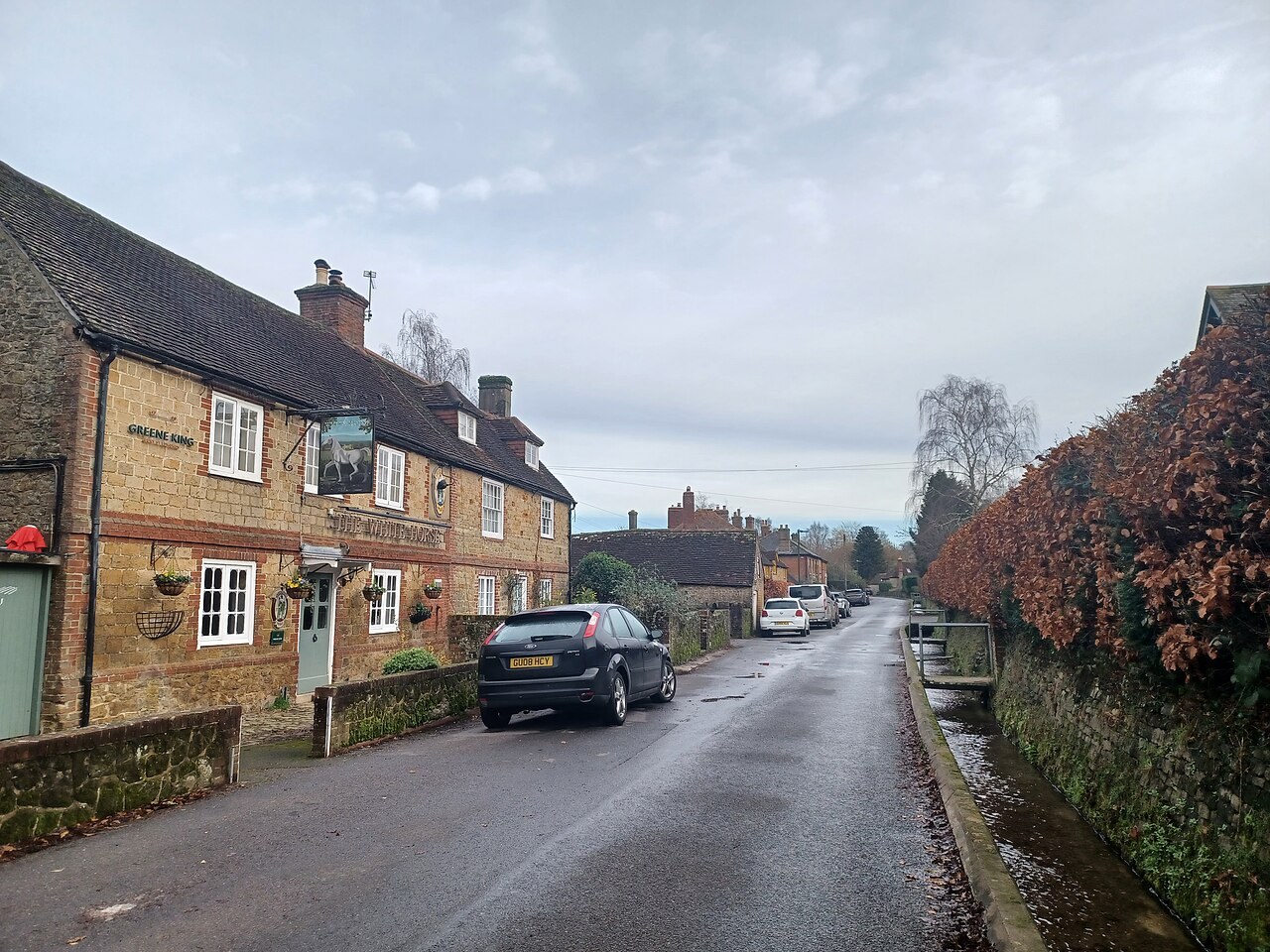
Easebourne's country pub occupies a roughly 300-year-old former coaching inn, with low beams, a wood-burning stove, a cellar bar and a side patio.
- Visit length
- Editorial estimate: Allow around an hour for a drink or light meal
- Locality
- on the edge of the Cowdray Estate
The Duke of Cumberland Arms
A historic food pub whose old front rooms retain red quarry tiles, boarded walls, matchboard counters and a log fire, with terraced gardens and a trout pond beyond.
- Visit length
- Editorial estimate: Allow around 90 minutes for a meal
- Locality
- Henley hamlet
Walks & outdoors
2 placesWoolbeding and Easebourne Circular
A moderate circuit crossing early-medieval Woolbeding Bridge and following the River Rother through pasture and chestnut coppice before reaching Cowdray Farm Shop and returning past the ruins.
- Visit length
- Editorial estimate: Allow four to five hours
- Locality
- starting in Midhurst and passing Easebourne
- Access
- Valley paths can be seasonally wet or muddy; check route conditions and dress accordingly.
Cowdray Ruins and St Ann's Hill Loop
An easy loop over the causeway to Cowdray Ruins, along the river edge and through woodland to traces of an Iron Age fort and Norman castle on St Ann's Hill.
- Visit length
- Editorial estimate: Allow 30 to 60 minutes
- Locality
- starting at Midhurst North Street
- Access
- Cattle can be present beside the river.
History & heritage
1 placeChurch of St Mary
A Grade I church with a 12th-century tower and fabric; Historic England identifies an 11th-century south aisle, while the shared medieval interior recalls its use by parishioners and Augustinian canonesses.
- Visit length
- Editorial estimate: Allow around 30 minutes
- Locality
- the historic church group
Things to do
1 placeCowdray Park Polo Club
The club describes itself as the home of British polo and welcomes spectators during its season, whose highlight is the Gold Cup for the British Open.
- Visit length
- Editorial estimate: Allow around 90 minutes for a match visit
- Locality
- Cowdray Park
- Access
- Spectator visits are seasonal; check the current fixture list before travel.
No places match this filter. Choose All places to reset the list.
Three ways to explore Easebourne
Signature outings
Cowdray's Tudor Remains
See the early-Tudor walls across the Rother water meadows from the public causeway, while checking current arrangements before expecting interior access.
Easebourne's Coaching Inn
Pause at the roughly 300-year-old White Horse for low beams, a wood-burning stove, cask ale and a patio on the edge of the estate.
The Long Valley Circuit
Walk 10–11 miles over Woolbeding Bridge and through riverside pasture and chestnut coppice before returning past Cowdray Ruins.
The village story
Easebourne Village Guide
A village of Cowdray-yellow joinery, estate food and layered history beside the River Rother.
Yellow Doors and the Village Pub
The doors are yellow, and so are the window frames. It is a distinctive yellow the Cowdray Estate paints on the houses it owns, so that walking through Easebourne you can read at a glance which cottages belong to the estate and which do not. The buildings are local sandstone under clay-tile roofs, and the village runs north out of Midhurst, which adjoins it closely.
The White Horse sits on the edge of the estate in a former coaching inn of about three hundred years. Inside there are low beams, a wood-burning stove and a central partition that keeps some corners private; there is a cellar bar at the back and a patio at the side, with a wood burner out there too. Greene King IPA is the regular cask bitter, with Abbot, St Austell Tribute and Timothy Taylor Landlord passing through. The kitchen does salt-and-pepper baby squid, gin-and-dill-cured salmon, a White Horse burger with Monterey Jack and smoked-bacon chutney, slow-cooked lamb shank with dauphinoise, sweet-potato gnocchi with cauliflower and mushroom sauce, and beef-brisket ragù with pappardelle. Dogs are welcome, there are darts and boules, and live music turns up on some summer evenings.
The Cowdray Larder and Henley Dining
For provisions there is the Cowdray Farm Shop and Café at Cowdray Park. The butchery sells estate-stalked venison and estate-reared grass-fed lamb and beef, and the café menu leans on the same larder: harissa-roasted Cowdray lamb shoulder on flatbread, a Cowdray cheeseburger, steak frites, a sausage roll with piccalilli, and gelato made with milk from the estate herd.
Two miles north, at Henley, the Duke of Cumberland Arms is worth the short drive. The front rooms have red quarry tiles, boarded walls, matchboard counters and a log fire, with a dining extension added behind; the gardens run to more than three acres of terraces, a timber pavilion and a pond stocked with trout that end up in the kitchen. Simon Goodman, the owner and head chef, buys meat from nearby organic farms, fish from the south coast and vegetables from the pub's own patch. The board might carry honey-roasted ham with Hallgate Farm duck eggs and Buddington Farm chips, wild-boar-and-apple sausages, cod with pancetta and broad beans in a Langham Hip Hop beer sauce, or confit pork belly with creamed cabbage and apple glaze. Harvey's Sussex Best and Langham Hip Hop are the regular ales, drawn from casks behind the counter.
Walking the Rother Valley
Walking is the reason many people come. A short loop from Midhurst's North Street crosses the causeway to the Cowdray Ruins, follows the river and climbs through woodland to the traces of an Iron Age fort and a Norman castle on St Ann's Hill. A longer circuit of ten or eleven miles takes in the medieval Woolbeding Bridge, the River Rother and pasture that may hold Herdwick sheep, Sussex cattle or Belted Galloways before returning past the ruins. On the estate you can find Benbow Pond and an oak the estate reckons is somewhere between 850 and 1,000 years old.
Tudor Ruins and St Mary's
The ruins are the great fact of the place. Cowdray House was begun around 1520 and finished by 1542, a Tudor mansion with castle features that drew visits from Henry VIII and Elizabeth I; in September 1793 a fire during pre-wedding repairs gutted most of it and left only the Kitchen Tower standing. The name comes from the French for hazel-wood. Nearby, the Church of St Mary has a twelfth-century tower and fabric, with Historic England identifying an eleventh-century south aisle; its nave was once divided so that Augustinian canonesses had the east end and the parish the west, until the wall came down in 1876.
Arriving in Easebourne
Haslemere and Chichester are the practical stations, about fifteen and twenty-five minutes by car; the A272 and A286 cross in the parish. "I love driving into Easebourne from Petworth, seeing Cowdray ruins across the fields, then as you enter Easebourne the sight of the old bridge," one resident wrote. The bridge is still there, and so are the yellow doors beyond it.
Stay around South Downs
Make a longer stay of it
Travel Fox holiday homes around South Downs, linked directly to their property pages.
For homeowners
Own a holiday home near Easebourne?
We manage holiday lets across the UK from 12% commission, charged after cleaning costs, with no lock-in. A co-founder visits before you decide.
How our holiday let management works →
A guide with a point of view
Written from research. Edited for real journeys.
Use the Official site links for live practical details, then use this guide for context, ideas and room to explore.
Photography credits & licences
Third-party photographs are credited to their named creators and reused under the linked Creative Commons licence or public-domain dedication. Travel Fox stores an optimised local copy; the file-specific changes and any browser-applied display crop are disclosed below. Reused photographs link both to the Wikimedia Commons source record and to the declared source image; Travel Fox's own photographs carry no such record and are marked as ours. These image licences do not cover Travel Fox text, branding or page design.
- File:The White Horse, Easebourne.jpg — photograph by Simon Burchell; Own work. Source record on Wikimedia Commons. Declared source image. Licence: CC BY-SA 4.0. File changes: Downloaded from Wikimedia Commons, resized to a maximum 1920px edge and encoded as an optimised JPEG. Display changes: Displayed with responsive CSS cropping.
Sources
Every place on this page is checked against a published source. Each entry links the record we used and names who publishes it.
- The White Horse — thewhitehorseeasebourne.com operator, sector body or destination organisation
- The Duke of Cumberland Arms — dukeofcumberland.com operator, sector body or destination organisation
- Cowdray Farm Shop & Café — cowdray.co.uk operator, sector body or destination organisation
- Church of St Mary — historicengland.org.uk statutory register or public authority record not machine-readable; publisher restricts automated access
- Woolbeding and Easebourne Circular — southdowns.gov.uk statutory register or public authority
- Cowdray Ruins and St Ann's Hill Loop — thegreatsussexway.org other published source
- Cowdray Ruins — cowdray.co.uk operator, sector body or destination organisation
- Easebourne Park — easebourne.org operator, sector body or destination organisation
- Cowdray Park Polo Club — cowdray.co.uk operator, sector body or destination organisation