
Downland walks and a village pub
Jevington
A quiet South Downs base for woodland circuits, flint-built history and a local-produce meal above the valley.
- Best for
- Downland walking and a pub lunch
- Give it
- A half day, or longer for the seven-mile circuit
- Don't miss
- St Andrew's rare wooden tapsell gate
Photo: Diliff · CC BY-SA 3.0 · cropped
The Fox verdict
A small village with walking at its heart
Jevington is strongest as a quiet, food-led walkers' village rather than a checklist of conventional attractions.
Pair the flint church and its unusual gate with a woodland circuit, then settle into the Eight Bells garden overlooking Hayward's Bottom and Folkington Hill. Longer days can follow the Three Tapsell Gate Walk or continue to the chalk coast at Birling Gap.
Where to go
Places in Jevington
Every place below is checked against a published source, listed with what it is and how long to give it.
Local signatures
3 placesThe Eight Bells
A small independent free house trading on this site since 1670, with two AA Rosettes, local-produce cooking and a garden looking across Hayward's Bottom towards Folkington Hill.
- Visit length
- Editorial estimate: around 90 minutes
- Locality
- Jevington village
- Access
- Dogs are welcome inside and in the garden, on leads and kept off the lawns.
Birling Gap and the Seven Sisters
A coastal stop with a visitor centre and cafe, beach access, a marine nature reserve and more than 500 acres of open chalk grassland.
- Visit length
- Editorial estimate: around 75 minutes
- Locality
- Birling Gap on the Seven Sisters coast
- Access
- The cliffs erode rapidly; follow current cliff-safety guidance.
Beachy Head to Birling Gap walk
A moderate official walk across the chalk coast, passing Belle Tout lighthouse, which was built in 1832 and moved inland in 1999 because of erosion.
- Visit length
- Editorial estimate: around 180 minutes
- Locality
- Beachy Head and Birling Gap
- Access
- This is an exposed cliff route; follow current route and cliff-safety guidance.
Walks & outdoors
2 placesThree Tapsell Gate Walk
An 11km downland-and-forest circuit visiting three churches and their distinctive gates, passing St Andrew's and within 200 yards of the Eight Bells.
- Visit length
- Editorial estimate: Roughly four hours
- Locality
- East Dean, Friston and Jevington
- Access
- The undulating route has two stiles and woodland navigation; carry the official route guide and a current map.
Friston Forest
A shorter circular option linking Jevington with Friston Forest, catalogued at 7.15km and about two hours 10 minutes.
- Visit length
- Editorial estimate: Around two hours 10 minutes
- Locality
- Jevington and Friston Forest
- Access
- This is a user-contributed OS Maps route; verify rights of way against a current map.
History & heritage
1 place
St Andrew's Church
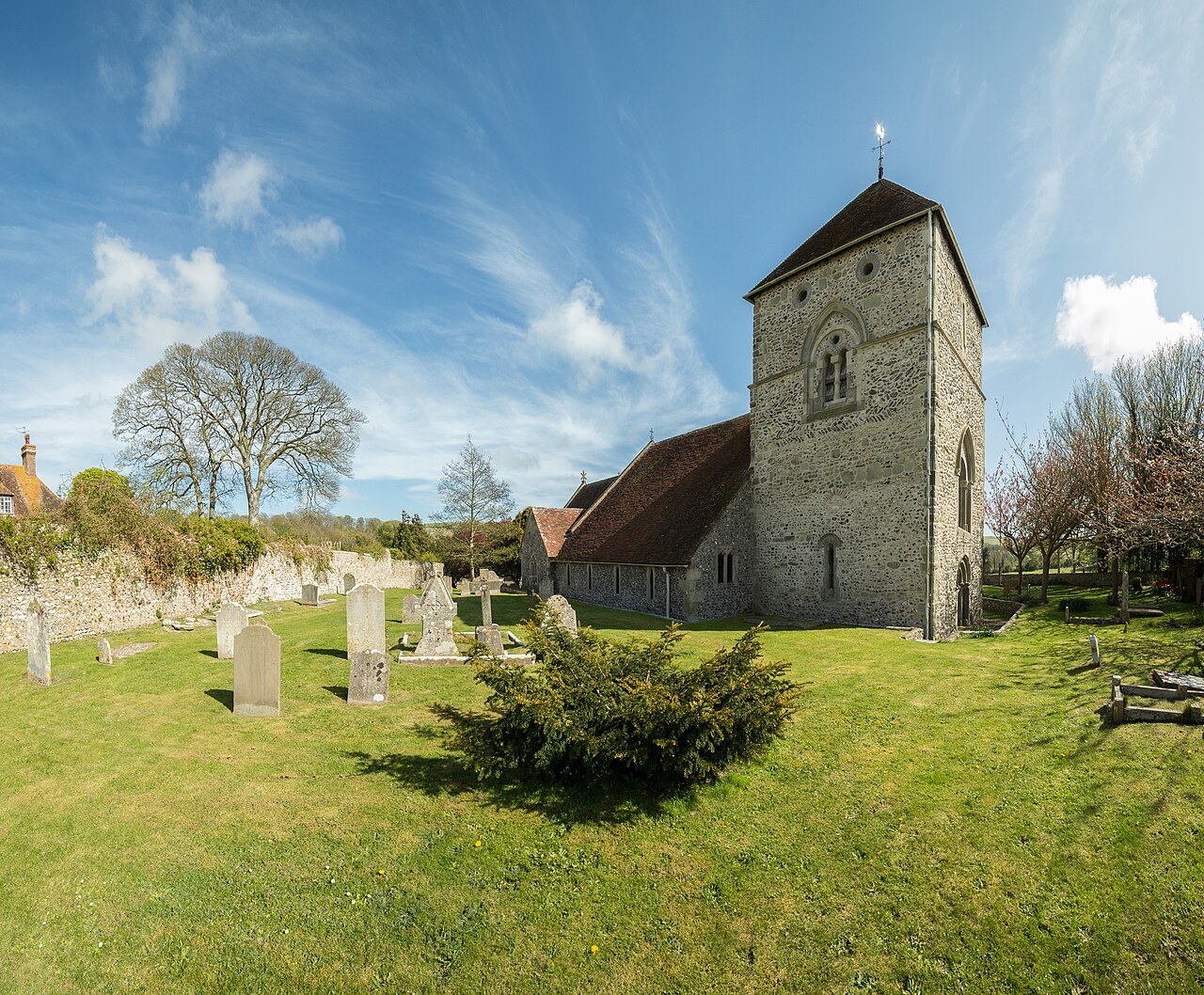
A small flint-and-green-sandstone church with a Saxon or very early Norman west tower, a rare wooden tapsell gate and a carved Harrowing of Hell relief reset in the nave.
- Visit length
- Editorial estimate: around 35 minutes
- Locality
- Jevington village
No places match this filter. Choose All places to reset the list.
Three ways to explore Jevington
Signature outings
Lunch at the Eight Bells
Choose local-produce cooking in the pub whose shaded garden looks across Hayward's Bottom towards Folkington Hill.
Find the tapsell gate
At St Andrew's, pair the rare wooden churchyard gate with the Harrowing of Hell relief reset at the west end of the nave.
Circle through Friston Forest
Take the 7.15km circuit catalogued from Jevington, allowing about two hours 10 minutes and checking current rights of way.
The village story
Jevington Village Guide
A downland village where a long-lived pub, an ancient church and walking routes carry most of the story.
A Garden Above the Downs
The garden at the Eight Bells drops away toward Hayward's Bottom, with Folkington Hill rising beyond a gravel terrace and a scatter of shaded tables. The pub has traded on this site since 1670. It is a small free house, food-led, holding two AA Rosettes, and it names itself Best Sussex Pub for 2026.
The kitchen leans hard on local produce. You might find locally smoked trout with dill crème fraîche, pickled cucumber and mizuna; a spiced pulled-lamb, spinach and mint filo pie; roasted Sussex mackerel with salt-baked beetroot; stuffed Sussex pork belly; or, for anyone leaving the meat alone, a wild-mushroom and lentil puff pie or a spiced squash-and-kale Wellington. There are bar snacks, tasting menus, food for children, and barbecues on summer weekends. The Guardian called it a "thoughtfully renovated 350-year-old pub," and singled out that garden looking over the Downs.
Walkers, Dogs and the Way In
Dogs are welcome inside and out, on leads and kept off the lawns. Harvey's is stocked, and local ales are poured, though the line changes. Beyond the barn and the terrace there is a seasonal outside bar.
This is a walkers' village. Polegate station, on the Southern line, sits about two and a half miles off; the Cuckmere Community Bus, route 41, calls at the Eight Bells and Church Lane on Tuesdays and Thursdays and links the village to Friston, East Dean and central Eastbourne. The road in is a minor one, running south from the A22 between Polegate and Friston.
Circuits, Coast and Banoffi
The walking is the point. The Three Tapsell Gate Walk is a seven-mile downland-and-forest circuit from East Dean through Friston and Jevington, visiting three churches and passing within two hundred yards of the Eight Bells, which is close enough to plan the day around. Friston Forest gives a shorter loop from the village, about four and a half miles and a couple of hours' walking, and the pub sits a five-mile walk from Birling Gap along the coast.
Banoffi pie was worked out here. It was developed in 1971 at the Hungry Monk by head chef Ian Dowding and the restaurateur Nigel Mackenzie, who kept the creators' own spelling of the name. The Hungry Monk has since closed, but its building survives, an eighteenth-century flint restaurant with red-brick dressings joined to an early-nineteenth-century house called Monk's Rest.
The Church and the Smugglers
St Andrew's stands on the walking circuit, small and built of flint and green sandstone. Its west tower is Saxon, or very early Norman, and the body of the church is mostly thirteenth-century, restored in 1873. Under the tower floor in 1785, Sir William Burrell found a carved relief read as Christ's Harrowing of Hell; it was reset at the west end of the nave, where it still is. The churchyard keeps a rare wooden tapsell gate. Inside, a marble monument shows Charles Rochester of Filching Manor being drawn toward the grave by his dead wife. Hartley Shawcross, the chief British prosecutor at Nuremberg, is buried here.
In 1086 the Domesday surveyors found twenty-three households, one mill worth eight shillings, and a place split between two lords and valued at four pounds fifteen shillings. Later the village turned to smuggling, and produced an innkeeper of several names remembered as Jevington Jigg; in 1788 armed constables came to the Eight Bells to make an arrest.
Evening in the Valley
Walk out past the church in the evening and the valley goes quiet. The sea is not far off, and the pub garden fills up slowly behind you.
Stay around South Downs
Make a longer stay of it
Travel Fox holiday homes around South Downs, linked directly to their property pages.
For homeowners
Own a holiday home near Jevington?
We manage holiday lets across the UK from 12% commission, charged after cleaning costs, with no lock-in. A co-founder visits before you decide.
How our holiday let management works →
A guide with a point of view
Written from research. Edited for real journeys.
Use the Official site links for live practical details, then use this guide for context, ideas and room to explore.
Photography credits & licences
Third-party photographs are credited to their named creators and reused under the linked Creative Commons licence or public-domain dedication. Travel Fox stores an optimised local copy; the file-specific changes and any browser-applied display crop are disclosed below. Reused photographs link both to the Wikimedia Commons source record and to the declared source image; Travel Fox's own photographs carry no such record and are marked as ours. These image licences do not cover Travel Fox text, branding or page design.
- File:St. Andrew's Church, Jevington, UK - April 2012.jpg — photograph by Diliff; Own work. Source record on Wikimedia Commons. Declared source image. Licence: CC BY-SA 3.0. File changes: Downloaded from Wikimedia Commons, resized to a maximum 1920px edge and encoded as an optimised JPEG. Display changes: Displayed with responsive CSS cropping.
Sources
Every place on this page is checked against a published source. Each entry links the record we used and names who publishes it.
- The Eight Bells — eightbellsjevington.com operator, sector body or destination organisation
- St Andrew's Church — historicengland.org.uk statutory register or public authority record not machine-readable; publisher restricts automated access
- Three Tapsell Gate Walk — eastdeanfriston-pc.gov.uk statutory register or public authority
- Friston Forest — forestryengland.uk national body or asset manager
- Birling Gap and the Seven Sisters — nationaltrust.org.uk national body or asset manager
- Beachy Head to Birling Gap walk — southdowns.gov.uk statutory register or public authority