
Chalk Giant Country
Wilmington
A single-street village beneath the Long Man, with high downland paths, deep church history and a walker-friendly inn.
- Best for
- Chalk-downland walks and village history
- Give it
- Half a day, or longer with a nearby stop
- Don't miss
- The footpaths to the Long Man
Photo: Shiroi Hane · CC BY-SA 3.0 · cropped
The Fox verdict
A small village with a giant sense of place
Wilmington works best as a walking base, pairing the Long Man and open downs with a richly layered church and a welcoming village inn.
The chalk figure supplies the drama, but the visit gains depth at St Mary and St Peter, where medieval fabric, an ancient yew and modern phoenix glass sit together. Add a measured stretch of the South Downs Way, then return to the village for a local cask ale or continue into the Cuckmere Valley.
Where to go
Places in Wilmington
Every place below is checked against a published source, listed with what it is and how long to give it.
Local signatures
3 placesLong Man Inn
An Edwardian village pub with a snug, garden and front terrace, serving locally sourced cooking where possible and gravity-dispensed Long Man ale.
- Visit length
- Editorial estimate: Allow around 90 minutes
- Locality
- on Wilmington's village street
- Access
- Dogs are welcome, and the kitchen caters for vegetarian, vegan and gluten-free diners.
Alfriston Clergy House
An early-15th-century house that became the National Trust's first acquired building in 1896.
- Visit length
- Editorial estimate: Allow around 60 minutes
- Locality
- in Alfriston in the Cuckmere Valley
- Access
- Check the official visitor page before travel.
Drusillas Park
A family zoo with indoor and outdoor play, rides, a maze, splash pad and fossil-dig activity.
- Visit length
- Editorial estimate: Allow around 3 hours
- Locality
- near Alfriston, just off the A27
- Access
- Rides and activities vary seasonally; check the official site before travel.
Food & drink
1 placeLitlington Tea Gardens
One of Sussex's oldest tea rooms, with tea gardens created around 150 years ago.
- Visit length
- Editorial estimate: Allow around 60 minutes
- Locality
- in Litlington near Alfriston
Walks & outdoors
1 placeSouth Downs Way at Wilmington
A high-level stretch of the 100-mile National Trail, with onward walking towards Alfriston or towards Jevington and Eastbourne.
- Visit length
- Editorial estimate: Allow around 2 hours for a local section
- Locality
- on the downs above Wilmington and the Long Man
History & heritage
2 places
Long Man of Wilmington
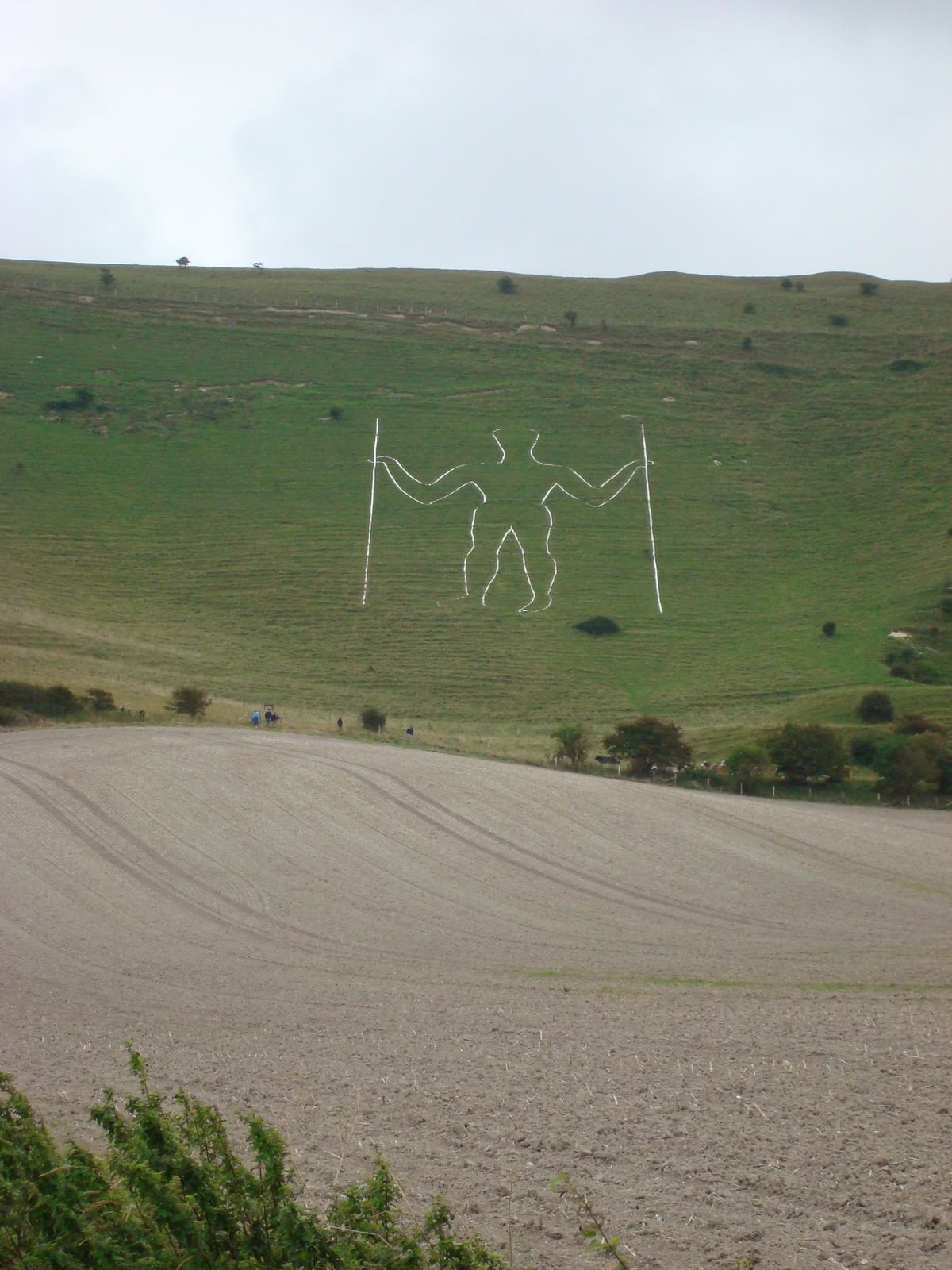
A roughly 70-metre chalk figure documented from at least 1710, reached by public paths to its foot and the top of the hill.
- Visit length
- Editorial estimate: Allow around 90 minutes
- Locality
- on Windover Hill above Wilmington
- Access
- The approach to the base is reasonably easy for walkers but probably unsuitable for wheelchairs.
St Mary and St Peter
A Grade I church with a 12th-century chancel, 14th-century font, Jacobean pulpit, modern phoenix glass and an ancient churchyard yew.
- Visit length
- Editorial estimate: Allow around 45 minutes
- Locality
- beside Wilmington Priory
- Access
- The church has level access to its main areas, cycle-securement space and welcomes dogs.
No places match this filter. Choose All places to reset the list.
Three ways to explore Wilmington
Signature outings
Meet the Long Man
Follow public paths from the village-side car park to the foot of the roughly 70-metre figure or continue to the top of Windover Hill.
Find the phoenix glass
Inside St Mary and St Peter, Paul San Casciani's replacement glass sets a phoenix beside centuries of Norman and Gothic work.
Walk the chalk ridge
Join the South Downs Way above Wilmington for a high route towards Alfriston or towards Jevington and Eastbourne.
The village story
Wilmington Village Guide
Beneath Windover Hill, Wilmington gathers a chalk giant, a walker-friendly inn and layers of sacred and village history along one gently sloping street.
The Giant Above the Street
Cut into the chalk of Windover Hill, a figure about seventy metres tall — some 230 feet — stands with a staff held out in each hand, looking down on Wilmington's single street. The Long Man has been drawn since at least 1710, when a surveyor called John Rowley recorded him, and William Burrell drew him again in 1766. What began as a shape you could only catch in certain light was later marked in yellow brick, then concrete blocks; during the Second World War the whole outline was painted green so enemy aircraft could not use it as a landmark.
The street below runs on a gentle slope, and the Long Man Inn sits along it. The building went up in 1908 as the Black Horse Hotel, became the Giant's Rest in 2000, closed after the pandemic, and reopened under its present name in May 2023. Inside there is a Locals' Snug; outside there is a garden and a sunny front terrace. The chef, Mathew Comben, cooks with local ingredients where he can, and the kitchen covers vegetarian, vegan and gluten-free eaters. Dogs are welcome, and four of the rooms are dog-friendly, which matters in a place where most people arrive with muddy boots and a lead.
Ale and Open Downs
The cask beer is Long Man Best Bitter, usually alongside another Long Man ale or the Long Blonde, and it is gravity-dispensed. The brewery is a short way off at Church Farm near Litlington, where brewing on the site is traceable to 1538, though it is not open to visitors. Litlington also has one of the oldest tea rooms in Sussex, its tea gardens laid out about a century and a half ago.
A stay here is arranged around walking. Footpaths climb from the car park to both the foot and the top of the figure; the lower path is manageable on foot but probably not for wheelchairs. Overhead runs the South Downs Way, giving a high route west to Alfriston or east towards Jevington and Eastbourne, and the Wealdway passes the Long Man on its way from Gravesend to the coast. For a full day, the Alfriston and Cuckmere circular takes in Friston Forest, the riverbank and the Litlington White Horse, with a short spur out to the tiny church at Lullington.
Stones, Yew and Phoenix
The parish church of St Mary and St Peter began around 1200 as a chapel beside the priory, and its chancel is still twelfth-century work in flint and imported Caen stone. There is a fourteenth-century font and a Jacobean pulpit with its sounding board. In the churchyard stands a yew reckoned at about 1,600 years old and twenty-three feet around near the base; a stone said to be Roman, dug from the vicarage well by the man who dug the well, now lies over his own grave. A fire in 2002 took the north transept, the organ and a window; the replacement glass by Paul San Casciani sets a phoenix in the new work and turns that ancient yew into a Tree of Life.
Priory, Pound and Domesday
The priory that the church grew beside started as a cell of Grestain Abbey in Normandy before 1086 and was closed in 1415. Beside it the village pound survives as a flint-walled enclosure, where the Pindar once held stray pigs, sheep and horses until their owners came with a fine. The Domesday surveyors counted thirty-five households here and valued the place at thirteen pounds and fifteen shillings.
The Road In, the Giant Above
Trains stop at Polegate, about two and a half miles off, and Berwick a little further; the A27 runs past the end of the lane, and Cuckmere Buses call on a handful of days each week, so it is worth checking the timetable before relying on one. Behind the village hall there is a garden with benches and a boules piste, and above it the Long Man keeps his own counsel. "The Giant keeps his secret," wrote the Rev. A. A. Evans, "and from his hillside flings out a perpetual challenge."
Stay around South Downs
Make a longer stay of it
Travel Fox holiday homes around South Downs, linked directly to their property pages.
For homeowners
Own a holiday home near Wilmington?
We manage holiday lets across the UK from 12% commission, charged after cleaning costs, with no lock-in. A co-founder visits before you decide.
How our holiday let management works →
A guide with a point of view
Written from research. Edited for real journeys.
Use the Official site links for live practical details, then use this guide for context, ideas and room to explore.
Photography credits & licences
Third-party photographs are credited to their named creators and reused under the linked Creative Commons licence or public-domain dedication. Travel Fox stores an optimised local copy; the file-specific changes and any browser-applied display crop are disclosed below. Reused photographs link both to the Wikimedia Commons source record and to the declared source image; Travel Fox's own photographs carry no such record and are marked as ours. These image licences do not cover Travel Fox text, branding or page design.
- File:The Long Man of Wilmington - panoramio.jpg — photograph by Shiroi Hane; Shiroi Hane. Source record on Wikimedia Commons. Declared source image. Licence: CC BY-SA 3.0. File changes: Downloaded from Wikimedia Commons, resized to a maximum 1920px edge and encoded as an optimised JPEG. Display changes: Displayed with responsive CSS cropping.
Sources
Every place on this page is checked against a published source. Each entry links the record we used and names who publishes it.
- Long Man of Wilmington — sussexpast.co.uk other published source
- Long Man Inn — longmaninn.co.uk operator, sector body or destination organisation
- St Mary and St Peter — nationalchurchestrust.org national body or asset manager
- South Downs Way at Wilmington — gov.uk statutory register or public authority
- Litlington Tea Gardens — explorewealden.co.uk operator, sector body or destination organisation
- Alfriston Clergy House — nationaltrust.org.uk national body or asset manager
- Drusillas Park — drusillas.co.uk operator, sector body or destination organisation