
Flint, beech and open downland
Patching
A one-street South Downs hamlet with a medieval church, a beechwood circuit and a country pub at the walk's beginning and end.
- Best for
- A country walk with church and pub stops
- Give it
- A half day, or longer with a nearby garden
- Don't miss
- The Patching Circular Loop through beech woods
Photo: nick macneill · CC BY-SA 2.0 · cropped
The Fox verdict
A small village with a properly rounded day out
Patching earns its place through the combination of an easy woodland circuit, an unusual medieval church and a welcoming pub.
The village itself is compact, but the visit reaches naturally into the South Downs landscape. Walk from The World's End through Patching and the Angmering Park Estate, pause at the flint church, then return for pub classics or extend the day to Highdown Gardens or Arundel Castle and Gardens.
Where to go
Places in Patching
Every place below is checked against a published source, listed with what it is and how long to give it.
Local signatures
3 placesPatching Circular Loop
An easy 6.8 km circuit from The World's End, passing St John the Divine before continuing into the Angmering Park Estate's beech woods.
- Visit length
- Editorial estimate: about 150 minutes
- Locality
- Patching and Angmering Park Estate
- Access
- A short early section can be muddy in winter.
Highdown Gardens
A free-entry chalk garden created by Sir Frederick and Lady Sybil Stern from a former chalk pit, with a visitor centre, glasshouse and sensory garden.
- Visit length
- Editorial estimate: about 90 minutes
- Locality
- Highdown Hill
Arundel Castle and Gardens
A substantial nearby day out with 38 acres including the Collector Earl's Garden, stumperies, water gardens, a rose garden and a kitchen garden.
- Visit length
- Editorial estimate: about 150 minutes
- Locality
- Arundel
- Access
- The castle grounds include 38 acres of gardens.
Food & drink
1 placeThe World's End
A family-friendly country pub and restaurant with log fires, a secluded garden, pub classics and Sunday roasts; mention a dog when booking so staff can assign a suitable table.
- Visit length
- Editorial estimate: about 75 minutes
- Locality
- Patching
History & heritage
1 place
St John the Divine
A small thirteenth-century flint church with Perpendicular windows, a tower at the north-east angle of the nave and an 1888-89 broach spire, vestry and south porch by H. Woodyer.
- Visit length
- Editorial estimate: about 30 minutes
- Locality
- Patching
No places match this filter. Choose All places to reset the list.
Three ways to explore Patching
Signature outings
Find the Tower at the North-East
Look for the tower at the north-east angle of the nave, then trace H. Woodyer's tall broach spire above the medieval flint church.
Finish with a Country-Pub Meal
Return to The World's End for pub classics or a Sunday roast, with log fires inside and a secluded family garden outside.
Explore Highdown's Quarry Planting
Walk through the free-entry garden that Sir Frederick and Lady Sybil Stern created from a former chalk pit.
The village story
Patching: Flint, Woodland and Deep Time
One short South Downs street opens onto beech woods, a medieval church, long archaeological memory and a pub made for the walk's end.
Pub Fires and a One-Street Village
The World's End keeps its log fires going and asks you to mention the dog when you book, so a suitable table can be set aside. It was the Horse & Groom until the A27 was extended, and the secluded garden is given over to families. The kitchen runs to pub classics and a Sunday roast of aged beef with Yorkshire puddings, roast potatoes and gravy made in the house. Badger Tanglefoot is the regular cask ale, with one other Badger beer that changes.
Patching is essentially one street. Seventeenth-century timber-framed houses stand among later ones, and the lanes climb north out of the village towards Patching Hill through fields and woodland. The whole place sits inside the South Downs National Park.
The Woodland Loop and Flint Church
The obvious circuit is the Patching Circular Loop, 4.2 miles from the World's End through the village, past the church and into the beech woods of the Angmering Park Estate. A short stretch early on turns to mud in winter. Coldharbour Lane, which runs east to Clapham, was once Deadman's Lane, and the tracks beyond Patching Hill carry on towards Storrington.
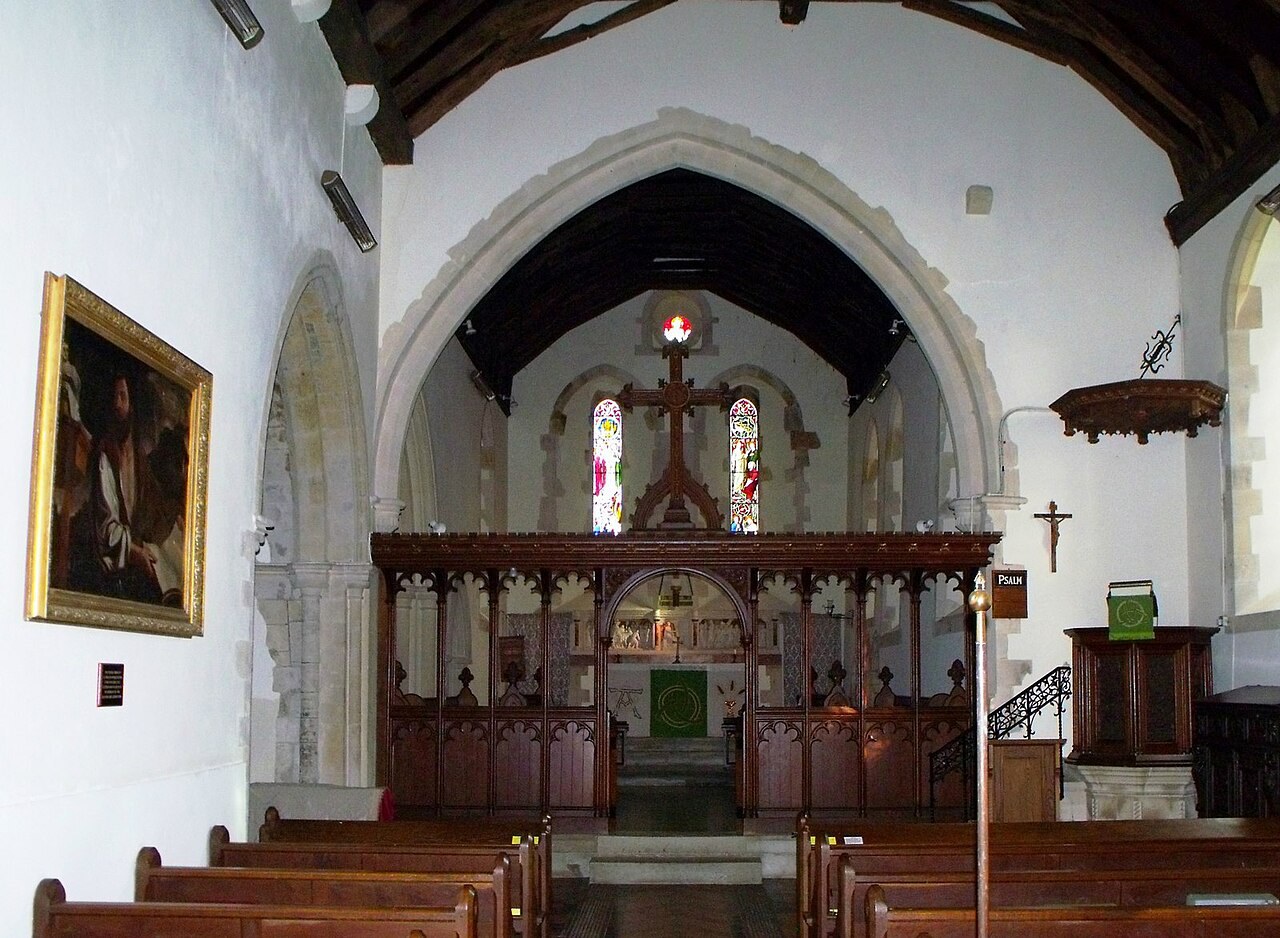
St John the Divine is the flint church at the northern edge of the village, thirteenth-century, with Perpendicular windows and a tower set at the north-east corner of the nave rather than the west end. Henry Woodyer restored it in 1888 and added the tall broach spire, the vestry and the south porch. Historic England calls it a "good small medieval flint church, rather much restored." Inside, the tiled reredos resembles the Morris & Co work at nearby Clapham and Findon.
Deep Time and Michelgrove
The Domesday surveyors counted forty-three households here in 1086 and valued the manor at fifteen pounds. Older still are the flint workings on the chalk above the village, thought to date from about 2500 to 1000 BC. In 1997 a metal detectorist working the fields south-west of Patching turned up fifty late-Roman coins, two heavy gold rings and fifty-four pieces of scrap silver; the latest coins were struck between AD 461 and 470.
A short way off, a castellated wall and an octagonal turret are all that remain of Michelgrove, the Shelley family's seat from the late fifteenth century until 1800, before the Duke of Norfolk bought the estate in 1828 and later had it demolished.
Routes In and Gardens Beyond
Getting here is straightforward. Angmering station is about two and a half miles away, with taxis and parking. The old A27 through the parish became Arundel Road after the 1995 bypass, and the A280 runs north over Long Furlong towards the Downs.
For a longer day out, Highdown Gardens sits free to enter on the chalk hill to the south-east, a former quarry planted by Sir Frederick and Lady Sybil Stern and now grown into a glasshouse, visitor centre and sensory garden. Arundel Castle and its thirty-eight acres of gardens are nearby.
The Hamlet Called France
One of the outlying hamlets is called France. Nobody is quite sure why: either because it stood apart from everything around it, or because a camp for Napoleonic prisoners of war once stood nearby. The parish council offers both and settles on neither.
Stay around South Downs
Make a longer stay of it
Travel Fox holiday homes around South Downs, linked directly to their property pages.
For homeowners
Own a holiday home near Patching?
We manage holiday lets across the UK from 12% commission, charged after cleaning costs, with no lock-in. A co-founder visits before you decide.
How our holiday let management works →
A guide with a point of view
Written from research. Edited for real journeys.
Use the Official site links for live practical details, then use this guide for context, ideas and room to explore.
Photography credits & licences
Third-party photographs are credited to their named creators and reused under the linked Creative Commons licence or public-domain dedication. Travel Fox stores an optimised local copy; the file-specific changes and any browser-applied display crop are disclosed below. Reused photographs link both to the Wikimedia Commons source record and to the declared source image; Travel Fox's own photographs carry no such record and are marked as ours. These image licences do not cover Travel Fox text, branding or page design.
- File:Nave, St. John the Divine, Patching - geograph.org.uk - 3358675.jpg — photograph by nick macneill; Nave, St. John the Divine, Patching by nick macneill. Source record on Wikimedia Commons. Declared source image. Licence: CC BY-SA 2.0. File changes: Downloaded from Wikimedia Commons, resized to a maximum 1920px edge and encoded as an optimised JPEG. Display changes: Displayed with responsive CSS cropping.
Sources
Every place on this page is checked against a published source. Each entry links the record we used and names who publishes it.
- The World's End — worldsendpatching.co.uk operator, sector body or destination organisation
- St John the Divine — historicengland.org.uk statutory register or public authority record not machine-readable; publisher restricts automated access
- Patching Circular Loop — discoversussex.org operator, sector body or destination organisation
- Highdown Gardens — highdowngardens.co.uk operator, sector body or destination organisation
- Arundel Castle and Gardens — arundelcastle.org operator, sector body or destination organisation