
Market town, ancient country
Cookstown
A mile-long main street points towards Slieve Gallion, with linen history, wooded river country and ancient monuments beyond.
- Best for
- Linen heritage, forest trails and ancient monuments
- Give it
- A day with a car for the out-of-town sites
- Don't miss
- Wellbrook's water-powered mill and Beaghmore's stone circles
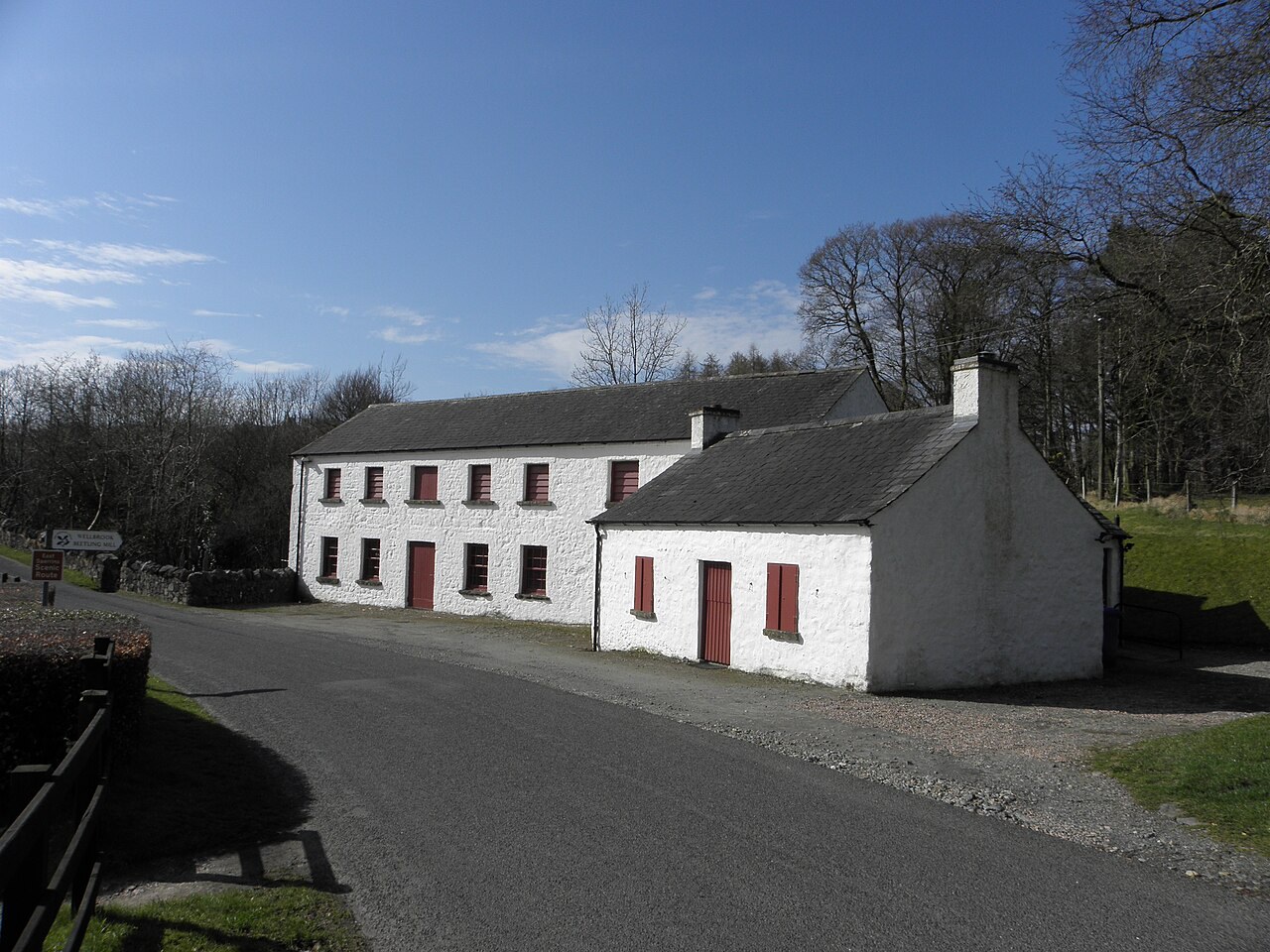
Photo: HENRY CLARK · CC BY-SA 2.0 · cropped
The Fox verdict
A market town with a much older horizon
Cookstown pairs its unusually long main street with the surviving machinery of its linen story and some of Tyrone's most resonant ancient sites.
Begin with the Gothic Revival landmark of Holy Trinity, then follow the wider story out to Wellbrook's water-powered mill, Drum Manor's gardens and trails, and the prehistoric and O'Neill sites beyond the town.
Where to go
Places in Cookstown
Every place below is checked against a published source, listed with what it is and how long to give it.
Local signatures
3 placesChurch of the Holy Trinity
A listed Gothic Revival landmark built from 1855 to 1860 by J.J. McCarthy, with a tower and spire at its east end.
- Visit length
- Editorial estimate: Allow around 45 minutes
- Locality
- on Cookstown's mile-long main street
Drum Manor Forest Park
A forest park with waymarked trails, an arboretum, butterfly and Japanese gardens, ponds, a wildfowl lake, a play area and camping facilities.
- Visit length
- Editorial estimate: Allow around 2 hours
- Locality
- off the A505 Cookstown–Omagh road
Tullaghoge Fort
The hilltop rath where the O'Neill chiefs of Tyrone were inaugurated; Lord Mountjoy smashed the stone coronation chair in 1602.
- Visit length
- Editorial estimate: Allow around 60 minutes
- Locality
- on a hilltop just south of Cookstown
History & heritage
4 places
Wellbrook Beetling Mill
Northern Ireland's last working water-powered beetling mill, with a 16-foot water wheel, worker's cottage and riverside woodland.
- Visit length
- Editorial estimate: Allow around 90 minutes
- Locality
- in a wooded glen on the Ballinderry River
- Access
- Seasonal opening with guided tours.
Beaghmore Stone Circles
A prehistoric complex of seven Bronze Age stone circles, ten stone rows and twelve cairns, uncovered from the peat in the 1940s.
- Visit length
- Editorial estimate: Allow around 60 minutes
- Locality
- in the Sperrins
Ardboe High Cross
A 10th-century high cross rising about 18.5 feet, with 22 carved biblical panels on the site of St Colman's 6th-century monastery.
- Visit length
- Editorial estimate: Allow around 45 minutes
- Locality
- on Lough Neagh
Lissan House
Lissan House developed over almost 400 years from building begun by Thomas Staples around 1620. The Lissan House Trust now cares for it as a place to visit.
- Visit length
- Editorial estimate: Allow around 75 minutes
- Locality
- on the town's edge
No places match this filter. Choose All places to reset the list.
Three ways to explore Cookstown
Signature outings
See water power at Wellbrook
See the 16-foot water wheel at Northern Ireland's last working water-powered beetling mill, set beside the Ballinderry River.
Walk among Beaghmore's circles
Explore seven stone circles, ten stone rows and twelve cairns uncovered during peat cutting in the 1940s.
Study Ardboe's carved panels
Look over the 22 biblical panels carved into the 10th-century high cross on the shore of Lough Neagh.
The town story
Cookstown Town Guide
A long market street opens onto linen country, wooded estates and a landscape marked by ancient power.
The Street That Meets a Mountain
Cookstown's broad main street runs for more than a mile and a quarter, with Slieve Gallion visible beyond its northern end. In 1837 Samuel Lewis described a town of one wide street crossed at right angles by another. Its generous width still defines the centre.
A market patent was granted to Allan Cook in 1628. By the nineteenth century the town held Tuesday grain markets and Saturday markets for linen cloth, flax, livestock and provisions. The broad street still recalls the scale of that trade.
Spires, Linen and River Country
Holy Trinity faces the main street from a raised site. Designed by J.J. McCarthy and built from 1855 to 1860, it is a Gothic Revival church with a tall tower and spire. At Derryloran, the ruined church built around 1622 occupies an older site associated with St Luran, and its graveyard remains in use.
Four miles west of Cookstown, Wellbrook Beetling Mill stands in a wooded glen by the Ballinderry River. Its 16-foot wheel powers the hammers used to finish linen, a reminder of an industry that once shaped this district. South-east of town, John Nash's Killymoon Castle overlooks the same river; part of its former demesne is now a golf course. About three miles from Cookstown off the A505, Drum Manor Forest Park offers waymarked trails, an arboretum, butterfly and Japanese gardens, ponds and a play area.
Stone Circles and O'Neill Power
Beaghmore in the Sperrins has seven stone circles, ten stone rows and twelve cairns, uncovered during peat cutting in the 1940s. South of Cookstown, Tullaghoge Fort was an inauguration place of the Cenél nEógain, later the O'Neills. On the shore of Lough Neagh, the 10th-century Ardboe High Cross stands 18.5 feet high, its 22 panels showing scenes from both Testaments.
Roads, Races and the Burnavon
Cookstown has a bus station but no operating railway station; Translink routes connect it with Belfast, Omagh, Dungannon and Magherafelt. The Cookstown 100 motorcycle road race began in 1922 and is the island's oldest road race. In the town centre, the Burnavon Arts and Cultural Centre hosts performances and workshops.
The Staples Family at Lissan
At Lissan House, the Staples family shaped the house over almost four centuries, beginning with Thomas Staples around 1620. The trust founded by Hazel Radclyffe Dolling now cares for the estate.
Stay around Tyrone
Make a longer stay of it
Travel Fox holiday homes around Tyrone, linked directly to their property pages.
For homeowners
Own a holiday home near Cookstown?
We manage holiday lets across the UK from 12% commission, charged after cleaning costs, with no lock-in. A co-founder visits before you decide.
How our holiday let management works →
A guide with a point of view
Written from research. Edited for real journeys.
Use the Official site links for live practical details, then use this guide for context, ideas and room to explore.
Photography credits & licences
Third-party photographs are credited to their named creators and reused under the linked Creative Commons licence or public-domain dedication. Travel Fox stores an optimised local copy; the file-specific changes and any browser-applied display crop are disclosed below. Reused photographs link both to the Wikimedia Commons source record and to the declared source image; Travel Fox's own photographs carry no such record and are marked as ours. These image licences do not cover Travel Fox text, branding or page design.
- File:Wellbrook Beetling Mill,Cookstown - geograph.org.uk - 1823545.jpg — photograph by HENRY CLARK; Wellbrook Beetling Mill,Cookstown by HENRY CLARK. Source record on Wikimedia Commons. Declared source image. Licence: CC BY-SA 2.0. File changes: Downloaded from Wikimedia Commons, resized to a maximum 1920px edge and encoded as an optimised JPEG. Display changes: Displayed with responsive CSS cropping.
Sources
Every place on this page is checked against a published source. Each entry links the record we used and names who publishes it.
- Church of the Holy Trinity — apps.communities-ni.gov.uk statutory register or public authority
- Wellbrook Beetling Mill — nationaltrust.org.uk national body or asset manager
- Drum Manor Forest Park — nidirect.gov.uk statutory register or public authority
- Beaghmore Stone Circles — communities-ni.gov.uk statutory register or public authority
- Tullaghoge Fort — communities-ni.gov.uk statutory register or public authority
- Ardboe High Cross — communities-ni.gov.uk statutory register or public authority
- Lissan House — lissanhouse.com operator, sector body or destination organisation