
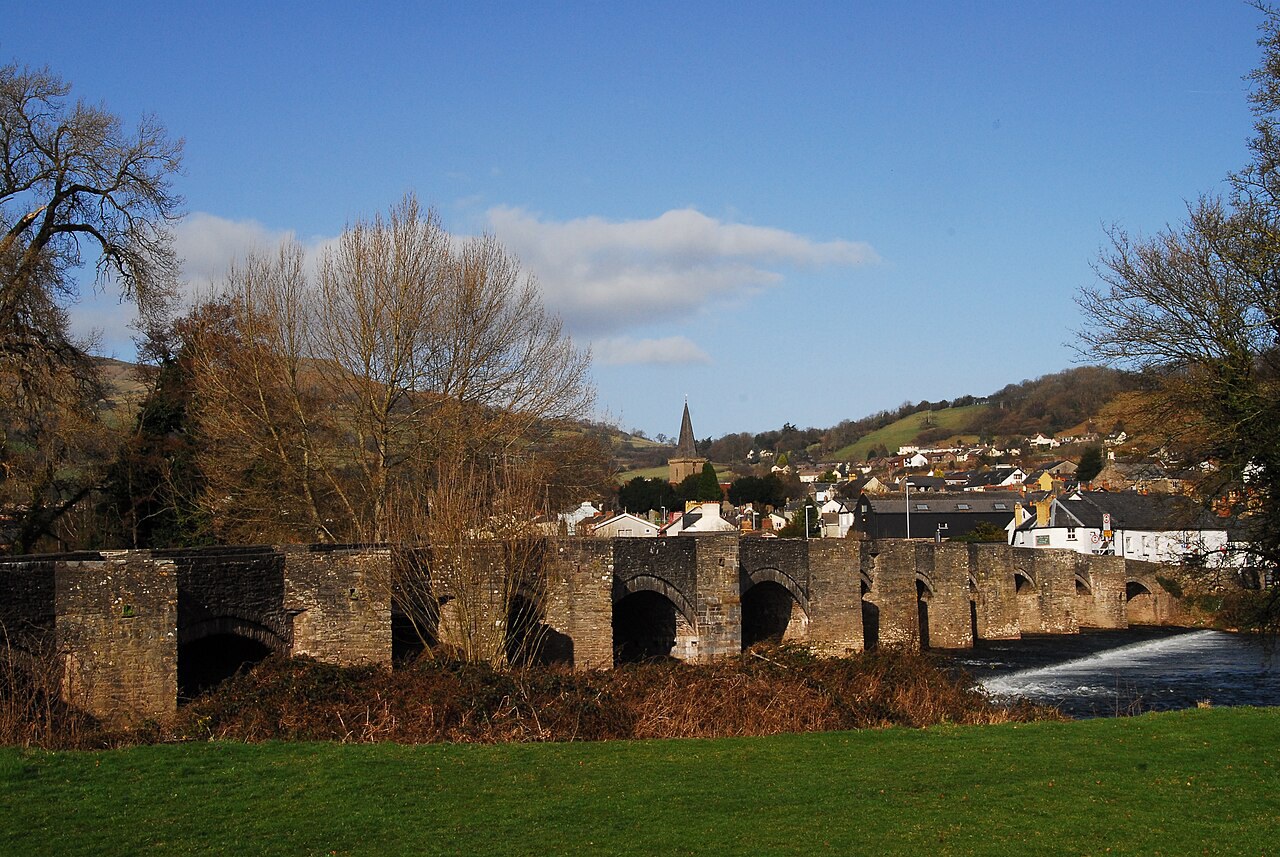
River, ridge and market town
Crickhowell
A historic town on the Usk where independent shops, coaching inns and medieval landmarks sit beneath Table Mountain.
- Best for
- Independent food, historic buildings and hill walking
- Give it
- About three hours for the Table Mountain town return
- Don't miss
- Crickhowell Bridge and the climb to Table Mountain
Photo: John Winder · CC BY-SA 2.0 · cropped
The Fox verdict
A market town with the mountains already in view
Crickhowell combines a Grade I bridge, medieval remains and a notably independent High Street with walks beside the Usk and up to Crug Hywel.
Begin at the multi-arched bridge, browse the town's independent food and book shops, then choose between the church and castle remains or a longer outing to Table Mountain and the Llangattock canal towpath.
Where to go
Places in Crickhowell
Every place below is checked against a published source, listed with what it is and how long to give it.
Local signatures
3 placesBear Hotel
A rambling traditional coaching inn with oak beams, wood panelling, settles, flagstones and several small drinking areas; its Grade II* interior is classed by CAMRA as historically interesting.
- Visit length
- Editorial estimate: Allow around 90 minutes
- Locality
- on the High Street
- Access
- Well-behaved dogs are welcome in the bar rather than the restaurant.
Book-ish
An independent bookshop, café and events venue founded in 2010, named Independent Bookshop of the Year at the 2024 British Book Awards.
- Visit length
- Editorial estimate: Allow around 60 minutes
- Locality
- Crickhowell
St Edmund's Church
A Grade II* cruciform church founded and endowed in 1303 by Lady Sybil Pauncefote, with a 1668 font and Pauncefote effigies on opposite sides of the sanctuary.
- Visit length
- Editorial estimate: Allow around 45 minutes
- Locality
- close to the River Usk
Food & drink
1 placeCashells
An independent family butcher, delicatessen, greengrocer and cheese counter, with three generations in the business since 1975 and more than 75 cheeses recorded by local guides.
- Visit length
- Editorial estimate: Allow around 30 minutes
- Locality
- on the High Street
Walks & outdoors
2 placesTable Mountain / Crug Hywel Walk
The signature there-and-back climb from Crickhowell reaches the flat-topped Iron Age hillfort above the town.
- Visit length
- Editorial estimate: Allow about three hours for the town return
- Locality
- above the town
- Access
- This is a real hill outing rather than a park stroll, so weather, footwear and descent conditions matter.
Monmouthshire & Brecon Canal Towpath
An easier linear walk from Llangattock on the level canal towpath beneath the limestone escarpment, contrasting with the steep Table Mountain approach.
- Visit length
- Editorial estimate: Allow around 90 minutes
- Locality
- from Llangattock
History & heritage
3 places
Crickhowell Bridge
A Grade I multi-arched stone bridge rebuilt in 1706 and later widened, with its southernmost arch also spanning the Nant Onnau before the stream reaches the Usk.
- Visit length
- Editorial estimate: Allow around 30 minutes
- Locality
- from Crickhowell towards Llangattock
Crickhowell Castle
The Grade I listed and scheduled ruins preserve a roughly 15-metre motte and traces of a shell keep, towers and a gatehouse from the planned post-Conquest town.
- Visit length
- Editorial estimate: Allow around 45 minutes
- Locality
- in the recreation ground
- Access
- Explore the paths and look at the protected monument rather than climbing vulnerable masonry.
Tretower Court and Castle
A site spanning roughly 900 years, with a stone tower, a restored great hall evoking the 1460s and a reconstructed garden using white roses associated with the Vaughans' Yorkist loyalties.
- Visit length
- Editorial estimate: Allow around 120 minutes
- Locality
- about three miles from Crickhowell
No places match this filter. Choose All places to reset the list.
Three ways to explore Crickhowell
Signature outings
Count the bridge arches
Follow the Grade I multi-arched crossing towards Llangattock and notice how its southernmost arch also spans the Nant Onnau.
Walk up Crug Hywel
Allow about three hours for the there-and-back climb from Crickhowell to the flat-topped Iron Age hillfort.
Enter Tretower's great hall
Explore a site spanning roughly 900 years, where the restored great hall evokes the 1460s beside the older stone tower.
The town story
Crickhowell Town Guide
From a many-arched bridge and independent High Street to coaching inns, medieval remains and the hillfort above town.
Bridge, landscape and coaching-inn beginnings
The stone bridge leaving Crickhowell carries so many arches that its southernmost one clears a second stream, the Nant Onnau, before that brook has even reached the River Usk. A crossing was first recorded here in 1538; the present multi-arched bridge was rebuilt in 1706 and later widened, and Cadw lists it Grade I as one of the finest early bridges in Wales. It takes you out of the town towards Llangattock, low and grey above the water, and it is the sensible place to begin: from here the High Street, the church and the castle mound are all within easy reach.
The town occupies a gentle slope on the north bank of the Usk, where Cwmbeth Brook comes down to meet it, the High Street running roughly parallel to the river above the church. Look up from almost anywhere and Table Mountain is there: Crug Hywel, the flat-topped Iron Age hillfort that gave the town its name, its enclosure clearly visible over the roofs. South across the river, Llangattock's wooded slopes climb to a pale limestone escarpment cut by old quarries, with the canal running along the lower contour. The view arriving in town layers river, bridge, pasture, wooded slope and quarried ridge, and none of it is far away.
Start with the pubs, because there are seven and they are genuinely different from one another. The Bear Hotel is the one people mean when they say they will meet you in town: a rambling coaching inn on the High Street with oak beams, settles, flagstones and real fires, several small drinking areas rather than one open room, and a claim to have kept a hostelry on the site since 1432. The Hindmarsh family has run it for more than forty years. The kitchen, under head chef Iain Sampson, who trained at the Ritz and was once Welsh Chef of the Year, has put out dishes such as slow-braised Welsh lamb shank with spring-onion mash, Welsh faggots with onion gravy and mushy peas, beef-and-ale pie, beer-battered fish and chips, Welsh rarebit and banoffee pie. Brains Reverend James and Timothy Taylor Landlord have been the regular cask ales. Dogs are welcome in the bar, where the staff keep water bowls and treats, and the chef will sometimes put together a bowl for them too.
Inns, taprooms and independent food
The Dragon Inn, a few doors along, is an early-Georgian coaching inn of 1765 with a garden that runs perhaps a hundred metres back towards a view of Table Mountain. Its kitchen buys meat from Cashells in town and fish from the Welsh coast, and makes a point of its Sunday sharing roast: three meats, Yorkshire puddings and gravy, with a pudding list written that same morning. The bar pours Felinfoel Double Dragon and leans into Welsh spirits, among them Barti rum, Brecon Gin and Penderyn whisky. Dogs are allowed inside, including beside the fire.
The rest divide up by what you want from an evening. The Britannia, red-fronted on the High Street, is the pub for pool, darts, live music and sport on the screens, with pizzas and nachos to go alongside Wye Valley Butty Bach. Treebeards is a micropub at 54 High Street, two or three changing Welsh cask ales served close to the barrel, Grey Trees Diggers Gold among the regulars, in part of the old Corn Exchange building. The Bridge End Inn sits right by the bridge with a garden on the bank of the Usk; it reopened at the end of 2024 after a long flood-related closure, and its west end takes in a nineteenth-century tollhouse from the days when the crossing was a turnpike. The Swan, on Llanbedr Road, is a sports pub with a patio and a pint of Wadworth 6X. Out on the eastern edge of town, on the Elvicta Estate, Antur Brew Company runs a taproom and can shop, with craft keg and canned beer brewed on a 500-litre kit and food vans dropping in at weekends. Antur means adventure in Welsh; the brewery moved here from Three Cocks in 2024 and opened the taproom that spring.
The food shopping is the other reason people stay. Cashells has been a family butcher on the High Street since 1975, three generations in, selling Black Mountain beef and lamb, home-roasted ham, pies, pickles and a cheese counter running to more than seventy-five kinds. Book-ish, the independent bookshop and café, was named Independent Bookshop of the Year at the 2024 British Book Awards; its café cooks with Cashells meat and Black Mountains Smokery fish and pours a Black Mountain Roast blend, and it runs the author events at the heart of the Crickhowell Literary Festival. Natural Weigh, opened by Robin and Chloe Masefield in March 2018, calls itself the first zero-waste shop in Wales: you bring your own containers and refill them with Talgarth flour, Bwlch vinegar, Llangattock honey and Anglesey salt, more than ninety per cent of it organic.
Independent shops, hill walks and St Edmund's
There is more of this than a town the size of Crickhowell has any obligation to keep going. Crickhowell Bakery, run by Magda and Jon, makes real bread, Italian-style focaccia and patisserie. Latte-da is a tearoom with a walled botanical garden and a welcome for dogs. The Courtroom Café occupies the former magistrates' courtroom on the upper floor of the 1830s Market Hall. Nicholls has traded since 1925, when it sold animal feed and pans to farmers, and now stocks Barbour and country clothing; Webbs, a family home and furniture shop, dates from the 1930s. Crickhowell Adventure sells maps, boots and the kind of forgotten kit you realise you need the evening before a hill walk. In 2018 the town won the overall Great British High Street Award, earned in part through the campaign in which 267 local people bought and redeveloped the Corn Exchange to stop it becoming a supermarket.
The walking is the third leg of a stay here. The signature climb is Table Mountain itself, a there-and-back from the town to the hillfort on top, roughly three hours up and down. It is a proper hill outing rather than a stroll, and footwear and weather matter on the descent. For a full day, the BBC's Derek Brockway mapped a circuit of 8.74 miles that starts at the Bridge End Inn, takes in Table Mountain and Darren, follows part of the Beacons Way and returns through Glanusk, with steep gradients, boggy ground and a couple of main-road crossings along the way. If that sounds like too much, cross the bridge to Llangattock and walk the level canal towpath beneath the escarpment, or follow the river close to town, where some stretches are gentle enough for a pushchair. The old quarries strung along the Llangattock escarpment add industrial archaeology to a route that is otherwise all open limestone.
The church stands lower down, near the river. St Edmund's was founded in 1303 by Lady Sybil Pauncefote, and is the only church in Wales dedicated to St Edmund, the ninth-century English king killed by Danish raiders. Lady Sybil's effigy lies on one side of the sanctuary and that of her husband, Sir Grimbald Pauncefote, on the other; there are two windows by Charles Eamer Kempe showing the Flight into Egypt, and a font dated 1668. One explanation for a separate parish growing up here, less than a mile from the older mother church at Llangattock, is the river's habit of flooding.
Castle, market town and literary echoes
The Pauncefotes turn up in the town's other ruin as well. Crickhowell grew as a planned borough around Alisby's Castle after the Conquest; Edward I granted murage in 1281, borough status followed in 1283, and Sir John Pauncefote refortified the place during Owain Glyndŵr's rising early in the fifteenth century. It fell, and by the mid-sixteenth century the keep was already uninhabitable. What survives, a fifteen-metre motte with traces of a shell keep and gatehouse, sits in the recreation ground near the centre, a Grade I monument you can walk up to without committing to a hill.
The town carries its past densely. The conservation area holds 121 listed buildings, which is why even the plain stretches of the High Street feel weighted. John Leland passed through in the 1530s and called it "a pretty little town," though a century later the market had lapsed, and a 1675 account found about a hundred houses and a single middling inn. The Duke of Beaufort's Market Hall of 1833 gave the town a civic centre, with lock-up cells behind it and a courtroom above that sat until the late 1980s. In 1950 an industrial estate arrived on the eastern edge, the Elvicta cabinet and tool factory, which made spirit levels and radio cabinets, employed about a hundred people, and once put Acker Bilk on in its canteen. Antur brews its beer on that same estate now.
Richard Fenton, travelling in the early nineteenth century, called Crickhowell "the most cheerful looking town I ever saw." Tolkien, who knew the country around here, wrote that the hamlet of Crickhollow in The Lord of the Rings was meant to resemble it.
Routes out and a High Street coda
Getting here is straightforward by road, the town sitting directly on the A40 between Abergavenny and Brecon with the A479 running north, and less so by rail, since the nearest station is at Abergavenny, seven miles east, where the buses along the Abergavenny–Crickhowell–Brecon corridor connect. Tretower Court and Castle, with its restored fifteenth-century great hall and a garden replanted with the white roses of the Vaughans' Yorkist loyalties, is three miles off; Llangorse Lake is about twenty minutes' drive; and Abergavenny's castle museum and market fill an easy day once the High Street has been thoroughly worked through.
A photograph from 1910, taken outside what was then Ward's seed merchants, caught a dancing bear on the High Street. Such bears were a common enough sight in the town, a local historian noted years later, before this particular one went berserk in Brynmawr. The bear and the seed merchants are long gone. Cashells is still curing its ham three generations on, and someone in Book-ish is making the coffee.
Stay around Brecon Beacons
Make a longer stay of it
Travel Fox holiday homes around Brecon Beacons, linked directly to their property pages.
For homeowners
Own a holiday home near Crickhowell?
We manage holiday lets across the UK from 12% commission, charged after cleaning costs, with no lock-in. A co-founder visits before you decide.
How our holiday let management works →
A guide with a point of view
Written from research. Edited for real journeys.
Use the Official site links for live practical details, then use this guide for context, ideas and room to explore.
Photography credits & licences
Third-party photographs are credited to their named creators and reused under the linked Creative Commons licence or public-domain dedication. Travel Fox stores an optimised local copy; the file-specific changes and any browser-applied display crop are disclosed below. Reused photographs link both to the Wikimedia Commons source record and to the declared source image; Travel Fox's own photographs carry no such record and are marked as ours. These image licences do not cover Travel Fox text, branding or page design.
- File:Crickhowell bridge and town (geograph 4038979).jpg — photograph by John Winder; John Winder. Source record on Wikimedia Commons. Declared source image. Licence: CC BY-SA 2.0. File changes: Downloaded from Wikimedia Commons, resized to a maximum 1920px edge and encoded as an optimised JPEG. Display changes: Displayed with responsive CSS cropping.
Sources
Every place on this page is checked against a published source. Each entry links the record we used and names who publishes it.
- Crickhowell Bridge — cadwpublic-api.azurewebsites.net other published source
- Bear Hotel — bearhotel.co.uk operator, sector body or destination organisation
- Book-ish — book-ish.co.uk operator, sector body or destination organisation record not machine-readable; publisher restricts automated access
- Table Mountain / Crug Hywel Walk — cadw.gov.wales statutory register or public authority
- St Edmund's Church — coflein.gov.uk statutory register or public authority
- Crickhowell Castle — cadwpublic-api.azurewebsites.net other published source
- Monmouthshire & Brecon Canal Towpath — visitcrickhowell.wales operator, sector body or destination organisation
- Tretower Court and Castle — cadw.gov.wales statutory register or public authority
- Cashells — visitcrickhowell.wales operator, sector body or destination organisation