
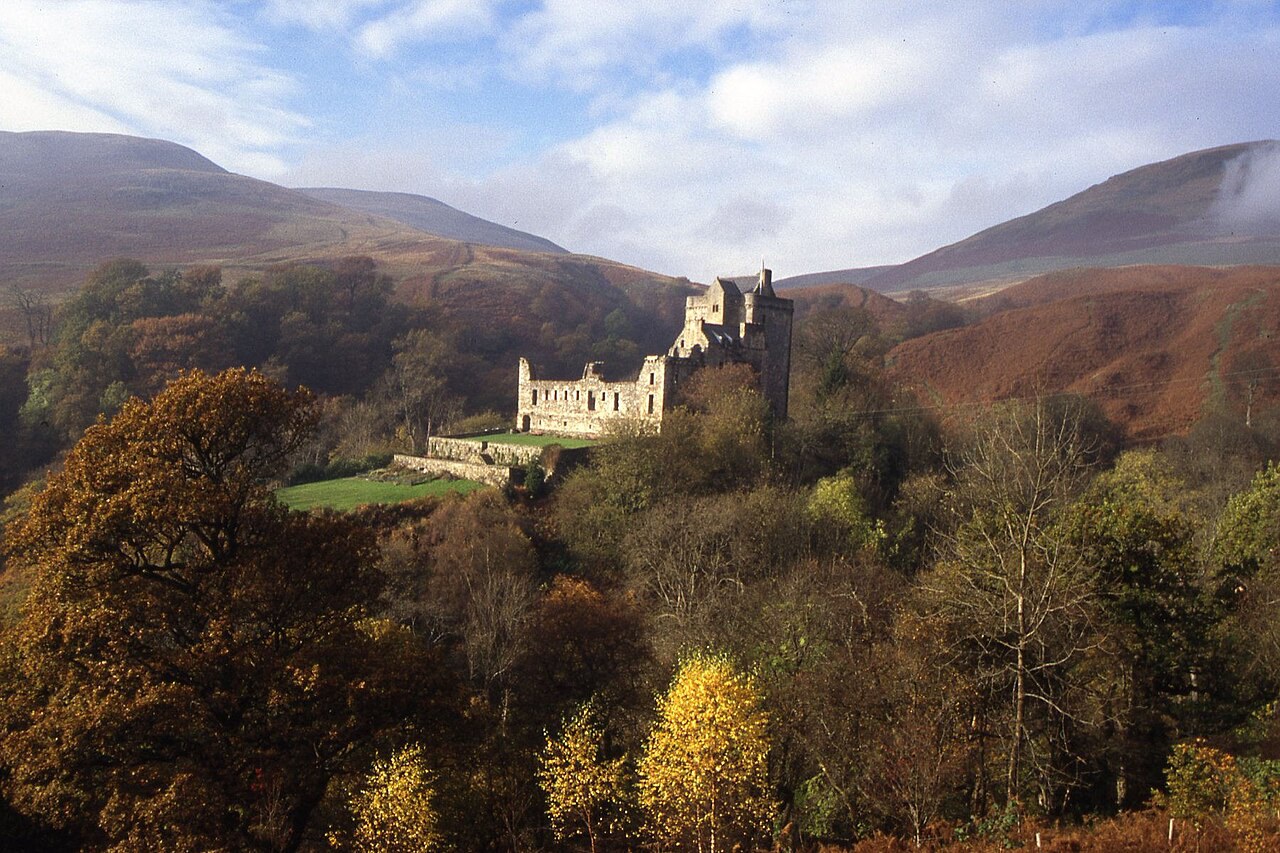
Below the Ochil Hills
Dollar
A stone-built Hillfoots town with a deep wooded glen, two evocatively named burns and Castle Campbell above.
- Best for
- The Dollar Glen circular and Castle Campbell
- Give it
- 1.5–2 hours for the glen circular
- Don't miss
- The Burns of Care and Sorrow below the castle
Photo: Colin Park · CC BY-SA 2.0 · cropped
The Fox verdict
A glen, a castle and a Hillfoots town
Dollar brings together a short gorge walk, Castle Campbell, local history and food on Bridge Street.
The two-mile Dollar Glen circular climbs through a deep woodland gorge past waterfalls and volcanic-rock chasms. Castle Campbell stands above the town where the Burn of Care and Burn of Sorrow meet below it, while Dollar Museum covers the town and academy's history.
Where to go
Places in Dollar
Every place below is checked against a published source, listed with what it is and how long to give it.
Local signatures
3 places
Start here
Castle Campbell
Originally called Castle Gloom, the castle was held by the Campbell earls of Argyll for about 400 years from the 1460s and served as their main lowland seat.
- Visit length
- Editorial estimate: allow around 60 minutes
- Locality
- at the head of Dollar Glen above the town
Dollar Museum
A local museum covering the history of Dollar and Dollar Academy.
- Visit length
- Editorial estimate: allow around 45 minutes
- Locality
- in Dollar town
Dollar's Deli
An award-winning licensed delicatessen selling freshly made sandwiches and cakes, deli foods, bread, beer and wine, with hampers and outside catering.
- Visit length
- Editorial estimate: allow around 30 minutes
- Locality
- 62 Bridge Street
Walks & outdoors
1 placeDollar Glen & Castle Campbell Circular
A circular through a deep woodland gorge, following the twin burns past cascading waterfalls, bridges and chasms cut into volcanic rock.
- Visit length
- Editorial estimate: Allow 1.5–2 hours
- Locality
- Dollar Glen
- Access
- Rough compacted-dirt paths with steep inclines; very muddy in winter, with waterproof footwear advised.
History & heritage
1 placeParish Church of St Columba, Dollar
A Category B listed church built in 1841–1843, designed by Sir William Tite in the later English Gothic style with a square embattled tower.
- Visit length
- Editorial estimate: allow around 30 minutes
- Locality
- Dollar
No places match this filter. Choose All places to reset the list.
Three ways to explore Dollar
Signature outings
Walk Dollar Glen
Take the two-mile circular through the woodland gorge past waterfalls and chasms carved into volcanic rock.
Enter Campbell history
Visit the castle once called Castle Gloom, held by the Campbell earls of Argyll for about 400 years from the 1460s.
See Tite's Gothic church
See the Category B listed parish church designed by Sir William Tite, with its square embattled tower.
The town story
Dollar Town Guide
Castle Campbell, Dollar Glen and the town beneath the Ochil Hills.
Castle Gloom and the Hillfoots
Above the town, at the head of a deep wooded gorge, Castle Campbell sits where two burns meet. The burns are called the Burn of Care and the Burn of Sorrow, and they join below the castle to form the Dollar Burn. The castle itself was originally Castle Gloom. Whoever named all this was not having a good century, but the walk up to it is one of the best short walks in central Scotland.
Dollar sits at the eastern end of the four Hillfoots Villages, tucked between the steep southern edge of the Ochil Hills and the River Devon. The older part of the town, beneath the castle, is built of two-storey stone houses, the oldest dating from the mid-seventeenth century. Behind it all rises King's Seat Hill, 648 metres, a long climb up through the glen for anyone who wants the Ochils proper rather than the woodland below.
Through the Glen to Bridge Street
The glen walk is the one most people come for. It is about two miles round, an hour and a half to two hours, on compacted-dirt paths that climb steeply through the gorge past waterfalls and chasms cut into volcanic rock. In winter it is, by every honest account, very muddy, so bring boots that can take it. The place has drawn visitors since Victorian times and supports red squirrels, badgers, deer, woodpeckers, owls and dippers, along with lichens and ferns of national importance.
Bridge Street handles the food. Dollar's Deli at number 62 is a licensed delicatessen selling freshly made sandwiches and cakes, deli meats, cheeses, olives, bread, beer and wine, and it does hampers and outside catering; it calls itself "an award-winning licensed Deli at the heart of the community." A few doors along at 31 is the Baker's Shop, and Bridge Street Kitchen handles the coffee.
Meals, School and the Shape of Dollar
For a sit-down meal you have a choice. The Forager, which opened in December 2022, is a modern gastropub with a private dining room. The Ochil Arms does British cooking in comfortable surroundings, the Royal Oak leans on live music and sport, and No5 Inn and Restaurant has been run by Alison, David and Darren since 2006. The Castle Campbell Hotel on Bridge Street, a fixture for generations, has closed.
The town owes much of its shape to Dollar Academy, founded in 1818 on a bequest from John McNabb, a sea captain and ship-owner. Its buildings were designed by William Henry Playfair, and the school pulled well-off families to the town and made it the handsomest of the Hillfoots. Its former pupils include James Dewar, who invented the vacuum flask, and the novelist Iain Banks.
Arriving in a Water-Meadow
There is no railway now; the Devon Valley line closed in 1964, and the nearest railheads are around Stirling and Alloa. Dollar sits on the A91, about twelve miles east of Stirling, with Hillfoots buses running the same corridor.
The name has nothing to do with money. It comes most likely from Pictish words for a water-meadow, which is a quieter thing to be named after than the castle, the gloom, the care and the sorrow all sitting on the hill above.
Stay around Clackmannanshire
Make a longer stay of it
Travel Fox holiday homes around Clackmannanshire, linked directly to their property pages.
For homeowners
Own a holiday home near Dollar?
We manage holiday lets across the UK from 12% commission, charged after cleaning costs, with no lock-in. A co-founder visits before you decide.
How our holiday let management works →
A guide with a point of view
Written from research. Edited for real journeys.
Use the Official site links for live practical details, then use this guide for context, ideas and room to explore.
Photography credits & licences
Third-party photographs are credited to their named creators and reused under the linked Creative Commons licence or public-domain dedication. Travel Fox stores an optimised local copy; the file-specific changes and any browser-applied display crop are disclosed below. Reused photographs link both to the Wikimedia Commons source record and to the declared source image; Travel Fox's own photographs carry no such record and are marked as ours. These image licences do not cover Travel Fox text, branding or page design.
- File:Castle Campbell near Dollar - geograph.org.uk - 6481626.jpg — photograph by Colin Park; Castle Campbell near Dollar by Colin Park. Source record on Wikimedia Commons. Declared source image. Licence: CC BY-SA 2.0. File changes: Downloaded from Wikimedia Commons, resized to a maximum 1920px edge and encoded as an optimised JPEG. Display changes: Displayed with responsive CSS cropping.
Sources
Every place on this page is checked against a published source. Each entry links the record we used and names who publishes it.
- Dollar Glen & Castle Campbell Circular — nts.org.uk national body or asset manager
- Castle Campbell — historicenvironment.scot statutory register or public authority record not machine-readable; publisher restricts automated access
- Dollar Museum — clacks.gov.uk statutory register or public authority
- Parish Church of St Columba, Dollar — portal.historicenvironment.scot statutory register or public authority
- Dollar's Deli — ratings.food.gov.uk statutory register or public authority