
The capital of the New Forest
Lyndhurst
A compact High Street, a hilltop church and open forest lawns where ponies graze at the village edge.
- Best for
- Forest walks and village history
- Give it
- 3–4 hours for the parish circuit
- Don't miss
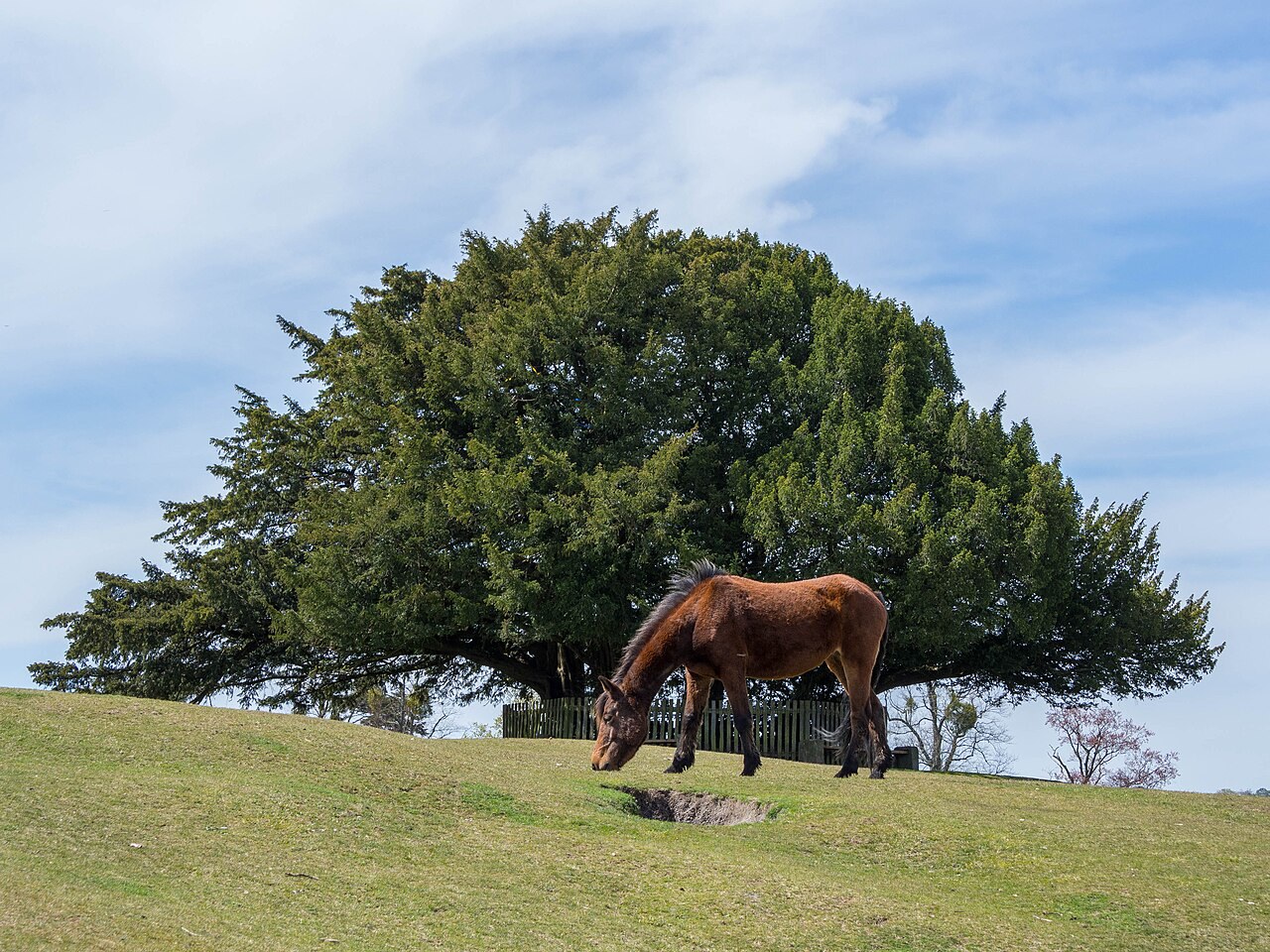
- Ponies at Bolton's Bench
Photo: Wintonian · CC BY-SA 4.0 · cropped
The Fox verdict
Forest capital, village scale
Lyndhurst brings the New Forest's administrative history, open grazing lawns and compact High Street together in one place.
Start with the ponies at Bolton's Bench, add the Heritage Centre and St Michael and All Angels, then choose between sourdough, a historic inn or a traditional pub.
Where to go
Places in Lyndhurst
Every place below is checked against a published source, listed with what it is and how long to give it.
Local signatures
3 placesNew Forest Heritage Centre
A family-friendly indoor museum with a gift shop and reference library, also serving as the village's main visitor information point.
- Visit length
- Editorial estimate: Allow around 1 hour 15 minutes.
- Locality
- In the main village car park
BakeHouse24
An artisan bakery and café specialising in sourdough.
- Visit length
- Editorial estimate: Allow around 45 minutes.
- Locality
- 53 High Street
Lyndhurst Parish Circular Walk
A circular walk around the parish boundary through heathland, grassland and outlying hamlets, beginning and ending at Bolton's Bench.
- Visit length
- Editorial estimate: Allow 3–4 hours.
- Locality
- Around the parish boundary
Food & drink
3 placesThe Fox & Hounds
A traditional Fuller's pub and restaurant in a large Georgian building, with antique furniture, exposed beams, log fires and a garden.
- Visit length
- Editorial estimate: Allow around 1 hour 30 minutes.
- Locality
- 22 High Street
The Crown Manor House Hotel
A historic boutique hotel and inn whose story begins as the Kings Arms Inn and includes a stone carriage mounting block and a much-discussed old lift.
- Visit length
- Editorial estimate: Allow around 1 hour 15 minutes.
- Locality
- At the top of the High Street, opposite the parish church
The Crown Stirrup
A traditional forest pub with a rustic interior, named for the gauge through which a dog had to pass to avoid expeditation under Forest Law.
- Visit length
- Editorial estimate: Allow around 1 hour 15 minutes.
- Locality
- At Clayhill on the edge of Lyndhurst
Walks & outdoors
1 place
Bolton's Bench
A yew-crowned grassy knoll for pony-watching, picnics and kite-flying, and the start of walks into the surrounding landscape.
- Visit length
- Editorial estimate: Allow around 45 minutes.
- Locality
- On the village edge
- Access
- Do not feed the ponies or eat near them.
History & heritage
1 placeSt Michael and All Angels
A red-brick Gothic Revival church with a polychrome spire, a Leighton reredos fresco, Burne-Jones glass and Alice Hargreaves's grave in the churchyard.
- Visit length
- Editorial estimate: Allow around 45 minutes.
- Locality
- On a hilltop
No places match this filter. Choose All places to reset the list.
Three ways to explore Lyndhurst
Signature outings
Meet the forest edge
See ponies and cattle grazing the open lawns around the yew-crowned knoll at Bolton's Bench.
Follow the polychrome spire
Explore William White's hilltop church, with its Leighton fresco, Burne-Jones glass and Alice Hargreaves's grave.
Find a fire and a pint
Take a table among the exposed beams, antique furniture and log fires of the Georgian Fox & Hounds.
The village story
The forest capital in its own words
Butchers, brewers, commoners, artists and innkeepers give Lyndhurst a story larger than its compact High Street.
A Custodian, a Capital and a Coaching Inn
The New Forest Butcher on the High Street makes a sausage to a recipe from 1929. The recipe was found in a trade journal in the shop's attic, and the sausage is called the Lyndhurst Special. There has been a butcher on this site for 130 years — through two World Wars, several recessions and Covid — and the current one, Neville Hallis, calls himself its custodian rather than its owner. He came to butchery nearly forty years ago after seeing an apprenticeship advert while working in a chicken factory. The shop butchers everything on-site, sells pannage pork and locally shot game, and makes over a thousand handmade Scotch eggs a week in flavours that include black pudding and caramelised red onion. It is one of two butchers on a High Street barely a few hundred yards long.
Lyndhurst sits at the centre of the New Forest, about nine miles south-west of Southampton, where the main forest roads converge. This is why it calls itself the capital of the New Forest, and also why it spends much of the summer in a traffic jam — a bypass has been discussed since the 1930s and never built. The A35 and the A337 meet here and are funnelled through a one-way system that loops the compact High Street, which climbs between brick and rendered buildings toward the church on the hill. New Forest ponies wander the edges of the village as a matter of course. They belong to commoners exercising grazing rights that predate the paperwork, and they graze the open lawns at Bolton's Bench on the eastern edge of town, where the signs ask you not to feed them or eat near them.
The pubs are good and there are more of them than the population of 3,019 strictly requires. The Fox & Hounds, a Georgian building of invitingly irregular shape at 22 High Street, is the anchor — a Fuller's house with exposed beams, antique furniture and log fires, pouring London Pride and Gales HSB. An ostler here once kept fresh horses ready to change the team on the coach that ran between Bournemouth and Southampton. The kitchen sources its meat from Owton's of Southampton and its eggs from Fluffett's Farm just down the road, and the menu runs to a Steak & Mushroom Pie made with London Pride, beer-battered haddock with triple-cooked chips, schnitzel, and a Sunday roast that arrives under what one diner called a massive Yorkshire pudding. A visitor reported that his wife's lamb was the best she had ever had.
Pubs from Bank to Clayhill
A mile south-west, in the hamlet of Bank, the Oak Inn does the version of this that people drive out for. It is a centuries-old country pub with a red K6 telephone box outside and ponies that graze right up to the door. The licensee is Anita, the food leans on game and seasonal produce, and the sharing roast — pork or beef, lamb cutlets, chicken and all the trimmings — is built for a table. The ales come from wooden cask-ends. One reviewer arrived on a Sunday with a Cocker Spaniel called Casper, which tells you roughly what kind of place it is.
Back on the High Street, the Stag Hotel — dated 1907 on the leadwork beneath its oriel tower — is the one to know if you are travelling with a dog. The entire hotel and adjoining bar are dog-friendly, water bowls and treats provided as standard. The adjoining Mailmans Arms, recently renovated, sits at the lower end of the street and is run alongside it. Newest of all is The Vibrant Tap, opened in July 2024 by Vibrant Forest Brewery, which founder Kevin Robinson started in his garage in 2011 before investing his life savings in a proper plant two years later. The tap pours fourteen ever-changing craft ales, all unfiltered, unpasteurised and vegan-friendly, alongside gluten-free and alcohol-free options, local spirits and vinyl nights.
Out at Clayhill on the edge of the village is the Crown Stirrup, a traditional forest pub named for the stirrup — the metal gauge a dog once had to pass through to be exempt from the mutilation that Forest Law otherwise required of it. At the top of the High Street, opposite the church, the Crown Manor House Hotel has held its commanding position since the fifteenth century, when it began as a coaching inn called the Kings Arms. In the mid-nineteenth century a horse-drawn taxi ran from its door to the railway station three miles away for one shilling, and a stone mounting block still stands by the entrance to help passengers into their carriages. The lift inside is rumoured to be the oldest in Europe and was originally diesel-powered. The hotel serves an afternoon tea with finger sandwiches, warm scones and New Forest preserves.
Coffee, Sourdough and Forest Stories
For daytime eating, the village is well supplied. Peggy May's, at 49 High Street, is a family-run tea room where the owner, Mitat, bakes scones daily and does an all-day New Forest Breakfast that regularly gets named among the best in the Forest. The Forage, a few doors down, runs as a café by day and a restaurant by night; the owner, Vivienne, has a habit of greeting people on their way out. At the top of the street, Forest Edge Roasting Co. roasts its own beans in a machine that sits as the centrepiece of the shop so customers can watch. Its owner, Robyn Barron-Martin, learned to make coffee in Sydney before bringing what she describes as Australian city coffee culture to the New Forest; the shop is solar-powered and plastic-free certified. And BakeHouse24, at number 53, is a sourdough specialist run in part by a head baker named Pete, who trained at one of London's finest bakeries and came home, working alongside his partner Jo.
There is a second butcher — New Forest Family Butchers, directly opposite the Stag — run by Chris, the son of a pig farmer, and his partner Ellie, and known especially for its sausages. Keeping the two straight is a local skill. Pages of Lyndhurst, trading since 1991 and dog-friendly, sells British spirits, over twenty coffees, loose-leaf teas and a good deal of collectable clutter, and has won awards for both customer service and being the best gift shop in the Forest. The New Forest Heritage Centre, in the main car park, combines a museum, gift shop, reference library and café, and is the village's main visitor information point.
From Ponies to Pre-Raphaelites
The walking begins at the front door. Bolton's Bench — a yew-crowned grassy knoll where the ponies and cattle graze — is the start of most of it. A five-mile circular from the car park there cuts through Pondhead Inclosure and returns across the open expanse of White Moor, following The Ridge, where a trig point and a bench look out over classic heath and mire toward distant woodland. It is easy walking with gentle gradients and almost no stiles. Pondhead itself is unusual: a two-hundred-acre inclosure that has not been grazed for several centuries and holds the largest area of hazel coppice on Crown land in the Forest, kept going by volunteers, and a sea of bluebells in spring before the trees leaf out. West of the village, a shorter route runs from the old cricket pitch at Swan Green — a row of thatched cottages fronted by Beehive Cottage, which dates to the 1830s and is sometimes called the most photographed thatch in England — through the woods to the hamlet of Emery Down. For longer legs there are ten-mile links to Brockenhurst and nine to Ashurst. The Woods Cyclery hires bikes, including for children, for the network of traffic-free gravel tracks.
The church earns its hilltop. St Michael and All Angels, built between 1858 and 1868 by William White, is a red-brick Gothic Revival with a 160-foot polychrome spire said to be visible from the Isle of Wight. Inside is a chancel-width fresco of the Wise and Foolish Virgins, painted in 1864 by Frederic, Lord Leighton — who accepted only twenty-seven pounds for materials, having recently sold a painting to Queen Victoria for six hundred guineas — and stained glass by Edward Burne-Jones, William Morris and Charles Eamer Kempe. Pevsner called it "exquisite throughout, among the best of the firm and infinitely superior to anything done by anyone else at the time." In the churchyard, on the south side, is the grave of Alice Hargreaves — née Liddell, the real Alice of Lewis Carroll's book — who lived at the Cuffnells estate nearby and asked for a simple stone bearing her married name.
Royal Forest, Lasting Impressions
The history is quieter than the church suggests. The Domesday surveyors recorded the place as Linhest — a wooded hill with lime-trees — noted two smallholders, no plough teams and a single yardland held by Herbert the Forester, and valued the whole of it at ten shillings before absorbing most of the land into the royal Forest. Lyndhurst has been the Forest's administrative seat ever since. The Verderers' Court, one of only two left in England, still sits in the Verderers' Hall inside the Queen's House on the third Wednesday of most months, opened by the senior Agister with a cry of "Oyez! Oyez! Oyez!", and it is the Verderers who organise the autumn pony round-ups, properly called drifts. Cuffnells, where Alice lived, was demolished in 1952 and survives only as a lodge and a driveway. And Arthur Conan Doyle, a regular guest at the old Grand Hotel here, once sketched the designs for its third storey — the only building he is known to have had a hand in shaping.
If the crowds and the traffic get too much, Brockenhurst is four miles on, Beaulieu with its motor museum six, and the Georgian shipbuilding village of Buckler's Hard eight. But the ponies are the thing that stays with people. At the Stag, which welcomes dogs as thoroughly as any pub in England, a guest once reported that the staff had served their spaniel its own sausage, in its own bowl, at breakfast.
Stay around New Forest
Make a longer stay of it
Travel Fox holiday homes around New Forest, linked directly to their property pages.
A guide with a point of view
Written from research. Edited for real journeys.
Use the Official site links for live practical details, then use this guide for context, ideas and room to explore.
Photography credits & licences
Third-party photographs are credited to their named creators and reused under the linked Creative Commons licence or public-domain dedication. Travel Fox stores an optimised local copy; the file-specific changes and any browser-applied display crop are disclosed below. Reused photographs link both to the Wikimedia Commons source record and to the declared source image; Travel Fox's own photographs carry no such record and are marked as ours. These image licences do not cover Travel Fox text, branding or page design.
- File:Bolton's Bench, Lyndhurst, Hampshire.jpg — photograph by Wintonian; Own work. Source record on Wikimedia Commons. Declared source image. Licence: CC BY-SA 4.0. File changes: Downloaded from Wikimedia Commons, resized to a maximum 1920px edge and encoded as an optimised JPEG. Display changes: Displayed with responsive CSS cropping.
Sources
Every place on this page is checked against a published source. Each entry links the record we used and names who publishes it.
- Bolton's Bench — newforestnpa.gov.uk statutory register or public authority
- New Forest Heritage Centre — newforestheritage.org.uk operator, sector body or destination organisation
- St Michael and All Angels — historicengland.org.uk statutory register or public authority record not machine-readable; publisher restricts automated access
- The Fox & Hounds — foxandhoundslyndhurst.co.uk operator, sector body or destination organisation
- The Crown Manor House Hotel — crownhotel-lyndhurst.co.uk operator, sector body or destination organisation
- The Crown Stirrup — crownstirrup.co.uk operator, sector body or destination organisation
- BakeHouse24 — bakehouse24.com operator, sector body or destination organisation
- Lyndhurst Parish Circular Walk — hants.gov.uk statutory register or public authority