
At Shetland's southern tip
Sumburgh
Four thousand years of settlement, living history and seabird cliffs around a lighthouse first lit in 1821.
- Best for
- Archaeology and summer seabirds
- Give it
- A focused half-day or longer
- Don't miss
- Jarlshof's four thousand years of settlement
Photo: Jo and Steve Turner · CC BY-SA 2.0 · cropped
The Fox verdict
Archaeology and seabirds at Shetland's southern tip
Sumburgh brings Jarlshof, Old Scatness and Sumburgh Head into one compact South Mainland visit.
Come for Jarlshof's remains from the Bronze Age to the 17th century, then add the living-history site at Old Scatness and the lighthouse, visitor centre and breeding seabirds at Sumburgh Head.
Where to go
Places in Sumburgh
Every place below is checked against a published source, listed with what it is and how long to give it.
Local signatures
3 placesJarlshof Prehistoric and Norse Settlement
Remains span from about 2500 BC to the 17th century, including Bronze Age houses, an Iron Age broch, Pictish wheelhouses and Norse houses.
- Visit length
- Editorial estimate: Allow around 135 minutes
- Locality
- Sumburgh
Sumburgh Head Lighthouse Visitor Centre
Robert Stevenson's lighthouse was first lit in 1821; its restored buildings reopened in 2014 with a visitor centre and exhibits.
- Visit length
- Editorial estimate: Allow around 60 minutes
- Locality
- Sumburgh Head
- Access
- The cafe is seasonal, from April to September.
St Ninian's Isle
The island is reached across the largest tombolo in Britain, a 500-metre sweep of sand; a hoard of Pictish silver was found there in 1958.
- Visit length
- Editorial estimate: Allow around 120 minutes
- Locality
- a short drive north-west
- Access
- The tombolo is walkable in summer and can be submerged at high winter tides.
Walks & outdoors
1 placeRSPB Sumburgh Head Nature Reserve
Clifftop trails give close views of nesting puffins, fulmars, guillemots and shags in summer, with possible cetacean sightings offshore on calm days.
- Visit length
- Editorial estimate: Allow around 90 minutes
- Locality
- Sumburgh Head
- Access
- Coastal paths are uneven and unimproved in places, with two stiles and steep terrain; a wheelchair-accessible lookout is 50 metres south of the main car park.
Things to do
1 place
Old Scatness Broch and Iron Age Village
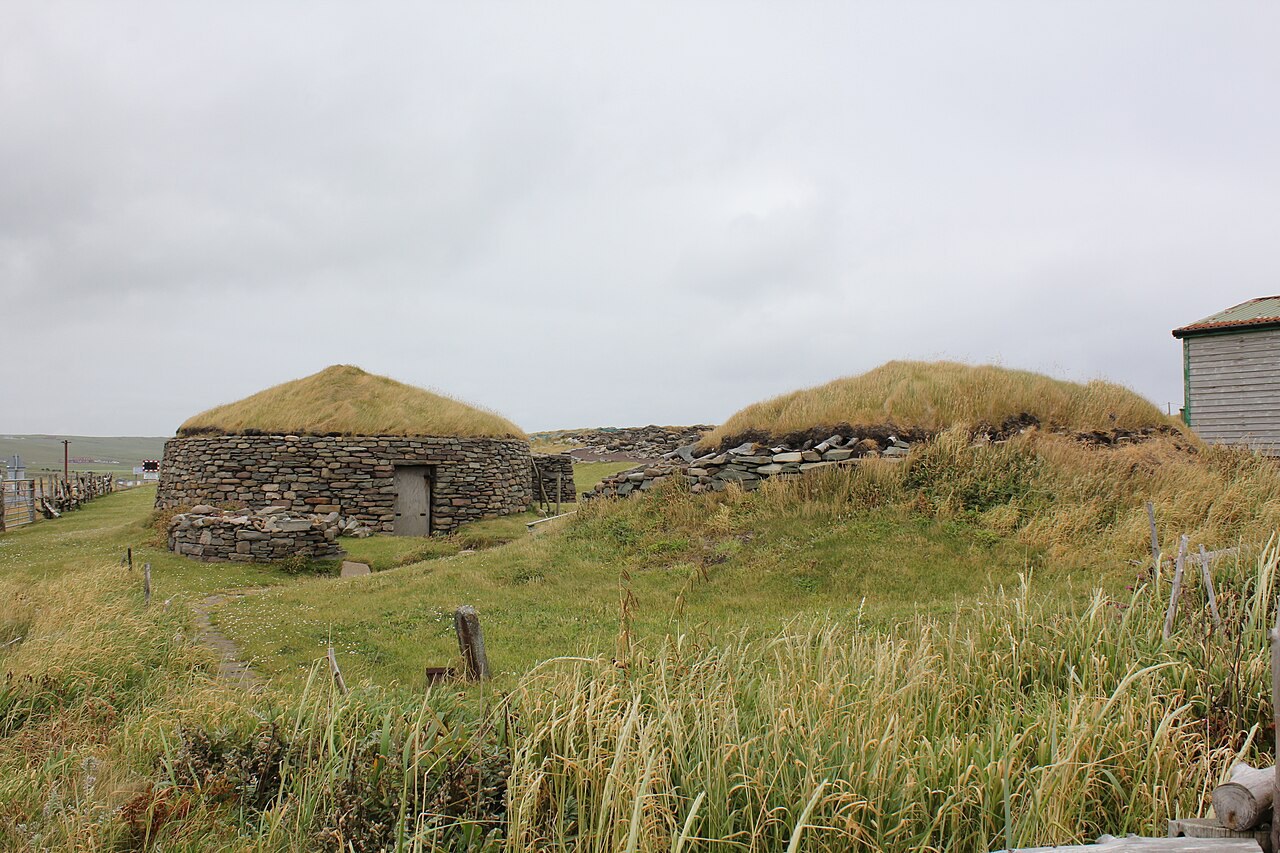
A broch and Iron Age and Pictish village presented with costumed guides, replica buildings and ancient-craft demonstrations.
- Visit length
- Editorial estimate: Allow around 90 minutes
- Locality
- right beside the airport
No places match this filter. Choose All places to reset the list.
Three ways to explore Sumburgh
Signature outings
Walk through Jarlshof's layers
Move from Bronze Age houses and an Iron Age broch to Pictish wheelhouses, Norse houses and the later fortified farmhouse.
Look for puffins and whales
Follow the headland trails for summer seabirds on the cliffs and, on calm days, minke whales, orcas and dolphins offshore.
See Old Scatness brought to life
Use the costumed guides, replica Iron Age and Pictish buildings and ancient-craft demonstrations to explore the broch village.
The village story
Sumburgh Village Guide
At Shetland Mainland's southern tip, roads, runways, archaeology and the North Sea meet.
Arrival at Shetland's Southern Tip
The A970 runs the length of Shetland Mainland, and at its southern end it crosses a live airport runway. Barriers drop across the tarmac when a plane needs it, drivers wait, and then the road reopens. This is how you arrive at Sumburgh, a settlement of about a hundred people at the very tip of the island, where crofting fields run green to the cliff edge and the North Sea does the rest.
The Sumburgh Hotel is the only bar and dining room down here, a former laird's home built in 1867, privately owned and standing immediately beside Jarlshof, five minutes from the airport. It serves restaurant and bar meals and is effectively the local for Sumburgh, Grutness and Scatness combined.
Four Millennia of Settlement
Jarlshof is the reason most people come. A storm in the 1890s washed away the shoreline and exposed buildings that turned out to hold four thousand years of settlement, from Bronze Age oval houses through an Iron Age broch and four Pictish wheelhouses to a Norse longhouse twenty metres long, still marked with the lines of timber benches and a central hearth. Alex Curle's 1930s dig uncovered the first confirmed Norse longhouse in the British Isles. The name is not old: Sir Walter Scott invented it, Old Norse for "Earl's Mansion," after visiting in 1814 and using the ruined house in his 1821 novel *The Pirate*.
Beside the airport, Old Scatness hides another broch and Iron Age village, its wall rediscovered during airport works in the late 1970s. The Shetland Amenity Trust runs it as a living-history site with costumed guides, replica Iron Age and Pictish buildings and craft demonstrations.
Lighthouse and Living Cliffs
Sumburgh Head rises to the south, a hundred-metre rocky spur where the lighthouse stands. Robert Stevenson, grandfather of Robert Louis Stevenson, built it, and the light was first lit in 1821. The restored buildings reopened in 2014 as a visitor centre, opened by the Princess Royal, with a seasonal café.
The clifftop path to the lighthouse is uneven and steep in places, with two stiles, though a wheelchair-accessible lookout sits fifty metres south of the car park. In summer the cliffs are loud with puffins, fulmars, guillemots and shags, and on calm days minke whales, orcas and dolphins pass below in the Sumburgh Roost, the tide-race that gave the headland its Old Norse name, *Dunrøstar høfdi*, "the head onto the loud tide-race." The puffins have thinned: an estimated 33,000 in 2000 had fallen to 570 by 2017.
Tombolo, Ferry and Betty Mouat
A short drive north-west, St Ninian's Isle is reached across the largest tombolo in Britain, a 500-metre sweep of sand walkable in summer and underwater at high winter tides; a hoard of Pictish silver was dug up there in 1958. From the pier at Grutness the *Good Shepherd* sails to Fair Isle. Lerwick and its shops are about twenty-five miles up the A970.
In January 1886 Betty Mouat, a spinner from Scatness, boarded the smack *Columbine* at Grutness for Lerwick to sell her knitting. The skipper was washed overboard, the crew could not get back aboard, and she drifted alone for nine days on two biscuits and a quart of milk before grounding on the Norwegian coast, where fishermen pulled her ashore. She was fifty-nine. Queen Victoria sent a £20 cheque. She went home to Dunrossness and lived another thirty-two years.
Stay around Shetland
Make a longer stay of it
Travel Fox holiday homes around Shetland, linked directly to their property pages.
For homeowners
Own a holiday home near Sumburgh?
We manage holiday lets across the UK from 12% commission, charged after cleaning costs, with no lock-in. A co-founder visits before you decide.
How our holiday let management works →
A guide with a point of view
Written from research. Edited for real journeys.
Use the Official site links for live practical details, then use this guide for context, ideas and room to explore.
Photography credits & licences
Third-party photographs are credited to their named creators and reused under the linked Creative Commons licence or public-domain dedication. Travel Fox stores an optimised local copy; the file-specific changes and any browser-applied display crop are disclosed below. Reused photographs link both to the Wikimedia Commons source record and to the declared source image; Travel Fox's own photographs carry no such record and are marked as ours. These image licences do not cover Travel Fox text, branding or page design.
- File:Old Scatness Broch and Iron Age Village by Sumburgh Airport - geograph.org.uk - 5849342.jpg — photograph by Jo and Steve Turner; Old Scatness Broch and Iron Age Village by Sumburgh Airport by Jo and Steve Turner. Source record on Wikimedia Commons. Declared source image. Licence: CC BY-SA 2.0. File changes: Downloaded from Wikimedia Commons, resized to a maximum 1920px edge and encoded as an optimised JPEG. Display changes: Displayed with responsive CSS cropping.
Sources
Every place on this page is checked against a published source. Each entry links the record we used and names who publishes it.
- Jarlshof Prehistoric and Norse Settlement — historicenvironment.scot statutory register or public authority record not machine-readable; publisher restricts automated access
- Old Scatness Broch and Iron Age Village — shetland.org other published source
- RSPB Sumburgh Head Nature Reserve — rspb.org.uk national body or asset manager
- Sumburgh Head Lighthouse Visitor Centre — portal.historicenvironment.scot statutory register or public authority
- St Ninian's Isle — portal.historicenvironment.scot statutory register or public authority