
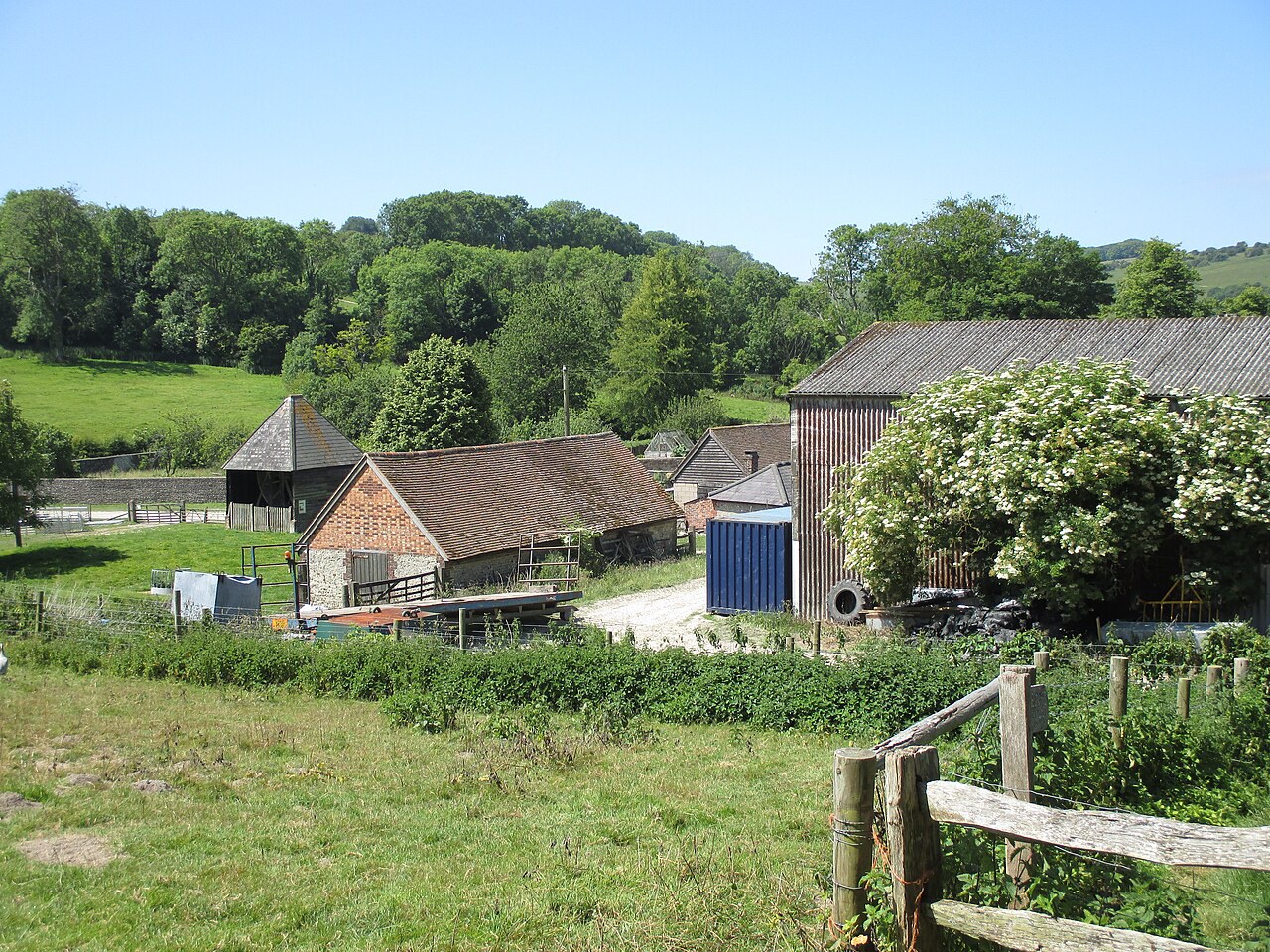
A hidden hamlet in the Downs
Saddlescombe
A working-farm hamlet folded into a chalk coombe, with the South Downs Way at the yard and Newtimber Hill rising around it.
- Best for
- Chalk-down walks and working-farm history
- Give it
- Choose a 1.5-mile or 3-mile walk
- Don't miss
- The donkey wheel and the views from higher ground
The Fox verdict
A farm hamlet made for walking
Come for chalk grassland, old woodland and farm history, using tiny Saddlescombe as a starting point rather than a conventional village centre.
The information barn and centuries-old donkey wheel give the working farm a strong sense of place, while short routes climb through Newtimber Hill or link into Devil's Dyke. There is no shop or pub in the hamlet, but footpaths lead to Fulking and the ridge-top pub at Devil's Dyke.
Where to go
Places in Saddlescombe
Every place below is checked against a published source, listed with what it is and how long to give it.
Local signatures
3 placesSaddlescombe Farm and Newtimber Walk
A moderate circuit over gently undulating open grassland, passing a disused chalk quarry, views into Devil's Dyke, a dew pond and the donkey wheel.
- Visit length
- Editorial estimate: Allow 1 to 1.5 hours
- Locality
- Saddlescombe Farm and Newtimber Hill
- Access
- A short steep climb starts the walk; the final sections can be muddy in winter.
Newtimber Hill Butterfly Walk
A chalk-grassland and ancient-woodland walk with possible summer sightings of Adonis blue, chalkhill blue, dark-green fritillary and silver-spotted skipper.
- Visit length
- Editorial estimate: Allow around 2 hours
- Locality
- Newtimber Hill
- Access
- Newtimber Hill has steep paths and stiles.
Devil's Dyke Histories and Mysteries Walk
A figure-of-eight linking Devil's Dyke, Saddlescombe Farm, the donkey wheel and the remains of the Victorian funicular.
- Visit length
- Editorial estimate: Allow around 2.5 hours
- Locality
- Devil's Dyke and Saddlescombe
- Access
- This is a challenging route with steep climbs and descents.
Food & drink
2 placesThe Devil's Dyke
A Vintage Inns country pub beside the viewpoint, making it a practical finish for walks from Saddlescombe.
- Visit length
- Editorial estimate: Allow around 1 hour 15 minutes
- Locality
- Beside the Devil's Dyke viewpoint
The Shepherd & Dog
A historic pub formed from two or perhaps three cottages, recorded under its present name in 1841 and probably named for sheep washing in the stream outside.
- Visit length
- Editorial estimate: Allow around 1 hour 15 minutes
- Locality
- Fulking
Walks & outdoors
1 placeDevil's Dyke
A vast dry chalk valley with an Iron Age hillfort, wide Weald and sea views, hang-gliding and remains of Britain's first cable car.
- Visit length
- Editorial estimate: Allow around 1 hour
- Locality
- Devil's Dyke ridge
History & heritage
1 placeSt John the Evangelist, Newtimber
A Grade II* parish church, basically 13th century with an 1839 west tower, containing Gordon family memorials and an SS Mendi memorial.
- Visit length
- Editorial estimate: Allow around 45 minutes
- Locality
- Newtimber
Things to do
1 place
Saddlescombe Farm
Find the information barn and the huge wooden donkey wheel that drew the hamlet's only reliable water from a well about 50 metres deep.
- Visit length
- Editorial estimate: Allow around 45 minutes
- Locality
- Saddlescombe hamlet
- Access
- The information barn and donkey wheel are visitor-accessible; the remaining areas support working-farm operations.
No places match this filter. Choose All places to reset the list.
Three ways to explore Saddlescombe
Signature outings
Stand beside the donkey wheel
See the huge wooden wheel that drew Saddlescombe's only reliable water from a well about 50 metres deep.
Take in the sweep of Devil's Dyke
Explore the dry chalk valley, its Iron Age hillfort and the long views towards the Weald and sea.
Pause at Newtimber's memorials
The church holds Gordon family memorials alongside an SS Mendi memorial and a staff presented by Indigenous South Africans.
The village story
Saddlescombe Village Guide
A courtyard café, a deep farm well and open chalk paths shape the story of this tiny working hamlet.
The farmyard and the coombe
In the old cattle yard at Saddlescombe Farm, a caravan and an open-sided historic barn house the Wildflower Cafe on the South Downs Way. It serves homemade vegetarian, vegan and gluten-free food in a sheltered courtyard used by walkers and cyclists.
Saddlescombe is a tiny working-farm hamlet folded into a winding chalk coombe, with no shop or pub. Newtimber Hill surrounds it with chalk grassland and ancient woodland. Sheep were kept here for about three thousand years before the practice ended in the twentieth century; Camilla and Roly arrived as tenants in 2013 and became the first resident sheep farmers since 1942.
Wheel, well and farmhouse
The National Trust has owned the farm since 1995. Visitors can see the information barn and donkey wheel, while the remaining buildings support a working farm. The huge wooden wheel drew the hamlet's only reliable water from a well about fifty metres deep, turned for centuries by an animal walking inside it. Stan Hollingdale, who lived at the farm until his death in 2011, remembered it last working in the 1930s. Organised farm visits include grass-fed cattle, working sheepdogs Fly and Ted, and, when weather allows, a tractor-and-trailer ride.
Saddlescombe Farmhouse itself mixes a timber-framed sixteenth-century south wing with an eighteenth-century red-brick front. Martin Robinson took the tenancy in 1853; his daughter Maude later wrote up a farm childhood in *A South Down Farm in the 1860s*, when twelve oxen still did the heavy work and the family, being Quakers, built better cottages for their labourers.
Pub paths and high ground
Fulking's Shepherd & Dog is a mile away by footpath. It began as two or perhaps three cottages, appears under its present name in the 1841 census, and probably took its name from annual sheep washing in the stream outside. A mile and a half the other way, The Devil's Dyke is a country pub beside the hilltop viewpoint. The pub's menu includes king prawn cocktail, garlic mushrooms, beef lasagne and a mini double chocolate brownie.
Walking is the reason to stay. The 1.5-mile Saddlescombe Farm and Newtimber circuit is moderate, beginning with a short steep climb and crossing open grassland past a disused chalk quarry, a dew pond and views into the chalk valley. The three-mile Newtimber Hill route crosses chalk grassland and ancient woodland, where summer brings possible sightings of Adonis blue, chalkhill blue, dark-green fritillary and silver-spotted skipper. Bluebells and a lime tree thought to be a thousand years old fill the woods, while higher ground looks towards the sea, the Weald and Chanctonbury Ring.
Templars, parish and arrival
The estate has passed through a long line of hands, including the Knights Templar, who were given it in the 1220s and ran it as a preceptory, drawing profits from sheep and arable to fund the order. The Domesday surveyors had counted thirty-three households here. There is no church in the hamlet; the parish church, St John the Evangelist, stands in Newtimber.
There is no station either. Brighton and Hassocks are each five miles away, and there is no parking at the farm; use Summerdown, about a quarter-mile away via the South Downs Way, or take the weekend Breeze 77 bus to Devil's Dyke and walk east to the farm along the South Downs Way.
Bob in the courtyard
Back in the courtyard, a chicken named Bob works his way between the tables.
Stay around South Downs
Make a longer stay of it
Travel Fox holiday homes around South Downs, linked directly to their property pages.
For homeowners
Own a holiday home near Saddlescombe?
We manage holiday lets across the UK from 12% commission, charged after cleaning costs, with no lock-in. A co-founder visits before you decide.
How our holiday let management works →
A guide with a point of view
Written from research. Edited for real journeys.
Use the Official site links for live practical details, then use this guide for context, ideas and room to explore.
Photography credits & licences
Third-party photographs are credited to their named creators and reused under the linked Creative Commons licence or public-domain dedication. Travel Fox stores an optimised local copy; the file-specific changes and any browser-applied display crop are disclosed below. Reused photographs link both to the Wikimedia Commons source record and to the declared source image; Travel Fox's own photographs carry no such record and are marked as ours. These image licences do not cover Travel Fox text, branding or page design.
- File:Saddlescombe farm buildings.jpg — photograph by Antiquary; Own work. Source record on Wikimedia Commons. Declared source image. Licence: CC BY 4.0. File changes: Downloaded from Wikimedia Commons, resized to a maximum 1920px edge and encoded as an optimised JPEG. Display changes: Displayed with responsive CSS cropping.
Sources
Every place on this page is checked against a published source. Each entry links the record we used and names who publishes it.
- Saddlescombe Farm — nationaltrust.org.uk national body or asset manager
- Saddlescombe Farm and Newtimber Walk — nationaltrust.org.uk national body or asset manager
- Newtimber Hill Butterfly Walk — nationaltrust.org.uk national body or asset manager
- Devil's Dyke — brighton-hove.gov.uk statutory register or public authority
- Devil's Dyke Histories and Mysteries Walk — nationaltrust.org.uk national body or asset manager
- The Devil's Dyke — vintageinn.co.uk other published source record not machine-readable; publisher restricts automated access
- The Shepherd & Dog — shepherdanddogpub.co.uk operator, sector body or destination organisation
- St John the Evangelist, Newtimber — nationalchurchestrust.org national body or asset manager