
Yews, barrows and fires
Stoughton
A secluded downland village where a steep path climbs from Norman stone and a pub fire to Bronze Age barrows and an ancient yew forest.
- Best for
- A steep four-mile walk, ancient yews and local history
- Give it
- The four-mile circuit plus time for the church and pub
- Don't miss
- The Devil's Humps above Kingley Vale
Photo: Dave Spicer · CC BY-SA 2.0 · cropped
The Fox verdict
A village shaped by the climb to Kingley Vale
Stoughton works best as a walking base, with an old church, a country pub and the ancient yews of Kingley Vale connected in one compact visit.
The four-mile circuit supplies the drama: a steep ascent past a wartime memorial and Bronze Age barrows into veteran yews, chalk grassland and wide South Coast views. St Mary's adds Norman and medieval fabric, while the Hare & Hounds gives the route a natural finish beside winter fires or in the rear garden.
Where to go
Places in Stoughton
Every place below is checked against a published source, listed with what it is and how long to give it.
Local signatures
3 placesHare & Hounds
A traditional country free house with stone-flagged floors, separate dining and public bars, winter fires, a paved patio and a rear garden.
- Visit length
- Editorial estimate: around 90 minutes
- Locality
- Stoughton village
- Access
- Dogs are welcome; current dishes and service arrangements can change.
Uppark House and Garden
A 17th-century house with scented borders, a wildflower meadow and long views over the Downs towards the Solent.
- Visit length
- Editorial estimate: around 90 minutes
- Locality
- South Harting
Chichester Cathedral
A cathedral at the centre of Chichester for more than nine centuries, offering architecture, art, tours, a shop and a café.
- Visit length
- Editorial estimate: around 75 minutes
- Locality
- Central Chichester
Walks & outdoors
1 placeKingley Vale National Nature Reserve
A chalk-downland reserve combining veteran yews, the Bronze Age Devil's Humps, wildlife-rich grassland and summit views towards the South Coast.
- Visit length
- Editorial estimate: Allow around 1½ hours for the four-mile circuit
- Locality
- Above Stoughton on Bow Hill
- Access
- Expect a steep climb and uneven ground with limited mobile reception; dogs must remain on leads all year because of grazing stock.
History & heritage
1 place
St Mary's Church
A cruciform Grade I church with an 11th-century chancel and transepts, a fine Norman chancel arch and a 13th-century trefoil-headed piscina.
- Visit length
- Editorial estimate: around 30 minutes
- Locality
- Top of Stoughton's steep village approach
- Access
- Normally open in daylight; parking is very limited, while the west door can provide level access.
Things to do
2 placesWeald & Downland Living Museum
A 40-acre, hands-on museum with more than 50 rescued historic buildings, working craft demonstrations and animals.
- Visit length
- Editorial estimate: around 2 hours
- Locality
- Singleton
Stansted Park
An Edwardian mansion in ancient parkland and forest, with gardens, a maze, light railway, farm shop, garden centre and tearoom.
- Visit length
- Editorial estimate: around 2 hours
- Locality
- Rowlands Castle
No places match this filter. Choose All places to reset the list.
Three ways to explore Stoughton
Signature outings
Walk among the ancient yews
Follow the steep circuit from Stoughton past the Devil's Humps into veteran yews and chalk grassland, with South Coast views from the top.
Find the Norman chancel arch
Step inside St Mary's for its fine 11th-century chancel arch, medieval piscina and layered fabric from the Norman period onwards.
Explore buildings brought back to life
Wander through more than 50 rescued historic buildings and see working crafts and animals across the museum's 40 acres.
The village story
Stoughton Village Guide
A steep South Downs walk links a village pub and Norman church with Bronze Age barrows, veteran yews and far-reaching views.
Fires at the Village Heart
The Hare & Hounds keeps two winter fires going, one in the dining room and one in the separate public bar where the locals drink. The floors are stone-flagged, the furniture is plain, and the pub has been the centre of Stoughton since the nineteenth century. Dogs are welcome. Out the back there is a paved patio and a rear garden, and the bar pours Flower Pots Perridge Pale, Long Man Best Bitter and Otter Amber as its regulars.
The kitchen leans on the wood oven: wood-fired pizzas, roasted meats, haddock chowder with local sourdough, bouillabaisse and local game. Recent plates have run to venison pie, rump steak, ribs, curry, risotto and duck spring rolls. On a busy Sunday the kitchen can slow.
From Stoughton to the Ancient Yews
The walking route into Kingley Vale begins at the village noticeboard. The circuit from the noticeboard and back is about four miles and an hour and a half, a steep climb with no stiles or gates. It passes a memorial to Bolesław Własnowolski, a 23-year-old Polish pilot officer with 213 Squadron whose Hurricane was shot down after combat with a Messerschmitt in November 1940; his family were there when the granite memorial was unveiled in 1997. The path also crosses a polo field once used by Lord Mountbatten and passes the Tansley Stone, named for the ecologist who helped create the reserve, before reaching the Devil's Humps.
The Devil's Humps are Bronze Age barrows on Bow Hill. The two largest are 24 and 28 metres across, their crowns hollowed by diggers in 1853. Above them the yews begin. Kingley Vale holds Britain's largest ancient yew forest, and perhaps one of the finest in western Europe. Some trees are more than five hundred years old and over five metres round, and Natural England counts thirty-nine of England's fifty-eight breeding butterfly species here, with red kites, buzzards and peregrines over the coombe. "Beneath the dense canopy, it's easy to see why humans have been enchanted by the site as it feels like you've entered another world," says reserve manager Rachel Guy. From the top you can see the South Coast and the spire of Chichester Cathedral.
Leads, Flint and Norman Stone
Take a lead — dogs must be on one all year because of grazing stock — and don't count on a phone signal.
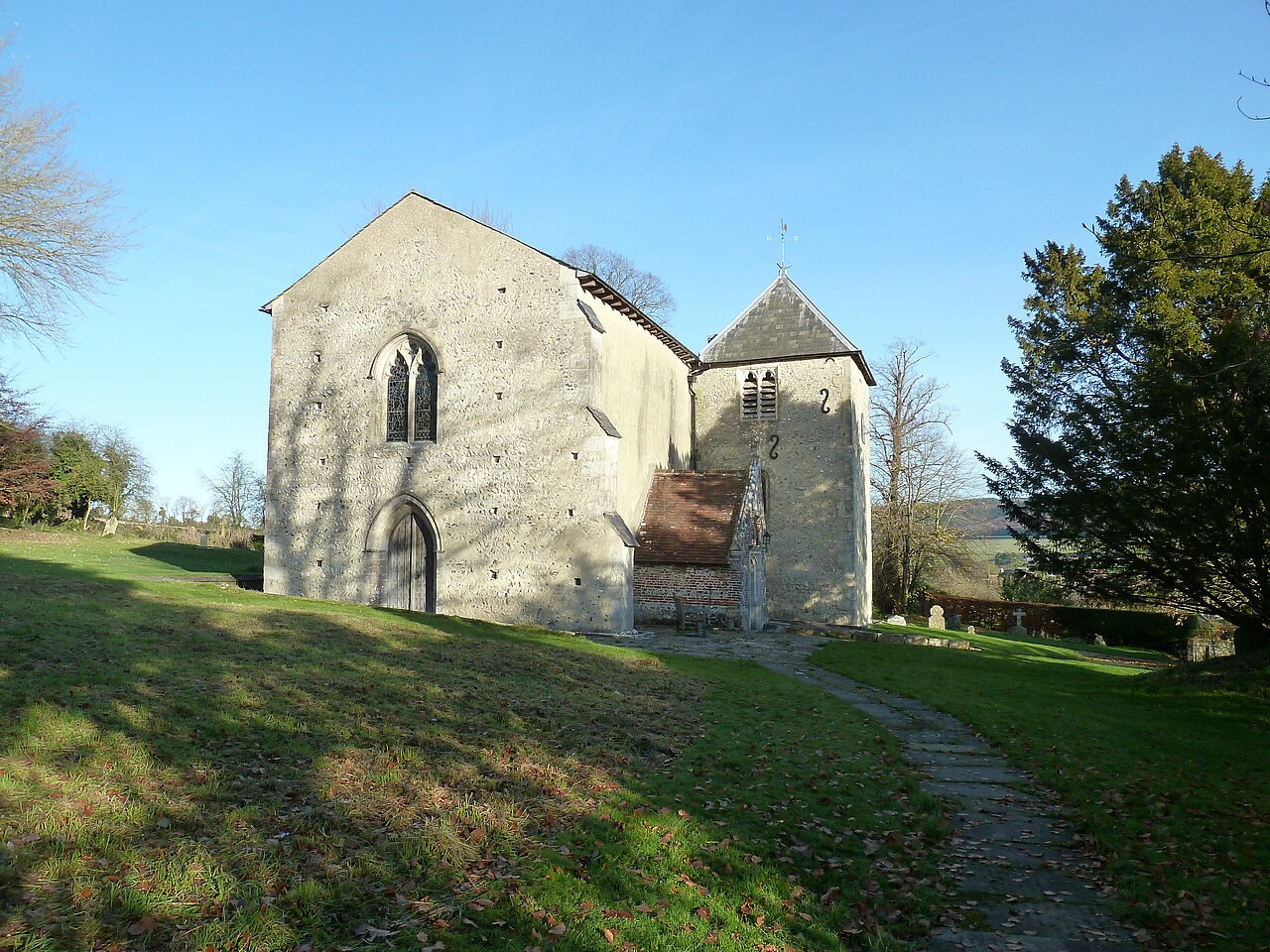
St Mary's stands at the top of the village's steep approach. It is cruciform, largely eleventh-century in its chancel and transepts, with a thirteenth-century nave and a tower made in the fourteenth century by converting the south transept. Inside are a fine Norman chancel arch and a thirteenth-century trefoil-headed piscina. The outside is flint under a skin of Roman cement, with a red-brick porch. It is usually open in daylight; parking is very limited, though the west door gives level access.
Domesday Roots and Day-Out Reach
The Domesday commissioners found ninety-four households here in 1086, along with one church and enough woodland to render sixteen hundred swine, and valued the manor at forty pounds. It belonged then to Earl Roger of Shrewsbury; Earl Godwin had held it before the Conquest.
Getting here means the B2146, a mile east of Walderton, then a minor lane. Chichester is the nearest station for Kingley Vale, and the Stagecoach 54 between there and Petersfield stops on the main road about a mile from the pub, though nothing runs into the reserve. Weald & Downland Living Museum at Singleton, Uppark, Stansted Park and Chichester itself are all within reach for a day out.
Back to the Fires
Come down off Bow Hill in the late afternoon, and the fires at the Hare & Hounds are the first warm thing you meet.
Stay around South Downs
Make a longer stay of it
Travel Fox holiday homes around South Downs, linked directly to their property pages.
For homeowners
Own a holiday home near Stoughton?
We manage holiday lets across the UK from 12% commission, charged after cleaning costs, with no lock-in. A co-founder visits before you decide.
How our holiday let management works →
A guide with a point of view
Written from research. Edited for real journeys.
Use the Official site links for live practical details, then use this guide for context, ideas and room to explore.
Photography credits & licences
Third-party photographs are credited to their named creators and reused under the linked Creative Commons licence or public-domain dedication. Travel Fox stores an optimised local copy; the file-specific changes and any browser-applied display crop are disclosed below. Reused photographs link both to the Wikimedia Commons source record and to the declared source image; Travel Fox's own photographs carry no such record and are marked as ours. These image licences do not cover Travel Fox text, branding or page design.
- File:Church of St Mary Stoughton - geograph.org.uk - 3233014.jpg — photograph by Dave Spicer; Church of St Mary Stoughton by Dave Spicer. Source record on Wikimedia Commons. Declared source image. Licence: CC BY-SA 2.0. File changes: Downloaded from Wikimedia Commons, resized to a maximum 1920px edge and encoded as an optimised JPEG. Display changes: Displayed with responsive CSS cropping.
Sources
Every place on this page is checked against a published source. Each entry links the record we used and names who publishes it.
- Hare & Hounds — ratings.food.gov.uk statutory register or public authority
- St Mary's Church — historicengland.org.uk statutory register or public authority record not machine-readable; publisher restricts automated access
- Kingley Vale National Nature Reserve — gov.uk statutory register or public authority
- Weald & Downland Living Museum — wealddown.co.uk operator, sector body or destination organisation
- Uppark House and Garden — nationaltrust.org.uk national body or asset manager
- Stansted Park — stanstedpark.co.uk operator, sector body or destination organisation
- Chichester Cathedral — chichestercathedral.org.uk operator, sector body or destination organisation