
Chalk heights, deep history
Dunstable
A town at the foot of the Chiltern Hills, where the line of Roman Watling Street meets a Norman priory and Bedfordshire's highest ground.
- Best for
- Chalk-down walks and layered history
- Give it
- A day between the town and the Downs
- Don't miss
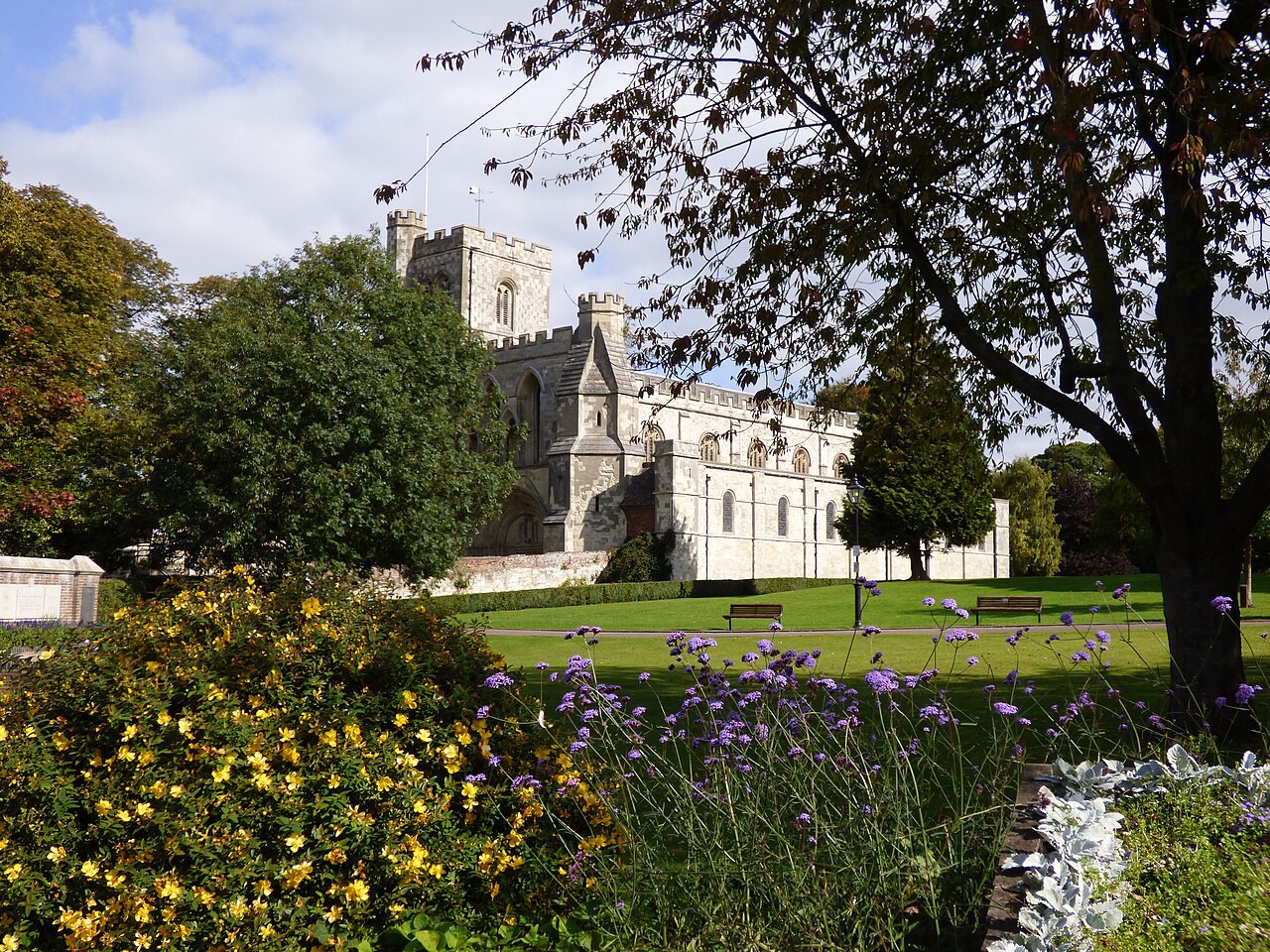
- The Priory's west entrance and the view over the Vale of Aylesbury
Photo: Dr Neil Clifton · CC BY-SA 2.0 · cropped
The Fox verdict
A historic crossroads beneath Bedfordshire's highest point
Dunstable pairs the surviving nave of a Norman priory with the open chalk landscape of the Downs.
Follow the old Watling Street coaching line through town, then make for the Downs for walks, wildlife and the westward view. Whipsnade Zoo, the Tree Cathedral and Totternhoe Knolls broaden the day without displacing Dunstable's own history.
Where to go
Places in Dunstable
Every place below is checked against a published source, listed with what it is and how long to give it.
Local signatures
3 placesWhipsnade Zoo
The country's largest zoo covers 600 acres and holds more than ten thousand animals; visitors can explore on foot, by car or on the narrow-gauge railway.
- Visit length
- Editorial estimate: allow around 150 minutes
- Locality
- about two miles from Dunstable
Totternhoe Knolls
Chalk-grassland nature reserve surrounding the earthworks of a Norman motte-and-bailey castle.
- Visit length
- Editorial estimate: allow around 75 minutes
- Locality
- a short drive
London Gliding Club
A conventional gliding club based at the foot of the Downs, below an escarpment also used for hang-gliding and paragliding.
- Visit length
- Editorial estimate: allow around 90 minutes
- Locality
- at the foot of the Downs
Walks & outdoors
1 placeDunstable Downs
Bedfordshire's highest point reaches 243 metres, with sweeping views west over the Vale of Aylesbury and chalk grassland crossed by the Icknield Way Path and Chiltern Way.
- Visit length
- Editorial estimate: allow around 90 minutes
- Locality
- immediately above the town
History & heritage
2 placesFive Knolls
A barrow cemetery on the Downs containing Bronze Age and later Saxon burials; excavations found the remains of a mother and child.
- Visit length
- Editorial estimate: allow around 45 minutes
- Locality
- on Dunstable Downs
Priory Church of St Peter
The surviving nave of Henry I's Augustinian priory has two western towers and a great four-arched west entrance. In 1533, the priory's Lady Chapel hosted Cranmer's court, which annulled Henry VIII's marriage.
- Visit length
- Editorial estimate: allow around 45 minutes
- Locality
- Dunstable
Things to do
1 placeWhipsnade Tree Cathedral
A free-to-visit garden of trees, shrubs and paths laid out in the plan of a medieval cathedral.
- Visit length
- Editorial estimate: allow around 45 minutes
- Locality
- near the Downs
No places match this filter. Choose All places to reset the list.
Three ways to explore Dunstable
Signature outings
Bedfordshire's Highest Ground
Reach 243 metres on Dunstable Downs and look west across the Vale of Aylesbury from the chalk escarpment.
The Surviving Priory Nave
See the Priory Church's two western towers and great entrance of four arches, surviving from a much larger Augustinian church.
A Cathedral Made of Trees
Wander among trees, shrubs and paths arranged to the plan of a medieval cathedral at Whipsnade.
The town story
Dunstable Town Guide
Coaching-road clues, a Norman priory and a chalk escarpment shape a town with unusually deep layers.
Coaching Inns and Chalk Downs
The Saracen's Head sits well below the road in front of it, on High Street South, and once you notice this you cannot un-notice it. The old coaching route has been resurfaced so many times over the centuries that the carriageway has crept up past the inn's front step. As one description of it has it, "It is positioned considerably lower than the road to its front, witness to the fact that the road has been resurfaced a number of times." Further along, on High Street North, the Old Sugar Loaf keeps the coaching gates from the days when Dunstable was a staging town on Watling Street, the London to Holyhead road. The A5 still follows that Roman line straight through the middle of everything.
The real reason to come is the ground to the south. Dunstable Downs rise straight out of the town to 243 metres, the highest point in Bedfordshire, with the whole Vale of Aylesbury opening up to the west. People fly kites off the escarpment, and hang-gliders and paragliders launch from the edge; the London Gliding Club works conventional gliders from the field at the foot of the slope. The National Trust's Chilterns Gateway Centre sits up top with a café and is the sensible place to begin a walk. The Icknield Way Path and the Chiltern Way both cross the Downs, and a circular trail runs along the chalk to Whipsnade village. The west-facing slope is grazed chalk grassland, which in summer brings bee orchids and butterflies — chalkhill blues, marbled whites. On the ridge, the Five Knolls barrows hold Bronze Age burials; one excavation turned up a mother and child.
Whipsnade Wildlife and the Tree Cathedral
Two miles on lies Whipsnade Zoo, at 600 acres the largest in the country, home to more than ten thousand animals. You can walk it, drive it, or take the narrow-gauge railway round. Below the zoo the Whipsnade White Lion is cut into the chalk hillside, visible for miles from the B489. Nearby, the Tree Cathedral is a garden of trees laid out to the plan of a medieval cathedral, free to wander.
The Surviving Priory Church
Back in the town, the Priory Church of St Peter is the surviving nave of a much larger Augustinian priory founded by Henry I in the 1130s, with two western towers and a great west front of four arches. In 1533 the priory's Lady Chapel hosted the court where Cranmer pronounced Henry VIII's marriage to Catherine of Aragon null and void. The rest of the priory is gone; the nave is Norman and the stained glass all twentieth-century.
From Durocobrivis to Dunstable
Dunstable has no Domesday entry, because in 1086 it did not exist. Henry I founded a new town at the crossroads of Watling Street and the Icknield Way, on the site of the Roman posting station of Durocobrivis, and granted its first charter in 1131.
The Busway and the Westward View
There have been no passenger trains since 1965. Luton, five miles east, is the nearest railhead, reached on the guided busway whose vehicles run at up to fifty miles an hour along sections of their own concrete track. The Downs, meanwhile, stay where they are, holding the view west across the Vale of Aylesbury.
Stay around Bedfordshire
Make a longer stay of it
Travel Fox holiday homes around Bedfordshire, linked directly to their property pages.
For homeowners
Own a holiday home near Dunstable?
We manage holiday lets across the UK from 12% commission, charged after cleaning costs, with no lock-in. A co-founder visits before you decide.
How our holiday let management works →
A guide with a point of view
Written from research. Edited for real journeys.
Use the Official site links for live practical details, then use this guide for context, ideas and room to explore.
Photography credits & licences
Third-party photographs are credited to their named creators and reused under the linked Creative Commons licence or public-domain dedication. Travel Fox stores an optimised local copy; the file-specific changes and any browser-applied display crop are disclosed below. Reused photographs link both to the Wikimedia Commons source record and to the declared source image; Travel Fox's own photographs carry no such record and are marked as ours. These image licences do not cover Travel Fox text, branding or page design.
- File:Dunstable, St. Peter's Priory Church - geograph.org.uk - 4690225.jpg — photograph by Dr Neil Clifton; Dunstable: St. Peter's Priory Church by Dr Neil Clifton. Source record on Wikimedia Commons. Declared source image. Licence: CC BY-SA 2.0. File changes: Downloaded from Wikimedia Commons, resized to a maximum 1920px edge and encoded as an optimised JPEG. Display changes: Displayed with responsive CSS cropping.
Sources
Every place on this page is checked against a published source. Each entry links the record we used and names who publishes it.
- Dunstable Downs — nationaltrust.org.uk national body or asset manager
- Five Knolls — historicengland.org.uk statutory register or public authority record not machine-readable; publisher restricts automated access
- Priory Church of St Peter — historicengland.org.uk statutory register or public authority record not machine-readable; publisher restricts automated access
- Whipsnade Zoo — whipsnadezoo.org operator, sector body or destination organisation
- Whipsnade Tree Cathedral — nationaltrust.org.uk national body or asset manager
- Totternhoe Knolls — centralbedfordshire.gov.uk statutory register or public authority
- London Gliding Club — londonglidingclub.co.uk operator, sector body or destination organisation