
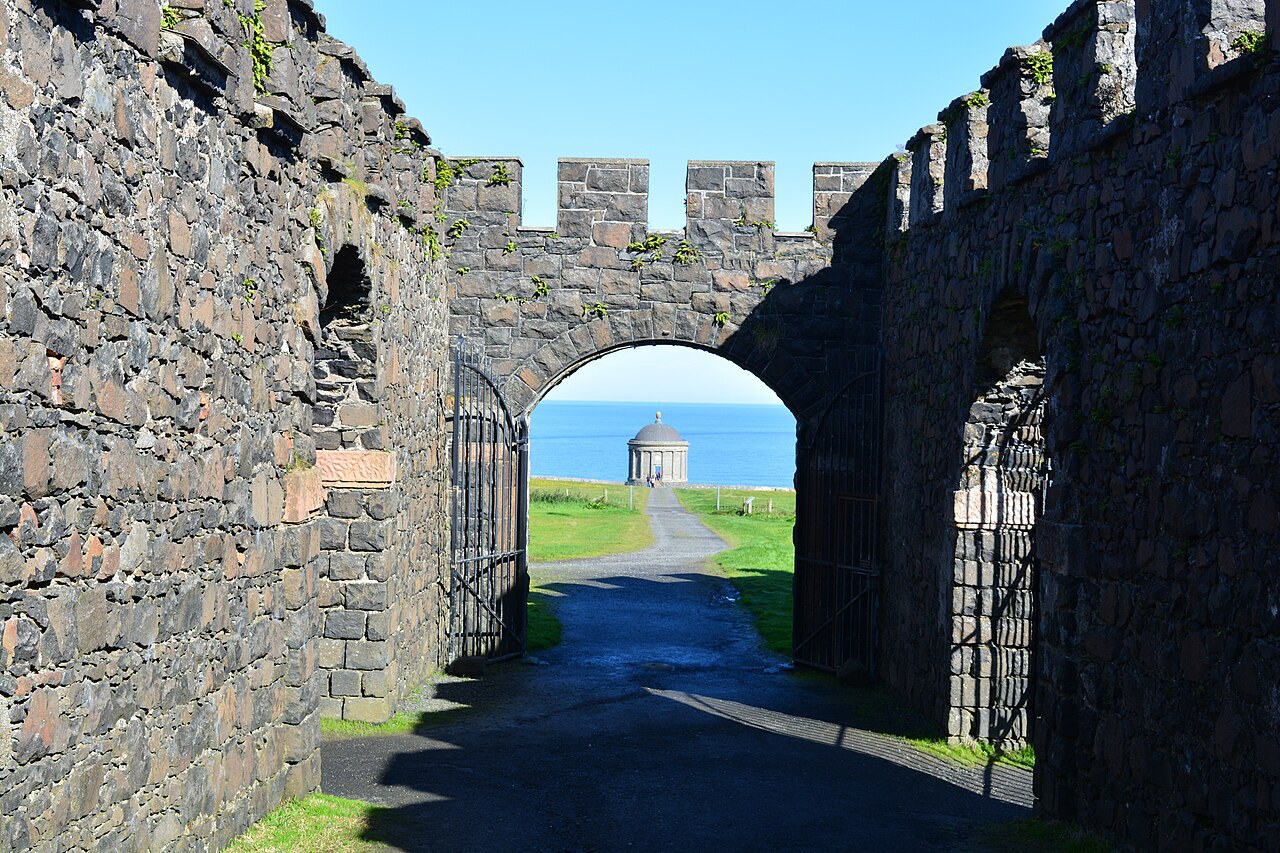
Atlantic cliff and strand
Downhill
A small coastal settlement between an Atlantic strand and the cliff-top Downhill Demesne, with Mussenden Temple at the cliff edge.
- Best for
- Clifftop walks, beach days and Earl-Bishop history
- Give it
- Two hours for the Bishop's Gate circuit
- Don't miss
- Mussenden Temple on the cliff edge
Photo: D LN · CC BY-SA 4.0 · cropped
The Fox verdict
A strand-and-clifftop day with an extraordinary library
Downhill brings a seven-mile sweep of sand together with National Trust trails, a ruined mansion and Mussenden Temple above the cliffs.
The Bishop's Gate circuit is the fullest introduction, passing the walled garden's apple orchard, Downhill House and Mussenden Temple, while the shorter Lion's Gate trail reaches the Atlantic clifftop in about half an hour. Below, Downhill Beach offers a long, level coastal walk when conditions allow.
Where to go
Places in Downhill
Every place below is checked against a published source, listed with what it is and how long to give it.
Local signatures
3 places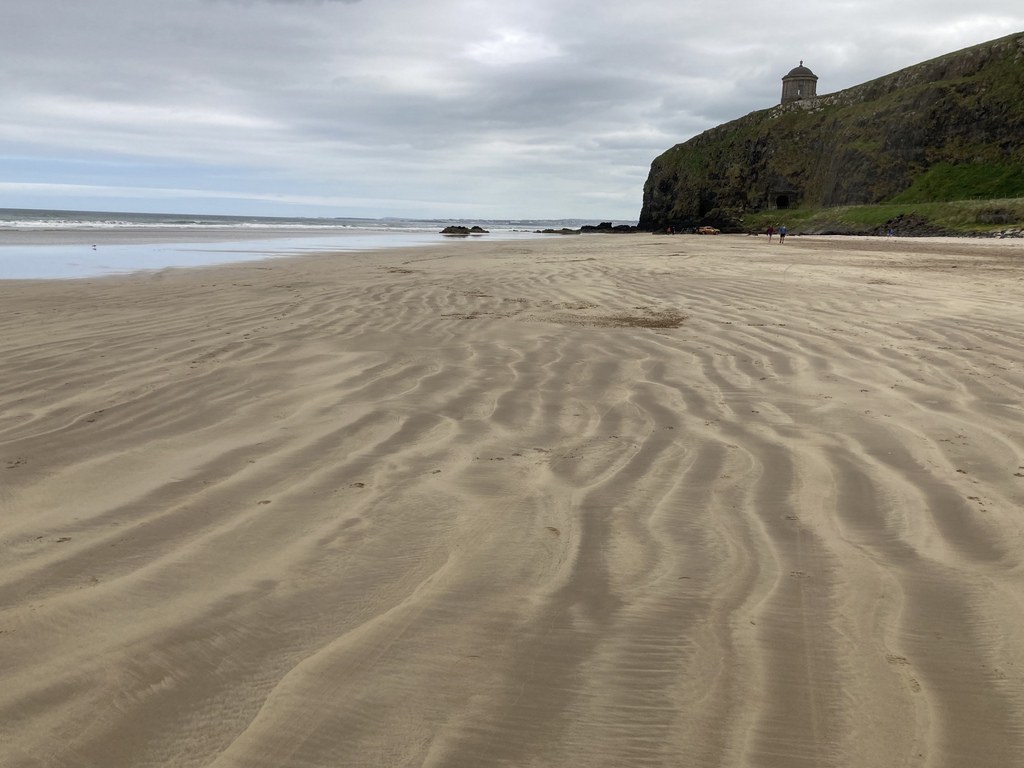 Start here
Downhill Beach
A broad strand and dune landscape supporting long, level coastal walking, watersports and family beach days, with toilets and disabled parking at the entrance.
- Visit length
- Editorial estimate: allow around 90 minutes
- Locality
- below Mussenden Temple
- Access
- Free on-beach parking is subject to tides, soft sand and signed restrictions.
Temple Cove Coffee Bar
A small coffee shop with views to the sea and Mussenden Temple, serving home-baked cakes including Victoria sponge.
- Visit length
- Editorial estimate: allow around 45 minutes
- Locality
- on the road to Downhill Demesne, immediately before the Downhill Beach entrance
Bertha's Bar
A beachside pub serving hearty local favourites and pub grub, with a spacious beer garden.
- Visit length
- Editorial estimate: allow around 90 minutes
- Locality
- at the far end of Castlerock Beach
- Access
- Dogs are welcome and are often seen with owners outdoors.
Food & drink
1 placeCrusoes Coffee Shop
An independent first-floor coffee shop serving freshly prepared homemade food, coffee and hot chocolate.
- Visit length
- Editorial estimate: allow around 60 minutes
- Locality
- 29 Sea Road, Castlerock
History & heritage
3 places
Mussenden Temple
A Grade A circular former library, completed in 1785 on a basalt base, with sixteen engaged Corinthian columns and a copper-clad dome.
- Visit length
- Editorial estimate: allow around 45 minutes
- Locality
- on the cliff edge above Downhill Beach
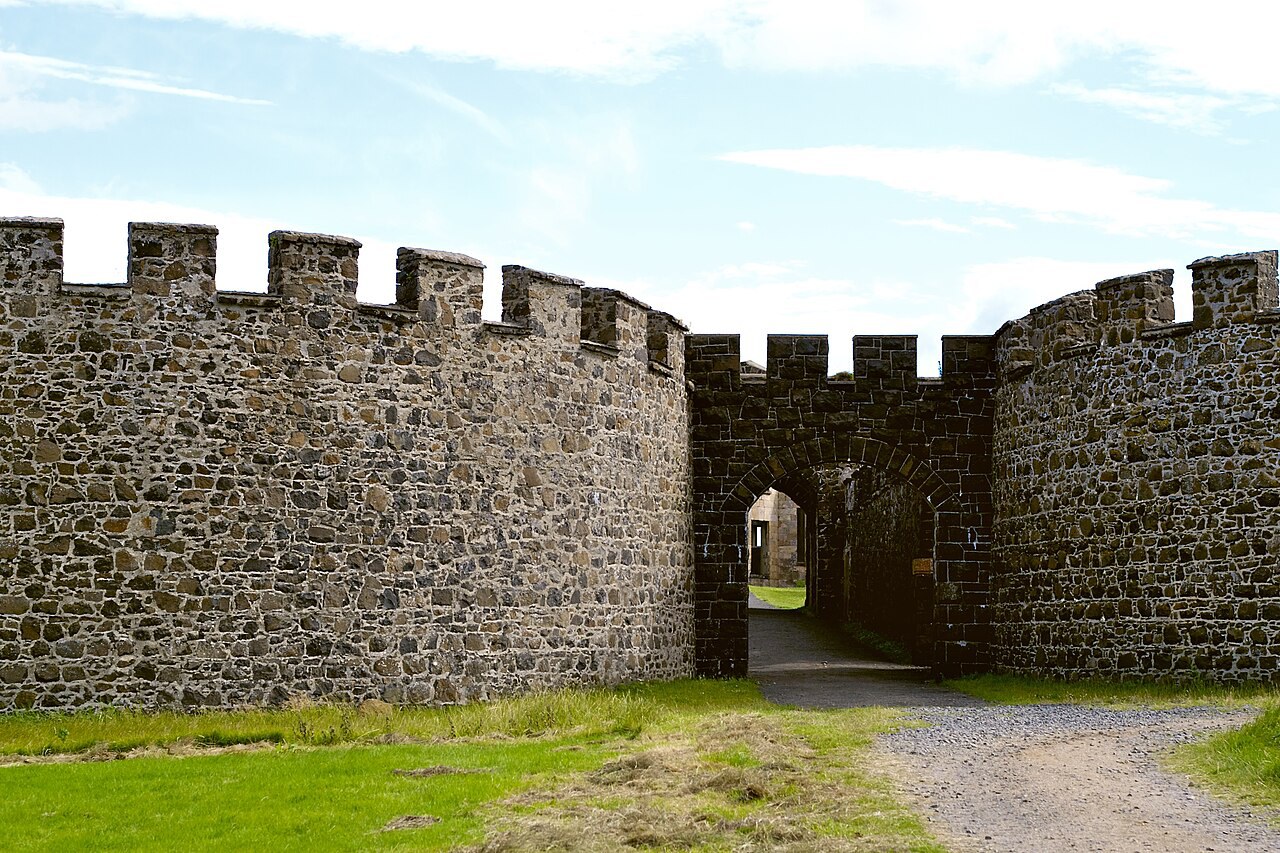
Downhill House
The ruined remains of the Earl-Bishop's mansion, built around 1780, devastated by fire in 1851, rebuilt around 1876 and left unroofed after the war.
- Visit length
- Editorial estimate: allow around 45 minutes
- Locality
- behind Mussenden Temple
Dunboe Old Church and Graveyard
A medieval rectangular church ruin with ivy-covered walls and a small obelisk over James McBlain, mason to the Earl-Bishop.
- Visit length
- Editorial estimate: allow around 45 minutes
- Locality
- in the old graveyard at Dunboe
No places match this filter. Choose All places to reset the list.
Three ways to explore Downhill
Signature outings
The Earl-Bishop's library
Mussenden Temple was completed in 1785 as a circular library on a basalt base, ringed by sixteen engaged Corinthian columns.
Downhill House open to the sky
Fire devastated Downhill House in 1851; it was rebuilt around 1876, requisitioned by the RAF and later stripped and unroofed.
Seven miles of sand and surf
Downhill Beach forms part of an 11km sweep west towards Benone and Magilligan, with dunes, waterfalls and birdlife.
The village story
Downhill Village Guide
Temple, strand, demesne and Earl-Bishop stories on the County Londonderry coast.
Temple and seven-mile strand
The Mussenden Temple stands on a basalt base at the very edge of the cliff above Downhill Beach, a circular stone rotunda ringed by sixteen engaged Corinthian columns under a copper dome. It was built between 1783 and 1785 as a library, its frieze carved with a line from Lucretius: "Tis pleasant, safely to behold from shore / The troubled sailor, and hear the tempests roar." The building cost £1,169 7s 3½d.
Below it runs the strand: seven miles of sand curving west toward Benone and Magilligan, backed by dunes that shelter waterfalls and birdlife and carry protection as both an Area of Special Scientific Interest and a Special Area of Conservation. You can walk a long stretch of it when the tide allows. There are toilets and disabled parking at the entrance, free parking on the sand where the tides and signs permit, and RNLI lifeguards through July and August. Dogs are welcome outside the summer restriction that runs from the start of June to mid-September.
Village pauses and demesne trails
The village itself is small, set between the strand and the cliff-top demesne. On the road down to the beach, just before the entrance, Temple Cove Coffee Bar looks out to the sea and the temple; it does home-baked cakes, the Victoria sponge in particular. A few steps along, Float-Away offers dry flotation, an infrared sauna and massage, its dry-flotation tank the first of its kind in Ireland.
The Demesne is National Trust land and the main reason to lace up boots. The Bishop's Gate trail is an easy two-mile circuit of about two hours, threading through sheltered gardens and out onto the clifftops, past the apple orchard in the walled garden, the ruined house and the temple; expect gravel, mown grass and some steep steps. The shorter Lion's Gate trail climbs 0.8 miles from the Walled Garden to the clifftop in half an hour, steeper and slippery in places, with dogs kept on leads because there is livestock about all year.
The Earl-Bishop's house and Great Blast
The ruined house behind the temple was Downhill House, built around 1780 for Frederick Hervey, Earl of Bristol and Bishop of Derry at once, and so the Earl-Bishop. He is remembered for a reputed leapfrog race in which local clergy raced along the beach to decide who got the best parish, and for asking that his body be shipped home from Italy packed in a casket of sherry. Fire gutted the house in 1851, after a chimney sweep named Anthony Gallagher fell through a floor and was badly burned; the library was lost, though most of the paintings were carried out. It was rebuilt around 1876, requisitioned by the RAF during the war, then stripped and left open to the sky.
The railway west from Castlerock had to be cut through the headland in two tunnels. Clearing the rock between them in June 1846 took 3,600 pounds of gunpowder in a single detonation known as the Great Blast; five hundred invited guests later sat down to a banquet inside one of the tunnels.
Arriving from Castlerock and Dunboe
Getting here, the A2 runs a mile west of Castlerock, whose unmanned station is the nearest stop and about half a mile off. The Ulsterbus 134 comes through from Coleraine Monday to Saturday; ask for the crossroads and walk the last few minutes.
In the old graveyard at Dunboe, among walls now thick with ivy, a small obelisk marks James McBlain, the mason who built for the Earl-Bishop.
Stay around Causeway Coast
Make a longer stay of it
Travel Fox holiday homes around Causeway Coast, linked directly to their property pages.
For homeowners
Own a holiday home near Downhill?
We manage holiday lets across the UK from 12% commission, charged after cleaning costs, with no lock-in. A co-founder visits before you decide.
How our holiday let management works →
A guide with a point of view
Written from research. Edited for real journeys.
Use the Official site links for live practical details, then use this guide for context, ideas and room to explore.
Photography credits & licences
Third-party photographs are credited to their named creators and reused under the linked Creative Commons licence or public-domain dedication. Travel Fox stores an optimised local copy; the file-specific changes and any browser-applied display crop are disclosed below. Reused photographs link both to the Wikimedia Commons source record and to the declared source image; Travel Fox's own photographs carry no such record and are marked as ours. These image licences do not cover Travel Fox text, branding or page design.
- File:Mussenden Temple viewed from Downhill House. Northern Ireland.jpg — photograph by D LN; Own work. Source record on Wikimedia Commons. Declared source image. Licence: CC BY-SA 4.0. File changes: Downloaded from Wikimedia Commons, resized to a maximum 1920px edge and encoded as an optimised JPEG. Display changes: Displayed with responsive CSS cropping.
- File:Downhill House (5689872987).jpg — photograph by Tony Bowden; Downhill House. Source record on Wikimedia Commons. Declared source image. Licence: CC BY-SA 2.0. File changes: Downloaded from Wikimedia Commons, resized to a maximum 1920px edge and encoded as an optimised JPEG. Display changes: Displayed with responsive CSS cropping.
- File:Downhill Beach - geograph.org.uk - 6867701.jpg — photograph by Kenneth Allen; Downhill Beach by Kenneth Allen. Source record on Wikimedia Commons. Declared source image. Licence: CC BY-SA 2.0. File changes: Downloaded from Wikimedia Commons, resized to a maximum 1920px edge and encoded as an optimised JPEG. Display changes: Displayed with responsive CSS cropping.
Sources
Every place on this page is checked against a published source. Each entry links the record we used and names who publishes it.
- Mussenden Temple — apps.communities-ni.gov.uk statutory register or public authority
- Downhill House — apps.communities-ni.gov.uk statutory register or public authority
- Downhill Beach — causewaycoastandglens.gov.uk statutory register or public authority
- Temple Cove Coffee Bar — visitcausewaycoastandglens.com operator, sector body or destination organisation
- Dunboe Old Church and Graveyard — heritagerecords.nationaltrust.org.uk other published source
- Crusoes Coffee Shop — crusoescoffeeshop.weebly.com other published source
- Bertha's Bar — visitcausewaycoastandglens.com operator, sector body or destination organisation