
A resort that never became only a resort
Portstewart
A year-round town where the Promenade, Atlantic cliff path and protected Strand meet independent food, arts and community history.
- Best for
- The Promenade, cliff walks and the Strand
- Give it
- About two hours for the 3.5-mile dune and estuary circuit
- Don't miss
- Two miles of sand backed by a protected dune system
Photo: Kenneth Allen · CC BY-SA 2.0 · cropped
The Fox verdict
An Atlantic resort with a year-round life
Portstewart brings its seafront, harbour, independent food and community institutions together without turning the town into scenery alone.
The strongest visit pairs the Promenade with one of two very different walks: the Strand's dunes and Bann Estuary, or the stepped cliff path below O'Hara's Castle. Morelli's, the Anchor Bar, Flowerfield Arts Centre and the Town Hall then reveal a town shaped by long-running businesses, arts and civic life.
Where to go
Places in Portstewart
Every place below is checked against a published source, listed with what it is and how long to give it.
Local signatures
3 placesPromenade, Harbour and Cliff Walk
A short, flexible section of the Causeway Coast Way with the Atlantic in view, passing below O’Hara’s Castle, now Dominican College.
- Visit length
- Editorial estimate: Around 90 minutes for a flexible town walk
- Locality
- the waterfront, Crescent and harbour
- Access
- The route climbs by steps to Portstewart Point.
Flowerfield Arts Centre
Northern Ireland’s first arts centre occupies the former house and offers contemporary exhibitions, creative learning, a pottery studio, media workshop, craft shop and 150-seat auditorium, with family and children’s activity in its programme.
- Visit length
- Editorial estimate: Around 75 minutes
- Locality
- Flowerfield
Anchor Bar Complex
A family-run complex established in 1898, centred on a traditional Victorian pub with an original fireplace and historic interior; the wider venue includes food, live music, sports screens, rooms and a nightclub.
- Visit length
- Editorial estimate: Around 75 minutes
- Locality
- 86–87 The Promenade
Food & drink
2 placesMorelli’s Portstewart
A 160-seat ice cream parlour and café whose Portstewart story began when Angelo Morelli came north in 1927; named sundaes include the Knickerbocker Glory, Yellow Man and Family Fundae.
- Visit length
- Editorial estimate: Around 45 minutes
- Locality
- The Promenade
Harry’s Shack
A relaxed beachside restaurant centred on local seafood and other locally sourced ingredients, with cocktails, brunch and outdoor dining; it opened as the coastal offshoot of Harry’s in 2014.
- Visit length
- Editorial estimate: Around 90 minutes
- Locality
- Portstewart Strand
- Access
- Dogs are accepted at the outdoor dining tables.
History & heritage
2 places
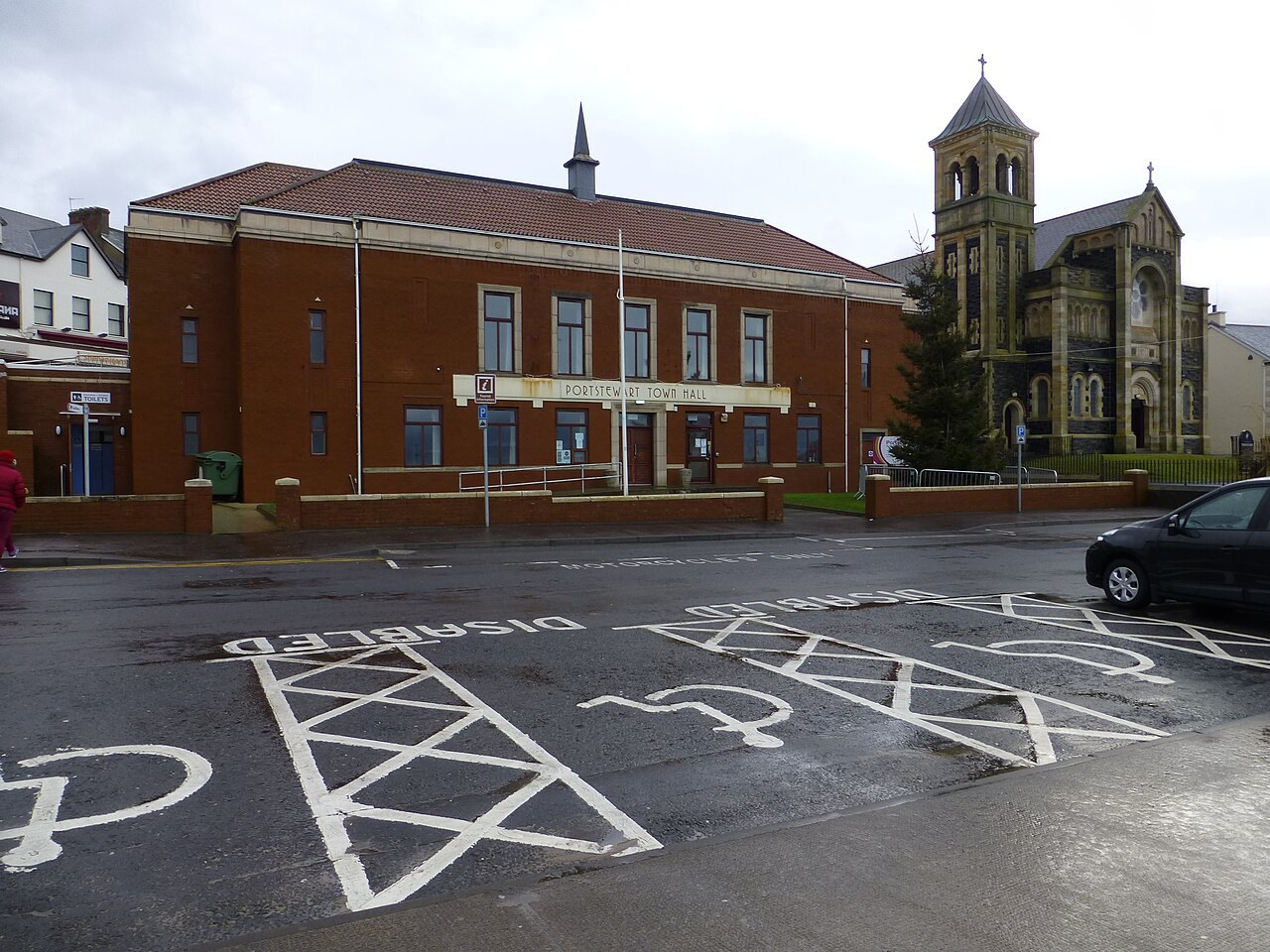
Portstewart Town Hall
A B2 listed seaside landmark completed in 1934–35 after Benjamin Cowser won the design competition.
- Visit length
- Editorial estimate: Around 30 minutes
- Locality
- overlooking the Crescent and sea
Portstewart Presbyterian Church
A B+ listed Art Nouveau church of about 1904 by Vincent Craig, built in roughcast, red sandstone and Ruabon tile, with a cruciform plan and tower.
- Visit length
- Editorial estimate: Around 30 minutes
- Locality
- Portstewart
No places match this filter. Choose All places to reset the list.
Three ways to explore Portstewart
Signature outings
Promenade, Harbour and Cliff Walk
Climb from the harbour by steps to Portstewart Point, then follow the cliff path below O’Hara’s Castle with Atlantic views.
The Town Hall Above the Crescent
See the B2 listed Town Hall overlooking the Crescent and sea, completed in 1934–35 after Benjamin Cowser won its design competition.
Morelli’s Sundae Heritage
Choose from named sundaes such as the Knickerbocker Glory, Yellow Man and Family Fundae in the 160-seat Promenade parlour.
The town story
Portstewart Town Guide
A seafront town of long-running food businesses, Atlantic walks, arts, civic history and volunteer tradition.
Promenade, Ice Cream and Pubs
Morelli's on the Promenade seats a hundred and sixty people and has been selling ice cream in Portstewart since Angelo Morelli came north in 1927 to work at his uncle's Ice Palace. The Sundae Garden opened in 1957, Nino Morelli took the business on in 1974, and the original premises was demolished and rebuilt in 2002. What survives is the ice cream and the vocabulary that goes with it: the Knickerbocker Glory, Nuts Galore, the Banoffee Pie, Nutella Crunch, Eton Mess, After 8, Strawberry Wonder, Yellow Man, and, for a table that cannot decide, the Family Fundae. On a wet afternoon the windows steam up and the queue does not shorten.
The Promenade is where you will spend most of your time. Portstewart lines its main street along the sea rather than turning its back to it, so the harbour, the shops and the water are all in view at once. The town runs to just under eight thousand people, and roughly a third of local employment is in hotels and restaurants, which tells you what it does for a living. It was named Northern Ireland's best place to live by the Sunday Times in 2024, a decision the judges put down to community spirit and a year-round life rather than the summer scenery alone.
For a drink, the Anchor Bar at 86–87 The Promenade is the obvious start. It has been family-run since 1898, keeps an original Victorian fireplace and interior, and calls itself the oldest traditional bar in the area. The complex has grown around that old core to take in food, live music, sports screens, rooms and a nightclub, but the pub at the middle of it is still a pub, and it takes its Guinness seriously. The Ice House at number 9 faces the harbour and pairs pub food with a large beer garden and a view of the water. Me & Mrs Jones, on The Diamond, is a boutique hotel with a cocktail-led bar rather than an ale house, and dogs on leads are said to be welcome in its snug and upstairs garden. Inland, at the top of Coleraine Road, the Portstewart Arms is the plainer local, away from the seafront trade.
Beachside Dining and Local Food
Eating out, the range is wider than a town this size usually manages. Harry's Shack sits directly on the Strand, a low building on the sand serving local seafood since it opened as an offshoot of Harry's in 2014: fish and chips, lobster, mussels, oysters, Dover sole, crispy squid, a steak sandwich, goat's-cheese and tomato arancini, Scotch eggs, and whatever the day's catch happens to be. Dogs are allowed at the outdoor tables, which in fine weather are the ones to book.
Back on the Promenade, Villa Portstewart at number 78 does a European grill and cocktail list, running from hot-honey and chorizo cheesy garlic bread and pil-pil prawns through salt-and-chilli chicken, seared sea bass, tempura monkfish balls and slow-cooked daube of beef, with a chickpea-and-spinach curry and a vegan bean chilli for the table that wants neither. The premises used to be Shenanigans, a bar, restaurant and nightclub, which is worth knowing only because half the town still calls it that. Amici, on Portmore Road, is the Italian: a charcoal oven, hand-kneaded dough baked in a wood-fired oven run at 800°F, arancini and bruschetta napoletana, gamberoni pil-pil, burrata with Parma ham, meatballs, and Neapolitan pizzas, with the Atlantic and the golf links out of the window. At the golf club, the first-floor Eighteen Ninety Four is open to the public through its own entrance; the chefs Ian Orr and Marcus Roulston describe what they do as fine dining without fuss, with local fish of the day, chargrilled steaks and slow-cooked lamb, and the Strand below. The club's own Strand Lounge and Bar keeps things simpler with a golfer's fry, an open prawn on Irish bread, Portnahapple chowder and Guinness wheaten bread.
For chips, Chipmongers on The Diamond is run by Gareth Montgomery and Katrina Fox and sources carefully — McAtamney's, Lecale seafood, Martin McAleese's vegetables, Bradmount potatoes — with a related Phat Pizza using high-hydration dough and a rotating wood-fired oven. The Prom Chippy handles the cod, fish suppers, chicken goujons and chips with curry or gravy.
Independent Shops and the Strand
The bakeries are the quiet strength of the place. Vittle Bakeshop at number 66 leavens its bread naturally, without commercial yeast; it took gold at the 2022 Irish Food Awards for an Irish custard tart and silver for a wild-garlic sausage roll. It was founded by David Loughran and Sarah Dale. Tom Tom's has been baking breads, tarts, traybakes and cakes since March 2012, run by Sebastian Pierzchalski. Griddle Bakery on Strand Road turns out scones, sausage rolls, pies, soup and soda-bread pizza. Born & Bread, in the old Carrig-na-Cule premises opposite the harbour, is a deli and café pouring Causeway Coffee, with gluten-free options and outdoor seating; the same address traded for years as Warke's Deli under Jacqui Warke. The Coffee Hut on the Promenade does home-made scones and traybakes alongside its coffee and has been nominated for the best scone in Northern Ireland. J. E. Toms & Sons at number 45 is the butcher.
Beyond food, the shops lean towards the practical and the coastal. Portstewart Clothing Company at number 51 stocks waterproofs, walking boots, changing robes and wetsuits, with Regatta, Dare2b and Craghoppers on the rails — the kit for a place where the weather turns. PortstewART Galleries deals in Irish fine art, The Fashion Shop is an independent designer clothier, and there is a Spar for the rest. A recent retail survey counted six convenience units against fifty-one service ones, which is a fair description of a centre built for hospitality more than a weekly shop.
The reason to be here, though, is the walking. The Strand runs for two miles of sand, one of nine beaches in Northern Ireland to hold a Blue Flag for 2026, with a bathing-water classification rated excellent the year before. The dune system behind it is around six thousand years old and protected as an Area of Special Scientific Interest. The National Trust's waymarked circuit from the visitor centre is an easy three and a half miles, following the beach and dunes to the Bann Estuary and the saltmarsh near Crab Bay before turning back from lifebuoy marker 14; allow about two hours, expect soft ground and some steep dune paths, and keep the dog on a lead, particularly between October and April when cattle graze the marsh. The dogs-off zone on the beach itself starts from marker post 10. In the dunes there are wild pansies and bee orchids, common blue and dark green fritillary butterflies, and shelduck, curlew and redshank working the estuary.
Cliff Walks and Layers of History
The other walk is the town's own. From the harbour a cliff path climbs by steps to Portstewart Point and then runs as a kind of balcony below the great house on the headland, with the Atlantic on one side the whole way. That house is O'Hara's Castle, built by Henry O'Hara in 1834, enlarged ten years later, and bought by the Dominican Sisters in 1917 for a school that opened with sixteen boarders and five day pupils. It is Dominican College now; the boarders went in the mid-1990s and the sisters left their convent in 1998, but the building still gives the cliff walk its silhouette. Keep going and you are on Section 1 of the Causeway Coast Way, ten kilometres to Portrush past a twenty-metre detour to St Patrick's Well and the site of Ballyreagh Castle, of which little remains. The full Way runs some fifty-two kilometres east to Ballycastle, best taken in stages.
The history sits lightly on all this. Agherton Parish Church, the Church of St John the Baptist, was raised in 1839 from the stone of an earlier church carried piece by piece to a new site; Thomas Drew added its Romanesque chancel in 1879. It is a Gothic Revival church of rock-faced blackstone with a pinnacled tower, aligned north to south because the plot allowed nothing else, and its oldest gravestone dates to 1713. The Presbyterian church of about 1904 is the more surprising building — an Art Nouveau design in roughcast and red sandstone by Vincent Craig, younger brother of the future prime minister of Northern Ireland, with the influence of Charles Rennie Mackintosh in it.
Two pieces of the past explain the shape of the town. The railway, when it came in the 1850s, was kept two miles out at Cromore because the landowner John Cromie would not let the line cross his ground, so from 1882 a narrow-gauge steam tram ran the gap into town until the buses took over in 1926. And Flowerfield, the house that is now Northern Ireland's first arts centre, opened as such in 1980 after the council rescued it from dereliction; during the Hearts of Steel unrest of 1772 its Eliza O'Neill wrote that "we have bags of sand nailed up in most of the windows to keep out their balls." Flowerfield Arts Centre today runs a pottery studio, a craft shop and a 150-seat auditorium.
Connections and Community
Getting here means getting to Coleraine, five miles off, which has the nearest station and the museum in its 1859 town hall; the Translink 140 runs the coast between Coleraine, Portstewart and Portrush, with a Strand Corner stop for the beach. Parking on the sand is limited and not to be counted on. Portrush is ten kilometres along the cliff, Dunluce Castle about six and a half miles by road, and Mussenden Temple sits west along the same coastline.
Portstewart holds a festival week each summer called Red Sails, run by volunteers, with music and dance and fireworks over the harbour. It grew from a carnival the Star of the Sea committee began in 1968, and one of its first projects was to raise money for a seaside break for children from the areas worst affected by the Troubles. That is the town in one line: it learned early that a coast is a thing you share. Vittle's baker Alisha Gurney puts the everyday version of it more simply — "I love working here because of the seafront, it is just really peaceful."
Stay around Causeway Coast
Make a longer stay of it
Travel Fox holiday homes around Causeway Coast, linked directly to their property pages.
For homeowners
Own a holiday home near Portstewart?
We manage holiday lets across the UK from 12% commission, charged after cleaning costs, with no lock-in. A co-founder visits before you decide.
How our holiday let management works →
A guide with a point of view
Written from research. Edited for real journeys.
Use the Official site links for live practical details, then use this guide for context, ideas and room to explore.
Photography credits & licences
Third-party photographs are credited to their named creators and reused under the linked Creative Commons licence or public-domain dedication. Travel Fox stores an optimised local copy; the file-specific changes and any browser-applied display crop are disclosed below. Reused photographs link both to the Wikimedia Commons source record and to the declared source image; Travel Fox's own photographs carry no such record and are marked as ours. These image licences do not cover Travel Fox text, branding or page design.
- File:Portstewart Town Hall (geograph 3788441).jpg — photograph by Kenneth Allen; Kenneth Allen. Source record on Wikimedia Commons. Declared source image. Licence: CC BY-SA 2.0. File changes: Downloaded from Wikimedia Commons, resized to a maximum 1920px edge and encoded as an optimised JPEG. Display changes: Displayed with responsive CSS cropping.
Sources
Every place on this page is checked against a published source. Each entry links the record we used and names who publishes it.
- Promenade, Harbour and Cliff Walk — visitcausewaycoastandglens.com operator, sector body or destination organisation
- Flowerfield Arts Centre — flowerfield.org operator, sector body or destination organisation
- Portstewart Town Hall — apps.communities-ni.gov.uk statutory register or public authority
- Portstewart Presbyterian Church — apps.communities-ni.gov.uk statutory register or public authority
- Morelli’s Portstewart — morellisofportstewart.co.uk operator, sector body or destination organisation
- Anchor Bar Complex — anchorbarcomplex.com operator, sector body or destination organisation
- Harry’s Shack — visitcausewaycoastandglens.com operator, sector body or destination organisation