
Arthurian legend, Cornish history
Tintagel
A north Cornwall village of cliff paths, medieval buildings, Arthurian stories and conspicuously well-stocked food stops.
- Best for
- Arthurian history, coastal walking and Cornish food
- Give it
- Five hours or more for the hard Port Isaac hike
- Don't miss
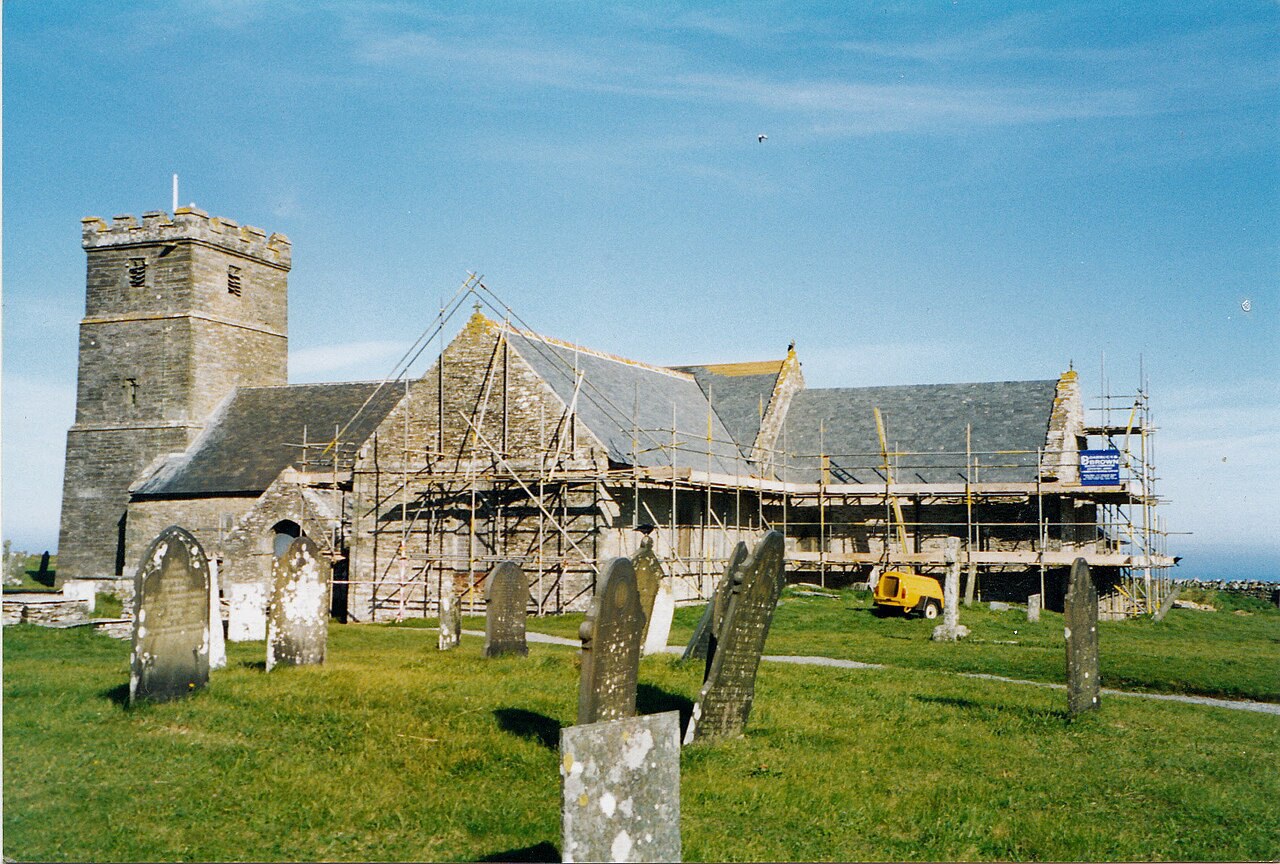
- The castle footbridge, Old Post Office roof and St Materiana's Church
Photo: Martin Richard Phelan · CC BY-SA 2.0 · cropped
The Fox verdict
A village where legend sits on older foundations
Tintagel combines an early medieval stronghold, an Arthurian tradition, cliff walking and a village full of independent food stops.
The castle carries both 5th- and 6th-century archaeology and Geoffrey of Monmouth's Arthurian story, while the village adds a Norman church, a 14th-century Old Post Office and King Arthur's Great Halls. Pasties, handmade sweets and a family-owned inn make useful pauses between them.
Where to go
Places in Tintagel
Every place below is checked against a published source, listed with what it is and how long to give it.
Local signatures
3 placesTintagel Castle
A 5th- and 6th-century high-status settlement with Mediterranean trade connections, later tied to the story of Arthur's conception; a footbridge links the castle's two wards and Gallos stands on the island.
- Visit length
- Editorial estimate: Allow around 2 hours 30 minutes
- Locality
- Tintagel Castle headland and island
- Access
- Merlin's Cave is on the beach below and accessible from Tintagel Haven at low tide.
King Arthur's Great Halls
Built between 1927 and 1933 by Frederick Thomas Glasscock for his Fellowship of the Knights of the Round Table, with 72 stained-glass windows and Arthurian oil paintings.
- Visit length
- Editorial estimate: Allow around 1 hour 15 minutes
- Locality
- Tintagel
King Arthur's Arms Inn
An independent family-owned inn serving fresh homemade dishes and Tintagel Brewery ales, with up to eight ales on tap and a praised gluten-free menu.
- Visit length
- Editorial estimate: Allow around 1 hour 15 minutes
- Locality
- Fore Street, centre of village
- Access
- Dogs are welcome and water is provided.
Food & drink
2 placesPengenna Pasties
A Cornish pasty bakery making Cornwall's signature bake since 1985, including the traditional Cornish pasty.
- Visit length
- Editorial estimate: Allow around 30 minutes
- Locality
- Atlantic Road
Tintagel Artisan Confections
A confectionery shop for handmade fudge, old-fashioned humbugs and sweets, run by two owners who have worked together since their teens.
- Visit length
- Editorial estimate: Allow around 20 minutes
- Locality
- Tintagel
History & heritage
2 placesTintagel Old Post Office
A 14th-century stone house built to a medieval manor-house plan, known for its wavy slate roof and displaying Victorian postal equipment and 16th-century furniture.
- Visit length
- Editorial estimate: Allow around 1 hour
- Locality
- Down in the village
St Materiana's Church
A Grade I church standing alone on the cliffs, with a late 11th- or early 12th-century Norman core and a site whose first church was probably founded in the 6th century.
- Visit length
- Editorial estimate: Allow around 45 minutes
- Locality
- On the cliffs between Trevena and Tintagel Castle
No places match this filter. Choose All places to reset the list.
Three ways to explore Tintagel
Signature outings
Two wards, one castle
Cross the footbridge that reunited the castle's two wards in 2019, then find the eight-foot bronze figure Gallos on the island.
The house that waves
Look for the 14th-century Old Post Office's undulating slate roof before seeing Victorian postal equipment and 16th-century furniture inside.
The cliff-top church
St Materiana's stands alone between Trevena and the castle, with a Norman church on a site probably used since the 6th century.
The village story
Tintagel Village Guide
Fudge and pasties lead into family inns, hard cliff walks, deep archaeology and one of Cornwall's most elaborate Arthurian stories.
Fudge, pasties and village inns
Granny Wobbly's Fudge Pantry is baby pink, hung with bunting, and has been making fudge on Fore Street for over twenty years. It sells five staple flavours and would be the most conspicuous sweet shop in most villages. In Tintagel it is one of at least three. A little along, Roly's pours and paddles its fudge in the window while you watch, made fresh daily; it's the fourth shop owned by Joel and Mary, who also have Padstow, Newquay and Fowey. Tintagel Artisan Confections does humbugs and old-fashioned sweets and is run by two people who have worked together since they were teenagers. For a parish of 1,725, that is a lot of fudge.
The pasties are similarly well covered. Pengenna Pasties on Atlantic Road has been making the traditional Cornish version since 1985 and now has shops in Bude and St Ives and an online delivery service. Slice, on Fore Street, keeps it simpler: the sign says "Cornish Pasties Homemade Here," which is about as much of a mission statement as a pasty needs. Charlie's is the place to go if you want a sit-down meal built around Cornish produce — a family restaurant, café and delicatessen in one.
There are more pubs than you'd expect, and they don't obviously overlap. King Arthur's Arms Inn sits in the centre of the village on Fore Street and is family-owned. The host is Jerome George Dangar, a native of Tintagel; his father, Terry Jerome Dangar, was born and brought up in the pub. It keeps up to eight ales on tap plus more than twenty lagers and ciders, serves Tintagel Brewery ales, and has its own "King Arthur's Ale" brewed by the same brewery. The food is honest pub cooking — fish and chips, steak and ale pie, mixed grill, lamb shank, surf and turf, burgers — and the gluten-free menu gets specific praise. One TripAdvisor reviewer summed it up as "Good, honest pub food – and great cider!" Dogs are welcome and get a bowl of water.
The Cornishman Inn is a pub, restaurant and hotel with eleven refurbished ensuite rooms, in the heart of the village. It makes its own chips and does steak, sausage and mash, a Hunters Chicken Burger, and vegan fish and chips for anyone who wants it. It is rumoured to be built on the site of an ancient dwelling, with a local legend of hidden smugglers' or knights' tunnels running beneath, which is the kind of thing a village this committed to Arthurian tourism was always going to attract.
Historic pubs and local ales
Ye Olde Malthouse Inn is a handsome 14th-century building on Fore Street, still holding many of its original features, with nine ensuite rooms above and a suntrap front courtyard that catches the sunset and the country views. The kitchen is open seven days and leans on Cornish produce — pork belly, burgers, fish and chips, sticky toffee pudding. The Crab Linguine has a following; one reviewer called it "Best pasta dish I have ever tasted!!!" CAMRA lists it, slightly primly, as the "Olde Malt House."
For a pub with a beach attached, you have to walk. The Port William stands at Trebarwith Strand, about two miles south, on a terrace looking straight out over the sand. It's managed by St Austell Brewery, pours Proper Job and Tribute, and does everything from post-surf light bites to a Sunday roast from noon with a choice of three meats plus vegan and vegetarian options. The Tintagel Arms Hotel occupies one of the more scenic spots in the village; the building dates from around 1750 and started life as a private home.
The Tintagel Brewery whose ales you'll keep meeting was founded in 2009 by John and Liz Heard on their working farm above the coast. Their "Cornwall's Pride" took bronze at the Cornwall County Beer Festival in 2010 and silver at Tuckers Maltings the year after; they also make a session ale called Castle Gold.
Cliff paths, church and castle
The walking is the reason a lot of people come, and the South West Coast Path runs straight through the village along the cliffs. The stretch from Trebarwith Strand climbs steeply to the cliff-top, and as you approach Tintagel you get St Materiana's Church and then the first view of the rocky castle island, before the path carries on past Trevalga and Firebeacon Hill, down into Rocky Valley and up around Bossiney Common above the sandy cove of Bossiney Haven. Going the other way, Tintagel to Port Isaac is about 8.8 miles, a hard hike with roughly 2,200 feet of climbing and old slate mines along the route — five hours or more if you're honest about it. The Rocky Valley and St Nectan's Glen circular follows a cascading river past ruined mills and the labyrinth carvings cut into the rock; the slate underfoot is slippery, so it wants good grip rather than good intentions.
St Materiana's Church stands alone on the cliffs between the village — properly called Trevena — and the castle, fully exposed to the Atlantic. The church you see is Norman, late 11th or early 12th century, though the first church on the site was probably 6th-century, founded as a daughter church of Minster. Pevsner, visiting in 1950, thought the Norman design carried some Saxon features and couldn't quite decide whether the tower was 13th or 15th century. It was heavily restored in 1870, when Piers St Aubyn gave it a new roof. It is Grade I listed, and it is the kind of building that makes more sense the windier it gets.
Then there's the castle, which is really two things pretending to be one. Archaeologically it was a high-status settlement in the 5th and 6th centuries, trading with the Mediterranean; the Artognou stone, a piece of inscribed slate turned up in a 1998 dig, carries 6th-century lettering and proves people here could read and write. The other Tintagel is the one Geoffrey of Monmouth invented around 1136, when he named it as the place King Arthur was conceived, with Merlin disguising Uther Pendragon as the Duke of Cornwall for the occasion. English Heritage opened a footbridge in 2019 reuniting the two wards of the castle across the gap, and on the island stands Gallos — Cornish for "power" — an eight-foot bronze crowned figure with a sword by Rubin Eynon, flown in by helicopter and unveiled in April 2016. Below, reachable across the beach at low tide, is Merlin's Cave.
Wavy roofs and Arthurian ambitions
Down in the village, the Old Post Office is a 14th-century stone house built to a medieval manor-house plan, chiefly famous for its wavy slate roof, which undulates as if the building had settled while nobody was looking. The National Trust has held it since 1903; inside are Victorian postal equipment and 16th-century furniture, and it is Grade I listed. Nearby, Barras Nose — the rocky headland just east of the castle — was the first piece of coastal land the National Trust ever bought, in 1897.
The strangest building in Tintagel is King Arthur's Great Halls, and the reason for it is stranger still. Frederick Thomas Glasscock had made a fortune as a founding partner in Monk & Glass custard powder, retired to Tintagel, and built the Halls between 1927 and 1933 as the headquarters of his Fellowship of the Knights of the Round Table of King Arthur, which he had founded in 1927 and which reportedly reached more than 17,000 members. A Freemason, he meant it to promote chivalric and Christian ideals. It holds 72 stained-glass windows designed by Veronica Whall, a pupil in the William Morris tradition. In April 1952 the building was consecrated as a Masonic lodge, which it remains. A custard millionaire built a temple to King Arthur, and it is now a working lodge; all of that is true.
The grand hotel on the headland has a comparable back-story. The Camelot Castle Hotel, originally King Arthur's Castle Hotel, was commissioned in 1894 by Sir Robert Harvey, designed by the Cornish architect Silvanus Trevail, and finished in 1899 after five years. It was meant partly to serve as the terminus of a branch railway from Camelford that was never actually built — one of several things Tintagel planned and then quietly didn't do, along with a medieval chapel of St Denys that has vanished and two golf courses that closed in the 1930s and never reopened after the war. The hotel was bought in 1999 by John Mappin, of the Mappin & Webb jewellery family, and restored from 2006.
Trevena, Tintagel and the journey here
Tintagel wasn't always called Tintagel. It was Trevena — from the Cornish for "village on a mountain" — until the Post Office adopted "Tintagel," previously the name only of the headland and parish, as the official village name in the mid-19th century. The sea here often reads turquoise, which is put down to the copper in the local slate and sand. In Domesday the village doesn't appear at all; the parish is represented by two manors, Bossiney, which included Trevena and was held by the Earl of Cornwall from the monks of Bodmin, and Treknow, held directly by the monks, with land between them for fourteen ploughs.
Getting here takes some doing, which is part of the character. The nearest railway station is Bodmin Parkway, about nineteen miles away; the village is reached on minor roads off the A39, with Camelford the nearest town at around five miles. First Kernow buses on routes 95 and 96 stop at the Tintagel Visitor Centre, about a mile from the castle entrance. Tennyson made the trip in 1860, and so at various points did Dickens, Thomas Hardy and Robert Hawker.
For all the King Arthur trade, the thing that lingers is smaller. The man who pours your pint at King Arthur's Arms grew up in the village, in a pub his father was born in, and if you ask he'll tell you which ale is the local one.
Stay around Cornwall
Make a longer stay of it
Travel Fox holiday homes around Cornwall, linked directly to their property pages.
A guide with a point of view
Written from research. Edited for real journeys.
Use the Official site links for live practical details, then use this guide for context, ideas and room to explore.
Photography credits & licences
Third-party photographs are credited to their named creators and reused under the linked Creative Commons licence or public-domain dedication. Travel Fox stores an optimised local copy; the file-specific changes and any browser-applied display crop are disclosed below. Reused photographs link both to the Wikimedia Commons source record and to the declared source image; Travel Fox's own photographs carry no such record and are marked as ours. These image licences do not cover Travel Fox text, branding or page design.
- File:St Materiana's Church - Tintagel, Cornwall - geograph.org.uk - 4189943.jpg — photograph by Martin Richard Phelan; St Materiana's Church - Tintagel, Cornwall by Martin Richard Phelan. Source record on Wikimedia Commons. Declared source image. Licence: CC BY-SA 2.0. File changes: Downloaded from Wikimedia Commons, resized to a maximum 1920px edge and encoded as an optimised JPEG. Display changes: Displayed with responsive CSS cropping.
Sources
Every place on this page is checked against a published source. Each entry links the record we used and names who publishes it.
- Tintagel Castle — english-heritage.org.uk national body or asset manager
- Tintagel Old Post Office — nationaltrust.org.uk national body or asset manager
- St Materiana's Church — historicengland.org.uk statutory register or public authority record not machine-readable; publisher restricts automated access
- King Arthur's Great Halls — historicengland.org.uk statutory register or public authority record not machine-readable; publisher restricts automated access
- King Arthur's Arms Inn — kingarthursarms.co.uk operator, sector body or destination organisation
- Pengenna Pasties — pengennapasties.co.uk operator, sector body or destination organisation
- Tintagel Artisan Confections — tintagelconfections.co.uk operator, sector body or destination organisation