
Little London by Sea
Swanage
A south-facing bay where a long sandy beach, Purbeck-stone history and coast paths meet a rebuilt heritage railway.
- Landscape
- Sandy Swanage Bay between Ballard Down and Durlston Head
- Town story
- Purbeck stone, a Victorian resort and Little London by Sea
- Family detail
- The Beach Toy Library outside Swanage Information Centre
Photo: Daniel Schmidt · CC BY-SA 4.0 · cropped
The Fox verdict
A seaside town built from stone, steam and salvaged London
Swanage pairs a gently shelving sandy beach with a Victorian pier, heritage trains and coast walks in both directions.
Its character reaches beyond the bay. George Burt's returning stone barges brought salvaged London architecture, Durlston holds his 40-tonne Great Globe, and Ballard Down leads towards the chalk stacks of Old Harry Rocks.
Where to go
Places in Swanage
Every place below is checked against a published source, listed with what it is and how long to give it.
Local signatures
3 placesSwanage Beach
A long sandy beach that shelves gently into a designated swimming zone, with a Beach Toy Library outside the Information Centre.
- Visit length
- Editorial estimate: around 90 minutes
- Locality
- opposite Swanage Information Centre
- Access
- The designated swimming zone is lifeguarded by the RNLI in summer.
Swanage Museum & Heritage Centre
A small, free museum covering dinosaurs and the Jurassic Coast, Swanage's stone trade, seaside resort history and the Second World War.
- Visit length
- Editorial estimate: around 45 minutes
- Locality
- in the Square
Durlston Country Park
A 320-acre country park and nature reserve with coast walks, sea views, the Great Globe, a lighthouse and family events.
- Visit length
- Editorial estimate: around 75 minutes
- Locality
- on the town's southern edge
Walks & outdoors
1 placeStudland to Swanage
A Studland-to-Swanage coast walk over Ballard Down, passing the chalk stacks of Old Harry Rocks at the eastern end of the Jurassic Coast World Heritage Site.
- Visit length
- Editorial estimate: Approximately 2 hours 45 minutes
- Locality
- north of Swanage Bay
History & heritage
3 placesSt Mary's Church, Swanage
A Grade II church whose rebuilt body retains a medieval tower, with three 14th-century lower stages and a top stage from 1620.
- Visit length
- Editorial estimate: around 30 minutes
- Locality
- Swanage
The Great Globe
George Burt's 1887 globe is a 40-tonne, roughly three-metre sphere of Portland stone, carved with continents, oceans and inscriptions.
- Visit length
- Editorial estimate: around 20 minutes
- Locality
- at Durlston
Anvil Point Lighthouse
A local-stone lighthouse completed in 1881 and automated in 1991, reached in the article's southward coast-path sequence through Durlston.
- Visit length
- Editorial estimate: around 30 minutes
- Locality
- at Durlston
Things to do
2 places
Swanage Pier
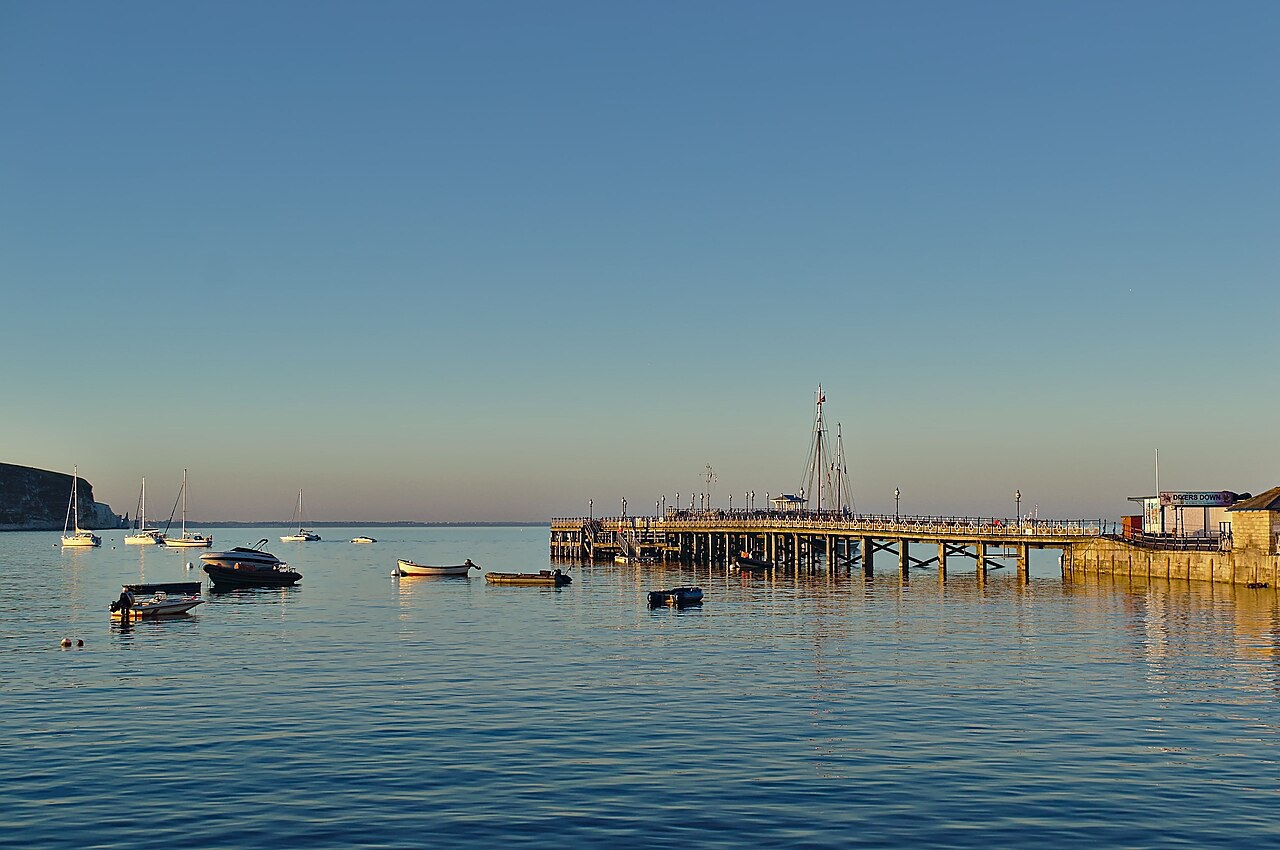
A restored Victorian pleasure pier used for strolling, angling and diving, with marine life around it and the skeletal piles of the older pier nearby.
- Visit length
- Editorial estimate: around 45 minutes
- Locality
- Swanage
Swanage Railway
A volunteer-rebuilt heritage line running steam and diesel trains from Swanage through Herston, Harmans Cross and Corfe Castle to Norden.
- Visit length
- Editorial estimate: around 120 minutes
- Locality
- Swanage
No places match this filter. Choose All places to reset the list.
Three ways to explore Swanage
Signature outings
The Victorian pier
Stroll Swanage Pier for its restored Victorian structure, angling and marine-life setting.
The Great Globe
Find George Burt's 1887, 40-tonne Portland-stone sphere at Durlston, carved with continents, oceans and inscriptions.
Swanage Railway
Ride the rebuilt heritage line from Norden through Corfe Castle and Harmans Cross to Swanage.
The town story
Swanage Town Guide
Beach rituals, Purbeck stone, salvaged London architecture and a railway rebuilt by volunteers shape this Dorset seaside town.
Beach days and town pubs
Outside the Swanage Information Centre, opposite the beach, there's a Beach Toy Library — a box of spades and buckets left out for anyone to borrow and bring back. This is a south-facing bay with a long sandy beach that shelves gently into a designated swimming zone, lifeguarded by the RNLI in summer, with deckchairs, ice cream and fish and chips along the front.
The town has nearly a dozen traditional pubs, most of them pouring locally brewed ales and ciders. The Black Swan on the High Street is Grade II listed and does seafood, sharing platters and Sunday roasts, and well-behaved dogs are welcome in the garden. The Ship Inn, central, has a "gourmet dog" on the menu alongside burgers and loaded fries, and its own dog walks running out from the door. The Red Lion is family-run with a spacious beer garden, and the Anchor Inn, near the beach, does Sunday roasts by a fire.
Blyton and Durlston
The High Street keeps a run of independent shops. Martins the newsagents occupies what was once the bookshop where Enid Blyton held signings for locals. She holidayed in Purbeck three times a year for over twenty years, and was elected President of the Swanage Carnival in 1957.
Walk south and the coast path climbs to Durlston Country Park, past the closed Tilly Whim Caves to Anvil Point Lighthouse, built of local stone in 1881. Durlston is also home to the Great Globe: a forty-tonne sphere of Portland stone, three metres across, carved with the continents and joined with granite dowels. George Burt had it made in London and shipped down by sea in 1887.
Little London and St Mary's
Burt is why Swanage was once called Little London by Sea. He and his uncle John Mowlem built fortunes shipping Purbeck stone to the capital, and the returning barges needed ballast, so Burt brought back salvaged London architecture and re-erected it here. The Wellington Clock Tower on the seafront originally stood at the Southwark end of London Bridge, where by the 1860s it had become "an unwarrantable obstruction" to traffic. Burt removed it to Swanage at no charge. Its spire came off in 1904 and was replaced with a copper cupola. The Town Hall carries the old Mercers' Hall façade, also brought down from London.
St Mary's, mostly rebuilt in Gothic Revival in 1859, kept its medieval tower — three stages from the 14th century, the top one from 1620 — and a ring of eight bells, two of them cast in 1594 and 1612.
Chalk ridge and heritage railway
North of the bay, the chalk ridge of Ballard Down runs out to Old Harry Rocks, the white stacks that mark the eastern end of the Jurassic Coast. The walk from Studland over the down is about six miles, with Poole Harbour and the Needles on the far side.
The mainline station is at Wareham, ten miles off; the A351 comes in through Corfe Castle, and the number 40 Purbeck Breezer runs hourly from Poole. The way to arrive, though, is the Swanage Railway, steam-hauled from Norden — lifted entirely under the Beeching cuts in 1972, then rebuilt from scratch by volunteers over the following two decades.
The missing pier
Enid Blyton and her husband, locals recalled, used to swim round both piers before supper. There is one pier fewer now.
Stay around Dorset
Make a longer stay of it
Travel Fox holiday homes around Dorset, linked directly to their property pages.
A guide with a point of view
Written from research. Edited for real journeys.
Use the Official site links for live practical details, then use this guide for context, ideas and room to explore.
Photography credits & licences
Third-party photographs are credited to their named creators and reused under the linked Creative Commons licence or public-domain dedication. Travel Fox stores an optimised local copy; the file-specific changes and any browser-applied display crop are disclosed below. Reused photographs link both to the Wikimedia Commons source record and to the declared source image; Travel Fox's own photographs carry no such record and are marked as ours. These image licences do not cover Travel Fox text, branding or page design.
- File:Swanage Pier.jpg — photograph by Daniel Schmidt; Own work. Source record on Wikimedia Commons. Declared source image. Licence: CC BY-SA 4.0. File changes: Downloaded from Wikimedia Commons, resized to a maximum 1920px edge and encoded as an optimised JPEG. Display changes: Displayed with responsive CSS cropping.
Sources
Every place on this page is checked against a published source. Each entry links the record we used and names who publishes it.
- Swanage Beach — swanage.gov.uk statutory register or public authority
- Swanage Pier — swanagepiertrust.com operator, sector body or destination organisation
- Swanage Railway — swanagerailway.co.uk operator, sector body or destination organisation
- Swanage Museum & Heritage Centre — swanagemuseum.org.uk operator, sector body or destination organisation
- St Mary's Church, Swanage — historicengland.org.uk statutory register or public authority record not machine-readable; publisher restricts automated access
- Durlston Country Park — durlston.co.uk operator, sector body or destination organisation
- The Great Globe — durlston.co.uk other published source
- Anvil Point Lighthouse — trinityhouse.co.uk other published source
- Studland to Swanage — southwestcoastpath.org.uk other published source