
Gateway to the Highlands
Milngavie
A quiet town where a granite trailhead, a community mill and Victorian waterworks open onto loch, moor and woodland.
- Best for
- Walking, art and community food
- Give it
- A half day in town or longer for Mugdock
- Don't miss
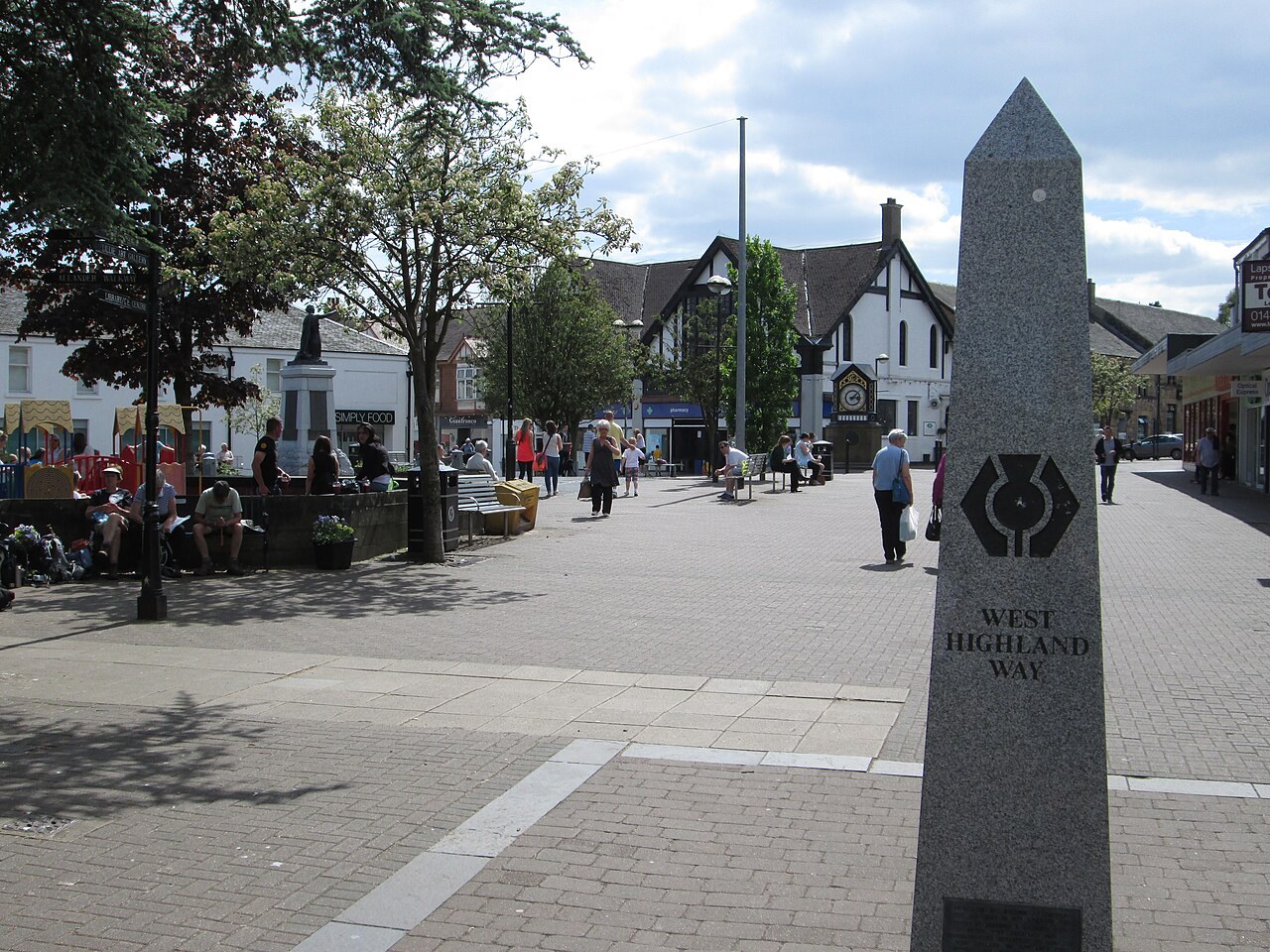
- The West Highland Way obelisk
Photo: Peter S · CC BY-SA 2.0 · cropped
The Fox verdict
A trailhead town with more than one reason to linger
Milngavie pairs the official start of the West Highland Way with a community mill, a free art gallery and Victorian waterworks.
Begin at the granite obelisk, pause for the Lillie Art Gallery and Gavin's Mill, then make time for the reservoirs or the loch, moor, woodland and castle ruins of Mugdock Country Park.
Where to go
Places in Milngavie
Every place below is checked against a published source, listed with what it is and how long to give it.
Local signatures
3 placesMugdock Country Park
A 260-hectare spread of loch, moor and woodland with walking and cycling routes, plus the ruins of Mugdock Castle and Craigend Castle.
- Visit length
- Editorial estimate: allow around 2 hours
- Locality
- immediately adjacent to Milngavie
Milngavie Reservoirs
Landscaped Victorian waterworks opened by Queen Victoria in 1859, holding Loch Katrine water on its way to Glasgow.
- Visit length
- Editorial estimate: allow around 75 minutes
- Locality
- north of the town
Gavin's Mill
A community social enterprise in one of the town's oldest buildings, with an ethical shop and a vegetarian café serving home baking and fair-trade drinks.
- Visit length
- Editorial estimate: allow around 75 minutes
- Locality
- Gavin's Mill Road
Walks & outdoors
2 places
West Highland Way Start
A granite obelisk marks the official start of the 96-mile footpath to Fort William, with a tourist information point about 50 yards away.
- Visit length
- Editorial estimate: allow around 45 minutes
- Locality
- pedestrianised town centre
Auld Wives' Lifts
A natural rock formation on Craigmaddie Muir that draws walkers north-east of the town.
- Visit length
- Editorial estimate: allow around 90 minutes
- Locality
- Craigmaddie Muir, north-east of the town
Things to do
1 placeLillie Art Gallery
A gallery founded through the legacy of local banker-artist Robert Lillie, holding paintings, prints, drawings, sculpture and ceramics.
- Visit length
- Editorial estimate: allow around 60 minutes
- Locality
- Station Road, opposite the station
- Access
- Free entry.
No places match this filter. Choose All places to reset the list.
Three ways to explore Milngavie
Signature outings
Stand at Mile Zero
Find the granite obelisk that marks the official start of the 96-mile footpath to Fort William.
Browse the Lillie Collection
See paintings, prints, drawings, sculpture and ceramics in the free gallery founded through Robert Lillie's legacy.
Walk Between Castle Ruins
Explore Mugdock Country Park's loch, moor and woodland, with the ruins of Mugdock and Craigend castles.
The town story
Milngavie Town Guide
A trailhead town of mills, art, Victorian waterworks and paths leading towards the Highlands.
At the Start of the Way
A granite obelisk stands in the pedestrianised centre of Milngavie, and it marks the official start of the West Highland Way — ninety-six miles of footpath north to Fort William. A tourist information point sits about fifty yards away. Most of the people gathered around the obelisk on a given morning are about to walk to the Highlands; the rest are doing their shopping.
The name is pronounced "mull-GUY", which catches out most visitors. The town sits on the Allander Water at the north-western edge of Greater Glasgow, about six miles from the city and a frequent train ride from Queen Street. The station is the terminus of the North Clyde Line and stands opposite the Lillie Art Gallery on Station Road.
Mill, Shops and the Old Core
Gavin's Mill is one of the oldest buildings in the town, a former watermill on the Allander now run as a community social enterprise. It houses an ethical shop selling fair-trade food, Scottish produce and zero-waste goods, and a vegetarian café with home baking and fair-trade coffee. Fresh bakery deliveries arrive on Tuesdays, Thursdays and Saturdays, and the mill keeps a calendar of talks, workshops and music.
The town centre was pedestrianised from 1974 and mixes Victorian shopfronts and Arts-and-Crafts frontages with later units. The Cross Keys, one of Milngavie's oldest surviving buildings, predates 1800 and anchors the old village core.
Moorland, Castles and Reservoirs
Mugdock Country Park begins more or less where the town ends — 260 hectares of loch, moor and woodland straddling East Dunbartonshire and Stirlingshire, reachable on foot. There are walking and cycling routes around Mugdock Loch and the Allander Water, and the ruins of two castles: Mugdock Castle, a fourteenth-century Graham stronghold, and Craigend Castle, a Gothic mansion that later housed a zoo. The park has adventure play, a ranger service, a garden centre and cafés.
North of the town, the Milngavie Reservoir holds up to 548 million gallons of Loch Katrine water on its way to Glasgow. Queen Victoria opened the waterworks in 1859. The landscaped Victorian embankments draw walkers, as do the Auld Wives' Lifts, a natural rock formation on Craigmaddie Muir.
Art and Industrial Memory
The Lillie Art Gallery, opposite the station, is free to enter and grew from the legacy of Robert Lillie, a local banker and artist who died in 1949. It has held paintings, prints, sculpture and ceramics for more than sixty years.
Milngavie grew from a New Kilpatrick milling village recorded around 1600 as "Millgay". Paper mills and bleach works ran on the Allander from the 1760s, and the railway's arrival in the 1860s brought wealthy Glaswegians who built stone villas around Tannoch Loch. In the 1930s a siding near the town tested the George Bennie Railplane, "a Jules Verne-esque silver cylinder with a large propeller" suspended above the track. The venture went bankrupt in 1937.
A Quiet Town Looking North
It is largely a commuter and retirement town now, quiet and comfortable. In 2008 some residents ran a campaign for Milngavie to host the 2020 Olympics. It came to nothing, but the obelisk still sends a steady stream of walkers north each morning, rucksacks on, heading for Fort William before the shops have opened.
Stay around East Dunbartonshire
Make a longer stay of it
Travel Fox holiday homes around East Dunbartonshire, linked directly to their property pages.
For homeowners
Own a holiday home near Milngavie?
We manage holiday lets across the UK from 12% commission, charged after cleaning costs, with no lock-in. A co-founder visits before you decide.
How our holiday let management works →
A guide with a point of view
Written from research. Edited for real journeys.
Use the Official site links for live practical details, then use this guide for context, ideas and room to explore.
Photography credits & licences
Third-party photographs are credited to their named creators and reused under the linked Creative Commons licence or public-domain dedication. Travel Fox stores an optimised local copy; the file-specific changes and any browser-applied display crop are disclosed below. Reused photographs link both to the Wikimedia Commons source record and to the declared source image; Travel Fox's own photographs carry no such record and are marked as ours. These image licences do not cover Travel Fox text, branding or page design.
- File:Granite obelisk marking the start of the West Highland Way at Milngavie (geograph 4070682).jpg — photograph by Peter S; Peter S. Source record on Wikimedia Commons. Declared source image. Licence: CC BY-SA 2.0. File changes: Downloaded from Wikimedia Commons, resized to a maximum 1920px edge and encoded as an optimised JPEG. Display changes: Displayed with responsive CSS cropping.
Sources
Every place on this page is checked against a published source. Each entry links the record we used and names who publishes it.
- West Highland Way Start — westhighlandway.org operator, sector body or destination organisation
- Mugdock Country Park — eastdunbarton.gov.uk statutory register or public authority
- Milngavie Reservoirs — portal.historicenvironment.scot statutory register or public authority
- Lillie Art Gallery — edlc.co.uk other published source
- Gavin's Mill — portal.historicenvironment.scot statutory register or public authority
- Auld Wives' Lifts — trove.scot other published source record not machine-readable; publisher restricts automated access