
Thread, stone and open heights
Paisley
Paisley's weaving story runs from restored looms and an abbey of the High Stewards to real ale and the Gleniffer Braes.
- Best for
- Textile heritage, medieval history and moorland walks
- Give it
- Choose between town heritage and a six-mile Braes walk
- Don't miss
- The original spirit cocks at The Bull Inn
Photo: Colin · CC BY-SA 3.0 · cropped
The Fox verdict
A thread town with deep roots and open heights
Paisley brings its world-changing textile story together with an abbey, restored weavers' homes, a historic pub and the Gleniffer Braes.
The Paisley Pattern and Paisley Shawl grew from a thread trade that ran locally from 1722 to 1993. The story survives in the Sma' Shot Cottages, while Paisley Abbey reaches back to the first High Steward of Scotland and The Bull Inn preserves a nationally important historic interior. South of town, the Gleniffer Braes open onto woodland, farmland and moorland.
Where to go
Places in Paisley
Every place below is checked against a published source, listed with what it is and how long to give it.
Local signatures
3 placesThe Bull Inn
A traditional Scottish town pub established in 1901, retaining stained glass, three small snugs, a spirit cask gantry and Scotland's only original set of spirit cocks alongside four changing guest ales.
- Visit length
- Editorial estimate: allow around 60 minutes
- Locality
- 7 New Street, Paisley
Finlaystone Country Estate
A country estate managed by the family of the Chief of Clan MacMillan, with gardens, woodland walks and views across the Firth of Clyde.
- Visit length
- Editorial estimate: allow around 90 minutes
- Locality
- near Langbank
Castle Semple Visitor Centre & Country Park
A visitor centre and country park for watersports and walking on Castle Semple Loch, within the larger Clyde Muirshiel Regional Park.
- Visit length
- Editorial estimate: allow around 120 minutes
- Locality
- Lochwinnoch
Walks & outdoors
1 placeGleniffer Braes Country Park
A 480-acre landscape of woodland, farmland and moorland with way-marked walking and cycling paths, panoramic viewpoints and the six-mile Tannahill Walkway from Robertson Park.
- Visit length
- Editorial estimate: allow around 180 minutes
- Locality
- the Gleniffer Braes, south of Paisley
History & heritage
2 placesSma' Shot Cottages
Restored 18th- and 19th-century weavers' homes furnished authentically with looms and exhibits on domestic life and Paisley's radical past, with guided tours led by local volunteers.
- Visit length
- Editorial estimate: allow around 60 minutes
- Locality
- Paisley
- Access
- Guided tours are led by local volunteers through the restored weavers' homes.
Paisley Abbey
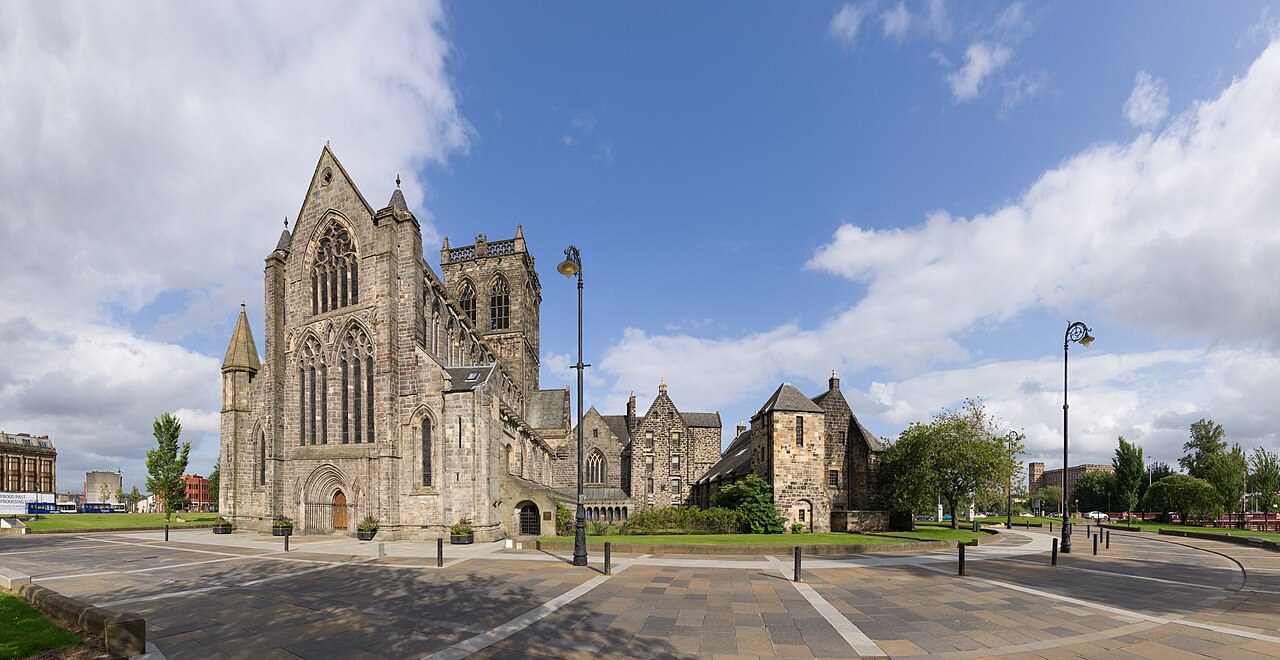
Founded around 1163 by Walter FitzAlan, the abbey is the final resting place of six High Stewards and contains Stewart royal memorials as well as its much-photographed alien-looking gargoyle.
- Visit length
- Editorial estimate: allow around 60 minutes
- Locality
- Paisley
No places match this filter. Choose All places to reset the list.
Three ways to explore Paisley
Signature outings
Find the alien gargoyle
Among Paisley Abbey's carved gargoyles is the much-photographed figure whose appearance is strikingly alien-like.
Tour the weavers' homes
Local volunteers guide visitors through restored 18th- and 19th-century homes furnished with looms and exhibits on domestic life and Paisley's radical past.
Walk Tannahill's landscape
The six-mile Tannahill Walkway starts at Robertson Park and passes Gleniffer Gorge, Craigielinn waterfall, Glenburn Reservoir and Thornley Dam.
The town story
Paisley Town Guide
A town shaped by thread, royal history, working lives and the moorland heights to its south.
The Bull Inn and the Thread Town
The Bull Inn on New Street has the only original set of spirit cocks left in Scotland, along with three small snugs, a spirit cask gantry and stained-glass windows that have been in place since it opened in 1901. It is reckoned the oldest pub in Paisley, and CAMRA counts its interior among the nationally important ones. Four changing guest ales come through, usually from Broughton, Loch Lomond, Orkney and Spey Valley, and the four snugs at the back can be booked free for a lunch or a party. On a St Mirren matchday it fills with supporters watching the football. One TripAdvisor visitor summed it up as "Great pub & great atmosphere!"
Paisley is Renfrewshire's largest town, sitting just west of Glasgow on the White Cart Water, with the Gleniffer Braes rising to the south. For about 150 years it was the thread capital of the world. Thread-making began here in 1722 and the last mill closed in 1993, and in between the town gave the world the Paisley Pattern and the Paisley Shawl. Thomas Coats built J & P Coats into what became, at its height, the third largest listed company in the world.
Stars, Stewards and Stone
You can see where the money went at Coats Observatory, Scotland's oldest public observatory and still working. Coats paid £3,097 17s 6d for it and died two weeks after it opened in 1883. The five-inch Thomas Cooke refractor from that year still turns; a ten-inch Grubb telescope was added in 1898, and the instruments here recorded the 1906 San Francisco earthquake. There is a planetarium now too.
Paisley Abbey is the older story. Founded around 1163 by Walter FitzAlan, the first High Steward of Scotland, it holds the graves of six High Stewards and a tomb whose female effigy is widely taken to be Marjorie Bruce, daughter of Robert the Bruce and mother of the first Stewart king. Queen Victoria gave the marble tomb of Robert III when she visited in 1888. Look up at the gargoyles and you will find one that appears, unmistakably, to be an alien.
Inside the Weavers' Homes
For the human side of the town, the Sma' Shot Cottages are a row of restored weavers' homes furnished as they were, with looms still in place and volunteers to show you round. Entry is free. On the first Saturday in July they host Sma' Shot Day, which ends with the burning of the cork.
Walking the Gleniffer Braes
Walking means the Gleniffer Braes. The Tannahill Walkway runs six miles from Robertson Park past the fifty-foot Gleniffer Gorge and Craigielinn waterfall, which grows icicles in winter. From the viewpoint in the 480-acre country park you can see the town, the Lower Clyde Valley and, on a clear day, as far as Ben Lomond. These braes were the favourite ground of the weaver-poet Robert Tannahill, who put them into his songs.
Rails, Airport and the Buddies
Getting here is easy. Paisley Gilmour Street is the fourth-busiest station in Scotland, with trains to Glasgow Central every ten minutes or so, and Glasgow Airport is close enough to walk. Gerard Butler, Paolo Nutini, Gerry Rafferty and David Tennant all came from here; the town calls them Buddies, and there is a walk of fame with their names on it.
Stay around Renfrewshire
Make a longer stay of it
Travel Fox holiday homes around Renfrewshire, linked directly to their property pages.
For homeowners
Own a holiday home near Paisley?
We manage holiday lets across the UK from 12% commission, charged after cleaning costs, with no lock-in. A co-founder visits before you decide.
How our holiday let management works →
A guide with a point of view
Written from research. Edited for real journeys.
Use the Official site links for live practical details, then use this guide for context, ideas and room to explore.
Photography credits & licences
Third-party photographs are credited to their named creators and reused under the linked Creative Commons licence or public-domain dedication. Travel Fox stores an optimised local copy; the file-specific changes and any browser-applied display crop are disclosed below. Reused photographs link both to the Wikimedia Commons source record and to the declared source image; Travel Fox's own photographs carry no such record and are marked as ours. These image licences do not cover Travel Fox text, branding or page design.
- File:Paisley Abbey from the west.jpg — photograph by Colin; © User:Colin / Wikimedia Commons. Source record on Wikimedia Commons. Declared source image. Licence: CC BY-SA 3.0. File changes: Downloaded from Wikimedia Commons, resized to a maximum 1920px edge and encoded as an optimised JPEG. Display changes: Displayed with responsive CSS cropping.
Sources
Every place on this page is checked against a published source. Each entry links the record we used and names who publishes it.
- The Bull Inn — portal.historicenvironment.scot statutory register or public authority
- Sma' Shot Cottages — paisley.is other published source
- Paisley Abbey — paisleyabbey.org.uk operator, sector body or destination organisation
- Gleniffer Braes Country Park — www1.renfrewshire.gov.uk statutory register or public authority record not machine-readable; publisher restricts automated access
- Finlaystone Country Estate — finlaystone.co.uk operator, sector body or destination organisation
- Castle Semple Visitor Centre & Country Park — renfrewshire.gov.uk statutory register or public authority