
Old Village to Sandown Bay
Shanklin
A thatched Old Village on higher ground, a wooded Chine dropping to the beach and a long sandy seafront below the cliffs.
- Best for
- Wooded ravine, coast and Old Village
- Give it
- A day between higher ground and seafront
- Don't miss
- The Chine waterfall and summer illuminations
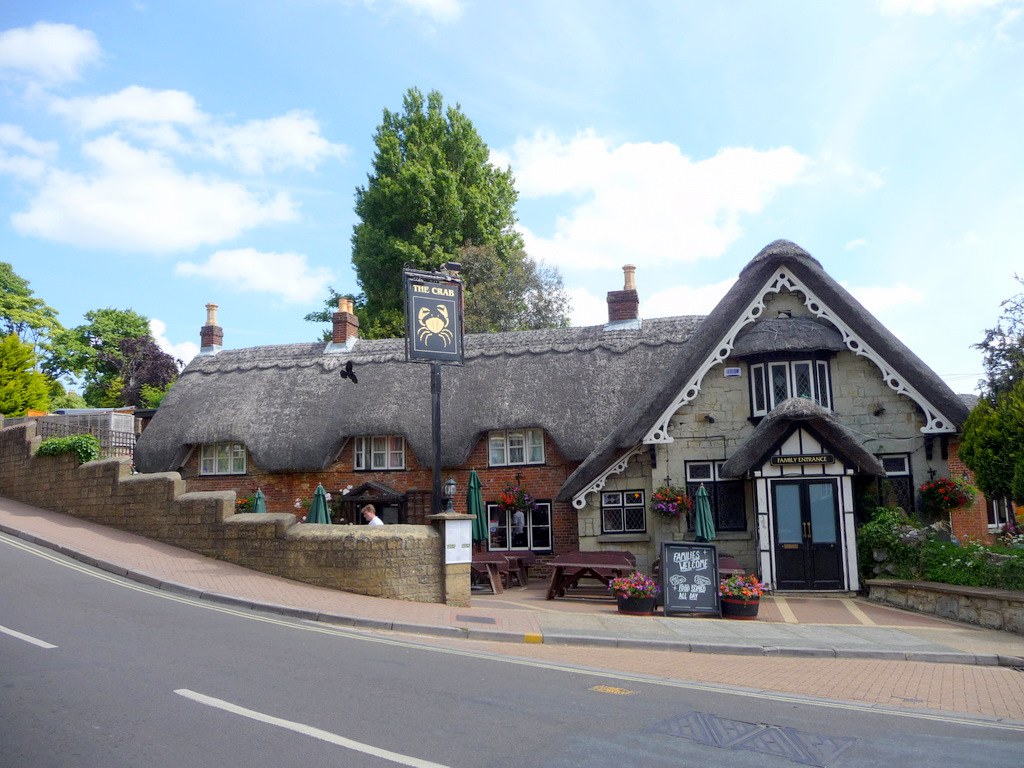
Photo: Christine Matthews · CC BY-SA 2.0 · cropped
The Fox verdict
Old Village thatch, a wooded ravine and sand
Shanklin links its higher Old Village to a sandy Sandown Bay seafront through the wooded Chine.
That contrast gives the town its shape: thatched cottages, tea gardens and the Crab Inn above; the Chine falling to the beach; and the coastal path continuing past Fisherman's Cottage and Appley Steps.
Where to go
Places in Shanklin
Every place below is checked against a published source, listed with what it is and how long to give it.
Local signatures
3 placesShanklin Chine
A wooded ravine path with a waterfall and spring lines on the cliff faces, opened to the public in 1817 and now the Island's oldest tourist attraction.
- Visit length
- Editorial estimate: Allow around 75 minutes
- Locality
- from the Old Village down to the beach
- Access
- Evening illuminations run in summer.
Shanklin Beach
A long sandy beach with an esplanade of hotels, restaurants and seafront cafes below the cliffs.
- Visit length
- Editorial estimate: Allow around 90 minutes
- Locality
- Shanklin, on Sandown Bay
- Access
- A summer-only cliff lift links the clifftop to the beach.
Shanklin Theatre
Shanklin's working theatre, off the top of the High Street.
- Visit length
- Editorial estimate: Allow around 90 minutes
- Locality
- off the top of the High Street
Food & drink
2 places
The Crab Inn
A traditional thatched village inn beside the stone and fountain commemorating Henry Wadsworth Longfellow, who stayed here in July 1868.
- Visit length
- Editorial estimate: Allow around 75 minutes
- Locality
- in the heart of Shanklin Old Village
Fisherman's Cottage
A thatched pub built at the base of the Chine in the early nineteenth century, passed by walkers on the Isle of Wight Coastal Path.
- Visit length
- Editorial estimate: Allow around 75 minutes
- Locality
- on the beach at the foot of Shanklin Chine
- Access
- Reached via the bottom of Shanklin Chine or Appley Steps.
Walks & outdoors
1 placeIsle of Wight Coastal Path
From Shanklin the path passes Fisherman's Cottage, climbs steeply via Appley Steps and continues south through the edge of Shanklin.
- Visit length
- Editorial estimate: Allow around 150 minutes
- Locality
- Sandown–Shanklin–Ventnor
History & heritage
1 placeSt Blasius Church
An old church with a medieval core, bell ropes hanging into the nave, a Renaissance oak chest and an 1874 organ by Forster and Andrews.
- Visit length
- Editorial estimate: Allow around 45 minutes
- Locality
- Shanklin
No places match this filter. Choose All places to reset the list.
Three ways to explore Shanklin
Signature outings
The Chine to the Sea
Follow the wooded ravine past its waterfall and spring lines as it drops from the Old Village to the beach.
Longfellow at the Crab
See the stone and fountain commemorating Henry Wadsworth Longfellow beside the thatched Crab Inn.
Bells in the Nave
At St Blasius, the bell ropes hang into the nave so the ringers can be seen by the congregation.
The town story
Shanklin Town Guide
From Old Village thatch and literary visitors to the wooded Chine, beach, wartime history and a vanished pier.
From Thatched Village to Wooded Chine
At the top of Shanklin's Old Village, where the High Street of thatched cottages and tea gardens gathers to a point, stands the Crab Inn, a thatched pub with a stone fountain beside it. The stone commemorates Henry Wadsworth Longfellow, the American poet, who stayed here in July 1868 on his last visit to Europe and left a verse on it. The Old Village is the postcard end of Shanklin: low thatched roofs, gift shops, cafés, tables set out under the eaves. It sits on higher ground inland, and the cliffs drop away behind it to the seafront.
The drop is the Chine. Shanklin Chine is a wooded ravine, just over 400 metres long, falling 32 metres from the Old Village down to the beach, with a waterfall and spring lines seeping from the cliffs. William Colenutt cut the present path and opened it to the public in 1817; admission was sixpence in 1873 and stayed sixpence until 1958. It is the Island's oldest tourist attraction, and in summer it is lit in the evenings. John Keats lodged nearby at Eglantine Cottage in 1819 and called it "a very great Lion." Jane Austen, Darwin, George Eliot and Dickens all came to look.
At the Foot of the Chine
At the bottom of the Chine, sitting directly on the sand, is the Fisherman's Cottage, a thatched pub built into the base of the cliff in the early nineteenth century. Walkers on the Isle of Wight Coastal Path pass it before climbing steeply up Appley Steps and on towards Ventnor, through the woods of the Bonchurch Landslips. The Chine was a smugglers' route, and a tunnel is said to have run from it to the Chine Inn.
The beach runs the length of Sandown Bay, long and sandy, with an esplanade of hotels, restaurants and seafront cafés below the cliffs. A cliff lift, summer only, saves you the climb. Sandown is a couple of miles north; Ventnor, the sheltered "English Mediterranean," about four miles south, with its botanic garden.
The Old Church
St Blasius, the old church, keeps its bell ropes hanging down into the nave so the ringers can be seen by the congregation. It has a medieval core, a good Renaissance oak chest brought from elsewhere, and an 1874 organ by Forster and Andrews. The parish registers begin in 1717. The lych-gate, with its clock and bell, is a memorial to Mr White-Popham.
Commando Training and Operation PLUTO
The Chine has a quieter history too. During the war, 40 Royal Marine Commando trained here before the 1942 Dieppe Raid, and Operation PLUTO ran a fuel pipeline through it to supply the Normandy landings. About sixty-five yards of that pipe are still on site.
Pier, Railway and the Town's Name
Shanklin Pier once ran 1,200 feet out from the front, host to Paul Robeson and Anna Pavlova, until the Great Storm of October 1987 tore it apart; it was demolished and never rebuilt. Trains still come, though, terminating at Shanklin station, which has been the end of the line since the Ventnor section closed in 1966. The name means "the bank by the drinking-cup" — a reference, all along, to the Chine.
Stay around Isle of Wight
Make a longer stay of it
Travel Fox holiday homes around Isle of Wight, linked directly to their property pages.
For homeowners
Own a holiday home near Shanklin?
We manage holiday lets across the UK from 12% commission, charged after cleaning costs, with no lock-in. A co-founder visits before you decide.
How our holiday let management works →
A guide with a point of view
Written from research. Edited for real journeys.
Use the Official site links for live practical details, then use this guide for context, ideas and room to explore.
Photography credits & licences
Third-party photographs are credited to their named creators and reused under the linked Creative Commons licence or public-domain dedication. Travel Fox stores an optimised local copy; the file-specific changes and any browser-applied display crop are disclosed below. Reused photographs link both to the Wikimedia Commons source record and to the declared source image; Travel Fox's own photographs carry no such record and are marked as ours. These image licences do not cover Travel Fox text, branding or page design.
- File:The Crab Inn, Shanklin, Isle of Wight - geograph.org.uk - 1708773.jpg — photograph by Christine Matthews; Christine Matthews. Source record on Wikimedia Commons. Declared source image. Licence: CC BY-SA 2.0. File changes: Downloaded from Wikimedia Commons, resized to a maximum 1920px edge and encoded as an optimised JPEG. Display changes: Displayed with responsive CSS cropping.
Sources
Every place on this page is checked against a published source. Each entry links the record we used and names who publishes it.
- Shanklin Chine — shanklinchine.co.uk operator, sector body or destination organisation
- The Crab Inn — greeneking.co.uk other published source
- Fisherman's Cottage — shanklinchine.co.uk other published source
- St Blasius Church — historicengland.org.uk statutory register or public authority record not machine-readable; publisher restricts automated access
- Shanklin Beach — visitshanklin.co.uk operator, sector body or destination organisation
- Shanklin Theatre — shanklintheatre.com operator, sector body or destination organisation
- Isle of Wight Coastal Path — gov.uk statutory register or public authority