
Market town, bay horizons
Ulverston
Climb to Ulverston's lighthouse-shaped monument, follow its old canal to the estuary and make time for the town's markets, screen heritage and local ales.
- Best for
- Market-town history and easy walks
- Give it
- A full day
- Don't miss
- The walk to Hoad Monument
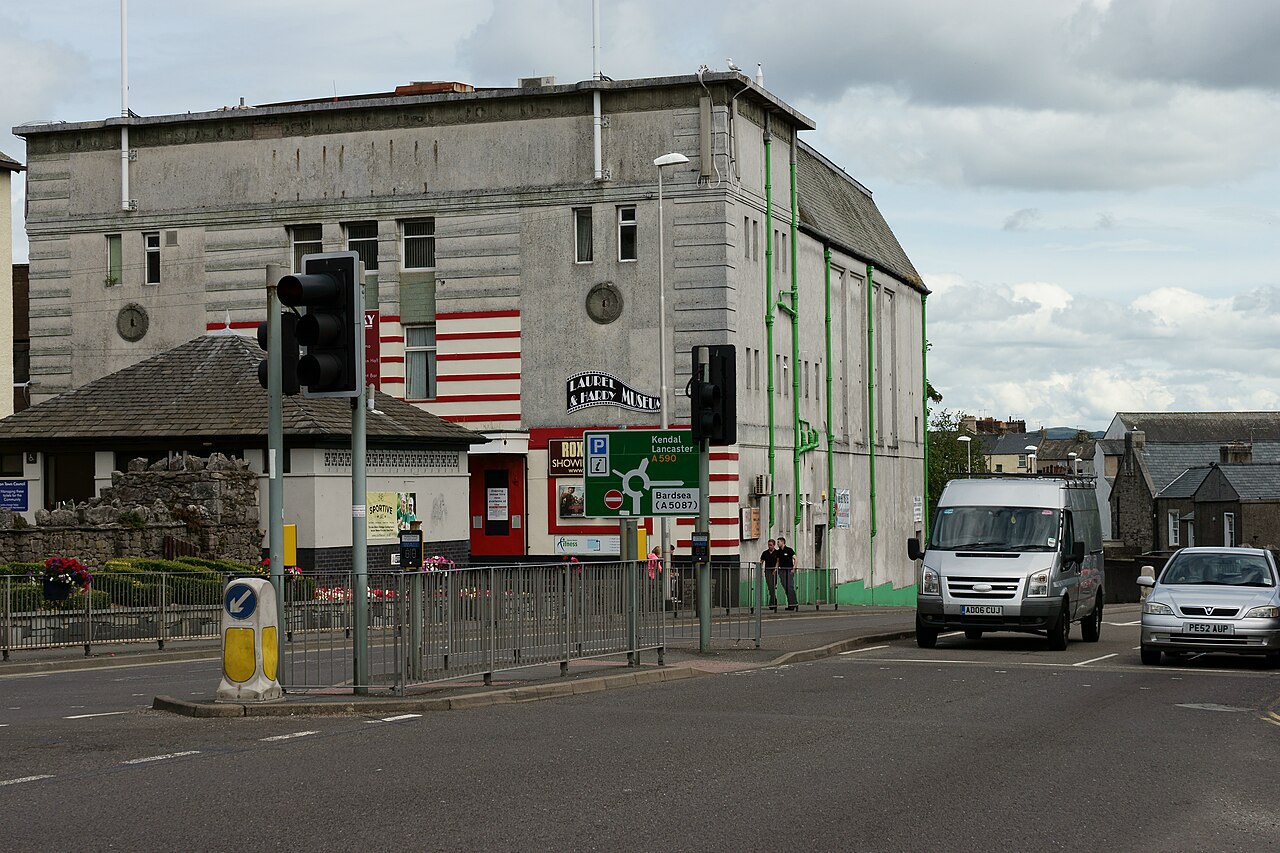
Photo: Peter Trimming · CC BY-SA 2.0 · cropped
The Fox verdict
A lively market town between fell views and the estuary
Ulverston combines a landmark hill walk with Laurel and Hardy history, a surviving charter market and an easy canal route.
Start with the panorama from Hoad Hill, then choose between the Laurel and Hardy Museum, market browsing and a flat walk towards Canal Foot. Traditional ale and estuary-side dining give the day an easy finish.
Where to go
Places in Ulverston
Every place below is checked against a published source, listed with what it is and how long to give it.
Local signatures
3 placesUlverston Market
A continuing weekly market in a traditional market town whose charter dates from 1280.
- Visit length
- Editorial estimate: Allow around 45 minutes
- Locality
- Ulverston town centre
- Access
- Outdoor stalls trade twice a week.
Stan Laurel Inn
A traditional pub with up to six hand-pulled ales, support for local breweries and a menu with vegetarian choices.
- Visit length
- Editorial estimate: Allow around 90 minutes
- Locality
- 31 The Ellers, Ulverston
- Access
- Food is served on selected days; dogs are welcome in the bar and games room.
Bay Horse Hotel
An inn serving fresh local produce, with formal and casual dining and conservatory views across the estuary to the fells.
- Visit length
- Editorial estimate: Allow around 90 minutes
- Locality
- Canal Foot on the estuary
- Access
- Dogs are welcome in the bar area but not the restaurant.
Walks & outdoors
2 placesSir John Barrow Monument on Hoad Hill
A short hill walk to the 100-foot lighthouse-shaped monument, with panoramic views across Morecambe Bay, the Furness Peninsula and the southern Lake District.
- Visit length
- Editorial estimate: Allow around 75 minutes
- Locality
- Hoad Hill above Ulverston
- Access
- Bad weather can prevent interior access; the staircase has 112 narrow steps.
Ulverston Canal
Follow the former canal's footpath towards Canal Foot. The waterway once connected Ulverston to the sea and is now home to swans, coots and otters.
- Visit length
- Editorial estimate: Allow around 2 hours
- Locality
- between Ulverston and Canal Foot
History & heritage
1 place
Laurel & Hardy Museum
A collection of Laurel and Hardy photographs and memorabilia in Ulverston's 1930s Roxy cinema, tracing the duo and Stan's local roots.
- Visit length
- Editorial estimate: Allow around 75 minutes
- Locality
- in Ulverston's Roxy cinema
- Access
- The museum closes in January.
No places match this filter. Choose All places to reset the list.
Three ways to explore Ulverston
Signature outings
Hoad Hill horizons
The 100-foot monument recalls Sir John Barrow's Admiralty career, while the hilltop gives broad views over Morecambe Bay.
Laurel and Hardy on film
Step into the Roxy's main auditorium for big-screen Laurel and Hardy films.
The old canal
Look for swans and coots along the canal, where a footpath shared by walkers, runners and cyclists follows a former maritime link.
The town story
Ulverston: lighthouse hill, market streets and a long memory
From the lighthouse-shaped monument on Hoad Hill, Ulverston leads into market streets, canal walks, old pubs and the town's Stan Laurel story.
The monument, market and old inns
Ulverston's lighthouse-shaped monument has never guided a ship. Built by public subscription in 1850–51, the Sir John Barrow Monument honours a local man who spent four decades at the Admiralty and promoted Arctic exploration. Trinity House's donation came with a condition that the monument carry no working light. Inside, 112 narrow spiral steps lead to the lantern chamber. A flag on Hoad Hill signals free interior access on Sunday and bank-holiday afternoons from Easter to October; bad weather can keep the doors shut. The hill walk gives views over Morecambe Bay and the Lakeland fells.
Ulverston itself is a market town of about 11,500 people on the Furness Peninsula, a few miles south of the National Park boundary, with the Leven estuary on one side and Coniston Old Man visible in the hills to the north. The market charter was granted by Edward I in 1280, and outdoor stalls still fill Market Street twice weekly; the indoor Market Hall sells cheese and fresh bread on five days of the week. The streets around it are cobbled.
Ulverston's brewing history still threads through its pubs: Robinsons acquired Hartley's Old Brewery in 1982. The Rose on King Street dates to the 1500s and retains oak beams and open fires. Its Sid's Room is named for a baker who worked next door for more than eighty years. A hatch once connected the buildings so he could pass loaves to the bar and receive pints in return; locals still play cards in the room.
The Farmers, on the market square, is run by the Chattaways, fifth-generation publicans who have had it for more than two decades. The sixteenth-century building was once called The Pack Horse. It serves breakfast and pub meals, including seafood. Dogs are welcome at its sheltered outdoor tables, but not inside.
A town that keeps pouring
Old Friends, uphill on Soutergate, is a former sea captain's house that started brewing its own beer in a back room in 2019; the beers are available nowhere else. There's a snug with an open fire, a heated beer garden, and a guitar and piano that anyone is allowed to play. The Sun Inn, an eighteenth-century coaching inn on Market Street, has twenty B&B rooms, smash burgers on the menu, and a nightclub in the basement. The Mill occupies a building with fabric dating to the twelfth century and retains its original waterwheel in the ground-floor bar, now part of a cask-ale gastropub.
The Stan Laurel Inn, on The Ellers, was called The Britannia until 1976, when it was renamed for the town's most famous son, who was born round the corner. Up to six handpulls include their own-badged Stan's Ale, there are two log-burning stoves in winter, the menu runs from teriyaki chicken to pork forestière to fisherman's pie, and dogs are welcome in the bar and games room.
The brewing tradition carries on outside the pubs. Ulverston Brewing Company makes Laurel and Hardy-themed beers, including Another Fine Mess and Lonesome Pine. Shed One Distillery began in 2016 in Andy and Zoe Arnold-Bennett's garden shed and moved to The Old Calf Shed in 2019. Its first gin, Cuckold's Revenge, takes its name from Andy's role as Master Ford in The Merry Wives of Windsor and has won a Great Taste Award. Visitors can book a distillery tour and tasting or a make-your-own-spirit experience.
For dinner with a view, drive out to Canal Foot, where the Bay Horse Hotel sits on the Leven estuary. It's a seventeenth-century coaching inn where travellers once rested before crossing the Morecambe Bay sands to Lancaster, and the Guardian named it among the top ten inns with waterside views. Chef-owner Robert Lyons spent seventeen years as head chef at Miller Howe on Windermere under John Tovey, and the cooking keeps the Tovey trademarks — tureens of soup with home-baked breads, terrines, Lakeland produce. He and Lesley have been at the heart of the place for nearly four decades. The conservatory dining room watches the tide come and go, and occasionally a steam special crosses the Leven viaduct while you eat. Dogs are welcome in the bar; children get homemade ice cream.
Tables, takeaways and makers
Ulverston has plenty of food stops along its market streets. Gillam's Tearoom on Market Street revives a family business that began there in 1892; Doug Gillam and Shirley opened the tearoom in 2006, and an adjoining specialist grocer stocks local produce. On Union Street, Poppies Cafe & Bistro changes its cafe menu regularly and hosts bistro evenings. Amigos on Cavendish Street serves Mexican food and takes reservations. L'al Churrasco offers Spanish, Portuguese and southern Mediterranean dishes served as small plates.
The fish and chips deserve their own sentence. Priory Place was named one of the top forty chip shops in the UK in the 2024 National Fish and Chip Awards, and Chippy Bank, trading since 1978, occupies a former Bank of Scotland branch at 7 King Street — hence the name.
Market Street handles the self-catering: Irvings the butcher, The Lake District Lobster & Seafood Co selling the catch of local inshore fishermen, Thomas Bakeries, and Sutton's Bookshop, with new and second-hand books across two floors of a two-hundred-year-old building. There's a Booths for everything else. And Cumbria Crystal is the last producer of completely hand-blown, hand-cut full lead crystal in the UK — it supplied most of the crystal on the formal tables in Downton Abbey, and you can watch the glassblowers at work.
Canal paths, family ground and Stan
The walking starts flat and gets steeper as you like. The canal towpath follows John Rennie's straight 1790s waterway from Canal Head to Canal Foot: a historic waterway. Along the route, the Grade II listed rolling railway bridge, England's only surviving nineteenth-century example of its kind, once rolled back on wheels to let boats through; a working model beside it shows the movement. Gill Banks is a circuit up a stream past a waterfall, thick with wild garlic and bluebells in spring; one field carries a public footpath sign warning of a bull. The Gill is also the official start of the Cumbria Way — towards Carlisle. South of Ulverston, Bardsea beach and Birkrigg Common offer a longer outing. And from Canal Foot, a guided walk crosses the estuary sands to Chapel Island, led by the officially appointed Guide over Sands. Don't attempt it unguided — the bay is notorious for quicksands and the channels shift.
Families are well served. Ford Park, under Hoad Hill, is nine acres of community-owned parkland with a thirty-metre zip wire, a nature trail, and a Saturday parkrun. Bardsea beach has a shingle shore, with Sea Wood next door — fifty-eight acres of ancient oak once owned by Lady Jane Grey, now one of the Woodland Trust's top ten bluebell woods.
Stan Laurel was born at 3 Argyle Street on 16 June 1890, and Ulverston still celebrates him. The Laurel & Hardy Museum occupies the 1930s Roxy cinema, with memorabilia to browse and films on the big screen. Outside Coronation Hall stands Graham Ibbeson's bronze of Laurel, Hardy and their screen dog Laughing Gravy; the pair appeared on the hall balcony during their 1947 visit.
Old stories and the market's return
The rest of the history is quickly told. Domesday records the town as Ulvrestun, six carucates held by one Turulf, filed under Yorkshire; the name comes from Úlfarr, wolf warrior. Scottish raiders under Robert the Bruce burned the town twice in the early 1300s, collapsing its assessed value from £35 to £5, and the market carried on anyway. George Fox preached at St Mary's in 1652, was knocked down and trampled by the congregation, then walked back out through the market — and the Quaker movement was organised from Swarthmoor Hall nearby, by Margaret Fell, who later married him. Conishead Priory, about 2.0 miles from Ulverston centre in a straight line to the south-east (with a longer road journey), has been a medieval priory, a Gothic mansion that bankrupted its builder, a spa hotel, a convalescent home for Durham miners, a wartime hospital, and — since 1976 — a Buddhist centre whose temple holds Europe's largest bronze Buddha, with the World Peace Cafe. And west of Ulverston, under the railway line at Lindal, a locomotive that sank into a mining subsidence hole in 1892 is still down there. The driver, Thomas Postlethwaite, scrambled clear. The engine was never recovered.
Getting here is straightforward. The Grade II listed railway station, rebuilt in the 1870s with a clock tower, has direct trains to Lancaster and through trains to Manchester Airport; the A590 connects to the M6 at Levens; the X6 bus links Ulverston with Kendal and Barrow. Come in September and you'll meet the Lantern Festival, started in 1983 after a local arts company saw a candle-lit procession in Japan — thousands of handmade lanterns carried through the streets. Late November brings the Dickensian Christmas Festival. And each spring the streets fill with flags, hung at dawn by volunteers led by Peter "Mr Festival" Winston and repaired every February by a sewing circle.
Stan never really left, on the evidence of his letters. Writing home to England in January 1950, from the far side of a Hollywood career: "I used to go shopping on Market Street with Grandma Metcalfe - that was a big treat for me. Beers Treacle toffee, it sure was good!" The small memory brings a Hollywood career back to Ulverston's ordinary streets.
Stay around Lake District
Make a longer stay of it
Travel Fox holiday homes around Lake District, linked directly to their property pages.
For homeowners
Own a holiday home near Ulverston?
We manage holiday lets across the Lake District from 12% commission, charged after cleaning costs, with no lock-in. A co-founder visits before you decide.
Holiday let management in the Lake District →
A guide with a point of view
Written from research. Edited for real journeys.
Use the Official site links for live practical details, then use this guide for context, ideas and room to explore.
Photography credits & licences
Third-party photographs are credited to their named creators and reused under the linked Creative Commons licence or public-domain dedication. Travel Fox stores an optimised local copy; the file-specific changes and any browser-applied display crop are disclosed below. Reused photographs link both to the Wikimedia Commons source record and to the declared source image; Travel Fox's own photographs carry no such record and are marked as ours. These image licences do not cover Travel Fox text, branding or page design.
- File:Laurel ^ Hardy Museum, Ulverston - geograph.org.uk - 4072610.jpg — photograph by Peter Trimming; Laurel & Hardy Museum, Ulverston by Peter Trimming. Source record on Wikimedia Commons. Declared source image. Licence: CC BY-SA 2.0. File changes: Downloaded from Wikimedia Commons, resized to a maximum 1920px edge and encoded as an optimised JPEG. Display changes: Displayed with responsive CSS cropping.
Sources
Every place on this page is checked against a published source. Each entry links the record we used and names who publishes it.
- Sir John Barrow Monument on Hoad Hill — ulverstoncouncil.org.uk other published source
- Ulverston Canal — ulverstoncouncil.org.uk operator, sector body or destination organisation
- Laurel & Hardy Museum — laurel-and-hardy.co.uk operator, sector body or destination organisation
- Ulverston Market — westmorlandandfurness.gov.uk statutory register or public authority
- Stan Laurel Inn — thestanlaurel.co.uk operator, sector body or destination organisation
- Bay Horse Hotel — thebayhorsehotel.co.uk operator, sector body or destination organisation