
Bay views and seaside landmarks
Morecambe
A long, flat promenade links Morecambe's bronze comedian, Art Deco hotel, railway jetty and wide views across the bay.
- Best for
- Promenade walks, public art and bay sunsets
- Give it
- A relaxed half day along the seafront
- Don't miss
- The Eric Morecambe statue and Stone Jetty
The Fox verdict
A seafront town with a strong sense of theatre
Morecambe's clearest pleasures line up along the promenade: a famous comic pose, expansive bay views, bold architecture and public art.
The promenade supplies the town's natural itinerary, running past the Eric Morecambe statue and Midland Hotel towards the Stone Jetty. Happy Mount Park adds a substantial family stop, while the Winter Gardens tells an ongoing story of restoration.
Where to go
Places in Morecambe
Every place below is checked against a published source, listed with what it is and how long to give it.
Local signatures
3 placesEric Morecambe Statue
Graham Ibbeson's bronze catches Eric Morecambe in his familiar one-legged pose, with binoculars around his neck and Bring Me Sunshine words in the surrounding paving.
- Visit length
- Editorial estimate: around 20 minutes
- Locality
- Central Promenade
The Midland Hotel
Oliver Hill's long, white Streamline Moderne hotel contains Eric Gill artworks, including entrance seahorses, a Neptune ceiling medallion and the Odysseus and Nausicaa stone relief.
- Visit length
- Editorial estimate: around 45 minutes
- Locality
- promenade
Happy Mount Park
A family park opened in the 1920s, with a splash park, natural adventure playground, miniature railway, crazy golf, trampolines, carousel and indoor soft play.
- Visit length
- Editorial estimate: around 150 minutes
- Locality
- on the promenade
- Access
- The park is free; the Splash Park is open through the summer.
Walks & outdoors
1 placeMorecambe Promenade
A long, flat route with views across Morecambe Bay to the Lake District fells, TERN Project public art and sunsets behind the Lakeland hills.
- Visit length
- Editorial estimate: around 60 minutes
- Locality
- seafront
- Access
- The promenade is long, flat, buggy-friendly and bike-friendly.
History & heritage
2 placesStone Jetty
The 1853 railway wharf now offers a lighthouse tower, giant compass, mythical-bird sculptures and the Flock of Words poem set into the stone.
- Visit length
- Editorial estimate: around 60 minutes
- Locality
- Stone Jetty
Morecambe Winter Gardens
Opened in 1897 as the Victoria Pavilion Theatre, this building has an active restoration campaign and a mixed programme of entertainment from the ground floor and stalls.
- Visit length
- Editorial estimate: around 60 minutes
- Locality
- Morecambe
- Access
- The theatre has reopened for entertainment from the ground floor and stalls; the circle and upper levels are open for tours and remain under restoration.
No places match this filter. Choose All places to reset the list.
Three ways to explore Morecambe
Signature outings
The promenade panorama
Walk the long, flat seafront while the bay opens towards the Lake District fells and TERN Project artworks punctuate the route.
Railway history and public art
Walk onto the 1853 Stone Jetty for its octagonal lighthouse, giant compass, mythical birds and Flock of Words poem.
The Winter Gardens restoration
The 1897 theatre welcomes entertainment from the stalls while tours reveal upper levels that remain under restoration.
The town story
Morecambe Town Guide
A source-locked journey along the promenade and through Morecambe's food, architecture, vanished attractions and latest reinvention.
A comedian, a promenade and the bay
On the Central Promenade there is a bronze of Eric Morecambe caught mid-skip, one leg kicked out behind him, binoculars slung round his neck. The binoculars are there because he liked birdwatching, and because the bay behind him is full of birds. Graham Ibbeson made the statue; Queen Elizabeth II unveiled it in 1999. The paving around it is engraved with the words to Bring Me Sunshine and the names of the writers and stars who worked on The Morecambe & Wise Show. The comedian was born here in 1926 as Eric Bartholomew and borrowed the town's name for the stage. He is not the only one the town produced. Dame Thora Hird and Tyson Fury were both born in Morecambe too, which is a fairly wide range.
The statue faces the water, and once you have found it you have essentially found the town. Morecambe is arranged along its seafront. The promenade runs flat and long, buggy-friendly and bike-friendly, past the statue and the Midland Hotel and out towards the Stone Jetty, and the whole time you are looking across Morecambe Bay to the Lake District fells. On a clear day you can pick out Coniston Old Man, Helvellyn and Scafell Pike, with the Bowland Fells to the south-east and the Pennines further back. There is an artwork on the prom by Russell Coleman called Mountainscape that names the peaks for you. The town is known for its sunsets, the sun dropping behind the Lakeland hills, and locals will tell you the best time to be on the prom is the last hour of light.
The bay itself is Britain's largest continuous stretch of intertidal sand and mud. At low tide it becomes an enormous silver flat under a very large sky. It is also dangerous — shifting sands, fast tides, quicksand — which is why the famous guided walk across it, from Arnside to Kents Bank, is led by the King's Guide to the Sands and should never be attempted alone.
Seafront tables and Art Deco
For a pub with a view, the Palatine is the one people mention first — an Edwardian seafront alehouse, CAMRA-listed, small and cosy, with a reputation for its outlook across the bay at sunset. The brewery tried and failed to sell it, and it reopened in December 2024. Along the front the Eric Bartholomew is the Wetherspoon, named after Morecambe's real surname, decorated with pictures of the nineteenth-century town and Morecambe & Wise artwork, and listed in the CAMRA Good Beer Guide 2025 for its ales. The Royal Bar & Shaker is the refurbished, busy option with live entertainment and bay views, and the Aspect Bar & Bistro inside the Lothersdale Hotel pairs a dedicated gin bar with an AA-rosette kitchen doing stone-baked pizzas, sharing platters and afternoon teas. If you are prepared to head a little north to Hest Bank, the pub there does burgers — guests single out the dirty burger — alongside fish and chips, gammon, chicken pie and Lancashire hot pot.
The thing to eat, though, is the shrimp. Morecambe Bay potted shrimps are the town's signature food and have been a local occupation since the eighteenth century. The shrimp are tiny, about six centimetres, pinky-brown, mild and sweet. They are boiled — traditionally in sea water — then shelled by hand, which is the labour-intensive part, and set in spiced clarified butter to be served cold with thin toast. The method reputedly dates to Tudor times and became fashionable on London tea tables in the early 1930s; the Slow Food movement has it on its Ark of Taste. Baxters and Morecambe Bay Shrimps are among the named producers. The bay also gives up cockles and mussels, gathered from the same sands and sold as street food.
The landmark building is the Midland Hotel, and it is hard to miss: a long, white, curving sweep of Streamline Moderne right on the promenade. Oliver Hill designed it for the London, Midland & Scottish Railway and it opened in 1933, replacing two earlier hotels on the site. What makes it worth going inside is the art. Eric Gill carved two seahorses over the main entrance, modelled on the local shrimps, and inside there is a circular ceiling medallion ten feet across at the top of the spiral staircase — a Neptune design in blue and yellow and red-brown, inscribed with a line lifted from a Wordsworth sonnet, "and hear old Triton blow his wreathed horn." Behind the reception desk is Gill's stone relief of Odysseus being welcomed from the sea by Nausicaa, generally reckoned his best piece here, and there is a decorative wall map of the north-west coast from Whitehaven to Birkenhead. The hotel was requisitioned as an RAF hospital in the war, fell into decline afterwards, and was rescued by the developer Urban Splash, reopening in the summer of 2008 after a restoration of around seven million pounds. It has since stood in for locations in Poirot and appeared in the 1960 film The Entertainer.
Jetty, theatre and family park
Keep walking and the promenade takes you onto the Stone Jetty, built by the North Western Railway in 1853 as a wharf and coal terminal. Trade collapsed once Heysham port opened in 1904, and between the wars the harbour was used for ship-breaking. It was resurfaced in the 1990s and now carries an octagonal lighthouse tower, a giant compass, a scattering of mythical-bird sculptures and the "Flock of Words," a poem set into the stone that you read as you walk. This is part of the wider TERN Project, an award-winning public-art scheme begun in 1994 that wove steel cormorants, gannets and razorbills into the rebuilt sea defences and put bird sculptures on the bollards and roundabouts — a nod to the oystercatchers, cockles and mussels of the bay.
The one grand building still being put back together is the Winter Gardens, which opened in 1897 as the Victoria Pavilion Theatre with Frank Matcham as consulting architect. It closed to the public in 1977 and has spent decades on the "at risk" register. A group called the Friends of the Winter Gardens has been at it since 1986; the theatre has reopened for shows from the stalls, with the upper levels open for tours and still under restoration, and in 2023 it won £2.74 million from the Cultural Development Fund to carry on. It also hosts ghost hunts.
Families tend to end up at Happy Mount Park, a free park on the promenade that opened in the 1920s. It has a splash park open through the summer, a natural adventure playground with a thirty-four-metre zip line and a five-metre swing, a miniature railway, crazy golf, trampolines, a carousel and indoor soft play. This is also, as it happens, the site of one of Morecambe's stranger episodes. In 1994 Lancaster City Council teamed up with the television presenter Noel Edmonds to open a Mr Blobby theme park here called Noel Edmonds' World of Crinkley Bottom. It drew 75,000 visitors in six weeks, was fiercely opposed by locals, and closed after thirteen. The courts found the council had acted unlawfully and awarded Edmonds £950,000; the whole thing cost taxpayers around £2.6 million and became known as Blobbygate. The park is now a family park again.
Loss, tragedy and reinvention
Blobbygate was not the only thing to come and go. Morecambe grew from the fishing village of Poulton-le-Sands after the railway arrived in 1846, and boomed as a seaside resort drawing so many West Yorkshire mill workers that it was nicknamed "Bradford-on-Sea," and, more ambitiously, the "Naples of the North." It had the country's largest Pontins camp. On Marine Road West there was an amusement park from 1906 that the Thompson family, owners of Blackpool Pleasure Beach, turned into the Wild West-themed Frontierland in 1987. Frontierland closed in 2000; its Polo Tower stood as the last relic until it was removed around 2017. The West End Pier was wrecked by a storm in 1977, the Central Pier was taken down in 1992, and Pontins closed in 1993.
The bay's danger is not only historical. On the night of 5 February 2004, twenty-three Chinese cockle-pickers drowned on the sands after being cut off by the incoming tide. They had been smuggled into the country and made to work by gangmasters. One man's final call to the emergency services managed only the words "sinking water" before it cut off. The gangmaster responsible was convicted of manslaughter, and the disaster led directly to the Gangmasters (Licensing) Act 2004.
Now the town is in the middle of another reinvention, and this one is large. Eden Project Morecambe is a £100 million eco-attraction being built on the seafront by the team behind the Cornwall domes, with £50 million from the government. The design was scaled back — two shell-like structures rather than four, named the Realm of the Sun and the Realm of the Moon — with construction due to begin on site in 2026 and full opening pencilled in for 2028. A public community garden called Bring Me Sunshine, its name borrowed from Eric Morecambe's song, debuts at the Chelsea Flower Show in 2026 before moving to the seafront. It is projected to draw over half a million visitors a year. "The project is now definitively shovel-ready," said David Harland of Eden Project International.
Arriving and the sunset ritual
Getting here is straightforward. Morecambe railway station runs Northern services to Lancaster, Preston, Leeds and Heysham, and Lancaster — a few minutes down the line, or a twenty-minute drive with Lancaster Castle and the Ashton Memorial worth the trip — connects to the West Coast Main Line. The M6 is a short drive inland at junctions 34 and 35, and Stagecoach runs the local buses. Just south is Heysham village, with its ruined chapel and rock-cut graves on the headland; a short drive north is the Arnside & Silverdale AONB, all limestone hills and quiet coves.
For all the piers and parks it has lost, the town keeps the same rhythm it always had. On any clear evening people drift out to the prom, past the bronze comedian, to watch the sun go down behind the fells and the tide come back across the sand.
Stay around Lancashire
Make a longer stay of it
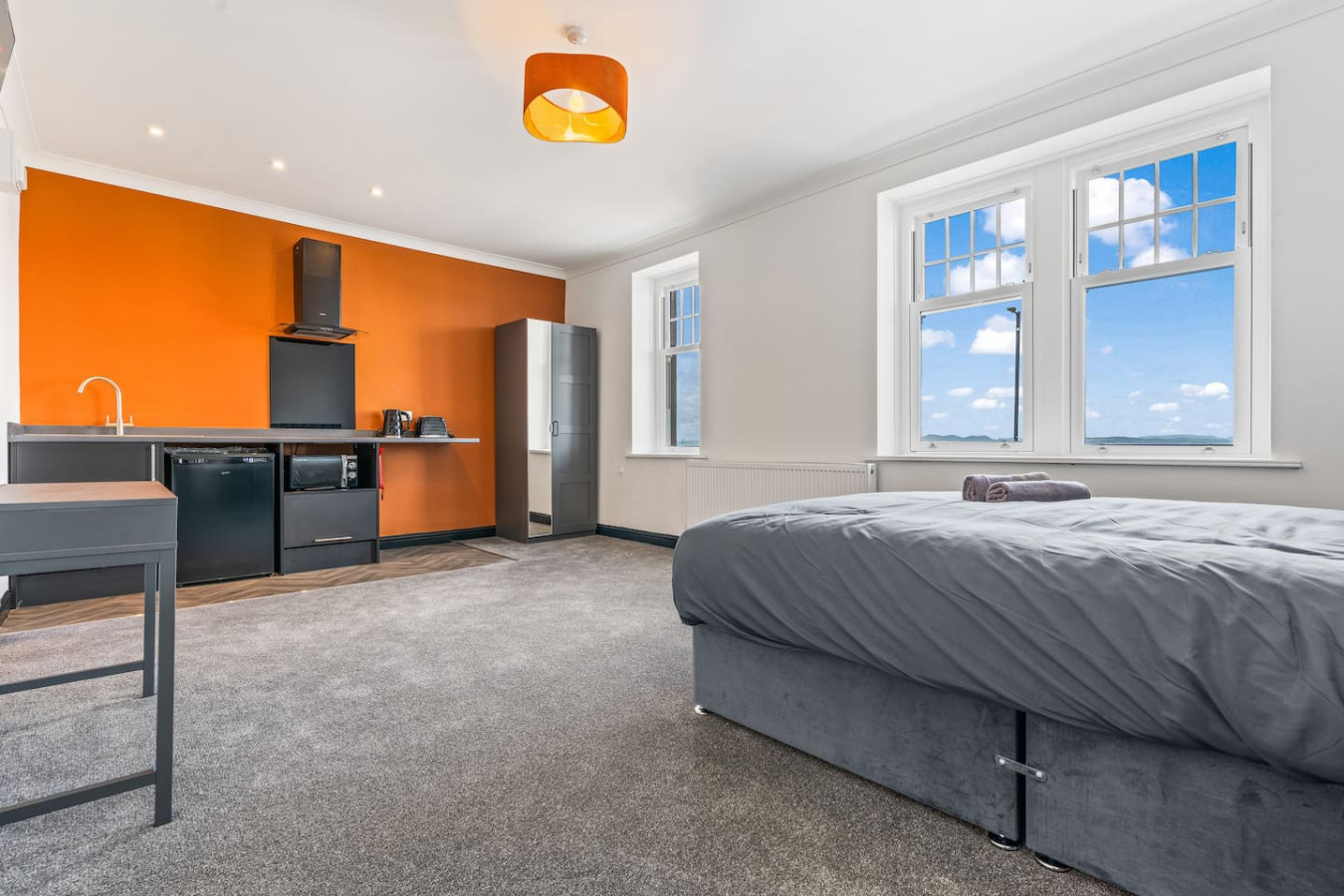
Travel Fox holiday homes around Lancashire, linked directly to their property pages.
A guide with a point of view
Written from research. Edited for real journeys.
Use the Official site links for live practical details, then use this guide for context, ideas and room to explore.
Sources
Every place on this page is checked against a published source. Each entry links the record we used and names who publishes it.
- Eric Morecambe Statue — lancaster.gov.uk statutory register or public authority
- Morecambe Promenade — lancaster.gov.uk statutory register or public authority
- The Midland Hotel — historicengland.org.uk statutory register or public authority record not machine-readable; publisher restricts automated access
- Stone Jetty — historicengland.org.uk statutory register or public authority record not machine-readable; publisher restricts automated access
- Morecambe Winter Gardens — morecambewintergardens.com operator, sector body or destination organisation
- Happy Mount Park — lancaster.gov.uk statutory register or public authority