
Arun Valley wetlands
Coldwaltham
A small three-community parish where floodplain birds, old churches and the village pub sit close to the South Downs.
- Best for
- Floodplain walking and church history
- Give it
- A half day, or longer with a nearby reserve
- Don't miss
- The flood-bank path at Waltham Brooks
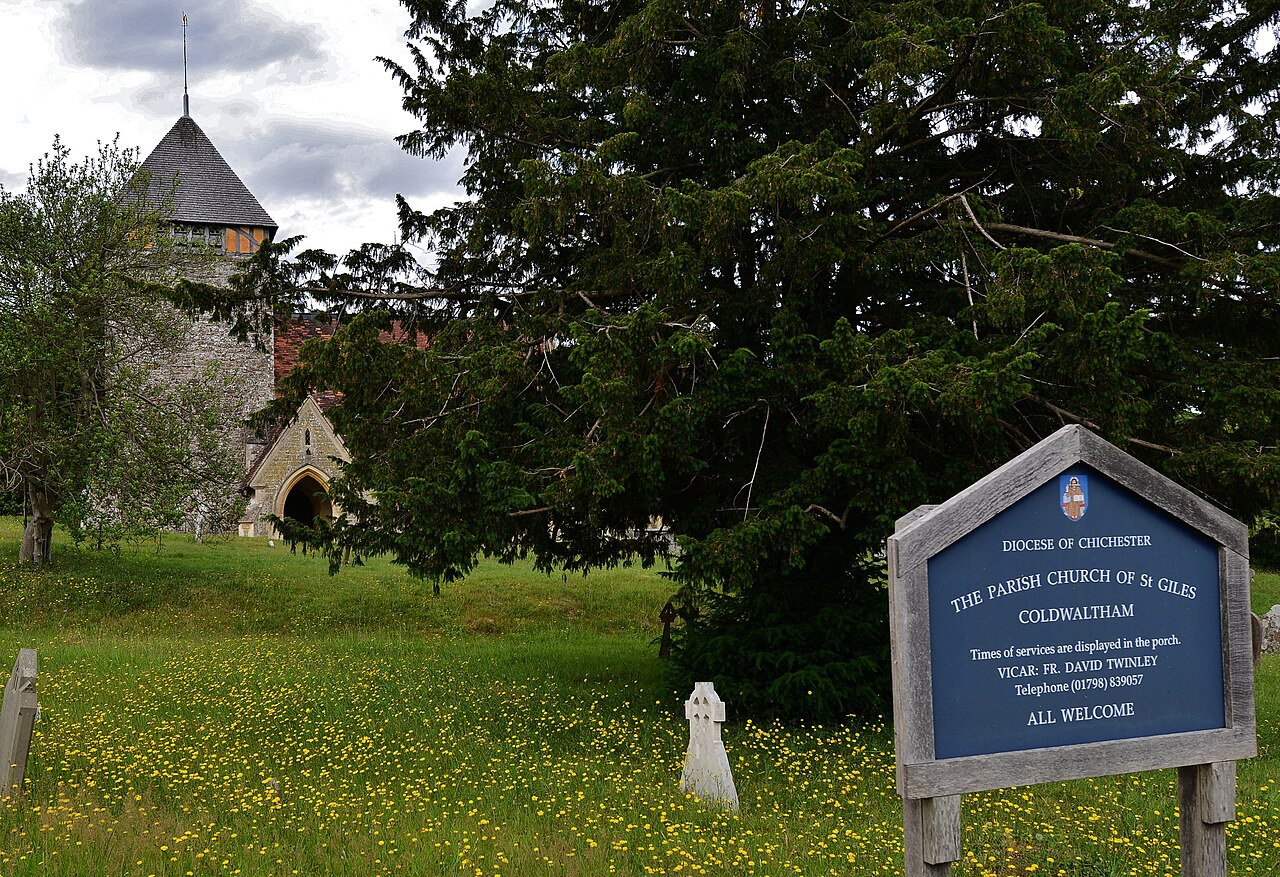
Photo: Michael Garlick · CC BY-SA 2.0 · cropped
The Fox verdict
A quiet Arun Valley base with real depth
Come for Waltham Brooks, then use the churches, pub and nearby reserves to shape an unhurried day.
Coldwaltham brings together tidal floodplain, the historic fabric of St Giles' Church and a country inn that serves as the village meeting point. The parish's position between Pulborough and the South Downs makes it a practical base for pairing local stops with a reserve, museum or historic park nearby.
Where to go
Places in Coldwaltham
Every place below is checked against a published source, listed with what it is and how long to give it.
Local signatures
3 placesThe Labouring Man
The village's sole pub is a relaxed country inn with home-cooked food, real ales, an open fire and a patio garden.
- Visit length
- Editorial estimate: Allow around 75 minutes
- Locality
- Coldwaltham, just off the A29
Waltham Brooks Nature Reserve
A 42-hectare floodplain reserve with broad views, resident and visiting birds, and a path following the River Arun flood bank.
- Visit length
- Editorial estimate: Allow around 2 hours
- Locality
- Brook Lane, Coldwaltham
- Access
- Stay on the path; expect stiles, tidal water and possible flooding. Park considerately on the Brook Lane verge further west towards the railway bridge, without blocking gateways.
RSPB Pulborough Brooks
An RSPB nature reserve with views across to the South Downs, close enough to pair with Coldwaltham's own wetlands.
- Visit length
- Editorial estimate: Allow around 2 hours
- Locality
- Pulborough
Food & drink
1 placeSandham Memorial Village Hall
The village hall hosts a community coffee shop and post-office service, making it a useful local stop for refreshments and postal services.
- Visit length
- Editorial estimate: Allow around 45 minutes
- Locality
- Coldwaltham
- Access
- Weekly coffee shop and post-office service at Sandham Memorial Village Hall.
History & heritage
4 places
St Giles' Church
A Grade II* church whose old tower, unusual half-timbered belfry stage, medieval font bowl and Victorian fittings reward a close look.
- Visit length
- Editorial estimate: Allow around 40 minutes
- Locality
- Coldwaltham
St Botolph's Church, Hardham
The small neighbouring parish church is noted locally for its medieval wall paintings and pairs naturally with St Giles'.
- Visit length
- Editorial estimate: Allow around 35 minutes
- Locality
- Hardham
Amberley Museum
A nearby West Sussex visitor attraction focused on industrial heritage.
- Visit length
- Editorial estimate: Allow around 2 hours 30 minutes
- Locality
- Amberley
Petworth House and Park
A 17th-century house with a major art collection set in a 700-acre deer park.
- Visit length
- Editorial estimate: Allow around 3 hours
- Locality
- Petworth
No places match this filter. Choose All places to reset the list.
Three ways to explore Coldwaltham
Signature outings
Read the tower in layers
At St Giles', compare the old tower with Henry Woodyer's short half-timbered belfry stage and Victorian interior work.
Make the museum an anchor
Use Amberley Museum's industrial-heritage focus as the substantial nearby stop in a church-and-history day.
Move from house to deer park
At Petworth, combine the 17th-century house and major art collection with time in its 700-acre deer park.
The village story
Coldwaltham Village Guide
A source-locked journey from the village pub and weekly provisions to the Arun floodplain, layered churches and nearby day-out choices.
Pub and weekly provisions
The Labouring Man stands twenty yards off the A29, the village's only pub and the place the parish treats as its meeting point. It has five en-suite rooms, an open fire and a patio garden for the summer. The food is home-cooked and the range is wider than the setting suggests: Welsh rarebit with homemade ale chutney, Parmesan and white-truffle arancini, a mushroom risotto with white truffle and Parmesan, grilled haddock with mash, tenderstem broccoli and a bacon-and-parsley sauce. There is also home-baked ham, egg and chips, beer-battered fish and chips, and sticky toffee pudding with rum-and-raisin ice cream to finish. Real ales are on.
For groceries you will need to plan. There is no permanent shop, but Sandham Memorial Village Hall runs a weekly coffee morning, with local produce for sale, and a post-office service.
A parish shaped by floodwater
The village sits about two and a half miles south of Pulborough in the Arun Valley, just north of the chalk of the South Downs. Coldwaltham is really three settlements — itself, Hardham and Watersfield — strung along roughly three miles of the A29 and adding up to about 420 households. The whole parish has been inside the South Downs National Park since 2012, and more than three-quarters of its eleven-mile boundary follows the rivers Arun and Rother.
Those rivers are the reason to come. East of the village lies Waltham Brooks, a 42-hectare reserve of floodplain that fills with resident and visiting birds. From Brook Lane a path runs around the reserve and along the Arun flood bank, mostly over stiles, with a spur that crosses the railway to Watersfield. You are asked to keep to the path, for the sake of nesting and wintering birds. Take the water seriously: this is tidal ground with deep, fast channels, unstable banks and winter flooding. Park considerately on the Brook Lane verge further west towards the railway bridge, without blocking gateways.
Two churches, layered centuries
St Giles' Church keeps its oldest fabric in the tower, built in the twelfth century and altered in the early thirteenth. Henry Woodyer rebuilt much of the rest in 1870 and 1871, and the short half-timbered belfry stage he added is unusual for the south-east of England. Inside there is a circular font bowl, probably twelfth-century, sitting on a Victorian base, along with Woodyer's carved reredos, pulpit and font cover and glass from the Hardman and Kempe workshops. The church historian John Allen judged that Woodyer's "restorations could be heavy-handed, but he had a compensating gift for the picturesque." At Hardham, the small church of St Botolph is known for its medieval wall paintings.
Road, posting station and canal
The Roman road Stane Street parts company with the A29 here, and a Roman posting station once stood at Hardham. Later the Arun Navigation drove a canal tunnel through, built in brick by James Edwards between 1787 and 1790. Its opening was marked with cannon fire, a public meal and a prize for the fastest barge through, carrying thirty tons of chalk; a section collapsed the same December. The 357-metre tunnel ceased use in 1889, the last barge passing with 26 tons of flint. At Watersfield the Old Crown House, seventeenth-century or older, was once an inn and is now two houses.
Reserves, museums and the journey home
Further afield the A29 takes you south to Arundel and its castle, while nearby an RSPB reserve, industrial museum and deer park offer alternative day-out choices. Pulborough, the practical railhead, is two and a half miles up the road; buses 69 and 71 pass through with limited service. End back in the village, where a pub fire suits a place this size.
Stay around South Downs
Make a longer stay of it
Travel Fox holiday homes around South Downs, linked directly to their property pages.
For homeowners
Own a holiday home near Coldwaltham?
We manage holiday lets across the UK from 12% commission, charged after cleaning costs, with no lock-in. A co-founder visits before you decide.
How our holiday let management works →
A guide with a point of view
Written from research. Edited for real journeys.
Use the Official site links for live practical details, then use this guide for context, ideas and room to explore.
Photography credits & licences
Third-party photographs are credited to their named creators and reused under the linked Creative Commons licence or public-domain dedication. Travel Fox stores an optimised local copy; the file-specific changes and any browser-applied display crop are disclosed below. Reused photographs link both to the Wikimedia Commons source record and to the declared source image; Travel Fox's own photographs carry no such record and are marked as ours. These image licences do not cover Travel Fox text, branding or page design.
- File:Coldwaltham, St. Giles' church from the south - geograph.org.uk - 4553806.jpg — photograph by Michael Garlick; Coldwaltham: St. Giles' church from the south by Michael Garlick. Source record on Wikimedia Commons. Declared source image. Licence: CC BY-SA 2.0. File changes: Downloaded from Wikimedia Commons, resized to a maximum 1920px edge and encoded as an optimised JPEG. Display changes: Displayed with responsive CSS cropping.
Sources
Every place on this page is checked against a published source. Each entry links the record we used and names who publishes it.
- The Labouring Man — labouringman.com operator, sector body or destination organisation
- Sandham Memorial Village Hall — coldwalthampc.org.uk other published source
- St Giles' Church — arunchurches.com other published source
- Waltham Brooks Nature Reserve — sussexwildlifetrust.org.uk national body or asset manager
- St Botolph's Church, Hardham — historicengland.org.uk statutory register or public authority record not machine-readable; publisher restricts automated access
- RSPB Pulborough Brooks — rspb.org.uk national body or asset manager
- Amberley Museum — amberleymuseum.co.uk operator, sector body or destination organisation
- Petworth House and Park — nationaltrust.org.uk national body or asset manager