
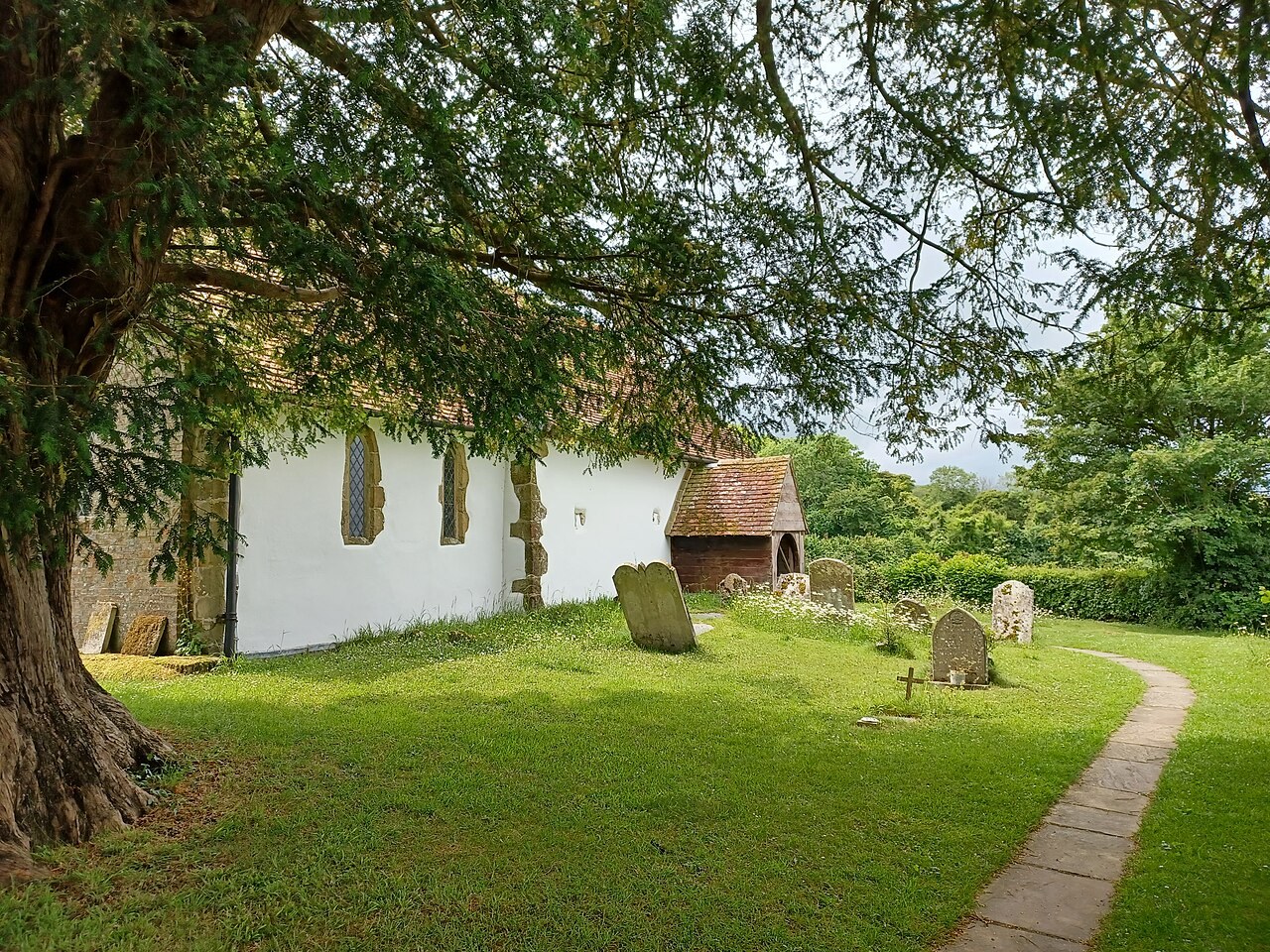
A tiny hamlet under the South Downs
Didling
Come for an isolated medieval church, open chalk country and nearby inns reached along minor downland lanes.
- Best for
- Church history and downland
- Give it
- A quiet half-day
- Getting here
- Minor downland lanes
Photo: Simon Burchell · CC BY-SA 4.0 · cropped
The Fox verdict
A church-first hamlet with the downs at its door
Didling is exceptionally small, but St Andrew’s and the surrounding chalk landscape give a short visit a strong sense of place.
The appeal is quiet and specific: a church without electricity, sheep pasture and old routes over the hills. Food, shops and indoor recreation sit outside the hamlet, so a useful day pairs Didling with Hooksway, Elsted, Midhurst or Uppark.
Where to go
Places in Didling
Every place below is checked against a published source, listed with what it is and how long to give it.
Local signatures
3 places
Start here
Church of St Andrew
An isolated Grade I church known as the Shepherds’ Church, with an undivided medieval nave and chancel, old benches and communion rails, and no electricity.
- Visit length
- Editorial estimate: 45 minutes
- Locality
- Didling
- Access
- The church stands on the north slope of Didling Hill and is reached along Bugshill Lane.
Royal Oak
An independent free house in a 16th-century cottage, with log fires, a large garden, real ales and a dog-friendly welcome.
- Visit length
- Editorial estimate: 1 hour 15 minutes
- Locality
- Hooksway
- Access
- The pub is a sixteenth-century cottage beside a lane signed from the B2141.
The Elsted Inn
A warm, traditional South Downs country pub in a Victorian building at Elsted, under new management.
- Visit length
- Editorial estimate: 1 hour 15 minutes
- Locality
- Elsted
- Access
- The Elsted Inn occupies a Victorian building in Elsted.
Food & drink
1 placeMichael Courtney Butchers
An independent butcher with more than 50 years of professional experience, supporting local farmers and selling meat boxes and pet food alongside its core range.
- Visit length
- Editorial estimate: 20 minutes
- Locality
- Midhurst
- Access
- The butcher is on North Street in Midhurst and sells meat boxes and pet food.
History & heritage
1 placeThe Devil’s Jumps
A scheduled Bronze Age round-barrow cemetery where five bell barrows form a line alongside two bowl barrows.
- Visit length
- Editorial estimate: 1 hour 15 minutes
- Locality
- Treyford Hill
- Access
- The Devil’s Jumps are a scheduled Bronze Age round-barrow cemetery on Treyford Hill.
Things to do
3 placesUppark House and Garden
A 17th-century house and garden with South Downs and Solent views, a meadow walk, picnic space and family activities.
- Visit length
- Editorial estimate: 2 hours 30 minutes
- Locality
- Uppark
- Access
- The grounds have South Downs and Solent views, a meadow walk and picnic space.
The Grange Centre
An indoor recreation option offering squash and badminton courts, exercise classes and a gym.
- Visit length
- Editorial estimate: 1 hour
- Locality
- Midhurst
- Access
- The Grange Centre offers squash and badminton courts, exercise classes and a gym.
Midhurst Rother College Climbing Wall
A public indoor climbing wall at Midhurst Rother College and a useful wet-weather recreation option.
- Visit length
- Editorial estimate: 1 hour 30 minutes
- Locality
- Midhurst
- Access
- Midhurst Rother College has a public indoor climbing wall.
No places match this filter. Choose All places to reset the list.
Three ways to explore Didling
Signature outings
Meet the Shepherds’ Church
See St Andrew’s undivided medieval interior, old benches and rough font in a church still lit through its lancets and by candles.
Trace the Devil’s Jumps
Follow the line of five bell barrows on Treyford Hill and look for the two bowl barrows that accompany them.
Roam Uppark’s grounds
Pair Uppark’s 17th-century house with its meadow walk, picnic space and long South Downs and Solent views.
The village story
Didling: a church, a track and the open downs
The original Travel Fox account moves from St Andrew’s survival and the hamlet’s red tiles to nearby pubs, practical Midhurst stops and Bronze Age high ground.
The church that did not fall
St Andrew's stands on its own on the north slope of Didling Hill, a short way from the handful of houses it serves, and it has no electricity. Inside there is a rough tub-shaped font, benches from the fifteenth century, and a pulpit and communion rails from the seventeenth, under rendered flint walls with lancet windows. The nave runs straight into the chancel with no arch or screen between them, a plan almost unchanged since Alan de St George is thought to have founded the church around 1220. It is still called the Shepherds' Church, close by the old drovers' track that crossed the downs.
It has not always been kept this carefully. A bishop who came in 1687 found it "soe ruinous that it is like to fall." It did not fall.
Red tiles and a pub lane
Didling itself is a very small group of houses north of the church, red-tiled farm buildings set among sheep pasture and chalk. Christopher Somerville, who walked through, called it "mellow, red-tiled Didling." North of here the land opens into wide pastoral lowland; to the south, woods and cornfields fall away toward a hazy line of sea.
Didling has no pub of its own. At Hooksway, the Royal Oak is a sixteenth-century cottage beside a lane signed off the B2141, with log fires, a large garden, real ales and a dog-friendly welcome. David Jeffrey and Sarah Warner have run it since 1990. Local lore says a sheep rustler named William “Shagger” Shepherd was shot here around 1680 after taking refuge, and his ghost is said to remain.
Elsted cooking and Midhurst errands
The Elsted Inn is a warm, traditional South Downs country pub in a Victorian building at Elsted, under new management.
For meat, Midhurst is roughly three miles away in a straight line. Michael Courtney Butchers on North Street has more than fifty years of professional experience and sells meat boxes and pet food. Cowdray Farm Shop is an estate farm shop, butcher and deli in Midhurst. Midhurst also has a medieval Market Square, historic Tudor buildings and independent shops, plus squash and badminton at the Grange Centre and a public climbing wall at the college. Minor downland lanes lead into town; Petersfield is the nearest station, about six miles away as the crow flies. Book-a-Bus runs only within designated zones, with journeys booked ahead and designated pick-up points; a separate scheduled bus calls at Lower Elsted.
Barrows on the walking circuit
Most people come to Didling to walk. Somerville’s six-mile circuit climbs a flinty track through yew and beech on Philliswood Down, follows the South Downs Way past the Devil’s Jumps, descends Didling Hill to the church, crosses farmland to Treyford and returns via Mount Sinai and rolling barley fields. The barrow cemetery on Treyford Hill has five bell barrows in a north-east/south-west line with two bowl barrows alongside. Four mounds were dug into in the late nineteenth century and held cremations beneath layers of earth and flint. A separate 4.1-mile Elsted–Didling–Treyford outing recorded on 17 June 2026 noted nettles and indistinct path marking; it is a dated group account, not a waymarked visitor route.
Back to candlelight
Didling was its own civil parish until 1933; the church had shared a benefice with Treyford since 1535. Walkers coming down off Didling Hill finish at the candlelit church.
Stay around South Downs
Make a longer stay of it
Travel Fox holiday homes around South Downs, linked directly to their property pages.
For homeowners
Own a holiday home near Didling?
We manage holiday lets across the UK from 12% commission, charged after cleaning costs, with no lock-in. A co-founder visits before you decide.
How our holiday let management works →
A guide with a point of view
Written from research. Edited for real journeys.
Use the Official site links for live practical details, then use this guide for context, ideas and room to explore.
Photography credits & licences
Third-party photographs are credited to their named creators and reused under the linked Creative Commons licence or public-domain dedication. Travel Fox stores an optimised local copy; the file-specific changes and any browser-applied display crop are disclosed below. Reused photographs link both to the Wikimedia Commons source record and to the declared source image; Travel Fox's own photographs carry no such record and are marked as ours. These image licences do not cover Travel Fox text, branding or page design.
- File:St. Andrew's Church, Didling 02.jpg — photograph by Simon Burchell; Own work. Source record on Wikimedia Commons. Declared source image. Licence: CC BY-SA 4.0. File changes: Downloaded from Wikimedia Commons, resized to a maximum 1920px edge and encoded as an optimised JPEG. Display changes: Displayed with responsive CSS cropping.
Sources
Every place on this page is checked against a published source. Each entry links the record we used and names who publishes it.
- Church of St Andrew — historicengland.org.uk statutory register or public authority record not machine-readable; publisher restricts automated access
- Royal Oak — royaloakhooksway.co.uk operator, sector body or destination organisation
- The Elsted Inn — elstedinn.com operator, sector body or destination organisation
- The Devil’s Jumps — historicengland.org.uk statutory register or public authority record not machine-readable; publisher restricts automated access
- Uppark House and Garden — nationaltrust.org.uk national body or asset manager
- Michael Courtney Butchers — michaelcourtneybutchers.co.uk operator, sector body or destination organisation
- The Grange Centre — visitmidhurst.com operator, sector body or destination organisation
- Midhurst Rother College Climbing Wall — visitmidhurst.com operator, sector body or destination organisation