
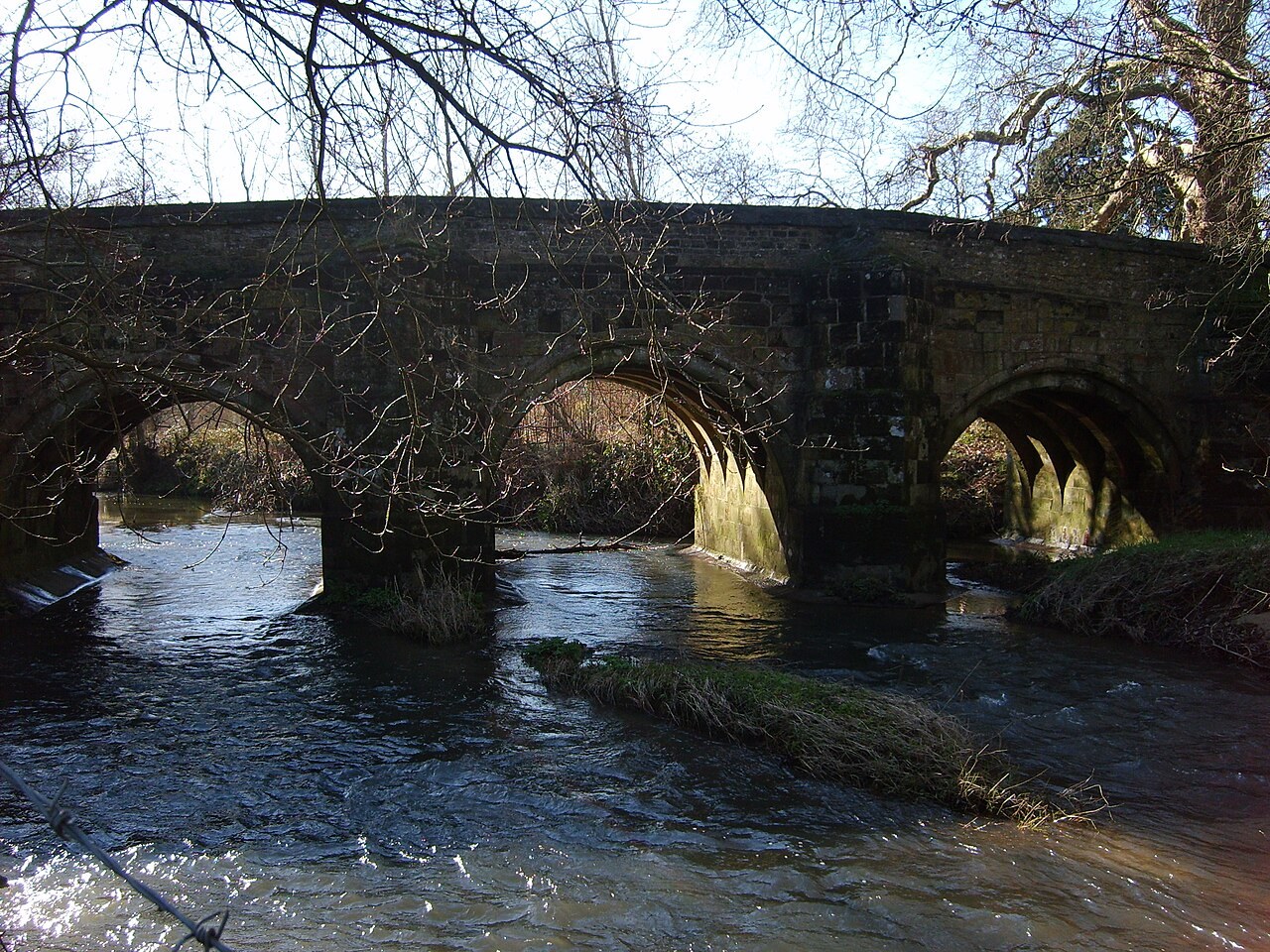
Rother Valley detail
Trotton
Five stone arches, rare medieval wall paintings and sandy heath make this small village worth a deliberate pause.
- Best for
- Medieval art and Rother Valley walking
- Give it
- Two hours for the four-mile valley circuit
- Don't miss
- The Last Judgement inside St George's
Photo: Simon Burchell · CC BY-SA 3.0 · cropped
The Fox verdict
A tiny village with uncommon depth
Trotton rewards a focused visit with a great stone bridge, an unusually rich medieval church and quick access to lowland heath.
The bridge and St George's form the essential pair: one is a five-arch landmark across the Rother, the other holds wall paintings, monumental brasses and the Camoys tomb. Add the nearby commons for a longer outing, then use the A272 or neighbouring Elsted for food because Trotton itself has neither a shop nor an operating pub.
Where to go
Places in Trotton
Every place below is checked against a published source, listed with what it is and how long to give it.
Local signatures
3 placesAylings Garden Centre and Tea Room
A family-owned garden centre with a tearoom serving breakfasts, light lunches, cakes and homemade puddings, plus a supervised children's play area.
- Visit length
- Editorial estimate: Allow around 75 minutes
- Locality
- A272 between Trotton and Midhurst
- Access
- The fenced play area is for children aged 4–12 and requires adult supervision.
The Three Horseshoes, Elsted
A 16th-century ridge-top country pub with a rose garden, South Downs views and at least three gravity-dispensed ales normally available.
- Visit length
- Editorial estimate: Allow around 90 minutes
- Locality
- Elsted
- Access
- Dogs are welcome in the garden but must be kept on a lead; food changes frequently.
The Elsted Inn
A warm, traditional country pub in neighbouring Elsted, useful when a Trotton visit needs a nearby food stop.
- Visit length
- Editorial estimate: Allow around 90 minutes
- Locality
- Elsted
- Access
- Check the current menu and practical details directly before travel.
Walks & outdoors
2 placesTrotton and Iping Commons
Sandy lowland heath crossed by the Serpent Trail, with restored heather habitat and nightjars recorded at dusk.
- Visit length
- Editorial estimate: Allow around 90 minutes
- Locality
- Trotton and Iping Commons
- Access
- When using the four-mile Rother Valley circuit, expect several stiles and possible cattle or horses; there are no toilets en route.
Trotton Community Wildflower Meadow
A community-seeded wildflower meadow created as a memorial to former parish-council chairman Chris Hodgson, with an elm planted by volunteers.
- Visit length
- Editorial estimate: Allow around 30 minutes
- Locality
- Trotton
History & heritage
2 places
Trotton Bridge
A Grade I scheduled stone bridge with five ribbed semicircular arches and triangular cutwaters rising to parapet level.
- Visit length
- Editorial estimate: Allow around 25 minutes
- Locality
- A272 crossing of the River Rother, Trotton
St George's Church, Trotton
An unusually complete early-14th-century church with a late-medieval Last Judgement, Camoys wall paintings, early life-size brass and double tomb.
- Visit length
- Editorial estimate: Allow around 60 minutes
- Locality
- Trotton
- Access
- Normally open; check before making a special journey. Level access and on-street parking are listed.
No places match this filter. Choose All places to reset the list.
Three ways to explore Trotton
Signature outings
Trace five stone arches
Look across the Rother to see five semicircular spans, each strengthened by five chamfered ribs and divided by triangular cutwaters.
Meet Trotton's medieval cast
Inside St George's, follow the Last Judgement, the Camoys figures and the hunting dog painted beside dead game.
Walk a Serpent Trail stretch
Take to sandy lowland heath among heather, woods and the habitat where nightjars have been recorded at dusk.
The village story
Trotton Village Guide
Stone arches, medieval paintings and a quiet Rother Valley community unfold across the original Travel Fox story.
Five arches and a changing village
The A272 crosses the River Rother here on five stone arches, each semicircular span strengthened by five chamfered ribs, with triangular cutwaters rising to the parapet. Historic England calls it one of the finest multi-span stone bridges over the Rother, and tradition links it to Thomas Camoys, though the date has never been settled.
The village is small — 318 people across the parish it shares with Chithurst, in about 140 households — strung along the road and the river. There is no shop, and no pub any more. The Keeper's Arms on Terwick Lane had been an inn for more than 150 years, and a blacksmith's shop before that; it closed in 2014 and is now a house. Ballards Brewery started nearby in a cowshed at Cumbers Farm in 1980, before it moved on to Elsted and then Nyewood.
Paintings, brass and the Camoys
St George's stands just off the road, aisleless and early-fourteenth-century, with no structural break between nave and chancel. It is normally left open. Inside, the west wall carries a late-fourteenth-century Last Judgement, uncovered from beneath limewash in 1904: Christ on a rainbow above Moses with the Tablets, the Seven Acts of Mercy set in roundels, the Seven Deadly Sins issuing from the mouths of dragons. On the north wall, four armoured figures bear the Camoys arms; one holds a hunting dog on a lead beside dead game.
On the nave floor lies the brass of Margaret Camoys, made around 1310 and among the earliest life-size brass effigies in England. She wears a wimple, and her feet rest on a dog. In the chancel, Thomas, Lord Camoys and his wife Elizabeth Mortimer lie holding hands beneath a double canopy. He commanded the left flank of the English line at Agincourt in 1415. She had earlier been married to Harry Hotspur.
From Otway to the Rother Valley
The dramatist Thomas Otway was born here in 1652, the son of the curate, and is remembered by a Latin inscription inside the church; he wrote Venice Preserv'd. In 1086, Trotton was valued at £5; the entry records one mill and one church.
Most of the walking starts at the bridge. A flat four-mile circuit follows the Rother from Iping, past the eleventh-century church at Chithurst — small, on a mound above the river, reached over a mossy stone bridge — to Trotton's arches and St George's, then out to Terwick Mill and the sandy heath of Trotton and Iping Commons. It takes about two hours and has several stiles, with cattle and horses in places and no toilets on the way. The commons carry a stretch of the Serpent Trail across lowland heath, where nightjars have been recorded at dusk.
Food beyond the village
For food you leave the village. Aylings, a garden centre and tearoom on the A272 towards Midhurst, does a full English, jacket potatoes, toasties, weekly specials and homemade puddings, and has a fenced play area with swings and a climbing frame for children aged 4–12; supervision required. George Ayling started it in 1934 on three acres he bought for £300.
The nearest pubs are a mile or so away in Elsted. The Three Horseshoes, sixteenth-century, sits up on the ridge with views south to the Downs; it keeps at least three gravity-poured ales and welcomes dogs on a lead in a garden full of roses. The Elsted Inn is close by. Midhurst is three miles east along the A272, on the Stagecoach 92, which stops at the church; Petersfield station is about seven miles the other way.
A meadow made by the community
The village keeps a wildflower meadow that began as a memorial to Chris Hodgson, a former chairman of the parish council. Volunteers seeded it and planted an elm, and in 2023 they held a coronation party there. Once a year there is a fete and a duck race on the Rother, which the village counts as its high point.
Stay around South Downs
Make a longer stay of it
Travel Fox holiday homes around South Downs, linked directly to their property pages.
For homeowners
Own a holiday home near Trotton?
We manage holiday lets across the UK from 12% commission, charged after cleaning costs, with no lock-in. A co-founder visits before you decide.
How our holiday let management works →
A guide with a point of view
Written from research. Edited for real journeys.
Use the Official site links for live practical details, then use this guide for context, ideas and room to explore.
Photography credits & licences
Third-party photographs are credited to their named creators and reused under the linked Creative Commons licence or public-domain dedication. Travel Fox stores an optimised local copy; the file-specific changes and any browser-applied display crop are disclosed below. Reused photographs link both to the Wikimedia Commons source record and to the declared source image; Travel Fox's own photographs carry no such record and are marked as ours. These image licences do not cover Travel Fox text, branding or page design.
- File:Trotton Bridge 1.jpg — photograph by Simon Burchell; Own work. Source record on Wikimedia Commons. Declared source image. Licence: CC BY-SA 3.0. File changes: Downloaded from Wikimedia Commons, resized to a maximum 1920px edge and encoded as an optimised JPEG. Display changes: Displayed with responsive CSS cropping.
Sources
Every place on this page is checked against a published source. Each entry links the record we used and names who publishes it.
- Trotton Bridge — historicengland.org.uk statutory register or public authority record not machine-readable; publisher restricts automated access
- St George's Church, Trotton — historicengland.org.uk statutory register or public authority record not machine-readable; publisher restricts automated access
- Trotton and Iping Commons — sussexwildlifetrust.org.uk national body or asset manager
- Aylings Garden Centre and Tea Room — aylingsgardencentre.co.uk operator, sector body or destination organisation
- The Three Horseshoes, Elsted — thethreehorseshoeselsted.co.uk operator, sector body or destination organisation
- The Elsted Inn — elstedinn.com operator, sector body or destination organisation
- Trotton Community Wildflower Meadow — trotton-with-chithurst.org.uk operator, sector body or destination organisation